
• Skip to primary navigation
  • Skip to main content
Danny Brown

Danny Brown

podcaster - author - creator

  • About
  • Podcasts
  • Journal

Influence

Global Survey Shows Influence Marketing Seen as Lead Generation Tool, Not a Branding Exercise

Robots replacing humans

Mention “influence marketing” today and it’s a good bet that the majority of people will think of social scoring platforms like Klout, Kred and PeerIndex.

These early movers in the influence space have carved a niche for themselves and the brands they’re looking to work with, by attempting to provide data on who the most influential online users are.

By connecting brands with these online influencers, the hope is that brand’s message will be amplified to the Nth degree and more awareness around the brand will ensue.

However, a new report based on a global survey of 1,3000 marketers, PR professionals and brand managers/agencies highlights brand awareness as being less of a goal when it comes to influence marketing.

Instead, lead generation and customer acquisition are much more important, and where brands are allocating their budgets in the next 12 months and beyond.

The report also shows that social scoring platforms lack trust and authority when it comes to the very people these platforms are looking to work with.

Brand Awareness Alone Doesn’t Pay the Bills

There are a few key insights that the report provides, from how influence marketing is perceived today to how effective those using influence marketing as part of their overall strategy perceive today’s more popular platforms.

However, it’s the fact that influence marketing is seen as a lead generation and customer acquisition tool that stands out.

It also lends weight to why scoring platforms like Klout, etc, come under fire for the lack of results (perceived or actual) when used as the influence marketing tool of choice.
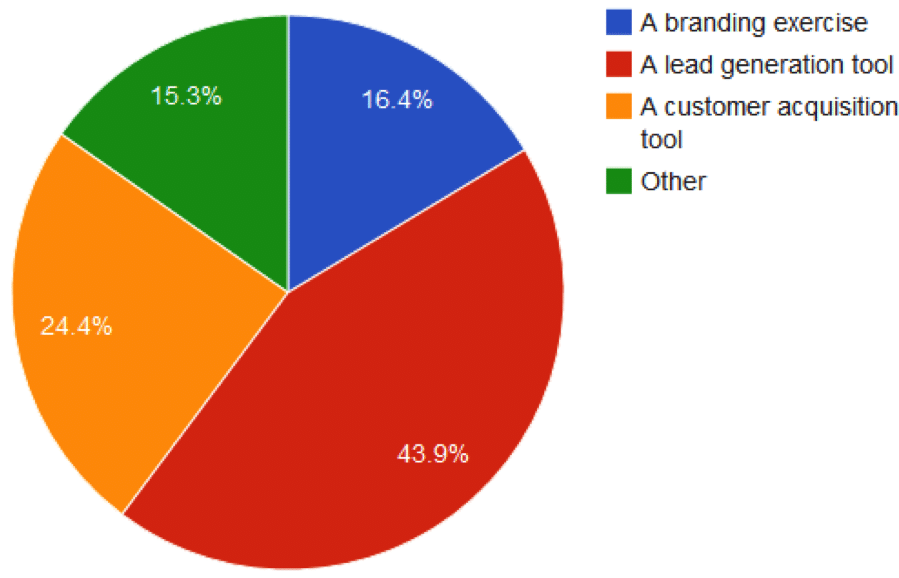
influence leads

As shown by the image above, almost 44% of respondents see influence marketing as a lead generation tool, with almost 25% seeing it as a customer acquisition tool. Just over 16% see it as a branding exercise.

With social scoring platforms like Klout (currently) not sharing the kind of measurement that shows what leads and customer acquisition their client promotions have resulted in, it leads to another concern for marketers – how effective are these platforms?

influence effect

This is reflected in the survey responses, with more than half feeling today’s scoring platforms aren’t effective at identification of the type of influencers that can drive leads and customer acquisition goals.

Additionally, more than one fifth felt the results were too varied, with only 5% of respondents believing today’s scoring approach to influence were effective for their goals when starting a campaign.

While not every influence marketing campaign needs to drive sales all the time, the fact of the matter is brand awareness doesn’t pay the bills nor drive profit.

Blog posts and social shares are nice to have for social proof, but businesses are placing success metrics on the financial and customer return influence marketing campaigns drive, not X amount of social network updates.

Social Scoring May Be Waning But True Influence Marketing is Just Beginning

While the report shows there’s a clear gap between what PR/marketers see as the strategy and the results generated by scoring tools, it also shows that they clearly differentiate between “social scoring influence” and “influence marketing”.
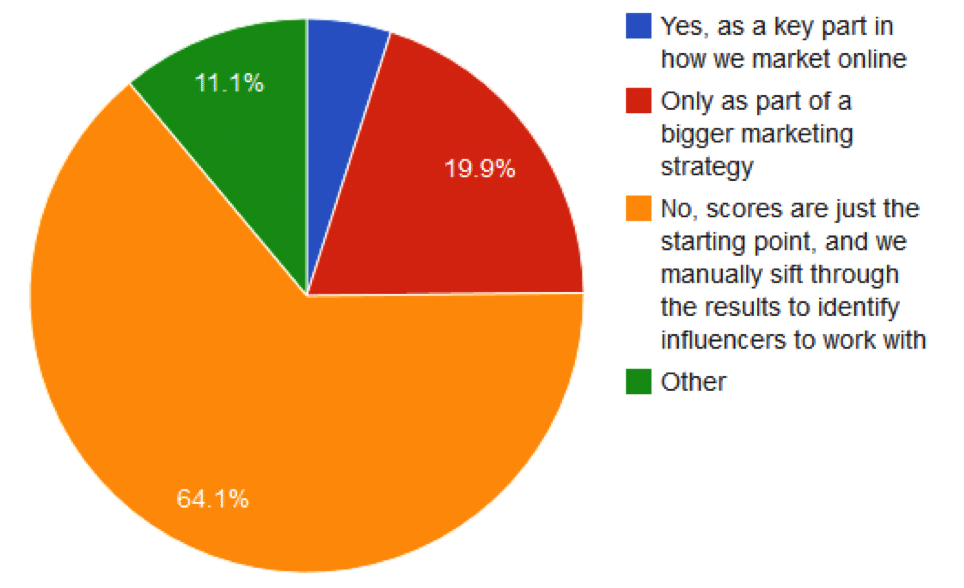
influence difference

As the above figure shows, almost 2/3 of all respondents identify social scores as simply a starting point in their campaign – they still see the need to filter through the results manually and filter the most relevant influencers.

Additionally, almost 20% use scoring as part of a bigger marketing strategy and not as a standalone tool. Less than 5% use scoring as a key part of their overall strategies and tactics.

This ties in perfectly to further data from the report, when discussing how whether they’ll be using influence marketing, and how much of their marketing budgets are being allocated for the next 12 months and beyond.

influence marketing allocation

According to the report, almost half – 44.1% – will be creating an influence marketing campaign in the next 12 months, with just over 30% indicating the likelihood of using influence marketing as part of an integrated strategy.

When it comes to actual budgets, however, there’s a clear gap between how much will be allocated to “social scoring” and how much will be allocated to actual “influence marketing”.

influence scoring use

The figure above represents how many respondents will use social scoring as part of their influencer outreach. Almost two thirds say it’s unlikely, as the methodology is not seen as a valid identification/measurement tool.

Just over one fifth will use scoring, but only as part of a bigger strategy, while less than 9% are sold on scoring as a key part in the influence marketing arsenal.

The Future of Influence Marketing

The full report makes for some pretty interesting reading overall, but it’s the takeaways shared in this post that I find to be particularly illuminating.

While I’ve personally questioned the value of social scoring when it comes to true influence versus online popularity and amplification, it’s been seen from a biased bubble, if you like.

The survey carried out by Sensei Inc. and ArCompany was open to anyone to complete, although they had to be representative of marketing, PR and communications disciplines.

Over 1,300 respondents from across the globe represented a good mix of professions and business functions. In fact, business-to-business (B2B) was serviced just as much as business-to-consumer (B2C) markets – another interesting statistic, given social media’s penchant to be more acceptable in the B2C market.

Because of this mix, the results took me completely by surprise when it came to how scoring was perceived by the very professionals and verticals these platforms are hoping to sell their services too.

Yet perhaps I shouldn’t have been as surprised.

As both Sam Fiorella and I have found, in numerous interviews and research for our imminent Influence Marketing book, we’re moving beyond today’s approach of amplified distribution when it comes to influence, and into true, measurable and actionable data, metrics and identification of true influence.

While scoring may continue to be popular when it comes to consumer awareness and where people stand with their score on these platforms, the business decision-makers are looking for more tangible results.

That bodes well for the future of influence, and for businesses working in this space.

Here’s to the next wave.

You can access the full report here.
Influence Marketing: The Book

Danny Brown Sam Fiorella Influence MarketingIdentify and Manage the Influence Paths That Convert Brand Awareness to Customer Acquisition

Today, you face a brutally tough, maddeningly elusive new competitor: the ?wisdom of crowds.??Social media gives consumers 24?7 access to the attitudes and recommendations of their most?engaged peers.

These?are the views that shape buying decisions.

These?are the views you must?shape and use.

Influence Marketing?won?t just help you identify and enlist key influencers: it will?help you manage the influence paths that lead consumers to buy.

By sharing empirical evidence?of hard-won lessons from pioneering influence marketers, Danny Brown and Sam Fiorella provide?a blueprint that moves influence marketing beyond simple brand awareness and into sales?acquisition and customer life time value measurement. They integrate new tools and techniques?into a complete methodology for generating more and better leads?and converting them faster,?at higher margins.

  • Put the?customer?not the influencer?at the center, and plan influence marketing accordingly
  • Recognize where each prospect stands in the purchase life cycle right now
  • Clarify how your consumers move from brand preference to purchase
  • Identify key micro-influencers who impact decisions at every stage
  • Gain indispensable insights into the?context?of online relationships
  • Recognize situational factors that derail social media brand recommendations
  • Understand social influence scoring models and overcome their limitations
  • Re-engineer and predict influence paths to generate measurable action
  • Master the ?4 Ms? of influence marketing: make, manage, monitor, measure
  • Transform influence marketing from a ?nice-to-have? exercise into a powerful strategy

Available May 13, 2013,?Influence Marketing?provides a blueprint for predicting and managing influence paths that generate measurable action and impact on the business? bottom line for both B2B and B2C organizations.

This book heralds in the next phase of this evolving industry and provides actionable strategies that will define how influence marketing is executed for the next 10 years.

Buy from these bookstores below:

Influence Marketing book Influence Marketing book Influence Marketing book Influence Marketing book

The Grading of the Social Web and Its Impact on Influence

Robots replacing humans

Where now for influence marketing

Last month, Twitter published an article on their developer blog, about new metadata being added to the Twitter API. There were two additions ? one to help identify the language of a tweet, while the other was the ability to allow developers to ?rank? tweets.

This second addition is of particular interest when it comes to influence marketing, and how we identify influencers, since it offers the potential to further dilute the ability to truly connect relevant influencers and advocates to the brands that are looking to work with them.

Now, in fairness, Twitter hasn?t divulged exactly how the ranking ability may work, apart from the option to possibly gauge tweets by a ?none?, ?low?, ?medium? and ?high? rank. It may be there?s a lot more context to the way the API will identify these tweets.

However, in the meantime, the worry is that true influence, yet again, is being demoted to nothing more than an algorithmic rank with no real context behind it. When this happens, it takes us back to the ?influencer elite??I?ve talked about previously on the Influence Marketing blog.

Which begs the question, can the everyday influencer still exist?

The Grading of the Social Web

It?s not just Twitter that?s taking this approach. Take a look at Google and the importance they?re placing on their Authorship Markup algorithm. Or Facebook with its ever-changing algorithm that places more emphasis on paying for a Sponsored Story to have your content seen versus organic appearance in a feed.

There?s no doubt that the social web is becoming an arena of rank and perceived import ? yet questions remain as to the validity of the import when it?s based on how well you play with a platform?s rules.

For example, let?s say you don?t have Google Authorship enabled on your blog or website, yet you write a fantastic white paper on the origins of mankind that challenges everything we?ve believed until now.

When someone searches for ?the origins of mankind? on Google, your expertise would (should) probably be the one that people should read. Yet because?someone with less expertise utilizes the Authorship Markup script, they actually appear more reverential than you?for that particular search.

The same goes with Twitter?s new API. Let?s say they base their authority score on the amount of retweets and engagement a tweet receives. While this is a good starting point, it lacks the more important aspects of context, perception and situation at the time.

This is particularly true when large events are happening.

Let?s say someone uses the hashtag for the Oscars to post an asinine comment about the price of popcorn at their local 7-Eleven. It gets 1,000 reweets and 500 favourites. That may appear as a high scoring tweet based on the new API.

But does it have the context of an Empire Magazine journalist in the UK only getting 20-30 retweets as he/she live-tweets about the event from the UK? Doesn?t their expertise in the movie arena make them more authority-driven?

This is the problem with grading importance based on reactions versus instilling a true action ? the sign of an influential impact. It also changes the very fabric of influence ? no bad thing on its own, but when it comes to trying to clear the muddied waters of the last few years, it can add to the confusion.

Which brings us back to the topic of this post.

The Everyday Influencer and Where They Fit Today

One of the criticisms levied at influence marketing today is the lack of results for brands using the medium. And that?s a fair criticism.

This can be attributed to several things ? generic social scores with no real relevance to the brand in question; lack of understanding and education on the brand?s behalf; and the gamification of social media channels to be seen as someone of influence.

Whatever the reason, influence has undergone some drastic changes in the last few years when compared to Carnegie?s principle, and not always for the better. The biggest impact this has had is in nullifying true individual influence, the kind that brands really want ? and need ? to connect with.

Activity and popularity online has led to people being seen as influencers, while the true influencers ? the ones not worried about social scoring and perceived ranking ? are the ones that should be identified.

These ?everyday influencers? are finding themselves marginalized because they?re not playing to a computational score; nor are their hands being tied by a search engine?s goal of making you use all their products to be seen as relevant.

The problem is, these are exactly the people brands should be connecting with. They?re the advocates; the consumer marketers; the people who truly have the ear of those that make a difference when it comes to the purchase cycle of their friends, colleagues and peers.

As public scoring and authority plays continue to evolve and find bigger footholds across the web, the question becomes:

Can the everyday influencer still exist, when the games being played to ?be? one nullify results based on much deeper questions?

My co-author on Influence Marketing Sam Fiorella and I believe so. In the next few weeks, we?ll show you why and, more importantly, how.

A version of this post originally appeared on the official Influence Marketing blog. Subscribe today and stay up-to-date with the latest innovations and future trends in influence marketing.

The Business of Influence

The business of influence

Since announcing our book at the tail end of last year, both Sam and myself have been asked why write a book on influence marketing.

Additionally, some people have said they’re looking forward to the book because “it will put social scoring [Klout] in its place” (paraphrased).

The answers to both points are simple.

For the first question, while there have been books written about social scoring and growing your own influence, we wanted to write a true business book on how influence marketing can be used for that most important element of business longevity – lead generation, sales, and the customer life cycle.

For the second question, this is definitely not an anti-social scoring or an anti-Klout book.

Instead, we offer our methodology (and the platforms that can use this framework), to truly understand what influence marketing is, why it’s important to business, and how to use it as a lead generation tactic with true measurable results and clear strategies to build advocacy, profits and customer engagement.

It’s what Sam and I call The Business of Influence, and for us it’s where the third wave of influence comes into play and will move the space forward.

Beyond Social Scoring

As I mentioned at the start of this post, we don’t discount social scoring platforms, contrary to the popular belief of some people.

We see where they offer value (initial identification of groups and conversations), but we also understand where their limitations lie. PeerIndex in particular are open about who they cater to – the mass information and data regarding ?the 70,000 people relevant to a topic versus the truly influential seven who can drive real actions and contextual reactions.

For businesses, however, social scoring currently doesn’t dive deeply enough into moving the customer along the purchase life cycle; nor does it offer the kind of in-depth analysis and the way an influence campaign can be disrupted via several situational factors.

It’s this kind of data – how a message is disrupted, how it can be put back on track, who are the secondary and tertiary influencers that can step up to redirect a disrupted message, etc, – that brands are clamouring for, and which we provide the framework for in the book.

The Influencer of Tomorrow

Another reason we wrote the book is because, as marketers ourselves, we saw a core area that the popular definition of an influencer was missing.

Whereas the route for an influence campaign on scoring platforms may be built around identifying mass numbers and attracting with brand perks or similar, to entice conversations around a product, this was still placing the influencer themselves at the heart of the marketing circle.

But, as we’ve seen countless times before from brand campaigns and case studies, if the influencer is either generic or one built on amplification and sponsored by a brand, does their trust factor get diluted? And, if it does, where does this leave brands looking to actually drive sales from these campaigns?

What was needed was a clearly defined path to where influence tips – that moment a decision moves from interest, to intent, to action (ideally, a purchase), and beyond.

By identifying this tipping point, brands could clearly identify who the true influencer is – and, as we share in the book, it’s not the usual suspects of today’s influence model, and is one of the key reasons influence marketing as it stands today is still seen as something of an enigma.

Brands know getting influencers to promote their product or service can be beneficial – but, much like celebrity endorsements, can be rife with risk as well, if the influencer isn’t chosen wisely.

This is where we felt a new methodology had to come into play.

The Path of True Influence

By implementing our methodology with our own clients, and the feedback we’ve received about our framework from leading influence technology vendors like Appinions, Traackr?and?Tellagence, as well as Social CRM vendors like Nimble?and oneQube, we’re confident we’ve created an influence marketing blueprint that will redefine how the medium is used today.

It reduces risk, grows sales, increases leads, builds influence paths and follows the customer at every touchpoint in the decision-making process.

In the next few weeks, we’ll find out whether others agree when our book is released.

If you’re ready to be part of this new method of influence identification and nurturing, and truly take influence beyond awareness and into measured business results, you can preorder now via Amazon, Barnes & Noble or Chapters Indigo.

We look forward to moving the next wave of influence marketing forward with you.

The Third Wave of Influence

Influence Marketing the book

Influence marketing is at a crossroads. As we know it today, influence marketing is primarily defined by social scoring platforms like Klout, Kred and PeerIndex.

However, while these platforms are decent starting points for brands looking to identify influencers, they don’t really go deep enough into contextual and situational human relationships to offer a true metric of influence.

What’s needed is a bigger understanding of how the human psyche works; what makes us tick as people; what impacts our decision process; and where we can predict paths of influence based on transactional relationships, where historic interactions can be merged with current knowledge and the likelihood of a future action based on that knowledge.

To get to that level, though, we need to move to the Third Wave of Influence Marketing.

The First Wave of Influence: Celebrity Endorsements

While Dale Carnegie can arguably be called the Grandfather of Influence as we knew it before social scoring entered the fray, it was the late Dan Edelman and his championing of celebrity endorsements that ushered in the First Wave of Influence.

Edelman saw the value in connecting celebrities with brands to share that brand’s message. The middle of the last century saw Edelman employ people like movie star Vincent Price to be the voice of the California wine industry, and people like baseball legend Nolan Ryan and activist Gloria Steinem.

This type of brand recommendation resulted in several successful campaigns, and turned Edelman’s fledgling self-named company into a global public relations powerhouse.

However, in recent years, the sheen has started to dull with celebrity endorsements. In 2008, Bloomberg BusinessWeek published an excellent article on the dangers of celebrity endorsement, which included (lack of) relevance of the celebrity to the brand.

On her agency blog, Margie Clayman took it one step further and highlighted the worst case scenario for brands when using celebrity endorsements – that of the celebrity “going rogue”.

Tiger Woods and his infidelity; Lance Armstrong and his doping scandal; Oscar Pistorius and the killing of his girlfriend (drawing comparisons to the OJ Simpson murder trial).

The combination of dangers associated to celebrity endorsement, as well as consumers becoming smarter when connecting the dots between endorsement and context, paved the way for the next wave of influence.

The Second Wave of Influence: Social Scoring

The social web has opened up a veritable treasure trove of opportunities for individuals to become the “new celebrity”, or influencer. By having access to social networks, blogging and more, everyday web users can grow a sizable audience and loyal following.

Brands began to take notice of this and naturally wanted to connect. There was just one problem – old school broadcast messaging didn’t quite work on the new web. Instead of connecting with influencers, brands came across as spammy. They needed a conduit.

Enter social scoring.

Early movers in the social influence space like Klout, Kred and PeerIndex saw the opportunity to create a platform that could connect these social influencers to brands looking to use them to promote their goods.

Soon, public scores were attached to individuals, with the higher scoring ones being invited to accept free products from brands, in the hope of exposure to that influencer’s audience.

This was all well and good, until the cracks started to appear.

Opting out Klout

Questions arose over the validity of the data being used, since it was just based on publicly available information versus more in-depth conversations happening behind closed networks and privacy settings.

People also questioned the right of these platforms to create a public profile and attach a score to you, without your specific content.

Privacy violation was also a hot topic, as well as the creation of profiles of minors – a big no-no for the social networks where the scoring platforms were scraping information from.

Perhaps the biggest crack was the resulting shift in how influence was perceived. Instead of context and micro relationships, influence was now judged by a score and how well a user played into the algorithm of the scoring platforms.

Even today, after improvements to the data, people with Klout profiles see their scores drop if they stay away from the likes of Twitter and Facebook for a few days. This “you’re only influential if you’re online” approach has left people questioning the validity of scoring as a method of influence.

Much like celebrity endorsements before them, social scoring platforms are being questioned over the context of how their influence is measured, and where the true transactional influence – that where trust, relationship and more comes into play – sits in their algorithm.

Which leads us to the next wave.

The Third Wave of Influence: The Business of Influence

The biggest problem facing brands today when it comes to influence marketing is the actions and end result that come from their campaigns, and did they result in leads and customers.

While there are various aspects to an influence campaign – short term buzz, new product awareness, donation run for non-profits, etc – the long tail aspect is often forgotten: customer acquisition and loyalty.

The reason for this can be attributed to many things, but the biggest overriding factor is clear – brands are still using influence marketing campaigns as one-offs, and with a campaign mindset.

This means they find their influencers, agree on the promotion, let the influencer do his or her thing, and then analyze how successful that campaign was.

However, this misses a huge opportunity – to turn influence into true advocacy, and build a loyal and engaged army of fans that are also customers. To do this, brands need to start looking beyond the short-term (potential) viral effect of an influencer, and instead address the need of the customer via the influencer.

A CRM platform like Nimble can help in this process, and taking influence beyond buzz and into true actionable business return is the natural next step.

Otherwise, the current direction of influence may erode brand trust. The recent indifference to the Kred and LinkedIn Top 1% emails showed early signs that perhaps consumers are getting tired of where we are today.

Instead of generic, we need to address complexity.

  • We need to decipher opinions of those that matter and how they impact us;
  • We need to adapt to fluid influence and how it continuously changes;
  • We need to move beyond public personas and into micro influencers;
  • And we need to stop confusing popularity and amplification for influence.

The stage is set for The Third Wave of Influence Marketing, and we look forward to continuing to move the discussion forward when the book is released in the next few weeks.

  • « Go to Previous Page
  • Page 1
  • Interim pages omitted …
  • Page 5
  • Page 6
  • Page 7
  • Page 8
  • Page 9
  • Interim pages omitted …
  • Page 15
  • Go to Next Page »
© 2026 Danny Brown - Made with ♥ on Genesis