• Skip to primary navigation
  • Skip to main content
Danny Brown

Danny Brown

podcaster - author - creator

  • About
  • Podcasts
  • Journal

Influence

The Third Stage of Influence Marketing – Free @Vocus Webinar

Vocus webinar influence marketing

Vocus webinar influence marketing

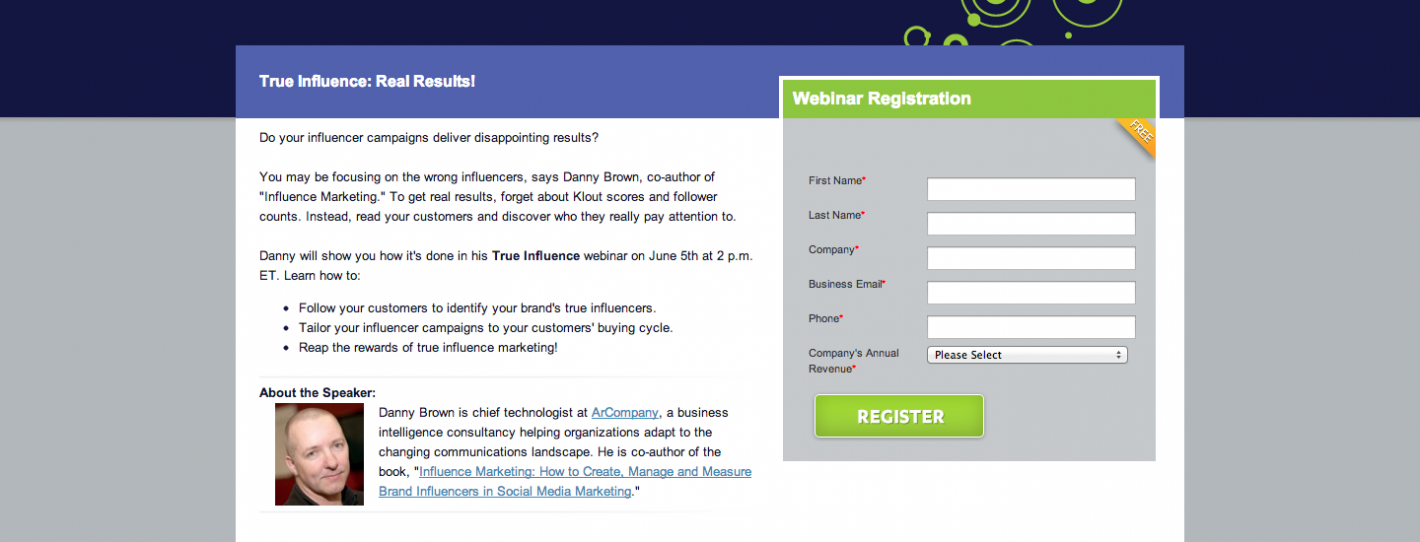
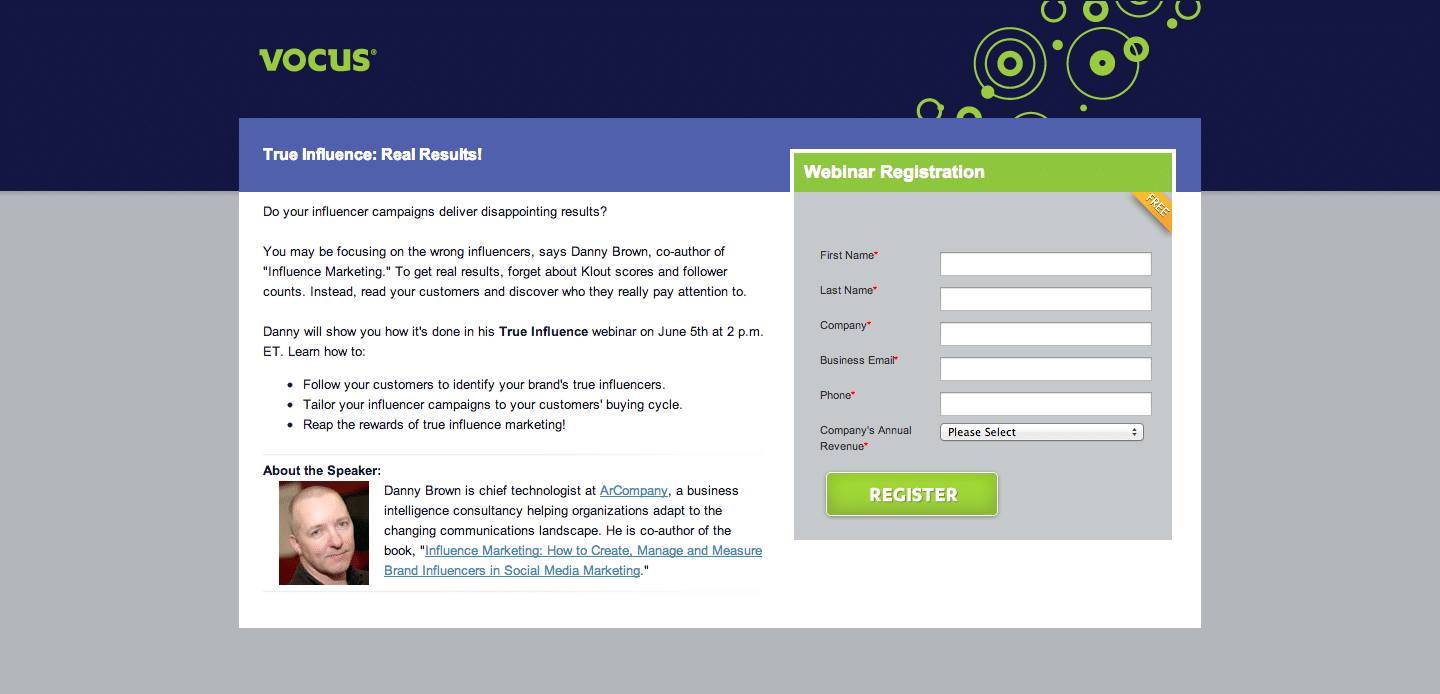
On Wednesday June 5th at 2.00pm EST, I’ll be hosting a free webinar in partnership with Vocus around actual business results through influence marketing. Details of the webinar and where to register are below.

For anyone that?s been involved in marketing for any amount of time, you?ll know there are shifts in thinking that take us beyond what we know, into what we can truly benefit from.

Think about some of the shifts from the last 20 years or so:

  • Print media and flyers to social media and banner ads;
  • Telesales to geo-fenced mobile marketing and QR codes;
  • Direct mail to email marketing;
  • Billboards to digital signage.

These shifts allowed us to be smarter at targeting audiences on a wider scale, and also to measure our campaigns more effectively.

However, despite these improved methodologies and metrics, there was still one form of marketing that could trump all of them ? word of mouth.

If we heard positive or negative feedback from a peer, friend or colleague about a certain product or service, there was a much higher chance of conversion to that recommendation than there was from any of the methods highlighted at the start of this post.

Brands understood the power of word of mouth marketing, and looked for ways to be part of these recommendations. This paved the way for influence marketing as we know it today ? otherwise known as social scoring.

Social scoring

The problem is, when it comes to actual business results like lead generation and customer acquisition, that definition hasn?t moved the marketing needle as much as the other shifts highlighted here.

Scoring platforms like Klout and Kred can help brands achieve share of voice and amplified awareness, but for true business results, we need to move deeper than the solutions they currently provide.

We need to move into the Third Stage of Influence Marketing.

What is the Third Stage of Influence Marketing?

When it comes to influence marketing, there are three clearly defined stages:

Stage 1: Celebrity Endorsement

PR pioneer Dan Edelman introduced the concept of celebrity endorsement in the middle of the last century. Seeing the shift of power to celebrities and how the public reacted to them, he pioneered the method of using stars like Vincent Price to represent the California wine industry. Through increased media, this led to an increase in sales and profits, and celebrity endorsement as a marketing tactic was born.

Stage 2: Social Scoring

While celebrity endorsements had a fine run and can still be used today to great effect, the danger of using a celebrity for your brand showed the flaws of that approach.

Tiger Woods; Lindsay Lohan; Mel Gibson; Oscar Pistorious; Lance Armstrong, and many more like them. Personal issues spilled into the public and began to tarnish the brands connected to these endorsers. A new method was needed, and this is where social scoring stepped in.

Early adopters in the social influence marketing space saw the potential of finding who was influential on a topic, and connecting these people to brands in that vertical to share that brand?s marketing message with their audience.

Initially, it worked. Superstar bloggers and social network users with large followings helped raise awareness for a brand or product, and public scores from Klout, Kred and PeerIndex could show which person was influential around what topic.

However, flaws started to appear in that methodology as well. Critics questioned the validity of the data and lack of success stories being shared publicly; influence was only measured by public Twitter updates unless you connected your other networks; and profiles and scores were being allocated to people without specific permission.

These flaws, along with how the algorithms on these platforms could be gamed, led to the need for a more effective and truer reflection of influence and what it means in the marketing sector.

Stage 3: Customer Centric Influence Marketing

The problem with both celebrity endorsements and social scoring when it comes to influence is that they both place the ?influencer? at the heart of the marketing circle.

While they may have a large following or audience, that doesn?t mean they?re right for the various segments of a brand?s customer base, current or potential.

The purchase decisions of a customer are influenced by many factors: emotional, financial, familial, peer, logical, time and many more.

True influence webinar

Additionally, a message resonates differently with customers depending where they are in the purchase life cycle.

Research. Awareness. Consideration. Intent. Purchase. These are just five stages of the purchase life cycle that need to be addressed differently ? then you also have guilt and vindication play into the mix of decisions.

As you can see, the simple act of making a purchase is far from simple, if we ? as marketers ? are looking to encourage the customer along the decision-making path and into the action of making a purchase.

This is where the Third Wave of Influence Marketing succeeds, because it places the customer at the heart of the marketing circle and works back from there.

We can identify where customers are regarding their decision to buy; we can identify what issues or questions they have around it; who in their immediate circle influences them and at what stage; and how we can overcome disruptors like competitor messaging and situational factors.

The upcoming True Influence webinar will show you exactly how to utilize this new wave of influence marketing, and how to drive real business metrics that add to the bottom line ROI while improving the top line, as well as the lifetime value of your customers.

I look forward to sharing with you.

To register for the webinar, click here.

What’s the Return on Influence Marketing?

Danny Brown Sam Fiorella Influence MarketingFor many brands, gauging the return on influence marketing has been one of their sore points in recent years.

While social scoring platforms like Klout, etc, can help identify who could potentially be influential from a brand amplification standpoint, the business return – dollars in the cash register – has been more problematic to solve.

Likes, shares, blog posts and more are discussed abundantly when it comes to reviewing a campaign using social scoring as the lead means of influence identification.

But likes and shares don’t pay the bills.

This was one of the key reasons Sam Fiorella and I wrote Influence Marketing: as marketers and users of influence campaigns ourselves, we knew the real return on influence had to be lead generation, customer acquisition, and moving the customer along the purchase life cycle.

With that approach, brands could better understand where their customers are, and how they could help solve the problems they faced.

Essentially, we take influence away from the superstar bloggers and social media rock stars, and place the emphasis squarely back on the customer, and work back from there.

To give you an idea of how this looks, this second teaser video from our upcoming video series to complement the book looks at what happens when the customer is placed at the centre of the marketing circle, and how that leads to financial and customer return on your brand’s influence marketing campaigns.

[vimeo width=”600″ height=”400″]http://vimeo.com/66128219[/vimeo]

What’s the Return on Influence Marketing?

Danny Brown Sam Fiorella Influence MarketingFor many brands, gauging the return on influence marketing has been one of their sore points in recent years.

While social scoring platforms like Klout, etc, can help identify who could potentially be influential from a brand amplification standpoint, the business return – dollars in the cash register – has been more problematic to solve.

Likes, shares, blog posts and more are discussed abundantly when it comes to reviewing a campaign using social scoring as the lead means of influence identification. But likes and shares don’t pay the bills.

This was one of the key reasons Sam Fiorella and I wrote Influence Marketing: as marketers and users of influence campaigns ourselves, we knew the real return on influence had to be lead generation, customer acquisition, and moving the customer along the purchase life cycle.

With that approach, brands could better understand where their customers are, and how they could help solve the problems they faced.

Essentially, we take influence away from the superstar bloggers and social media rock stars, and place the emphasis squarely back on the customer, and work back from there.

To give you an idea of how this looks, this second teaser video from our upcoming video series to complement the book looks at what happens when the customer is placed at the centre of the marketing circle, and how that leads to financial and customer return on your brand’s influence marketing campaigns.

[vimeo width=”600″ height=”400″]http://vimeo.com/66128219[/vimeo]

State of Play for Influence Marketing in 2013 – Infographic

Influence Marketing the bookBusinesses are now competing with ? and often losing to ? ?the wisdom of crowds? in the branding battle.

Identifying individuals who sway online consumer opinion on specific topics and within specific communities has become critically important to marketers and public relations professionals.

A slew of social scoring platforms have emerged with claims that they can identify who influences who online while providing various tools and scoring systems to rank those who are influential and those who are not on a variety of topics.

However, as with most early adopters, their efforts have been widely criticized. Some say they?re just misunderstood and that the technology is just too new.

Either way, there?s one certainty: Marketers and public relations professionals are taking notice.

We surveyed marketing professionals around the world in our ongoing effort to better understand this growing industry and where businesses stand on the issue.

  • Can social influence truly be measured?
  • Is anyone using them?
  • What?s the future of influence marketing?

Influence marketing survey key insights

We’ve created the following infographic to highlight some of the key findings:

  • How marketers define Influence Marketing
  • What budgets they?re allocating to Influence Marketing in the next 12 months
  • How do marketers rate various social influence scoring platforms
  • What successes they have had with social influence scoring platforms and if they plan on using them in the future
  • The demographics of audience surveyed
  • And more!
Publish the infographic on your site – use the Embed code at the bottom of this page:

IM infographic

Influence Marketing bookBuy the book that offers the methodologies that answer the needs raised in this report: Influence Marketing: How to Create, Manage, and Measure Brand Influencers in Social Media Marketing

Book Authors: Danny Brown & Sam Fiorella
Copyright: ? 2013 by Que Publishing
ISBN-13: 978-0-7897-5104-1
ISBN-10: 0-7897-5104-6

?Survey Sponsored by:

arc-logo
sensei-logo

The Crossroads of Influence Marketing

Where now for influence marketing

Influence marketing is at a crossroads. As we know it today, influence marketing is primarily defined by social scoring platforms like Klout, Kred and PeerIndex.?However, while these platforms are decent starting points for brands looking to identify influencers, they don’t really go deep enough into contextual and situational human relationships to offer a true metric of influence.

What’s needed is a bigger understanding of how the human psyche works; what makes us tick as people; what impacts our decision process; and where we can predict paths of influence based on transactional relationships, where historic interactions can be merged with current knowledge and the likelihood of a future action based on that knowledge.

To get to that level, though, we need to move to the Third Wave of Influence Marketing.

The First Wave of Influence: Celebrity Endorsements

While Dale Carnegie can arguably be called the Grandfather of Influence as we knew it before social scoring entered the fray, it was the late Dan Edelman and his championing of celebrity endorsements that ushered in the First Wave of Influence.

Edelman saw the value in connecting celebrities with brands to share that brand’s message. The middle of the last century saw Edelman employ people like movie star Vincent Price to be the voice of the California wine industry, and people like baseball legend Nolan Ryan and activist Gloria Steinem.

This type of brand recommendation resulted in several successful campaigns, and turned Edelman’s fledgling self-named company into a global public relations powerhouse.

However, in recent years, the sheen has started to dull with celebrity endorsements. In 2008, Bloomberg BusinessWeek published an excellent article on the dangers of celebrity endorsement, which included (lack of) relevance of the celebrity to the brand.

On her agency blog, Margie Clayman took it one step further and highlighted the worst case scenario for brands when using celebrity endorsements – that of the celebrity “going rogue”.

Tiger Woods and his infidelity; Lance Armstrong and his doping scandal; Oscar Pistorius and the killing of his girlfriend (drawing comparisons to the OJ Simpson murder trial).

The combination of dangers associated to celebrity endorsement, as well as consumers becoming smarter when connecting the dots between endorsement and context, paved the way for the next wave of influence.

The Second Wave of Influence: Social Scoring

The social web has opened up a veritable treasure trove of opportunities for individuals to become the “new celebrity”, or influencer. By having access to social networks, blogging and more, everyday web users can grow a sizable audience and loyal following.

Brands began to take notice of this and naturally wanted to connect. There was just one problem – old school broadcast messaging didn’t quite work on the new web. Instead of connecting with influencers, brands came across as spammy. They needed a conduit.

Enter social scoring.

Early movers in the social influence space like Klout, Kred and PeerIndex saw the opportunity to create a platform that could connect these social influencers to brands looking to use them to promote their goods.

Soon, public scores were attached to individuals, with the higher scoring ones being invited to accept free products from brands, in the hope of exposure to that influencer’s audience.

This was all well and good, until the cracks started to appear.

klout no profile

Questions arose over the validity of the data being used, since it was just based on publicly available information versus more in-depth conversations happening behind closed networks and privacy settings.

People also questioned the right of these platforms to create a public profile and attach a score to you, without your specific content.

Privacy violation was also a hot topic, as well as the creation of profiles of minors – a big no-no for the social networks where the scoring platforms were scraping information from.

Perhaps the biggest crack was the resulting shift in how influence was perceived. Instead of context and micro relationships, influence was now judged by a score and how well a user played into the algorithm of the scoring platforms.

Even today, after improvements to the data, people with social scoring profiles can see their scores drop if they stay away from the likes of Twitter and Facebook for a few days. This “you’re only influential if you’re online” approach has left people questioning the validity of scoring as a method of influence.

Much like celebrity endorsements before them, social scoring platforms are being questioned over the context of how their influence is measured, and where the true transactional influence – that where trust, relationship and more comes into play – sits in their algorithm.

Which leads us to the next wave.

The Third Wave of Influence: The Business of Influence

The biggest problem facing brands today when it comes to influence marketing is the actions and end result that come from their campaigns, and did they result in leads and customers.

While there are various aspects to an influence campaign – short term buzz, new product awareness, donation run for non-profits, etc – the long tail aspect is often forgotten: customer acquisition and loyalty.

The reason for this can be attributed to many things, but the biggest overriding factor is clear – brands are still using influence marketing campaigns as one-offs, and with a campaign mindset.

Influence Marketing survey key insights

This means they find their influencers, agree on the promotion, let the influencer do his or her thing, and then analyze how successful that campaign was.

However, this misses a huge opportunity – to turn influence into true advocacy, and build a loyal and engaged army of fans that are also customers. To do this, brands need to start looking beyond the short-term (potential) viral effect of an influencer, and instead address the needs of the customer via the influencer.

A CRM platform like Nimble can help in this process, and taking influence beyond buzz and into true actionable business return is the natural next step.

Otherwise, the current direction of influence may erode brand trust. The recent indifference to the Kred and LinkedIn Top 1% emails showed early signs that perhaps consumers are getting tired of where we are today.

Instead of generic, we need to address complexity.

  • We need to decipher opinions of those that matter and how they impact us;
  • We need to adapt to fluid influence and how it continuously changes;
  • We need to move beyond public personas and into micro influencers;
  • And we need to stop confusing popularity and amplification for influence.

But most of all, we need to place the customer at the heart of the influence circle, and understand their needs; where they are in the purchase life cycle; and who immediately impacts their decisions based on their current situation (financial, emotional, etc).

The stage is set for The Third Wave of Influence Marketing – all it needs now is you.

[vimeo width=”600″ height=”400″]https://vimeo.com/65202873[/vimeo]

  • « Go to Previous Page
  • Page 1
  • Interim pages omitted …
  • Page 3
  • Page 4
  • Page 5
  • Page 6
  • Page 7
  • Interim pages omitted …
  • Page 15
  • Go to Next Page »
© 2026 Danny Brown - Made with ♥ on Genesis