• Skip to primary navigation
  • Skip to main content
Danny Brown

Danny Brown

podcaster - author - creator

  • About
  • Podcasts
  • Journal

Latest posts from Danny Brown

Enjoy the latest posts from Danny Brown, and feel free to add your own thoughts in the comments after the post.

Special Announcement – Introducing ArCompany

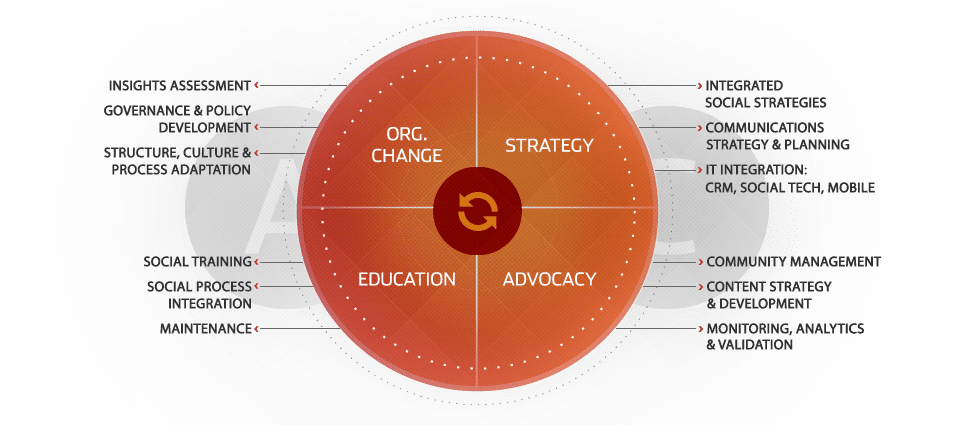
ArCompany services

A?social business?is one that becomes engaged, transparent?and?nimble. – John Mell, IBM

So it’s been a bit of a milestone week. First, I celebrated 1,000 posts here, and my daughter Salem turns one year old today so about to shoot off and get the party ready!

And, since these things always seem to happen in three, yesterday saw the official launch of ArCompany, the new business I’m part of dedicated to helping organizations and Enterprise operationalize social through business intelligence.

From the introductory blog post:

In the past, the value between a company and its customers was based on transaction history. A true value has emerged that includes customer relationships and behaviours outside of the organization and provides him/her with a stronger voice that the company must heed.

However, companies, for the most, part are not ready [to operate in this manner]. They don?t have the ability nor forethought to recognize the value of the data.

Companies are not ready to shape their processes and structure around this information to properly receive, manage and analyze and action on it (in the appropriate timeframes)?all in an effort to mitigate reputational impacts, to capitalize on potential revenue streams, and to reduce customer churn.

This is where ArCompany enters the equation.

We Are Not Just an Agency

It’s clear organizations needs strong education and guidance/governance when it comes to the business landscape we find ourselves moving in today.

In the past customers may have had the benefit of being listened to if the service team deemed them worthy. Today, however, businesses are increasingly finding themselves having their hand forced into listening, due to the myriad of options the connected customer has to air grievances.

Additionally, employees are true brand ambassadors for a business whether they have officially signed up to be one or not. Every action taken by an employee online reflects on the brand, and often the most innocuous statement leads to a crisis of reputation and perception.

These murky waters are making it increasingly difficult for businesses to just run the day-to-day operations, never mind the extra resources and expertise needed to oversee other core factors like the ones mentioned above, and more.

This is why ArCompany is not just an agency. We’re not just a marketing house. We’re not just a digital services team.

Instead, as befits the way the company name is pronounced, we are the driver of your business when it comes to accountability for the customer at all levels, internally and externally, from employee to consumer to stakeholder.

Understanding the Connected Customer

Through three key areas, we will help organizations be the drivers of change, bridge gaps by elevating the relationship between customer and brand, and allow businesses to focus their resources in driving the other parts of their business to meet market needs and expectations.

These three key areas are:

  • Comprehensive Data Analysis – ArCompany filters through the noise of the social web allowing you to have meaningful conversations with your customers and stakeholders;
  • Strategies That Drive Business Return – We help evolve companies to the changing communication landscape and build programs to set up organizations for success;
  • Customer Experience Solutions – Helping your business understand and evolve with your customer’s expectations and increase loyalty and advocacy.

The team at ArCompany has an average of 18 years experience each in helping businesses transform the way they do business to meet ever-changing marketplace demands.

ArCompany team

It feels like this company has been a long time in the making. Organizations are ready to make the jump into being a true social business – they just need the right guidance across all parts of the business to make this jump and implode the silos that currently exist.

ArCompany will be that company.

Our partnership with you will be?a true collaborative effort to move you to the next level, through education, technology partnerships and implementing business objective initiatives. The word ?arc? shows steady momentum and progression. Taken together with ?company? it sounds like ?Our Company?. The next generation of business will have accountability to the customer? at?all?levels of the organization.

We look forward to getting started.

You can get more information on ArCompany on our website, as well as Facebook, Google+, LinkedIn and Twitter (minor tweaks are still being made to the social profiles).

1,000 Blog Posts Later – An Introspective

Danny Brown

Today’s post marks a bit of a milestone for me, as this post is the 1,000th one since I started this blog back in September 2008.

While I tend not to “celebrate” various milestones too much, with the exception of (occasional) annual birthday posts, the 1,000th one is a little bit different. It’s one of these weird numbers that “says” something, whatever that something is.

It’s funny to think of the number 1,000 – it truly only seems like yesterday when I started this blog. I’ve been blogging since way back in 1999, and had a few writing projects that have morphed into blogs since then – but this one is the one that’s truly stuck and, I guess, the one that defines my goals and outlook.

So today’s post is going to be a bit of an introspective (and thanks to everyone on Facebook who gave me some great ideas on what to write about) on what’s changed since that very first post. If this is something you’re not interested in, I hear you and feel free to come back on the next post when normal service will be resumed.

For those of you still hanging around, I thank you – and let’s dig in.

Everything is Fluid

When I first started here, it was a continuation of a public relations blog that I had, back in my early solo consultancy days. The goal was simple – to share thoughts and ideas on social media and where that fit in the business world.

For the first six months or so, I was probably way too myopic for my own good – everything was based around social media in the purest form. Don’t do this; be like that; it’s all about the conversation, blah blah blah.

And you know, perhaps at that time it was okay to write about things that way. But everything’s fluid – we need to keep moving. Staying in the same place leads to boredom and stunted knowledge.

Looking back, I probably listened to and read too many kumbaya social media blog posts and bought into the mantra. I come from a traditional marketing and communications background, where everything is set in stone and the relationship to the sale is a true and trusted path.

Yet this path doesn’t allow for too much veering off to try new things, so seeing the risks people were taking (or appearing to take) in social media was a bit liberating.

However, it soon became apparent that these risks weren’t truly born with any business acumen – it was more from a “I’m pretty popular with this stuff I’m saying and I’m just making shit up – maybe I’ll keep this up a while!”

Once that realization kicked in, the tone of this blog changed quite a bit and I was determined to make this part of the web one that’s always evolving, and letting its vision, voice, whatever you want to call it, be shaped by the readers and commenters as much as it was by me.

Thankfully, that’s worked so far.

Being Wrong is Okay

Most people hate to be wrong. Most people hate to admit they’re wrong even more. For many people, admitting you’re wrong is a sign of weakness. And if you’re a blogger and you admit you’re wrong, then why should the community you’ve built up hang around?

Yet it’s okay to be wrong. In fact, we need to be wrong more and celebrate that fact – because it’s the only way we grow.

I’ve written posts on here where I’ve been cocksure in my belief that the opinion stated in it is the right one. Heck, perhaps the only one. But, of course, that’s bullcrap.

[pullquote position=”right”]None of us have all the answers. Hell, very few of us have a decent amount of answers when it comes to most things[/pullquote]

So why do we feel we should be right the majority of the time when it comes to our opinions?

The biggest learnings I’ve taken from this blog is when someone comments on a post and completely blows my point of view out the water, whether from their opinion or from backing it up with facts and statistics.

Does it make me look an idiot? Sometimes. But ignoring the better opinion or statement when it’s right there in front of you and everyone else that reads the post is more idiotic.

If we truly want to grow as people, whether personally or professionally, we need to be open to other points of view. If we’re putting our thoughts out for the world to see, we really need to be open to other points of view.

Otherwise, why even share in the first place?

The Fallacy of Numbers

We get so wrapped up in numbers at times.

At Christmas, we want more presents than we got the year before – same goes for birthdays.

In high school, we want to lose our virginity at a younger age than our friends (and then have more girlfriends/boyfriends than them). At work, we want to get bigger raises and more recognition than our colleagues.

And yet, numbers are so superficial.

Sure, they may make us feel better and enable us to have a better “life”, but that depends on your definition of what a better life is (for me, it’s being able to spend evening and weekend time with my wife and kids).

When I first started this blog, I was so wrapped up in checking the numbers that everyone says matters – new subscribers, new social shares, unsubscribers, comment count, etc.

And, sure, I still afford a little smile when a new subscriber joins, since that offers an opportunity to get to know them in the comments and see what makes them tick.

But this concentration on numbers hurts us. Just as chasing more presents at Christmas turns us into spoiled brats, so does chasing blog numbers turn us into the blogger we don’t want to be.

We start writing generic list posts, just to try and hit that viral social share gold. We stop being opinionated and lose the voice that attracted readers in the first place. We write linkbait and ass-kissing posts so the highlighted folks will come by, say we’re great, share and then maybe, just maybe, invite you to their next conference.

Do we really want to be that blogger? Is that why we started in the first place, and continue when others stop?

By all means, care about how your content is perceived – but don’t let the numbers rule you. Now when I get email alerts that tell me someone has unsubscribed and they offer the reason why, it simply tells me we’re not a good fit anymore and they’d be better catered to elsewhere.

And that’s okay, and the way it should be.

A Blog is Just a Blog

We hear so many people (and I’ve been guilty of this) telling us what we should do when it comes to our blog. “Build your list!”; “Cover it with ads!”; “Sell shit!”. And, yes, we can do all that.

But we don’t have to.

[pullquote position=”right”]The great thing about a blog, and something I’m seeing more of, is that we control what it is and what it does for us[/pullquote]

As I mentioned earlier, this blog has taught me that being wrong is okay. It’s also (I believe – feel free to disagree!) made me a much better writer and thinker than I was four years ago. It’s enabled me some wonderful opportunities, for which I’m eternally grateful.

And it’s allowed me to meet some of the funniest, smartest, humblest, caring and downright awesome people, either in the comments, discussions around the web, or at speaking events I’ve been invited to because someone was kind enough to read something here and ask me to come out and speak.

But, at the end of the day, a blog is just a blog.

Because this one is primarily a business one, it makes sense that business things happen because of it. But, to be honest, if they didn’t, I wouldn’t care – it would just mean I’d have to do some more “hustling”, if you like, away from here.

And that’s something we can all do.

Don’t let anyone tell you your blog needs to be about this, or you need to do that, to make it a success. I know people who don’t give a crap if their blog is read or not – it’s an escape valve for their innermost thoughts and fears, and just getting it out of their system into something physical makes their lives easier.

A blog is what we wish it to be – and every choice is the right one, for us. It can be world-changing globally; it can be world-changing personally. And isn’t that all that really matters at the end of the day?

The Next Chapter

So I guess I’ve rambled a little bit here, and I apologize if you’re still here and bored out of your skin. I don’t often write posts this long, and it probably won’t happen again for a looooong time (if it does at all).

I’m also wary that this post may come across as a delusion of self-grandeur (to paraphrase Han Solo) – hopefully if it does, it’s not too much.

I sincerely thank you for being here at whatever part of the 1,000 posts you jumped in on and, whether you’re a regular or an occasional visitor, I hope you find at least some of the stuff here useful.

I don’t know what lies ahead in between now and the next 1,000 posts. I have an idea of some things that will happen (and more on that in the next post, probably), but then that’s the fun part – taking it as it comes.

Thanks for the first 1,000 memories – here’s to continued fun ahead. Slainte!

The Party’s Over for Professional Reviews Leading the Purchase Cycle

11 user reviews before making a decision

Just over 20 years ago, when I first got into marketing, professional reviews were the lead driver of foot traffic to storefronts.

Magazines like Consumer Review and reviews from other print publications, as well as television review shows, would often dictate how well a product would be received once in the open.

It led to a booming industry of professional reviewers, some of whom made a very nice living being known as The Review Person.

But things change.

Jump forward 20 years, and the swan song for the professional reviewer could be about to play out, at least in the tech sector.

It’s All About the Peer

In a recently published joint survey carried out by Weber Shandwick and KRC Research, and involving more than 2,000 U.S. consumers, it’s clear to see that peer reviews have grown beyond just friends advising each other on a new purchase. Now, social connections and search play a far greater role in the purchase cycle, often ignoring professional reviews altogether.

11 user reviews before making a decision

Some of the key findings include:

  • 65% of consumers have bought a product they weren’t intending to buy after reading a positive review;
  • 74% of consumers search for reviews online before making a decision;
  • Consumers read an average 11 reviews before making a decision;
  • Peer reviews are trusted by more consumers (77%) than professional ones (23%);
  • A well-written, fair and reasonable review, with statistics and facts and where the reviewer is named, are the top four factors that will influence a consumer to move from intent to buy;
  • Amazon leads the way in consumer trust, with 39% of the surveyed audience trusting the site completely.

These figures, and some of the other ones in the fuller report, should act as a wake-up call to brands that are still investing in the traditional method of product review – buy advertorial or pitch the mass media – and ignoring search and social graph impact.

Why the Landscape Shifted

It’s easy to blame social media and the advent of easy sharing and research for the trending rise in peer reviews overtaking professional ones. Many brands have cited the lack of accountability when it comes to peer reviews, and as such these reviews should be taken with a pinch of salt.

The thing is, it’s actually the accountability factor that’s helped increase the authority of peer reviews and decreased the need for professional reviews. [pullquote position=”right”]With nothing being invisible thanks to Google Search and other visibility tools, what goes online is there for millions to see.[/pullquote]

If a review on Yelp is seen as false and made with bad intentions to the recipient, it’s removed and the user can’t post other reviews of that business.

If a blogger makes false claims about a company, not only are they liable for prosecution, but the commenters will leave links with the real story for other visitors to access.

And with the likes of the Federal Trade Commission (U.S.) and the Advertising Standard’s Authority (U.K.) addressing the murky waters of false advertising on social media outlets, it’s no longer okay to be a paid shill to promote garbage (if it ever truly was).

There’s also the inherent trust that we build in each other, the more we interact online. Through natural conversations and everyday back and forths, we get to see who’s similar to us in both beliefs and interests.

Influence Marketing book

That manifests itself in our willingness to take their recommendation of something they’ve tried and take a look ourselves, versus some stranger being paid to write about something

And perhaps therein lies the biggest reason for the growth in peer reviews.

The Strength of the Advocate

Whether someone is paid to review a product neutrally, positively or negatively, we know money has exchanged hands. Depending on how long a contract with a publisher is, the author of a professional review may word it in such a way that it’s encouraging the brand to rehire the author.

It’s similar to the failings of focus groups, where the feedback can be biased because of the desire to be invited back and be paid again.

Because of this, people are naturally wary of a professional review and how unbiased (or factual) it truly is.

Switch that around with our social connections who don’t have a play in the game except to help you make your decision. “Yeah, the iPhone is excellent but the speed of the Windows 8 phone was crazy fast compared to my iPhone.”

Peer reviewers (or opinion sharers) aren’t in it for money; there’s no bias; there’s no hidden agenda. It’s simply an honest opinion of theirs to help you make the right choice in yours.

That difference is becoming more evident as we start to filter our connections into groups based on relevance and context to our needs at that time. As these groups and authority within them grow, the professional review will struggle to keep up.

For any brand not making inroads to the peer review marketplace, they might struggle to keep up too…

For a copy of the Executive Report on the survey, click here.

images: Weber Shandwick and KRC Research

Popularity Is Not the Same as Influence

Data on influence

Earlier this week, Forbes published an article by Haydn Shaughnessy entitled, Who Are The Top 50 Social Media Power Influencers?

As of writing this post, it had been shared several thousand times across various networks, and resulted in over 100 comments after the post. So, a good list then, right? Not exactly.

The problem with the article is the title is misleading. This isn’t a list based on influence – instead, it’s a list based on popularity and amplification and, as we’ve spoken about time and time again here, popularity and amplification do not influence make.

[Read more…] about Popularity Is Not the Same as Influence

We Need Better Insights, Not More Data

A little while back, I wrote about the difference between analytics and insights. My key point was while we may have awesome data at our fingertips, not knowing what to do with that data renders it obsolete and ineffective.

A new survey, with responses from attendees of the recent DMA2012 conference, as well as the recent Forrester Research conference Seizing Opportunity From Digital Disruption, seems to back up that insights versus analytics post.

Filtering The Noise Chamber

Today’s connected consumer has access to an insane amount of information, all at their fingertips, thanks to the ubiquity of smartphone access to the web.

From checking restaurant reviews and stock prices, to taking pictures of a new pair of jeans and asking the opinion of friends on Facebook, today’s consumer is no longer restricted to choosing a brand through a push marketing approach.

This change of direction in the purchase cycle has resulted in brands playing catch up in trying to make sense of this new paradigm.

Instead of buying a media spend and determining results based on increased foot traffic to a storefront, marketers and analysts now have to understand what tipped a consumer from intent to buy to an actual purchase, and what external factors can impact that decision in the first place.

To enable this, technologies and companies have sprung up to allow marketers all the data they need, and more. However, this now presents a new and far more dangerous problem, from the perspective of the marketer:

How can the right data be filtered when there is so much of it? Failure to extrapolate the right data will only make the job tougher for any brand looking to truly understand their customer’s mindset.

Failure to understand your customer equals failure to grow and remain afloat. The scary thing is, though, it’s clear that many marketers just aren’t getting to grips with this new analytical methodology, as the report shows.

The Problem with Data – Lack of Insight

Some of the key findings from the attendees include:

  • 45% said the analysis and application of data is the biggest challenge;
  • 39% are not using demographic information or customer behaviour patterns when creating marketing strategies;
  • 44% don’t envision hiring new employees to oversee this data;
  • 83% plan to start considering using real-time data.

There are other worrying statistics from the results, but I picked out these four because they highlight perfectly the challenges to today’s marketer, as well as the failings of many businesses looking to operate in the space.

If more than a third don’t take something as basic and yet hugely important like demographics and customer behaviour into the equation, and almost half think they’re qualified to oversee this core business component themselves, that’s a problem.

Even more disconcerting is the percentage that don’t use real-time data – 83%.

Eighty three percent.

That’s more than three quarters of the businesses asked not utilizing something as simple as Twitter Search to get the lowdown on what’s being said about their brand or product at any given time, and being able to react to it.

It’s almost like we’re trapped in 2006. If businesses today aren’t utilizing the technology out there to make their business smarter and more effective, then it’s no wonder so many fail when it comes to using social as a complementary component to their other marketing efforts.

It’s not data that’s the problem – it’s the lack of insight into how that data can be mined, analyzed and acted upon. And there’s no need for this to be the case.

Smarter Thinking, Better Execution

Just looking at some of the key points I pulled from the report, there are simple solutions to every one of them.

If analysis and application are the biggest challenges, identify the people who understand this new research opportunity to provide the analysis that’s most important to you – lead generation results, customer service satisfaction, brand perception, competitor activity, etc. (This also addresses the 44% of businesses who don’t foresee employing people to oversee the data).

Additionally, identify the analysis that’s most important to you – lead generation results, customer service satisfaction, brand perception, competitor activity, etc. If you have no-one internally that can address this need, look to the kind of people your competitors have in this key role and act accordingly to, at the very least, match that investment.

Use technology like Quantcast to identify the demographics and behaviour of your web traffic. Cross measure this with tools like Traackr and Nimble, that can identify the key people talking about your brand and then filter them into groups and level of relevance and/or importance when it comes to contact.

Change the mindset of considering real-time intelligence and start making it a key part of your brand’s customer experience reporting. Hell, you don’t even have to be on a platform to set up alerts on the information that matters, and then allocating the right person to deal with that opportunity/situation.

Unless, of course, you’re the type of business that would have the chance to speak with your customer in your shop about how their visit was, and instead advise them you’d rather be in the office drinking coffee and playing Angry Birds.

Data doesn’t have to be scary – you don’t need to be mining every single piece of information out there about your brand. You do, however, need to be mining for the right data that’s important to you at that given time, and act on that.

Reduce the data. Increase the insights. Be a smarter business. You owe it to yourself, and your customers deserve better.

You can get a free copy of the full report here.

Data rich and insight poor

  • « Go to Previous Page
  • Page 1
  • Interim pages omitted …
  • Page 96
  • Page 97
  • Page 98
  • Page 99
  • Page 100
  • Interim pages omitted …
  • Page 283
  • Go to Next Page »
© 2026 Danny Brown - Made with ♥ on Genesis