• Skip to primary navigation
  • Skip to main content
Danny Brown

Danny Brown

podcaster - author - creator

  • About
  • Podcasts
  • Journal

Latest posts from Danny Brown

Enjoy the latest posts from Danny Brown, and feel free to add your own thoughts in the comments after the post.

Influence Marketing Survey for Marketing and PR Pros

Influence Marketing the book

Social media has opened many opportunities for businesses, such as direct communications with customers and prospects, peer-to-peer support groups, improved customer service channels and real-time reputation management.

This new communication channel has proven valuable to the sales, marketing, customer service and PR functions of businesses large and small.

Yet, as more consumers grow their social graphs, access social networks through mobile devices and engage in more brand discussions online, the increased noise has also added many new challenges.

Influence Marketing Today

Among the social media marketing tools created to better manage and drive greater value from this over-populated communication channel are social influence scoring applications.

They?re designed to collect and analyze a person?s social media activity in order to determine the influence he/she has over others on various topics, and then use that person as a conduit to deliver a recommendation or brand advertisement to prospective customers.

As the public?s penchant for social media communications grows, these tools have become more popular with new start-ups joining the fray every few months.

Yet this growth has not been without a fair amount of criticism regarding the accuracy, methodology and ethics of those providing the service and those who participate in their scoring programs.

However, both advocates and pundits agree that we?re just at the beginning of this growing marketing practice. A lot of growth is still expected and required among software providers and marketers alike.? Still, the question remains: in what direction will it go?

The Next Wave of Influence Marketing

Sensei Marketing and ArCompany have partnered on an initiative that seeks to better understand the attitudes and forecasts of surrounding this hot topic.

The first part of this effort is survey of international marketers and public relations professionals, which will provide additional data for a planned whitepaper on the future of influence marketing.

If you work in marketing or PR ? as a consultant, for an agency or employed by a brand directly ? we invite you to participate in this short online survey.

It?s completely confidential and takes less than 5 minutes to complete. The data collected and the subsequent analysis will be shared publicly in a whitepaper to be released this spring.

Go to the survey >>

Note: No personal information collected during the completion this survey will be sold, shared or made public at any time.

Influence Marketing: A Business Book for the Next Wave of Influence

Robots replacing humans

This is a cross post with the Influence Marketing blog.

Since Sam and I announced our book at the end of last year, many people have asked us one primary question about it:

Is it for people looking to increase their social score, or is it something different?

The one sentence answer to that is fairly simple:

This isn’t a book about improving your social score; instead, as you’ll see below, this is a business book around the topic of influence and how it shapes marketing as well as other business verticals.

While today’s influence market is (arguably) led by social scoring platforms, we see things very differently.

We’ve already shared where we see the future of influence marketing and which platforms will be leading the way.

With regards the audience best-suited to the book and what it offers, below is the full overview.

[Read more…] about Influence Marketing: A Business Book for the Next Wave of Influence

Influence Marketing: A Business Book in the Truest Sense

Influence Marketing: The BookSince we announced our book at the end of last year, many people have asked us who the book’s audience is. Is it for people looking to increase their social score, or is it something different.

The one sentence answer to that is fairly simple:

This isn’t a book about improving your social score; instead, as you’ll see below, this is a business book around the topic of influence and how it shapes marketing as well as other business verticals.

While today’s influence market is (arguably) led by social scoring platforms, we see things very differently.

We’ve already shared where we see the future of influence marketing and which platforms will be leading the way.

With regards the audience best-suited to the book and what it offers, below is the full overview.

Influence Marketing: Why You Should Buy This Book

The practice of influence marketing, popularized by Daniel Edelman in the late 1960?s with celebrity endorsements, is enjoying a renaissance in the social media era.

As more and more consumers migrate to online communications, the concept of branding and advertising has been democratized.

Increasingly, consumers are making decisions based on the attitudes and recommendations expressed by the masses and their peers, with whom they now have immediate and around-the-clock access to.

Businesses are now competing with ? and often losing to ? ?the wisdom of crowds? in the branding battle.

Therein lays the opportunity that has spurred on the growth of modern influence marketing: identifying individuals who sway consumer opinion and solicit them to advocate on your behalf.

Yet the early adopters attempting to capitalize on this opportunity by offering influence scoring platforms have been marred with criticisms of faulty algorithms, unethical behavior and lack of measurable impact on the bottom-line.

Influence Marketing: How to Create, Manage and Measure Brand Influencers in Social Media Marketing analyzes the renewal of this marketing practice, the factors that impact how consumers are influenced to take action and the challenges faced with current software solutions and strategies.

With that analysis, it builds a new methodology for how businesses can evolve this practice from a promotional and branding exercise to a measurable lead generation and sales conversion effort.

Key lessons in this book include:

  • How to identify at what stage in the purchase life cycle target customers are at;
  • How to identify the micro-influencers who directly impact purchase decisions at each stage;
  • The situational factors that contribute to derailing brand recommendations in social media.

Influence decision process

With this methodology in place, we provide a blueprint for predicting and managing influence paths that generate measurable action and impact on the business? bottom line for both B2B and B2C organizations.

This book heralds in the next phase of this evolving industry and provides actionable strategies that will define how influence marketing is executed for the next 10 years.

The Next Wave of Influence

As you can see by the overview, this is a business book in the truest sense. Much of the criticism around influence marketing at the moment is that there are no real measurable metrics being shared.

It’s all well and good raising buzz and awareness but if there is no real action happening behind that buzz, where’s the return? Likes and retweets will only keep you in business so long.

Influence can be used for so much more than just initial buzz and awareness.

The book provides a defined framework of how to identify the end result; where that brand message tipped from awareness to intent to action; and how to build true long-term advocacy across multiple verticals, including marketing, service, HR, non-profits and much more.

Exclusive online components offer webinars, one-on-ones and lesson plans for executing and measuring your own influencer program(s).

We look forward to sharing our vision soon.

Pre-order your copy of Influence Marketing: How to Create, Manage and Measure Brand Influencers in Social Media Marketing from either Amazon or Barnes & Noble today.

The Sunday Share ? Enabling Your Google Authorship Markup

what does google want to be

As a business resource,?Slideshare?stands pretty much head and shoulders above most other content platforms.

From presentations to educational content and more, you can find information and curated media on pretty much any topic you have an interest in.

As a research solution, Slideshare offers analysis from some of the smartest minds on the web across all verticals. These include standard presentations, videos, multimedia and more.

Which brings us to this week’s Sunday Share.

Every week, I?ll be sharing a presentation that catches my eye and where I feel you might be interested in the information inside. These will range from business to content to social media to marketing and more.

This week, a short but useful Slideshare from JoannaVaiou, a SEO consultant and strategist from Greece. As Google continues to utilize Google+ as a social layer that ties all its other products together, its Authorship Markup feature has become even more important.

This presentation explains just what Google’s Authorship Markup is, why you need it, and how to enable it.

Enjoy.


So You’re the Top 1% on Generic Social Network X. Great – Now What?

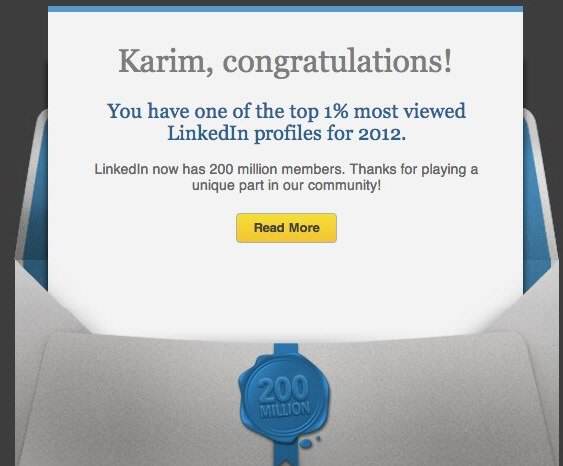
You might be aware of a certain email that’s doing the rounds at the minute from LinkedIn that’s generating some online buzz.

In the email, LinkedIn shares its milestone of reaching 200 million users. Then they go one step further and add in (for certain users) where you personally fit into LinkedIn.

Some users received emails saying they were in the Top 1%. Some received saying they were in the Top 5%, and so on.

It’s a smart but lazy move on behalf of LinkedIn when it comes to some viral buzz around the platform.

Smart, because it plays to peoples’ egos (as Bilal Jaffery points out in a Facebook discussion around the email), and lazy, because this kind of short-term hit and ego-massaging offers little in the way of context and long-term value.

Top 1% of What, Exactly?

The email itself is pretty generic, as you can see from the screen grab below from the email received by my friend, Karim Kanji:

LinkedIn 1% BS

In Karim’s own words:

Thanks LinkedIn, but I’m calling bullshit on this.

It’s not only Karim who views this as no more than a numbers play by LinkedIn to create buzz, possibly due to their slip down the pecking order of social network user numbers when it comes to active users.

Over at MarketingTechBlog, Douglas Karr shares his view on the email:

This is the kind of campaign that drives me nuts. The percent is a ridiculous number that means nothing? truly nothing. If you?re a superstar in your field that is picky about who you connect with on LinkedIn, you didn?t get one of these emails. But if you?re in an industry with heavy recruitment with a big network? and you?re crappy at your job? you still received one of these emails.

At Soshable, J.D. Rucker, while congratulating LinkedIn on savvy marketing for stroking egos, muses:

When you really think about it, it?s not as much of an accomplishment as a great marketing ploy by LinkedIn to get their name out there and into conversations on Twitter. Top of mind? The math makes it seem less impressive. Even those who received the top 1% email might not have been as quick to brag about it had they realized they were one of over 2 million users to receive the honor.

And this is what it boils down to – there’s a complete lack of context as to what the “award” really means.

Without Context, It’s An Empty Metric

If LinkedIn truly wanted to share who had the most viewed profiles on their network – and, by definition, who people should connect with from a business point of view – they should have included at least some modicum of context with the statement.

For LinkedIn’s message to offer value to me, I’d want to understand the following:

  • What does the 1% mean?
  • Who’s viewing these profiles – recruiters, headhunters, or just old colleagues and friends from high school?
  • What are the industry specifics of those viewing?
  • What’s the likelihood of all these views resulting in a job offer or consultancy hire?

These are just four basic but immediate questions that spring to mind. There’s much more value to be had in knowing it’s people that want to do business with you viewing your profile, rather than the majority of views coming from ex-colleagues and college buddies.

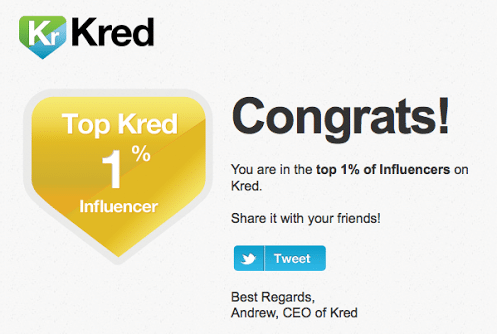
The email has been compared to a recent campaign by social scoring platform Kred, who sent out Top 1%, 5% and 10% emails to their users.

Kred top 1%

This email generated a great discussion over at Geoff Livingston’s Google+ account.

Andrew Grill, Kred CEO, stepped into the discussion to answer questions and criticism, much of which centred around the same mindset as that of the recent LinkedIn email – is it truly recognizing top users, or simply a mass market email to generate buzz?

One of the areas that Andrew accepted could have been better was the area of context within the email. Again, Kred – like LinkedIn – simply sent a generic message with the percentage of where a user fell inside the Kred database.

Had the message been more specific – say, “Congratulations, you’re in the Top 1% Marketers / Bloggers / Social Good Advocates”, etc, then that shows the algorithm was used to determine your niche listing and they’re sharing that with you.

The smallest amount of context can make the biggest amount of difference when it comes to perception of a campaign, as highlighted by some of the reaction around both LinkedIn and Kred’s emails.

Stroking Egos and Long Term Benefits

One of the things that both sides of the coin mostly agree on is that stroking the egos of users is a smart move from LinkedIn.

By advising users of their mythical status within the ecosystem, and encouraging recipients of the email to share on Twitter and other networks, it ensures a healthy amount of buzz around the platform.

The problem is, ego-stroking this way generally doesn’t work long-term. Now that LinkedIn has placed these “1% leaders” on a pedestal, will they continue to make them feel special with regular outreach? Will they answer their email questions to support quicker than the rest of LinkedIn’s non-1% userbase?

Because that’s the funny thing when egos become involved – once it feels like it’s no longer being massaged, the owner of the ego can be quick to move elsewhere where they’re treated in a manner worthy of such lofty percentile.

If you truly want to sustain long-term benefits and buzz around your brand, it takes more than a warm, fuzzy email as a one-off viral push.

Then again, truly smart brands already know this.

  • « Go to Previous Page
  • Page 1
  • Interim pages omitted …
  • Page 94
  • Page 95
  • Page 96
  • Page 97
  • Page 98
  • Interim pages omitted …
  • Page 283
  • Go to Next Page »
© 2026 Danny Brown - Made with ♥ on Genesis