• Skip to primary navigation
  • Skip to main content
Danny Brown

Danny Brown

podcaster - author - creator

  • About
  • Podcasts
  • Journal

Latest posts from Danny Brown

Enjoy the latest posts from Danny Brown, and feel free to add your own thoughts in the comments after the post.

The Sunday Share ? HTML5 vs Native Mobile App Development

mobile marketing

As a business resource,?Slideshare?stands pretty much head and shoulders above most other content platforms.

From presentations to educational content and more, you can find information and curated media on pretty much any topic you have an interest in.

As a research solution, Slideshare offers analysis from some of the smartest minds on the web across all verticals. These include standard presentations, videos, multimedia and more.

Which brings us to this week?s Sunday Share.

Every week, I?ll be sharing a presentation that catches my eye and where I feel you might be interested in the information inside. These will range from business to content to social media to marketing and more.

This week, a short but effective presentation from SaaS mobile platform developers Appcelerator.

With the ever-increasing mobile-first approach of today’s web, knowing which platforms to develop on is becoming a key separator for businesses everywhere. This presentation compares HTML5 to native app development to offer guidelines for your organization.

Enjoy.


Why The Conversation Prism Misses the Boat on Influence

Conversation Prism

Conversation Prism

Recently, Altimeter analyst Brian Solis released the fourth iteration of the Conversation Prism, a visual representation of where the social web stands today.

As part of this update the prism included influence, in a nod to how key this area of social media has become for today’s businesses, in both goals and tactics. Unfortunately, like many other examples, the influence part of the prism misses an opportunity to move beyond the obvious and really discuss where influence is going.

By primarily highlighting social scoring platforms like Klout and Kred, the prism talks less about influence and more about amplification, popularity and ego-centric versus customer-centric platforms (thanks for that last phrase, Chris Heuer!).

For me, this misses the much bigger influence picture, so I reached out to Brian on the original LinkedIn post, and discussed the inclusion of scoring and the exclusion of better solutions.

On Moving the Influence Conversation Forward (Or Not)

DB:?What stands out is the Influence line. Same old platforms, either based around scores or single networks. Where’s the innovation? Where are the new leaders that are really pushing the influence discussion forward? Companies like Traackr, Appinions, InNetwork Inc., Tellagence, Measurely, etc? With their exclusion and your focus on the technologies that are questionable when it comes to measuring influence, it dilutes this data and leaves it looking a bit outdated even as it’s just published.

BS:?Those companies are indeed leaders in the field. In fact, I’ve written about Digital Influence going back to the late 90s. However, their place is not on this version of the prism as the majority of them are services rather than networks. So, it’s more focused and therefore allows it to be iterative in a systematic fashion.

DB: Klout isn’t a network. Kred isn’t a network. PeerIndex isn’t a network. There is no networking to be had on these sites. Indeed, PeerIndex’s own chief data scientist sees them as the type of company that provides data and consultancy services to their clients. Even taking that aside, though, these companies aren’t really measuring influence – they need you to add your other networks for them to successfully “measure” you.

By that definition, they’re saying you’re only influential based on your public Twitter presence (since that’s all they effectively measure without your strict permissions and connecting of other accounts). It’s why their inclusion on a line of “influence” is skewing the data and reducing any validation of the prism itself.

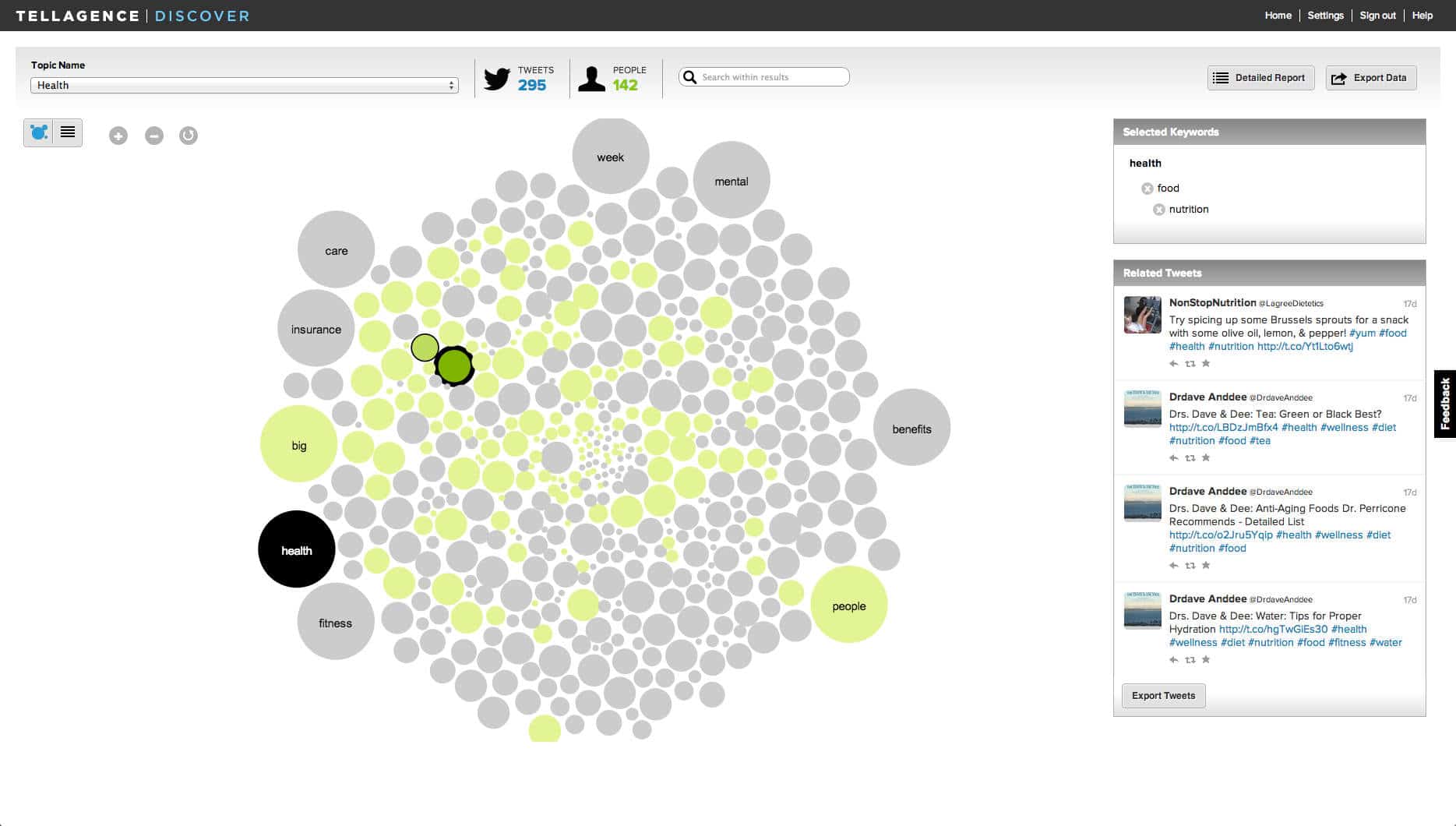
If you want to highlight true influence, look at how Tellagence tracks the ebbs and flows of influential communities and how that changes; or Traackr’s INA solution of who influences the influencers; or Appinions and their use of offline data and reactions to flesh out online influence; or Measurely and their parent company, Lymbix, and how they can successfully identify the emotion an update or content instills in you, making it easier to identify what type of media, content, etc., to use when looking to attract that audience. *That’s* influence – scoring isn’t.

Tellagence Discover Visualization

BS: I tend to disagree…they are networks. And, if you read my report, you will see how I trash the “idea” of scores. Might help to read first. Saves time when you see we are in agreement.

DB: I read that report when it came out, and questioned it at time of publication. It proposes that scoring platforms track more than they do; they don’t. The majority of information they use is from the Twitter firehose, regardless of what they would have you believe (why do you think Kred is so worried about the legal case with Twitter?).

But you have to be consistent as well; in one breath, you say they’re influence platforms (your prism) and then in the other you say they don’t measure influence, but the potential (something we do agree on, though probably not to the same level). And I stand by the definition they are not networks – unless you call a +K a true interaction along the lines of a Twitter interaction or a G+ conversation. They are data repositories – nothing more, nothing less.

BS:?No…no the report doesn’t draw that conclusion at all…in fact, it’s quite the opposite. And in terms of consistency…I’ve 10 years of research, development and experimentation in digital influence. My published work speaks for itself. In regards to an infographic that has “influence” as a category and not as a validation of the social networks that purport influence as a standard, that’s between you and those developers…

I merely created a sliver because the traction of some of those networks has the notable attention and budget of some of the biggest brands in the world. The center of the graphic is there for a reason. So, you can either try to pick a debate that at its root is out of context or you can focus your time on teaching other people about the merits of the services that help brands do a better job i.e. Traackr, eCairn, and the like.

And don’t forget, I co-founded and sold Buzzgain, which was an early player in this arena. If you step back from a ping pong game in the comments, you’ll probably find that I support your message and mission.

At this point I decided to not reengage as the conversation seemed to turn from a discussion about influence into a promo for accomplishments over questions about the inclusion of certain platforms when others would appear more suited to be there.

However, there were some valid points made, and some less valid ones, that deserve addressing, so let’s dig in some more here.

The Idea of Influence Platforms as Networks

Solis’s main reasoning for the inclusion of Klout, Kred, etc., versus more relevant platforms when it comes to actual influence, is that the former are networks while the latter are more service-led.

Yet within these platforms, there is absolutely zero networking opportunities or functions by today’s definition of a social network (unless the awarding of Kred or Klout points via a simple button click is classed as networking). Additionally, if they are networks, then shouldn’t they have been placed in the Network area of the prism?

However, moving beyond that simple overview, even the platforms included see themselves as services. Kred’s business model is to provide the data they gather to their clients, and act as a consultancy on how best to use them.

Kred for Brands

The closest influence platforms – public scoring or otherwise – come to “networking” is within the InNetwork model, where brands and influencers can connect directly within the portal and agree on project deliverables, compensation, etc. Even that, though, is limited to two parties, which makes it a more gated community/network versus a truly public one.

The Potential for Influence versus Actual Influence

In the report that Solis refers to, he speaks of social scoring platforms offering the “potential for influence” and this is where we definitely agree.

During research for our book, Sam Fiorella interviewed PeerIndex founder Azeem Azhar, who shared this interesting and definitive statement on where social scoring stands in the influence sphere:

There’s no real way for companies today, at a large scale, to identify who are the nodes that are more likely to spread messages around given categories. If you’re looking for the 7 people most important to me right now, PeerIndex isn’t for you. If you’re looking for the top 70,000, look to us. That’s where PeerIndex is and where we’re going.

There are two key parts to Azhar’s quote: influence can’t be built at generic scale, which is what scoring platforms profess to offer, and real influence comes from much smaller communities and interaction.

It’s why the platforms I suggested should be in the influence sector of the prism make much more sense than the current scoring-led inclusions – they’re measuring real influence and what that means for a business, versus those that may or may not be influential and lack relevance because of that.

The Social Bubble Needs Popping

I’ll freely admit I’m more than a bit biased when it comes to discussing influence and where it stands today, as far as the social web is concerned.

For the last three to four years, I’ve been a vocal critic of the data and identification methods that scoring platforms use when it comes to determining influence. They’re built for generic metrics, that agencies and brands can use to start the real legwork.

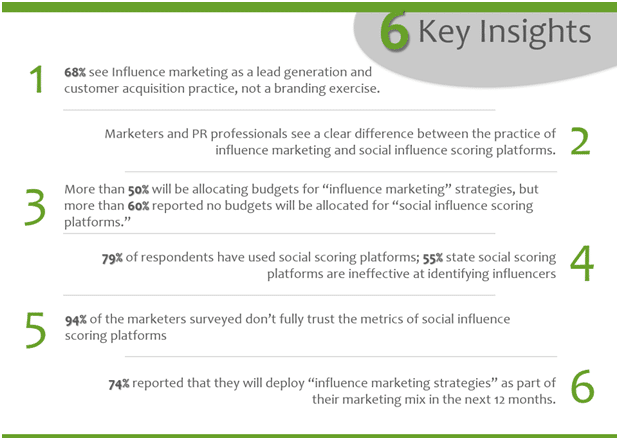
Indeed, in a recent survey of more than 1,300 marketers, brands and agencies commissioned by ArCompany and Sensei Marketing, 94% said “they didn’t fully trust the metrics provide by scoring platforms”, with 55% stating that “scoring platforms were ineffective at identifying influencers.”

influence marketing survey

These are the very companies, brands and professionals that the Conversation Prism is geared towards, and highlights why the continued inclusion of scoring platforms is in danger of diluting the authority of the prism itself.

If we’re to truly move beyond the social media bubble that seems to regurgitate the same names and platforms year in, year out, we need to offer real answers and solutions versus those that have bigger awareness but less relevance.

Once we do that, everyone benefits, because only the best and most relevant information is being offered. And isn’t that where we all aim to be anyway?

image: ConversationPrism.com

You can download the full Conversation Prism here.

The Sunday Share ? Less: What Your Customers Really Want

europe-crisis

As a business resource,?Slideshare?stands pretty much head and shoulders above most other content platforms.

From presentations to educational content and more, you can find information and curated media on pretty much any topic you have an interest in.

As a research solution, Slideshare offers analysis from some of the smartest minds on the web across all verticals. These include standard presentations, videos, multimedia and more.

Which brings us to this week?s Sunday Share.

Every week, I?ll be sharing a presentation that catches my eye and where I feel you might be interested in the information inside. These will range from business to content to social media to marketing and more.

This week, a short but punchy presentation from speaker and entrepreneur Bruce Kasanoff.

As marketers and brands, we often overpower our customers with the amount of things we not only provide them, but also ask of them. As Bruce succinctly points out, though, in the case of our customers less truly is more.

Enjoy.

The Problem with Marketing is It’s Full of Marketers

Marketing dilemma

I’m a marketer. In marketing, our mission, if you like, is to instill desire.

You may see a product you like, but don’t necessarily need. Marketing’s job is to instill enough desire around that product to make you need, or want, it.

While there are several facets to marketing – including the afore-mentioned desire, as well as awareness and promotion – the ultimate goal of any marketing strategy is to increase growth of a brand.

Primarily, this growth is in lead generation and in sales. But it can also be:

  • Customer acquisition;
  • Customer value;
  • Customer loyalty;
  • Share of voice;
  • Competitive advantage;
  • Brand perception.

At its simplest, marketing is the hub that holds much of sales, service, PR and more together. And while that’s part of marketing’s biggest strength, it’s also increasingly becoming its biggest weakness.

The Hyperbole Factor

Because marketing’s role is to instill desire, often it sounds like too many marketers are loving the sound of their own voices, and the niche area that they concentrate on becomes the next big thing to save businesses.

Take a look around the social web, and see what’s being said on Twitter, Facebook, LinkedIn, Google+ and blogs, just as a starting point.

Some of the choicest comments, posts, updates, etc, go a little something like this:

  • Why content marketing is the future of marketing;
  • It’s time for something bigger than social media marketing;
  • Social influence marketing is about to change your business;
  • Mobile marketing is the most powerful media ever invented.

And on, and on, and on. There are literally thousands of different takes on the four highlighted above, but they all share the same malaise of hyperbole where common sense is needed instead.

And that’s the biggest issue with many marketers today – everything is “the next big thing”, and brands need to engage or die, or similarly worded sensationalism.

The truth of the matter, as it’s always been, is that nothing is really the future of anything – it’s simply the evolution of the current.

Marketing is Knowledge

Although his expertise was based in advertising, David Ogilvy nailed it when it comes to successful marketing:

Advertising people who ignore research are as dangerous as generals who ignore decodes of enemy signals.

Good marketers have always used research to base their strategies on.

When I gained my marketing degree way back in the day, it took me four years to attain. During that four years, we were taught everything about the importance of research – the data we needed, the filtering it required, the insights it gave us, and the implementation that would lead to.

That research allowed us, as marketers, to understand our consumers, or those that the brands we worked with were looking to target, from existing customers to potential ones.

The Four A's

It enabled us to create targeted campaigns and content long before content marketing was even a buzzword, and track these campaigns and see what worked and what didn’t.

Simply put, knowledge truly was, and remains, power. Except today, it’s not.

Lazy Marketing Syndrome

Today, marketers have an abundance of ready-made solutions at their fingertips that bypass the need for knowledge.

Instead of doing the legwork that real marketing involves, you have the lazy marketing solutions:

  • Social scoring platforms that promote non-relevant influence;
  • Content marketing platforms that spit out content in classic spray-and-hope promotional tactics;
  • Invasive software that allows mass direct messaging or mobile texts to unsuspecting, non-targeted consumers;
  • Social media “marketing” automation that blasts messages out regardless of goal, platform, relevance of content and more;
  • The pulpits of the gurus and their message that “everything non-social is dead”.

And the sad part is, people and brands are buying into this.

The reason? Marketers, in their ultimate wisdom, have created this fallacy that there’s this amazing golden goose that will deliver results without the legwork needed to make these results happen.

Marketers saw an opportunity to instill the desire we spoke about at the beginning of this post and run with it in a new way. Instead of the desire to buy a product or service, now the desire was “Don’t be the company that dies because you’re not on Platform X!”

Even though Platform X may have been the most ineffective platform for the brand to be on, because there was little research carried out as to whether that was the right move for the brand, based on what their goals and long-term objectives were.

The Folly of Marketers Today

The ironic thing at play here is that the marketers who think this is beneficial, because it makes their jobs easier and brings in easy money, are the ones that are closing the doors on not only their future success but marketing in general.

With the amount of data available to marketers today, there has never been a better time to be a research-led marketer.

  • Big data offers us the insights on purchase life cycles and consumer behaviour that we could only have dreamt of when I started my career;
  • Consumers are helping us shape increasingly targeted solutions that meet their needs, leading to warmer purchase intentions;
  • Metrics and debrief data show us immediately where a marketing message is failing, and how we can fix it;
  • Emotions around a message can be identified, measured and shape future interactions, promotions and sales.

Lymbix ? Sentiment Analysis Reinvented

We have the opportunity to positively impact both the customer’s life and the brand’s success with these tools and data-points we have access to.

Instead, we push the strength of marketing – research, strategy, implementation – aside, and offer diluted versions that have little chance of providing the same level of solutions.

Worse yet, we remove the desire factor and replace it with the push, push, push factor of crappy content and supposed marketing that, while impressions may tell us we’re successful, the real story is how much has been invested and how little that’s yielded.

That’s not marketing – that’s taking the easy path of bullshit metrics and making them sound worthwhile. It nixes real marketing that meets the needs of the customer, the kind of marketing that increases the brand’s bottom line while improving the top line because resources haven’t been wasted on non-effective tactics.

And that’s unforgivable for any real marketer.

The sad thing is, this lazy marketing isn’t just harming an industry – it’s harming other facets of that industry.

When Marketing Sucks, Everyone Suffers

While marketing is primarily around the art of promotion and desire, its footprint touches many more areas of a brand that can mean a major impact if lazy marketing is left unchecked.

  • Future products and innovation suffer, since the brand is unwilling to put more resources into something the customer would welcome with open arms, because real data and insights weren’t forthcoming;
  • Customer service bears the brunt of consumer anger at poor products that don’t live up to the marketing hype;
  • The brand takes a hit, reputation-wise;
  • Competitors are handed sales on a plate as they react to your poor efforts and attract any potential customers you may have swayed.

These are just the basics.

Internally, the damage can be even worse, as marketing teams are fired, morale takes a hit, budgets are cut and stagnation replaces drive and future plans, with brands playing it safe and sticking with what they know, even if all that does is prolong their eventual failure.

While that might seem a drastic scenario, I’ve seen it happen before and will no doubt see it happen again, as we continue to be sucked into the lazy marketer’s pitch and grasp.

But it doesn’t need to be this way.

Marketing should be hard work. It should see brands demand more. It should see marketers deliver more. It should see consumers benefit overall.

Anything else isn’t really marketing – don’t be fooled into thinking otherwise.

image: Joel Abroad

The Sunday Share – 5 Key Principles for Displaying Data Effectively

Data

Data

As a business resource,?Slideshare?stands pretty much head and shoulders above most other content platforms.

From presentations to educational content and more, you can find information and curated media on pretty much any topic you have an interest in.

As a research solution, Slideshare offers analysis from some of the smartest minds on the web across all verticals. These include standard presentations, videos, multimedia and more.

Which brings us to this week?s Sunday Share.

Every week, I?ll be sharing a presentation that catches my eye and where I feel you might be interested in the information inside. These will range from business to content to social media to marketing and more.

This week, an excellent presentation from content visual content producer Bipul Deb Nath.

When trying to present data and statistics to our peers and colleagues, often we go for as much as possible, as opposed to as much as we need. Bipul shares 5 key principles for displaying data effectively, to make your presentations much more impacting.

Enjoy.

  • « Go to Previous Page
  • Page 1
  • Interim pages omitted …
  • Page 83
  • Page 84
  • Page 85
  • Page 86
  • Page 87
  • Interim pages omitted …
  • Page 283
  • Go to Next Page »
© 2026 Danny Brown - Made with ♥ on Genesis