• Skip to primary navigation
  • Skip to main content
Danny Brown

Danny Brown

podcaster - author - creator

  • About
  • Podcasts
  • Journal

Latest posts from Danny Brown

Enjoy the latest posts from Danny Brown, and feel free to add your own thoughts in the comments after the post.

Tipping the Scales

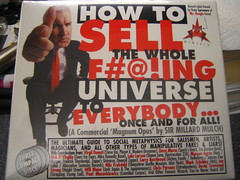
Sir Millard MulchSo there’s been plenty written about why bloggers hate PR people.

From lazy pitches to not knowing names and audience, there’s a veritable mish-mash of scorn poured on us PR nuisances from a lot of bloggers.

And, yes, some of it is warranted and trust me, I’m the first to call out bad PR practices.

But you know that just like anything, there’s always a flip side. Here’s an example.

I was speaking with a very good friend of mine who runs her own PR agency. She’s established a terrific reputation as one of the best PR people around and has deservedly won awards for her approach. Simply put, she’s a role model for great PR.

We were talking about the relationship between bloggers and PR and how we can improve it (“we” being both the blogosphere and the PR industry). This was when my friend shared one of her examples as to why that improvement might be further off than hoped.

She was working with a client whose core audience were “mommy bloggers”. The client’s product was ideally suited to the thousands of moms that have families of their own and blog about products in that niche. So, it would make sense for the PR campaign to connect with the blogging audience it’s suited to. So far, so good.

When my friend approached some of the key bloggers in this field, she had this response: “It’s $75 for a positive review, $100 if there’s an image attached.” When my friend queried this, she was told, “Get your client to splash the cash. If you’re getting paid, we want paid too.”

Say what?

Now, I understand about paid blogging and I have no qualms with it, as long as the blogger is upfront that it’s a sponsored post and that the review remains unbiased. Heck, we all need to make a living, but if you can’t offer full disclosure and non-bias then don’t take the money.

But this isn’t paid blogging – it’s simply a company asking (through their PR agency) if you’d be interested in product testing. You get first shot at the new line and you get to use and keep the product.

But you’re saying that if I pay $75, I’ll get a “positive review”? Isn’t this false advertising, or marketing, or whatever you wish to call it?

What happens if the product is crap? Will you still tell your readers that it’s great, because you’ve agreed to offer a positive review? How do you think your readers would feel about that? After all, aren’t they your most important audience?

Or is this just another point in your one-upmanship game with the PR industry?

Now, I’m not saying all bloggers (mommy or otherwise) are like this, either when it comes to product reviews or in the relationship they have with PR. I have some fantastic relationships with many bloggers and I couldn’t do a lot of my work without them.

But to those bloggers that my friend had the misfortune of dealing with?

A blog is your personal voice. Your readers are your community. Is both your voice and community something you’d happily sell down the river for a few bucks?

Because if they are, then that’s the real bad PR.

Creative Commons License photo credit: rick

Experts Television

If I want to watch repeats, I?ll subscribe to some crappy network
that just shows re-runs of ABC, CBS and other programming misfits.

But if I want to watch innovation, I?ll subscribe to HBO.

I know who the HBO people are – the rest are just missing out on viewers.

Experts Television

If I want to watch repeats, I?ll subscribe to some crappy network
that just shows re-runs of ABC, CBS and other programming misfits.

But if I want to watch innovation, I?ll subscribe to HBO.

I know who the HBO people are – the rest are just missing out on viewers.

Internet Censorship, Google Style

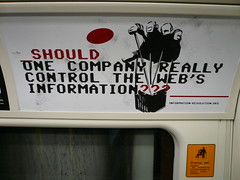
Ask.com anti-Google campaign on the London tube - P1030880Google seems to be coming in for a lot of stick at the moment.

Many Twitter users are aghast at the thought of Google buying Twitter, and their handling of popular blog tool Feedburner has come under fire (including here on this blog).

Some of the criticism is justified, others less so. Yet is it any surprise that Google continues to come under fire when the company itself seems to go out of its way to upset the community it relies on for its userbase?

Here’s an example.

Yesterday I asked if Google bought Twitter, would they would be a benefit or a hindrance to the micro-blogging site. I cited Google’s handling of Feedburner, and the fact that their Gmail email service is still in beta after five years. I linked this to the official Gmail blog.

The link resulted in some new traffic that I may not have had, with the readers of the Gmail blog obviously curious about the Twitter angle and Google’s involvement.

Today, I noticed that the link had been removed from the Gmail blog. And not just my link – there was another one that asked how a company can keep a product on beta for five years (which is now back on the blog, bizarrely).

(As a test, I’m linking there again with screen capture at my side – let’s see if they’ll allow this link and if so, for how long).

google-internet-censor-721pmest

So, does Google only link to stories that are positive about their company? Are they trying to paint a picture that all is well with their services, and that they’re still every web user’s friend?

Wouldn’t it have made more sense to allow the link and maybe respond to the post in question?

Open up discussion and have some healthy debate about what users would like to see and whether this is feasible or not, as well as address blogger issues at the same time?

It’s a shame. By removing the link to a non-congratulatory piece, Google have taken a step down the Internet censorship path that web users hate. Sure, it’s Google’s Gmail blog so they can do what they want – that’s their prerogative.

But the end result of this is that Google begins to look like the indie band that struck it lucky and hit superstardom, and then forgot all about the fans that put them there. Instead, they’d rather hang with the faux celebrities and hangers-on that only stroke their ego.

Of course, you could say Google’s so big they don’t need to worry about what the little guy like me says. Funny thing is, though, upset enough of the little guys and it soon becomes a big guy problem.

And with little guy alternatives to Google’s services becoming more widespread, where would that leave Google?

Creative Commons License photo credit: Larsz

Community Manager

Great community comes from two things:

1. Interaction.

2. More interaction.

It’s not all about you – it’s about us. We learn from each other and this helps us grow together.

Open up your blog, from comments to guest posts. Just listen on Twitter once in a while; make notes of problems people are having; then either offer them solutions or write a blog post about it for everyone.

Community is made up of two words – communicate and unity. There’s a reason for that.

  • « Go to Previous Page
  • Page 1
  • Interim pages omitted …
  • Page 243
  • Page 244
  • Page 245
  • Page 246
  • Page 247
  • Interim pages omitted …
  • Page 283
  • Go to Next Page »
© 2026 Danny Brown - Made with ♥ on Genesis