
Branding is the public face of decisions you make in private.
Branding
Branding is the public face of decisions you make in private.
Why Social Media Needs the FTC
While some people might think that Ashton and Oprah on Twitter is the only news, the real social media story happening at the minute involves the FTC (the Federal Trade Commission).
Their announcement that they want to regulate social media advertising has been met pretty negatively by many in the social media field, particularly bloggers and advertisers. The feeling is bloggers will refuse to publish content that could see them being sued for false advertising, meaning a reduced social media-led advertising spend.
Now, call me naive, but personally I don’t see the FTC’s announcement being a problem. If you’re honest.
The Good, The Bad and the Sponsored
 Think about the current discussions taking place about sponsored posts and the ethics behind them. The main argument against sponsored blog posts is that the blogger immediately loses credibility, since you can’t possibly be unbiased if you’re being paid for something.
While there’s some merit to this, I actually do believe you can remain both ethical and unbiased. Of course, it all boils down to the individual, but it can be done.
However, introduce the FTC into the equation, and it immediately lends authority and credence to both the blogger and the advertiser using them to promote their products. Immediate benefits include:
- Blogger and advertiser has to adhere to FTC standards
- Blog readers can read a product review and know it’s honest
- Builds trust between blogger and reader
On a long-term basis, the professional blogging industry gains more respect, advertisers see that social media is a field to take seriously, and consumers get the best of both worlds.
Yet still there are the complaints that it’s a bad move for social media.
Against the FTC
One critic is Richard O’Brien, vice-president of the American Association of Advertising Agencies (4A’s). He claims, ?Bloggers and other viral marketers will be discouraged from publishing content for fear of being held liable for any potentially misleading claim.?
Meanwhile, Nathania Johnson of SearchEngineWatch.com states, “The FTC should go back to elementary school. That’s when kids learn that opinions are not true or false – only facts are. They even have homework assignments about it.”
 Let’s take both arguments at face value.
With regards Richard’s claim, surely the only people that will be discouraged by the new regulations will be the ones that were skirting around false advertising anyway?
Wouldn’t a claim only be misleading if any of the facts are distorted? Which would be the fault of both the blogger and the company using them.
Looking at Nathania’s position, it’s not opinion that’s being questioned – it’s false advertising. They’re two completely different things. Nathania herself points this out further in her piece (and, in a way, contradicts her opposition) when she asks, “When you see a celebrity endorse a consumer brand in traditional advertising, does anyone really believe that celebrity uses the brand?”
No. Most people don’t believe that the celebrity uses that product.
Because it is quite clearly a paid advertisement.
The difference with sponsored or paid blog posts is that it’s not always apparent that this is the case. While the blogger should disclose, not every one does. And this is where the false advertising argument comes into play.
Food for Thought
If I read someone and they say I should eat at Joe Average Burger Joint rather than Wendy’s or McDonald’s because they use healthier ingredients, and I then find out it’s not the case, I’m going to be angry. I’ve been lied to.
If I then find out that the blogger who reviewed and recommended Joe Average Burger Joint has never been there in their life, but instead was paid to write a positive review on their food blog because that’s Joe Average’s core audience… This is no longer opinion – this is paid advertising, and false advertising at that.
If anything, if social media is seen as being regulated properly it may actually encourage more businesses to become involved, knowing that the competition is fair.
The very fact that the FTC wants to step in and stop this kind of unethical and questionable consumer manipulation can only be a good thing. At least for the majority of those affected.
Otherwise, doesn’t it just raise the question of what are you hiding?

Lazy Sundays – SuzeMuse
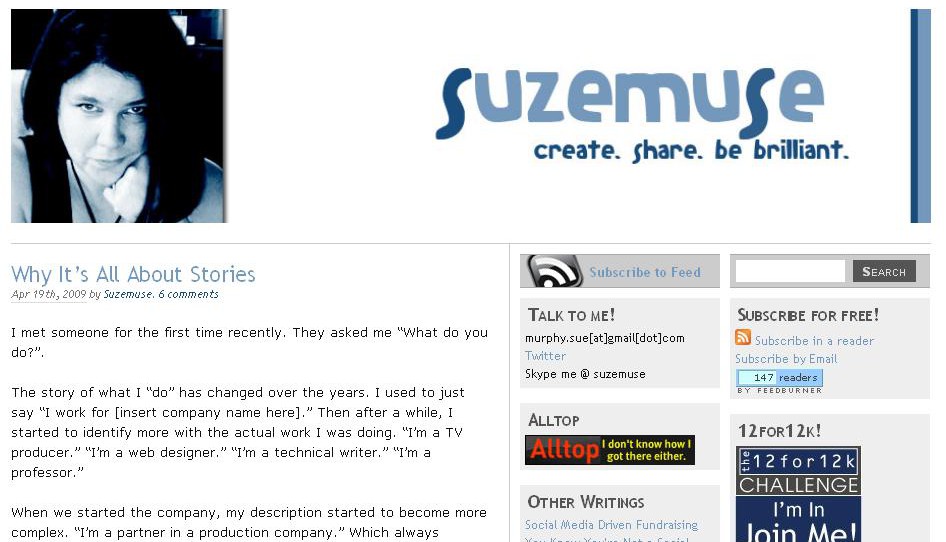
According to figures, there are roughly 175,000 new blogs started every day. That?s a lot of reading to take in, even for the most avid blog reader.
So, to try and help just a little, I?m going to use Sundays as an opportunity to share a blogger and their blog with you. It won?t be restricted to social media, PR or marketing either. There are a lot more to read than just the bloggers from my neck of the woods.
I?ll also be focusing more on lesser-known blogs – after all, the big guys don?t really need another recommendation, do they? So, without further ado, I give you Lazy Sundays – I hope you enjoy.
 SuzeMuse – create.share.be brilliant.
As the tagline itself, says, SuzeMuse is all? about creativity and connectivity. Written by Susan Murphy, co-owner of Jester Creative and one of the creative partners at 12for12k, this blog is one of my consistently favourite reads.
Instead of taking with the normal “Twitter is great and social media will save the business world” type of approach, SuzeMuse looks at the more human angle.
Perhaps this comes from Sue’s own background as a teacher, but to her the story and the people are more important than the tools.
She wants to know why things happen and what these results are for you – and she wants you to guide her in this quest. This thirst for information and her willingness to share with you makes SuzeMuse an almost quintessential example of “real” social media.
Not the faux expertise or the tunnel vision approach that many in the social media bubble adhere to. Instead, SuzeMuse opens everything up to “the little people” and for that, it’s more than a worthy addition to the Lazy Sunday series.
Check out SuzeMuse for yourself and if you like what you find, why don?t you take a minute to subscribe? I think you?ll enjoy.
Talking Twitter with CityNews Toronto
One of the cool things about Twitter is the connections that you make. People you’d possibly otherwise miss or never know can become either friends or close contacts.
Two people I’ve come to know over the last 6-8 months are Kris Reyes and Dave Fleet.
Kris is a news reporter for CityTV in Toronto, and is one of the station’s key people in the social media space. She understands the medium and encourages the station’s viewers to become more involved.
Dave Fleet is a guy I respect immensely and one of the leading lights in the Toronto social media, PR and communications scene. As one of the guys behind Podcamp Toronto and more, he knows his stuff.
Today, these two met on Kris’s news show and discussed Twitter and its growing popularity and acceptance. If you’re curious about the whole Twitter explosion, here’s your chance to find out why it does what it does.
Oh, and for some reason, they let me join in the fun too. Hope you enjoy.