• Skip to primary navigation
  • Skip to main content
Danny Brown

Danny Brown

podcaster - author - creator

  • About
  • Podcasts
  • Journal

Latest posts from Danny Brown

Enjoy the latest posts from Danny Brown, and feel free to add your own thoughts in the comments after the post.

Why Affiliate Vendors Need to Start Taking the Rap

Affiliate marketing masks

Affiliate marketing masks

There’s a lot of news about disclosure online at the minute.

I’ve written about it a ton of times (and spoke about it over at Joe Hackman’s radio show), and smart bloggers like Lorelle are giving some great tips on how bloggers (and other online network users) should go about disclosing their affiliate or professional relationships (thanks to Christina Kingston for the heads-up on Lorelle’s post).

It’s becoming even more important as the U.K. joins the U.S. in cracking down on non-disclosed social updates, whether it’s on your blog, Twitter, Facebook, or anywhere else.

Simply put, if you’re using your platform to promote a service or product on behalf of someone else, you need to state that relationship clearly. Unfortunately, many bloggers and social network users are failing to do this – and the blame’s not entirely theirs.

Instead, it’s the affiliate vendors who are letting their affiliate marketers down.

Yes, You Do Have a Responsibility

I once asked a vendor about their approach to disclosure. The vendor in question makes a product, and a lot of people sell it as part of an affiliate scheme. The product’s very popular, so the vendor has probably made a nice amount of income from it.

I’d seen a lot of tweets and blog posts about this product, where it was clear the affiliate link was being used but not disclosed. I asked the vendor if they were aware, and why they weren’t being more vocal in ensuring affiliate links were disclosed. The vendor’s response?

“Of course, we’d prefer all links to be disclosed. But it’s not our job to police all our affiliates to make sure they’re adhering to the guidelines.”

I disagree and call BS on that.

The minute you make someone a salesperson for your company – which is exactly what an affiliate seller is – you have a responsibility to make sure they’re representing your company properly, and that they’re not breaking any laws in the process of that representation.

It’s your responsibility to make sure that they’re aware of any online regulations, especially in the wake of the FTC and ASA rulings in their respective countries. Saying you have it covered in your Terms and Conditions is an easy out, as we all know how often people read the small print (hint – not a lot).

If you’re not making it clear to your sellers what they need to be aware of, you’re setting them up for legal action or, at the very least, a need to take down their promotion of your products.

But there’s another reason why you, the vendor behind the affiliate program, needs to make sure your bloggers, tweeters or whatever, are disclosing their affiliation to you. The FTC doesn’t really care about the bloggers.

Instead, the FTC will be coming after you.

Bloggers 1, Vendors 0

In the most recent update to their guidelines, the FTC makes it clear who’ll suffer for non-disclosure. “We’re not monitoring bloggers and we have no plans to. If law enforcement becomes necessary, our focus will be advertisers, not endorsers – just as it’s always been.”

Of course, this shouldn’t be taken that bloggers no longer have to disclose – that’s still a given, as it is with Twitter, Facebook and other social network updates. However, it does mean that vendors can no longer claim to have no responsibility to “police affiliates”, because it won’t be the affiliates who get taken to court for non-disclosure – it’ll be the vendors themselves.

The funny thing is, the vendors can make it easier on themselves with just a simple, big bold piece of copy that all new affiliates see when they sign up to an affiliate program:

“Due to regulations regarding the disclosure of beneficial partnerships, we must ask you to make sure you disclose any affiliate links when talking about our product, regardless of where you are.”

This covers everyone – even if they live in a country that doesn’t require disclosure at the minute – and the affiliate can’t say they weren’t aware of the regulations, because they’ve agreed to them before being allowed to become part of the affiliate program.

PR and marketing programs could also adopt this approach, so any bloggers or Twitter users, etc, that are part of a promotional program know they have to make sure they’re not misleading anyone with their promotional updates.

Heck, it’d even offer those vendors moaning about policing their affiliates a fix, since they’ve made it clear and simple to understand what’s required from their affiliates, as opposed to being hidden in some small print.

I don’t know – seems kinda simple to me. How about you?

image: poropitia outside the box

Is Social Media Crowdsourcing Making Us Lazy?

Social media makes us lazy

Social media makes us lazy

You?ve become lazy. You?re no longer smart. You?re a shadow of the clever person you really could be. Don?t feel bad ? I am too. We all are. We used to be questioning; now we just ask questions.

Blame social media. Actually, don?t ? blame social media?and crowdsourcing. Penned by Jeff Howe in a 2006?Wired Magazine article, crowdsourcing does exactly what it says on the tin ? allows us to source a crowd for an answer.

Want to know where the best steakhouse in Waco is? Ask Twitter. Need to find a kid-friendly bar for your next day out? Update your Facebook status. Want to find out if G.I. Joe blows? Start a conversation on Quora.

Useful? Yes. Informative? Yes. Necessary? Not always. Encourages laziness? Most definitely.

Whatever happened to good old-fashioned research? Taking the time to satisfy our curiosity by looking up information ourselves? Have we really got to the stage where we?re so dependent on others that we?re collectively wasting our intelligence?

At school, we?re given textbooks to help us learn what we need to know. We can also access libraries, Google (man how I wish I had?that available when I was at school!) and numerous other resources. A world of knowledge is at our fingertips.

Yet increasingly we?re asking for others to use their fingertips instead. Who does this benefit?

Do we really learn more by asking someone else to find out something for us? Does our memory retain facts and information if it?s fed to us, or if we hold the spoon ourselves?

There?s no denying that crowdsourcing can offer a valuable and beneficial option for gathering information or opinions on any given topic. Yet just because something is there doesn?t mean it needs to always be used.

Instead of crowdsourcing your next question, try this:

  • Google it. There?s a reason why Google is the number one search engine ? people use it to?search for things. Try it ? it?s fun.
  • Use an online encyclopedia. The website?Encyclopedia.com gathers information from 49 encyclopedias and 73 dictionaries and thesauruses. There?s not a lot that won?t be there.
  • Try a relevant resource. If it?s a sports question, try a sports trivia site. If it?s an entertainment question, try an entertainment site. And so on?

Don?t get me wrong – I crowdsource just like anyone else does. But it?s usually for opinion as opposed to information, or for information that I?ve searched for and just can?t find anywhere (yes, even Google isn?t all-powerful).

Human beings are pretty clever by nature. Can we work on keeping it that way?

image: wstera2

Help Me Choose a Name?

Beginning on Sunday January 30, I’ll be running an ongoing series on the blog that answers a new question each week from you, the readers. It might be on strategy; marketing; building loyalty; business; blogging; social media; and more.

Originally I was going to call it Sunday School, since it’ll be posted on a Sunday and it will have an educational slant (yeah, I know, not very original).

But then I was thinking some folks might think it’s a religious thing, and I wouldn’t want to confuse or upset anyone. So… any ideas?

Leave your suggestion(s) in the comments below. My favourite will be the name of the series, and will get a special little something mailed out to them.

Thanks, guys, and look forward to seeing your suggestions!

Update: Thanks to Phil McDonnell and his suggestion – the name for the new series will be Sunday Brunch – details here.

What I’d Like to See From Location Based Marketing Services

Find your customers LBS

Find your customers LBS

Location based (or geo-located) marketing is getting a huge amount of buzz at the minute, as?Twitter apps connect location tweets to its service,?Foursquare is credited with Domino?s Pizza?s UK success and?smartphone users get ready for augmented reality to guide their leisure time.

And then there’s Facebook’s continued assault on world domination with its new Places app.

All good stuff. And yet?

For the most part, we?re still being safe and boring when it comes to how we, as marketers, use these geo-location services such as Foursquare and?Gowalla to drive traffic and sales to our clients and own business.

And there are some great opportunities to set yourself apart.

Cross-Platform Marketing

One of the cool things about Foursquare is the ability to offer specials to folks who check in at your place. Yet even this is being underused, and generally stops at offering mayorships.

Why not tie it into other social media platforms you use?

For example, let?s say you have a?Facebook page for your brand. When you set up a reward for your Foursquare users, why not show the message, ?Thanks for checking in! Why not friend us on Facebook too, and download your exclusive code for?Facebook-only offers??

Not only does this strengthen the relationship with you, you?re offering a great call-to-action to grow your Facebook page while giving your customer even easier ways to make a purchase with you.

Mayorship Shmayorship

Check out any of the offers that businesses using Foursquare promote, and it?s usually rewarding the mayor of that location only.

Great for the mayor, but let?s face it, that can be gamed ? I can check in at the coffee house across the street from my office without even entering the premises, so no sale there!

So why not offer a Happy Hour promo instead? An alert goes out to your followers, something along the likes of, ?Hey guys, between 6 p.m. and 7 p.m. today, all purchases are 2-for-1 on everything up to $50 when you stop by and check in.?

Not only are you opening up the offer to everyone, you?re offering it with urgency ? something that?s hugely effective at getting buy-in from customers.

Cross Promotion Retailing

When we shop, we don?t always go for the cheapest offer. More often than not, we go for the one that best suits our needs. That could mean mix-and-match purchasing ? we get jeans from one store, a top from another, and shoes somewhere else.

So why aren?t we offering that more often via geo-location marketing?

For example, let?s say I go to the movies to see the new Batman movie. Obviously I check in there and maybe even write a note to say what I?m there to watch.

Now, imagine if that movie theatre was partnering with the local comic book store or chicken wings diner. As soon as I come out of the theatre, there?s a Foursquare alert from the comic book store that tells me I can get 10% off all Batman purchases that day.

Or if I go to the wings place, I can get 2-for-1 on special Bat wings (not real bats, obviously!) for that day only. Or good for a limited time from the update ? say, 72 hours.

Again, it?s tying into something I already like so I?m more than likely to check it out. And if I like Batman, there?s a pretty good chance I?m going to like comic books, too.

Like I said at the start, there are a ton of options available for smart marketers to use when it comes to geo-location.

All they need to do is find them. Do that and they might just find more customers, too.

This post first appeared on Spin Sucks, the business blog of Arment Dietrich, a non-traditional marketing agency headed up by Gini Dietrich. Spin Sucks looks to dismantle industry buzz and hype with thought-provoking insights and discussions.

image: mhartford

Is Your Marketing Message Being Diluted by Automated Advertising?

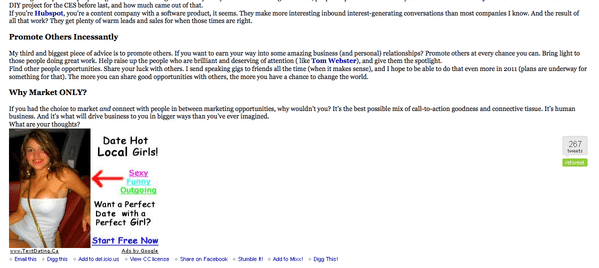
Chris Brogan dating ad

Chris Brogan dating ad

This morning, I received the latest post from a popular blogger via the blog’s email subscription service, which runs on Feedburner.

The post talks about marketing and how relationships and connections are a key part of the marketing mix (and can often be the starting point for any marketing campaign).

It’s a good post with a sensible message. What caught my attention, though, was a Google Ad at the bottom of the post, which is the image at the top of this post (and, yes, I’m a man and, no, the scantily clad young girl wasn’t why the picture caught my attention).

It’s a prime example of why you need to be careful of how your message is being shared, and why automated monetizing can (potentially) backfire.

Adventures in Keywords

A lot of bloggers look at ways they can monetize their blogs. One way is through affiliate marketing; another is through products; another is through running related ads via Google, which is what’s happened here.

The way this works is you set up a Google Ads account and set them to run automatically with your content. This could be your blog’s sidebar, the blog post itself, or (in this case) the subscription feed. Google looks at the keywords in the blog, and automatically inserts what it thinks are relevant ads.

In the post used here, a lot of the talk is about “connections” and “relationships”, so they’re seen as keywords. Throw in the odd “touchpoints” and “love”, and Google probably thought the blogger was talking about dating – hence the accompanying image and ad.

And that’s where the problem of automation can rear its ugly (or scantily-clad) head.

Your Readers Are Listening

When you subscribe to a blog by email, it’s because you’re really interested in what a blogger has to say. You’re investing in them, and giving over real estate in your Inbox as opposed to just catching up now and again via an RSS feed. It’s showing your trust in that blogger’s voice.

Because of this, you might think that an ad like the one in this example is something the blogger has attached to that post by choice. And that can cause problems.

A lot of people could be offended by the image and the message it portrays. Others could be receiving the email at their workplace, and potentially break any rules about adult images on-screen. Or you could be the girl’s parents opening the email…

It’s not (directly) the blogger’s fault – the choice was made by Google, not the blogger. But it’s an image that’s gone out from a highly-respected blog, with more than 60,000 subscribers, and it’s attached to a marketing message on how to do business right.

Yet through a simple error on keywords, the message of the post could potentially be diluted. Additionally, if the ad was worse, it could also lead to some readers unsubcribing (depending on the trust built up for the blog in question).

Something you might want to keep in mind when considering automating your readers’ content…

  • « Go to Previous Page
  • Page 1
  • Interim pages omitted …
  • Page 156
  • Page 157
  • Page 158
  • Page 159
  • Page 160
  • Interim pages omitted …
  • Page 283
  • Go to Next Page »
© 2026 Danny Brown - Made with ♥ on Genesis