• Skip to primary navigation
  • Skip to main content
Danny Brown

Danny Brown

podcaster - author - creator

  • About
  • Podcasts
  • Journal

social media

Ford, Red Tape and Social Media Roadblocks

Ford F-series recalls social media

Ford F-series recalls social media

News came out this week that Ford are recalling more than 1 million F-series trucks, due to a defect in the straps that secure the truck’s fuel tanks to the vehicle. The defect could see the straps corrode, causing the tanks to fail. So far, there have been 8 incidents, three of which included a fire, and one injury.

The news came to the fore after an investigation by the U.S. auto safety regulator, and affects older versions of the truck. In response, Ford has targeted mid-September to notify owners about what to do if their truck is affected.

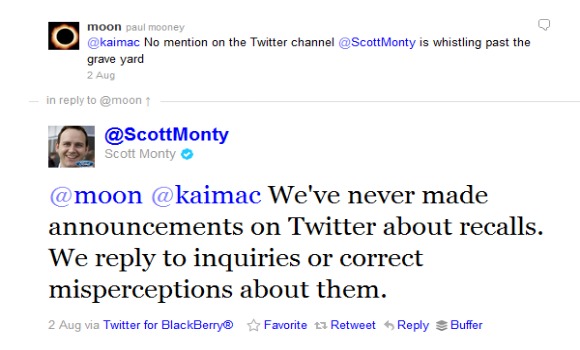
What’s interesting is how a company that’s noted for its use of social media isn’t using social platforms to pro-actively share news about the recalls. Instead, as the image at the start of this post shows, they’re using it reactively when asked about the recall situation, and to correct any non-factual statements. There’s also nothing about the recalls in the Ford newsroom.

Is this a sign of choice or legal red tape?

The Pros of Being Pro-Active

Head of social media at Ford, Scott Monty, says the reasoning behind the “silence” is to avoid inciting panic and unsubstantiated rumours. This is understandable, since we all know the consequences of fake stories and rumours online, and how that can affect brands.

Yet as a way to share news to a wider audience, and quell rumours at the start, social media has continuously proven to be a very strong tool. While Scott may allude to the legal constraints he and the Ford communcations team are under, does being silent unless questioned help?

Wouldn’t it be useful to have an official update in the Ford newsroom, as opposed to having to put out fires by false rumours due to the reactive approach? And a single tweet, or a Facebook page update, that shows a link to where F-series drivers can get the latest and official updates, would help alleviate the very concerns Ford wants to meet.

Additionally, if you’re pro-active, it can also help deflect the view that you have something else to hide (this isn’t just Ford, this is any company online). In a post from 2010, Scott praises SeaWorld on how they were being pro-active at quelling fears, by releasing an official statement from the SeaWorld President and linking to it from their Twitter account.

The Social Media Marketing Blog  When Crisis Attacks

The Cons of Being Pro-Active

As Scott mentions in his answers over at Google+, the reason nothing is mentioned on social media platforms or the Ford newsroom is down to necessity. Ford is handling this recall situation the same way they handle all recalls, and don’t feel the need to say anything “unless the recall rises to a level that is relevant to the wider public.”

Additionally, Ford needs to adhere to regulatory and legal issues and this is tying their hands (at least, that’s how it reads).

Christian Adams, in his response to the question on Google+, advises how he was involved in testing tires after the Firestone fiasco, and that having to wait until the auto safety regulator gave the green light on a problem was very constrictive.

I know the constricted feeling well. When I was contracted at an organization last year, they handled a prize promotion for Canada’s largest airline. Due to some prizes not being delivered in time for the holiday season (a bit attraction to the promotion), there were some negative comments posted on a forum. They asked how it should be handled (as they blamed the couriers and the couriers blamed them), and I advised to let them know that we were looking into it, and that we would reply directly and publicly once an answer had been found.

Due to crappy red tape, it took eight days for someone to come back and tell the person that the case was being looked at. And this was just an update to say the company was aware and would investigate. Eight days is a long time for any answer – on social media, it’s a lifetime.

So I completely get the need to do things right. But couldn’t there be at least one update from Ford, and others like them, to alleviate the questions that will be asked due to silence? Especially if it becomes a wider issue, and the questions become accusations of trying to cover a problem up.

Then again, with the news that Ford has been accused of fraudulent tactics and destroying documents in a lawsuit by a woman paralyzed when her van accelerated out of control, Ford may be feeling the heat and doesn’t want to add to it any more.

Obviously there are pros and cons to any choices made, both by people and businesses. The right one can be difficult to gauge, and perhaps it’ll be in the next couple of months if we see whether the Ford reactive one is the better over the pro-active.

The Ten Songs The Rolling Stones Wrote About Social Media

The Rolling Stones social media

The Rolling Stones social media

This is a guest post by Marjorie Clayman.

It’s been a weird year. Grand in many ways. Here’s an example. So, Mr. Brown here, he asked me to guest post on this site you’re looking at, and I thought, “Wow, what an honor!!”

Shortly thereafter, I was playing on Google+ and I got invited to a hang-out with Mick Jagger and Keith Richards. I hadn’t even circled them! How did they know where I was?? Anyway, I agreed to hang out with them because, well, who wouldn’t. Unfortunately, I found out they were not very happy with me.

See, a while back, I wrote a post about how the Beatles had been really ahead of their time because they wrote 20 songs about Social Media engagement. I had written it as a kind of funny joke-type post. Well, as it happens, the Rolling Stones really did write songs about Social Media because they really were that far ahead of their time. I had no idea.

In order to fix this great pain I have caused, I thought I would record here, on Mr. Brown’s site (they didn’t want to be on my site cuz the Beatles were there) my conversation with the Rolling Stones, which mostly was about the 10 songs they really did write about Social Media (they insisted in a follow-up that the Beatles wrote 2 songs for every 1 of theirs).

Oh yeah, and MJ = Mick Jagger, KR = Keith Richards, and MC = me.

1. Can’t Get No Satisfaction

MJ: Right, so the first song we wrote about Social Media was actually Can’t Get No Satisfaction.

KR: Can’t get no…

MJ: You know, we just knew that people would never be satisfied online, no matter how much they achieved. Oh, you got your post tweeted out by God? Well, that’s still not good enough, probably. You do try to get satisfaction, but it just never works, does it?

2. Ain’t Too Proud to Beg

MJ: Sometimes we found a song someone else had done and thought, “Aye, that has to do with Social Media!” – that was what happened with Ain’t Too Proud To Beg.

KR: Yeah, you know, it’s ironical, because uh…because…uh…because a lot of people do beg, don’t they?

MJ: Right, people beg to have their posts tweeted out, people beg for attention. The Rolling Stones would never do something like that, so we covered this song and made it our own. You shouldn’t beg, by the way. It makes you look silly.

3. Waitin’ On a Friend

KR: Yeah, we wrote Waitin’ on a Friend because that’s what Social Media is all about isn’t it?

MJ: Well, you don’t get money off of friends unless you sell ’em, mate.

KR: Yeah, but having friends online is really nice, you know. It makes it fun and sweet and *sniff*

MJ: Are you crying?

KR: Naw.

4. Paint It Black

MJ: Well, Keith’s turn to being morose reminds me that we wrote Paint it Black because we knew that people online would have the tendency to see the dark side of everything and exhibit the darker sides of their nature. It’s really a shame, isn’t it, because positivity could spread really fast online.

KR: Maybe we should have written Paint it White to give people the idea.

MJ: Go wipe your nose, Keith.

5. Wild Horses

MC: Well, not every song you guys wrote could have been about Social Media. I mean, how would Wild Horses relate, for example?

MJ: Cor, you’re daft though aren’t ya? Wild Horses couldn’t tear me away. That’s the Social Media experience, isn’t it? Everyone says, “Ohhhh, I hate it.” But they’re still tweeting that, aren’t they?

MC: So you knew about Twitter in 1969, eh?

KR: I saw into the future.

MC: OK.

Time

6. Time Is On My Side

MJ: Did you know that we wrote Time is on My Side?about Social Media? Very few people get this connection but it’s really true. We wanted people to take their time growing their strategy, their plan, their presence…

KR: And their egos. Heh heh heh.

MJ: Well….yeah. That’s true. But mostly the first things I said.

7. Pleased To Meet You

MJ: We were really shocked that people applied such a mean and dark translation to Pleased To Meet You (Sympathy for the Devil)...we really meant it as a reminder to introduce yourself to new people in the online world, and the “guess my name” part was ironical again. Your name should be close at hand when you’re online, shouldn’t it?

KR: Yeah…

MJ: I wasn’t asking you.

KR: Right.

8. Under My Thumb

KR: We wrote Under My Thumb because the keys are always going to be under your thumb. Heh heh heh.

MJ: Keith, I think there’s a guitar over there that needs tuning.

KR: Where?

MJ: Right, so we really wrote Under My Thumb to reflect the power struggle that goes on in the online world, right? You always want to beat the person above you and manipulate them in some way. It’s crap that people spend their time that way. Anyway, we thought if we would really talk about controlling someone and getting them to do everything you want, it would make a point to people. But people just said, “Oh yeah, great idea, mate. I think I’ll try that.”

KR: People are SO stupid.

MJ: Yeah, really they are.

9. Honky Tonk Woman

MC: Well, okay, what does Honky Tonk Woman have to do with Social Media? I mean, there can’t be a connection there, right?

KR: Oh you’re an ignorant twat. That’s about two things we knew would happen in the online world. First, unprofessional and profane behavior. And second, uh…

MJ: Second was the rumor-mongering aspect of Social Media. You know, “People say…” that part. All about online rumor-mongering.

MC: Of course it is.

MJ: I don’t like you.

MC: I know. That’s cool.

10. Mixed Emotions

MC: So what’s song number 10 in this line-up, gentlemen?

MJ: Well, the last song we wrote about Social Media *specifically* was Mixed Emotions. And there’s a lot of meaning in there. For example, we knew people would often have mixed emotions about Social Media. You love it, you hate it. It’s so much work but so much fun. But also it’s, you know, we say “You’re not the only one,” so it’s…

KR: It’s a reminder that you’re not an island, you’re a person in a big group of people and you should pay explicit attention to what people are doing around you. I mean what are you thinkin, you’re the only one with a bad day or an irritation in your life? Toughen up and look out for other people for a change how about it ya great waste of life?

MJ: Uh, yeah. That about sums it up.

Alright, so, those are the ten songs Mick and Keith say they wrote about Social Media. Once they got going, though, I really felt like they may have written more. It was just too hard to keep Keith’s attention throughout the interview.

So I need your help now. What other songs did the Rolling Stones write about Social Media? Did they actually write about it more than the Beatles? What do you think?

Margie ClaymanAbout the author: Marjorie Clayman works for her family-owned agency, Clayman Advertising, Inc., where she represents the third generation! Margie is the resident blogger at MargieClayman.com, and can be found on Twitter at @MargieClayman.?

image: Melvin Starbrook
image: pietroizzo

Debunking Popular Myths of Social Media

Social media myths

Social media myths

Social media is many things to many people. For some, it’s a core part of their overall business and marketing strategy. For others, it’s a key player in driving traffic to their blog. For others, it’s a new toy they’re just beginning to play with. And for some, it’s about as interesting as pond moss.

So, lots of uses and definitions, depending on who you speak to.

Yet there is one area where all the definitions can come together and agree on, and that’s the area of social media myths. The claims from people that should know better, either for a hidden agenda or a lack of foresight.

So, here are a few social media myths that we can probably all agree are out-of-date thinking at best, and dangerous advice at worst.

Social Media is Free

Bzzzzt (insert noisy buzzer sound here). This one’s been doing the rounds for a while now, and still seems to pop up, even though everything points to the complete opposite. So let’s make it simple – social media is not free.

Yes, the tools are free (unless you have the premium version of these platforms). And, no, not everyone will be looking at the cost investment from the example linked to above.

But even if you’re a small business user or solo entrepreneur using social media to help raise awareness of your brand through interaction, you have to invest a serious amount of time for any traction to begin. So take whatever salary you give yourself, deduct the man hours you put in by the financial cost of this, and that’s the bare minimum of how much social media is going to cost you.

Add to that any advertising on the likes of Facebook Ads and LinkedIn Advertising, and then how you’re going to integrate all your online stuff into your everyday marketing and promotion, and the costs start to add up.

Sure, you can bootstrap your way around social media – but free it ain’t.

Social Media Levels the Playing Field

One of the pros of social media, according to many of its most vocal proponents, is that it levels the playing field. This comes from the viewpoint that it allows the consumer – who never had much of a voice before – to air their grievances in a far more public forum, as well as have access to leading players at these brands.

The belief is that this now means the brand is no longer in control, and the little guy is now the giant. And it’s true – social media does allow the consumer to be a bigger part of the business decisions being made.

Yet there’s also the flip side for businesses. A lot of social media purists will say that small businesses and solo practitioners can compete with the huge corporations and the big agencies, because the tools are the same for everyone.

Except they’re not. A corporation with a $10 million budget for research, strategy, implementation and measuring is going to have a heck of a lot more at their disposal than a small business with $10,000 to play with. And then the scale factor comes into play – can a one-man band (or even a two or three-man band) monitor and respond to social interaction the same way a dedicated team of fifty can for the bigger guys?

The simple answer is no. So, yes, social media can level the field somewhat – but then it also means you have to get new machinery to keep it level, and that’s still beyond the capabilities of many businesses.

You Need the Voice of the Influencers

Like any eco-system, social media has many layers, and at the forefront of these layers are the Influencers. Usually these will be early adopters in the space, and they’ve become influential for identifying trends and looking at how these tools can be used for business.

The problem is, influence is based on relevance, yet many businesses still try and get the Influencers to talk about their products, regardless of whether they’re experienced in that brand’s niche or not. The mindset is that the Influencer has over 100,000 Twitter followers, or tens of thousands of blog subscribers, so it’s an easy “in” to that audience.

Except it’s not.

Because nine times out of ten (not a scientific figure), the Influencer will only share your brand or product for reward. Hard cash, or a large amount of swag. They’ll write about you once, and then move on to the next brand. Because they’re (usually) not invested in you.

But your brand advocates are.

The ones that write and talk about you every day, both online and offline. The ones that truly have your best interests at heart, so they’ll offer you honest feedback on how you can improve. Compare that to the Influencer who thinks your product is great, now just pony up the greenback.

The Influencer may get you a quick buzz, but longevity and success very rarely come from a fire sale. It does come from having an army of advocates and loyal customers, though – look after your advocates and they’ll look after you better than any Influencer can.

Conclusion

There’s no doubt that social media has changed much of the business landscape, and continues to do so. And with potentially game-changing products like Google+ entering the fray, the real fun could just be beginning.

We just need to make sure we’re keeping a level head at what social media can, and doesn’t, offer. If history has taught us anything, it’s that hyperbole is very often the precursor to, “Remember so-and-so?”…

image: Luminis Kanto

Social Media Gurus, Real Work and Diversity

Social media guru

Social media guru

This is a guest post by Olivier Blanchard.

Earlier this year, Danny wrote a post about social media diversity, that received a fair bit of conversation both on his blog, and away from it.

Maybe diversity has nothing to do with it, though. Maybe the answer is far simpler than that.

From where I stand, it says something about 30-40 year old white dudes that so many of them feel compelled to spend all day talking about social media and how to get better at social media, and how to make more money with social media and how to get more followers on social media and how to be more time-efficient on social media and how to measure their influence on social media and how to get jobs through social media and how to become speakers and experts and gurus and f***ing ninjas on social media, and everyone else doesn’t.

Maybe the fact that no one else does this is because most other people out there in the real world are more concerned with solving real problems than becoming the next Seth Godin?

And because these folks are out there doing real work instead of pontificating about Google + or investing in one another on Empire Avenue, they neither have time nor feel the need to create idealized versions of themselves on the interwebs (you know, a version in which they are brilliant and cool and successful instead of being your garden variety slob.)

No Diversity? Think Again

I could be wrong, but from where I stand, there is no diversity problem in social media. I see every religion, nationality, ethnicity, culture and community represented in the social web. You know why? Because I, like you, see beyond the glow of our own little imaginary twitternet stars. The guys I learn from are in Asia. In Africa. In Europe. In the Middle East. In Latin America. They aren’t just SxSW and Blogworld speakers. They aren’t experts or gurus either.

The only real problem touching on diversity I see in the “social media space” is this: About four dozen assholes in the US and Canada making up an imaginary social media “industry,” who suddenly realized a week ago that with all the navel-gazing and ego projection fueling their “thought leadership,” they have mostly managed to cater to people who conveniently look and sound just like them. Wow. How did THAT happen?

By the by, if they ever manage to pull their heads out of their asses long enough to get some oxygen back into their brains, they will either meet or remember having met – among hundreds of thousands of other social media users who are not pre-midlife crisis white dudes – Rohit Bhargava, Maz Nadjm, Jeremiah Owyang, Gabrielle Laine Peters, Karima Catherine Goudiam, Bonin Bough, Liva Judic, Monika Melsha, Guy Kawasaki, Chris Penn, Danielle Lewis, Peter Kim, Charlene Li, CD, Hajj Flemings, and many, many, MANY more who, last time I checked, contributed more to the social media world than all of their “white” social media guru blog posts combined, and managed to do so while being other than strictly caucasian.

So. What’s the next big topic for the “we’ve run out of things to talk about social media guru” crowd: Why aren’t there more foreigners involved in social media?

Someone really needs to pinpoint the exact moment when “social media expert” became synonymous with “dumbass” so we can add that to Wikipedia.

Note: This was originally a comment by Olivier on my post about diversity. I just thought it would be a great standalone post to complement the original, and Olivier kindly agreed to let it run as such.

Olivier BlanchardAbout the author: Olivier Blanchard is Principal at BrandBuilder, Inc., an East Coast-based New/Social Media consultancy and Marketing management firm. He’s also the author of the book Social Media ROI, and owner of The BrandBuilder Blog. Follow Olivier on Twitter at @thebrandbuilder.
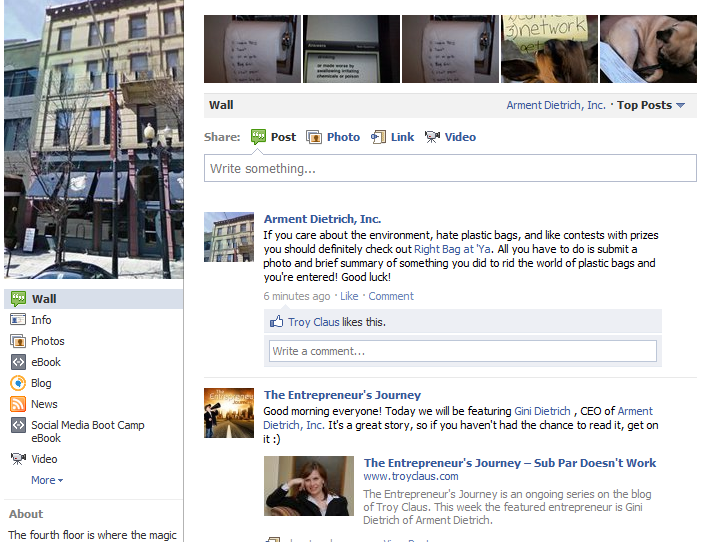
image: doughaslam

The Difference Between Engaged and Engaging

Arment Dietrich Inc.

Companies love to share their successes with social media. How it’s allowing them to “engage with fans and customers”, and how they’re “being part of the conversation”.

Like it’s something new and wild and golly gee, aren’t we great?

Well, yes, it’s great that you’re doing something you should have been doing all along – talking with customers, and not just because of social media – and it’s great that you’re now part of the conversations around your brand.

But are you really engaging, or just being engaged? Because there’s quite the difference between the two.

Check out these two Facebook Pages as an example.

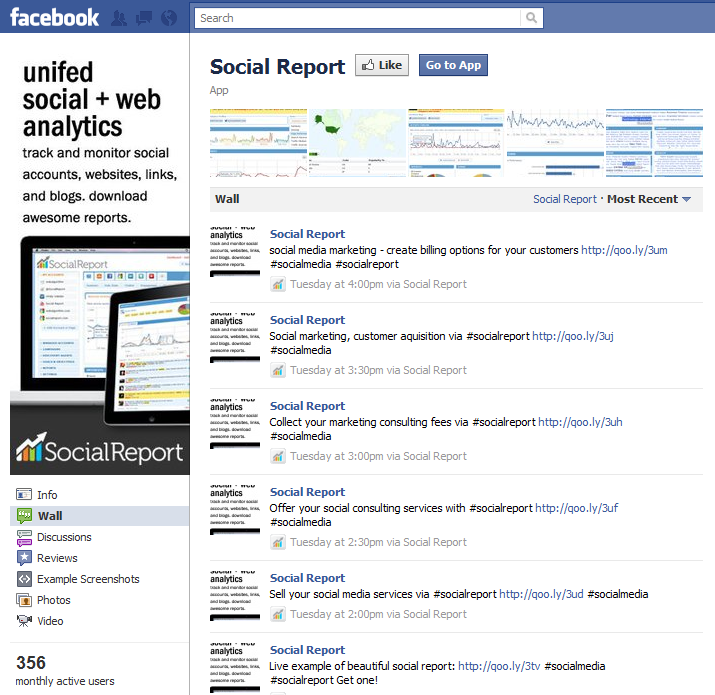
Social Report

Arment Dietrich  Inc.

The first page is for Social Report, “a social network analytics solution that gives you rich insights into your social space and marketing effectiveness.” It’s a lively page – if lively equals automated updates every thirty minutes about what their service features are. Their Twitter stream is pretty much the same.

The second is for Arment Dietrich (a little disclosure – Gini Dietrich, the CEO of Arment Dietrich, is a friend, but this doesn’t bias my post). Their wall is a mix of company updates, social media and communication industry news, helping the environment, questions from “fans” and fun Facebook tips. And they have a lot of their connections sharing stuff on their wall too – always a great sign of full engagement.

If you were someone looking to hire a company – or see how a business understands – social media, which one would you choose (going by these two Facebook Pages)? One where it’s just update after update with no real depth, or one that shares a mix of useful advice and tips, and allows their customers (fans) to do the same?

So. Are you engaging with social media, or are you just engaged?

  • « Go to Previous Page
  • Page 1
  • Interim pages omitted …
  • Page 10
  • Page 11
  • Page 12
  • Page 13
  • Page 14
  • Interim pages omitted …
  • Page 55
  • Go to Next Page »
© 2026 Danny Brown - Made with ♥ on Genesis