• Skip to primary navigation
  • Skip to main content
Danny Brown

Danny Brown

podcaster - author - creator

  • About
  • Podcasts
  • Journal

Search Results for: postmatic

Can We Stop Calling It Blog Commenting Now?

Think of the last time you got together with friends, or family, or even colleagues from work.

You enjoyed the company, you laughed, you caught up on missed life events, and – hopefully – had a really good time, right?

As you reflect on that time together,?there’s probably a good chance that the key takeaway for everyone is that you all enjoyed both the company and conversations.

Because, let’s face it, conversations – and those that help make us more educated, or filled in, or even better people – can make all the difference between a drab experience and a fun one.

So why don’t we treat blog comments the same way? In fact, why do we continue to even call them comments when, in truth, they’re very much the same as the awesome conversations we have offline?

We Don’t Just Comment Our Way Through Life

Ever since blogs were set up to enable comments in the Web 2.0 era, they’ve been a mainstay of many a blog. And rightly so.

From opening up an extended dialogue around the post itself to fostering friendships within the blog’s community, blog comment sections have been one of the unsung “heroes” of the blogging world.

And yet…. all too often, they’re either looked upon with disdain due to the belief it’s just a breeding ground for immature trolls or spammers, or they’re ignored as being a tacked-on surplus area that no-one really cares about.

The first reason is down to the blogger – yes, there are trolls and spammers, but if you really care about your blog and your audience, you’ll handle these issues the way they should be dealt with. The technology exists.

The second reason is a fair one – and, for me, it’s all down to the use of the words “blog comments”. Specifically, comments.

Think back to the opening part of this post, and the example of a great time with people you like, and the wonderful conversations that sprung from that.

Now, imagine if, when looking back, you’d described the evening as “oh, yes, we all commented really well together, and left such great comments after everyone had said their piece.”

How ridiculous does that sound? Right? Stupid ridiculous!

So why do we take conversations after our posts and call them comments? Because that’s exactly what we should be calling comments – conversations.

[bctt tweet=”#Blog #comments are true #conversations, pure and simple. It’s time to start treating them as such. ” username=”DannyBrown”]

Comments, by perception, are throwaway snippets of soundbites that are soon forgotten.

Conversations, on the other hand, are true one-to-one and one-to-many sharing of thoughts, agreements, disagreements and more, and can live as long as there’s a new thought shared.

And comments as email? They don’t get much more conversational than that.

It’s Time to Shift the Comment Mindset

Although a few years old now, there’s a reason The Atlantic called email “the best thing on the Internet”.

From that piece:

Email is a refugee from the open, interoperable, less-controlled “web we lost.” It’s an exciting landscape of freedom amidst the walled gardens of social networking and messaging services.

Simply put, it’s the simplicity?- and, most importantly of all, privacy – of email that enables true conversations to take place, as opposed to the guarded, stilted ones that can be found on social media and groups.

Email’s usage is ubiquitous across so many cultures and generations, and the buy-in is minimal. And that fact you’re sitting in a comfy spot to send and reply to an email makes it easier to settle into a “this is a personal conversation” mindset.

I see it here in the conversations around my posts, due to my use of Postmatic.

Comments are thoughtful. Caring. Educational. Raw. Real. Honest. Fun. Happy. Encouraging. And so much more.

Because if there’s one thing I truly believe, “blog comments” are deserving of so much more than the reputation and perception they have.

They’re more than a breeding ground for waste and hostility. They’re more than a throwaway line at a second-rate comedy open night.

They’re true conversations, pure and simple. It’s time to start treating them as such.

A version of this post first appeared on the Replyable blog.

The Focus of Needing to Be Focused

Focus

Since starting my blog back in 2008, it’s gone through many iterations, both in the style of presentation, and the theme of the content within.

It’s gone from having about a dozen or so categories, to only having one (which is the bigger picture of this thing called life and where we sit in it, personally and professionally).

It’s gone from having multiple sidebars to zero; from having affiliate ads and posts trying to sell something to zero ads and zero selling (at least, not the hard sell).

And it’s gone from using a socially-driven comment system like Livefyre to a more personal and thoughtful comment solution like Postmatic.

The reason for all of these changes is simple – to meet the goals I have, the focus has to be on the paths to get there.

My goal is to make my blog a destination for folks that prefer pure blogging, where a more personal experience is enjoyed, and the content isn’t driven by the desire for social proof and vacuous clicks (hence my decision to remove social sharing buttons from my blog).

To do that means the content has to be focused. Hence the stripped down look and feel of the blog, where the only thing in front of you are the words.

It’s a little worrying, if I’m honest – because now the content truly does have to stand on its own, as opposed to being supported by a nice flashy sidebar with a colourful sticker or two.

But it’s also a good exercise, as it makes you more aware of the words you’re putting down and the message you want to create.

It’s not too different from life, really, if you think about it.

Pulling Back the Covers on a Life Lived in Shadows

Oftentimes in life, when asked by people what others might think of us, we reply with something like,

I’m an open book. If you want to know me, just look at me or be around me for an hour or two.

While that’s an admirable – and mostly honest – statement, it’s not quite a true one. Think about it.

  • When you share something on Facebook, is it a picture/update of how awesome your kids/husband/wife are, or is it “Shouted at the kids, felt like a shitty parent for doing so, and don’t get me started on what my other half did yesterday!”?
  • When you upload a picture to Instagram, is it the first one you take or is it the 4oth attempt at getting a smile just right, a background just so, a pet just in the right contortion to be cute?
  • When you leave a comment on a blog, do you really say what you want to say, or is it a sanitized version of what you believe, because you don’t know the make-up of the other commenters?

These are just online examples. Offline, it’s the same.

  • How we present ourselves to our colleagues.
  • How we approach a social setting.
  • How we act in the privacy of our own homes versus how we behave under the gaze of the public.

We might think that’s a natural defense mechanism, but the truth of the matter is it’s anything but natural.

Instead of being the open book we say we are, we’re an edited version of the story we want to tell.

We do this because we tell ourselves this is how people will like us. This is how people will gravitate towards us. This is how people will become our friends.

And they might – for a while. Until the covers are pulled back, and the shadows of your real life are on display for everyone to see.

Some may stick around. Others may not. But the choice is no longer yours to make. Now the story decides which characters are left to take part.

The irony is, if we don’t live in the shadows to begin with, we’ll attract the people we truly deserve. The people who’ll be there when we need them.

The people we can truly call friends.

It’s not easy. You have to be focused, and brave, and ready to throw the covers back, even when it’s cold and dark outside.

But the reward and validation are worth it.

Try it sometime. You might just pleasantly surprise yourself.

Why Social Sharing Buttons Might Not Be Needed on Your Blog

At the end of last year, I ran a little experiment on what would happen if you removed social sharing options from your blog.

My curiosity stemmed from a couple of things: a really interesting blog post I read from Sam Solomon, and the fact that my blogging goals had changed drastically.

Instead of talking about social media, marketing, and all the usual business stuff, I moved to a more personal style and one that was driven by conversations through email using the Postmatic service.

Following that experiment, I shared the results at the beginning of this year, and they were a little surprising.

While seeing a little drop in social traffic due to the buttons being removed, direct traffic rose.

Not only that but actual share counts rose too, from 392 shares for the posts before removing sharing options, to 511 for the posts where there were no on-page sharing buttons.

So, clearly, people were still happy to share, despite the need to manually copy-paste to their choice of social network.

Since that experiment, I’ve gone back and forth on whether to keep social sharing buttons on or remove them altogether and simply offer the content.

Following another, slightly longer experiment with them removed, I’m switching them off for good, as the “benefits” of social sharing plugins/buttons may not be all they’re cracked up to be.

Distraction-Free Content Will Continue to Be Shared

For the last 6-7 weeks, there have been no sharing buttons on here. Instead, blog posts published since then have either been read via email by subscribers, RSS subscribers, or direct shares on social.

In leading up to the switch off, the breakdown of traffic looked like this:

db-channels-with-social

The main section to look at is the yellow one, which relates to social media traffic. That accounts for 4.9% of traffic to my blog, which is minimal (and plays into my bigger strategy).

Given it’s such a small percentage of my audience, my thinking was would it really matter if I switched off sharing buttons anyway, and concentrate on more valuable metrics like subscribers, direct/referrals, and search?

After switching the sharing options off, this is what the breakdown of traffic looked like:

db-channels-without-social

Again, the yellow section relates to social – but instead of a drop, there’s a small increase, from 4.7% to 5.3%. This equates to another 546 visitors from social media in the comparable period.

So, as far as social media traffic is concerned, visits went up when social sharing buttons were switched off.

Adding to that discovery, I went back and compared how many shares overall happened between the two six-week periods – the first for when social sharing options were on-page, the second for when they were removed.

The result? The same as the experiment earlier this year.

  • With sharing buttons: 1,829 shares
  • Without sharing buttons: 2, 144 shares

That’s an increase of 315 shares with on-page options removed. Which, again, suggests perhaps social sharing options on-page aren’t as big a deal as they’re promoted to be.

Won’t Removing Social Shares Impact Traffic and Goals?

Of course, social sharing is but one part of a blog’s overall “success” and content strategy. Every blogger has different goals, different success metrics, different ideas of what works and what doesn’t work.

However, one of the goals all bloggers (or at least, most bloggers) would say remains important regardless of blog style is traffic to the site.

After all, if your content doesn’t get seen, does it even exist?

So I compared the six weeks prior to switching off social sharing options to the six weeks following it:

db-comparable-sessions

As you can see, with the exception of Pages per Session, every metric was up:

  • 1,536 more Sessions
  • 1,473 more Users
  • 1,503 more Pageviews

Additionally, the Bounce Rate (how quickly people leave after viewing just one page) dropped dramatically. For me, I’m not so bothered, as I don’t have a Related Posts or similar option on single posts.

However, for any content creator looking to make their site more sticky, reducing Bounce Rate by more than a third isn’t too shabby a result.

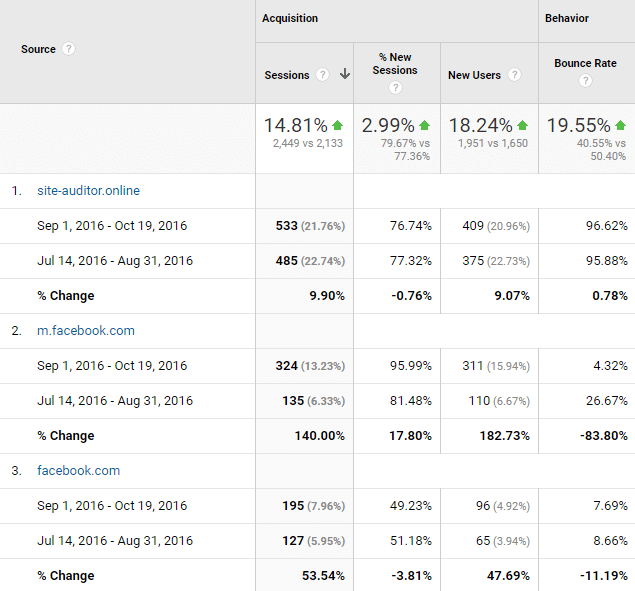
Digging further into the two date ranges, I also saw an increase in direct traffic from Facebook:

db-facebook-comparison

As you can see from the simple comparison above, mobile Facebook traffic saw a 140% increase in Sessions and almost 183% increase in new visitors.

Looking at the desktop version of Facebook, there’s also an increase there (though not to the same level of mobile). More than 53% new Sessions, and almost 48% increase in new visitors.

This suggests that mobile sharing is far more effective (and most mobile browsers have built-in sharing options, so no need for on-page buttons) and that it’s not just the same Facebook users/visitors who are manually sharing and clicking through.

Which, if your goal is to continue growing a new audience while looking after your existing one, is a nice metric to see.

The final goal comparison for me was subscribers, and how removing any distraction would alter that.

  • Six weeks with sharing options on: 147 new subscribers
  • Six weeks with sharing options off: 361 new subscribers (of which 207 came from the after content sign up form)

That’s quite the jump.

Given the level of content output remained the same, both anecdotal and empirical evidence would suggest the lack of sharing options alongside the after content subscription form focused attention on my goal – subscribers.

Especially since before switching off the sharing options, the majority of my conversions for subscribers came via my Exit Intent pop-up box.

Social Sharing is Not for Everyone, and Some Caveats

For me, given this is the second time I’ve run this experiment, and the results are pretty much the same both times, social sharing options on-page aren’t an effective tactic.

Indeed, the goals I have for my blog are almost universally met by removing the buttons and truly focusing attention on what really matters – content, conversion, engagement.

It’s not just me, either.

A couple of weeks back, I received an email from Benjamin Houy, of FrenchTogether.com. Benjamin has a much higher trafficked site than I do and had come across my post on sharing buttons.

He was curious about the usefulness of social sharing buttons too, as he’d carried out similar experiments to mine in the past and these had been inconclusive.

Benjamin and I have been exchanging emails over the last few days, and his own findings are pretty interesting:

benjamin-social-traffic
benjamin-social-warfare

As you can see from Benjamin’s social data above, social traffic also plays a small part in his bigger traffic picture, accounting for only 1,300+ Sessions from an overall 193,000 sessions.

But social sharing options on-page (in Benjamin’s case, Social Warfare) accounted for about 10% of all Social Sessions.

Note: As you can see, Social Warfare is being tracked from the beginning of October, so I’m only comparing the date range it was switched on when looking at how it contributed to social media metrics.

As Benjamin himself mentions, it’s clear to him that – for his site and traffic, at least – most people are sharing manually on social media, or using browser extensions like Buffer, as shown by Benjamin’s comparison between on-page buttons and Buffer’s browser app.

social-warfare-clicky
buffer-clicky

Which brings up the question: do you need social media sharing buttons on your blog or website? I’d suggest no – but with some caveats.

  • This analysis is based on my blog, which has been going for eight years, so I (technically) should have an audience willing to share regardless of methodology;
  • A third of my audience is mobile-first, meaning they more than likely use mobile browser sharing versus on-page;
  • 60% of my audience fall within the 18-34 age group, meaning (again) mobile browsing would be their first option;
  • Three of the Top Five interest groups of my traffic relate to Technology, Mobile, and Social Media Enthusiasts, indicating they aren’t averse to using browser extensions and sharing directly via copy/paste linking.

For your own blog, the results might be very different, and your audience make-up could include visitors that prefer on-page sharing of some form or another.

Additionally, new blogs without a decent subscriber base may find it easier to build awareness via social sharing buttons and a strong call-to-action to share a post via these buttons.

Like anything, your own data and knowledge should drive your decisions.

The one thing I would say, though, is that with social networks increasingly trying to keep you on their platforms when it comes to content (Facebook Instant, Facebook Notes, Twitter Moments, LinkedIn Pulse), social sharing looks to be fighting a multi-front battle.

If your concentration lies towards getting shares that drive traffic to your site and you think on-page buttons are the way to do that, make sure that thinking is backed up by hard data from your analytics.

My data, and that of Benjamin’s, suggest on-page options are not the driver of traffic many people feel they are. Instead, manual sharing (where readers can add extra thoughts of their own to the share) would appear to be more effective.

Check your analytics. Check your own experiences. Compare your goals to how social sharing is impacting these goals, and especially compare which sharing option is driving toward them.

Then make a calculated and educated decision on whether sharing buttons are really needed, or if they’re just a distraction.

If they turn out to be a distraction, why continue to use them?

Dear Mr. Houston – An #UNFUCD Thank You Letter

Thank you

This letter of thanks is part of the UNFUCD “Thank a teacher” mission, which encourages us to write a letter of thanks to someone who has helped shape the person we are today.

UNFUCD

Dear Mr. Houston,

You may or may not remember me – after all, you must have seen thousands (if not tens of thousands) of boys and girls pass through your history class at Hawick High School during your time there.

[Read more…] about Dear Mr. Houston – An #UNFUCD Thank You Letter

If You Want to Build Engagement, Build Your Learning First and Never Stop Learning

When people think of growing an engaged audience, it’s usually in reference to blog readers; or an email list; or visitors to a sales page on your website; or listeners to your podcast; a social network community, or similar.

But what are we really building an audience for?

Is it simply to participate (click through on an offer or download a product)? Or is it to interact, via comments on a blog, tweets, Google+ conversations and more?

If it’s the former, then do we even care about engagement?

After all, no-one says anything on a sales page except the seller, so where would the need for engagement be?

If it’s the latter, though, and you’re looking to build a truly engaged audience or following, then understanding your blog audience is key to building your goals for what that engagement will look like, and what your end goal really is.

It Doesn’t Need To Be About the Sale

When I first started my own blog, there was no agenda for it to be a lead generation platform. While a lot of business blogs will act as a cover for a sales message (and there’s nothing wrong with that), my goal was a bit different.

Instead of having a ton of ads and affiliate links, and subconscious messages to drive traffic to the website of the agency I ran at the time, I simply wanted a place where I could put ideas out and have others respond to them, no matter whether the response was positive or negative.

There were so many blogs out there that simply state a point of view and don’t encourage further conversation – I found little to get excited about on these blogs. So I made a decision.

While I couldn’t guarantee that I’d get a lot of readers, I would guarantee that those who did find me would arrive at a place where their view was just as important as mine, if not more so.

I’d also keep my viewpoints honest, even if it meant pissing off the “leaders” in the space that I was blogging about (and that’s happened a few times!).

Again, this meant that readers would know that they could come to my blog and learn exactly how I felt about something, and they’d have the platform to share their frustrations too, whether they agreed with me or not.

By doing this, I’ve been incredibly fortunate to have had some great discussions on here, and these have continued across the web on platforms like Google+ and Facebook walls.

There may not have been a huge amount of conversation in the beginning, but I stuck to my goal of having an open mic where all opinions are respected equally. For me, this has led to the growth of the blog since these early days more than anything else.

Learning As You Go

Of course, like anyone, I’ve made mistakes along the way, and I know I’ll make more – that’s just how we are.?For example, a few of my early posts were the kind I call “traffic jams” – lots of traffic, but not going anywhere.

  • The lists posts;
  • The “Top 10 Ways to…” posts;
  • Simple posts about Twitter, Facebook, etc.

Basically, the types of post that were easy to write but had little real substance.

That’s not to say they were written that way deliberately – every post I’ve written has been with good intent.

But from a satisfaction viewpoint, there was little to be had from some of these earlier posts. I could have easily stayed on that path, and would have probably had a lot more subscribers than I do today.

But I didn’t.

Instead, I wanted somewhere that would be a real source of engagement. So I learned from the early posts, and made a more conscious effort to write more questioning posts, and try to offer up ideas that weren’t available elsewhere.

[clickToTweet tweet=”Write more questioning posts, and offer up ideas that aren’t available elsewhere #pureblogging” quote=”Make a conscious effort to write more questioning posts, and offer up ideas that aren’t available elsewhere”]

And it worked.

My subscriber list grew, as did the engagement with my readers – and not just on my own blog.

There have been some great examples of continued discussion as readers took the original viewpoint into a brand new direction and really made me think about the original post.

For someone that thrives on that kind of exchange, you can’t ask for much more than that.

Accepting Change Needs to Happen

It’s not just the interaction where the benefits have come. By building an area of trust where people would feel welcome in a safe and open community, it resulted in that same community showing their own value.

For example, when a non-profit consultant attacked me personally regarding a social media-led charity project I had founded, the community rallied in numbers to counter the claims, resulting in her removing the piece from her blog.

They also rallied round me when I was seriously ill in 2010, and for that I will be eternally grateful. So, yes, opening up your blog offers some huge benefits.

That doesn’t mean I wouldn’t have done anything differently – heck, if we’re always satisfied, then we aren’t growing! If I had my time again, I would have implemented some things differently.

1. I would have posted less frequently

I started off writing a blog post a day (and sometimes I posted more than once on the same day). Sometimes this made me publish stuff that, in hindsight, could have (should have) been better.

In the middle of 2011, I made a conscious decision to post less frequently and really ask questions of the stuff I wrote about. I’d like to think it made me a better blogger and resulted in deeper conversations and points of view being exchanged.

2. I would have been more honest

Let me rephrase that – I would not have been afraid to speak more honestly. There were times early on when I wouldn’t have offered a negative opinion about certain people, since I (incorrectly) thought they were right.

Turns out we all get blinded by vacuous respect.

When I realized this, and began writing openly about questionable practices or calling out BS, it opened up a new level of understanding between blogger and reader, since others were clearly thinking the same thing.

3. I wouldn’t be so closed off

One of the things many bloggers complain about is that social sites like Twitter and Google+ have seen comment numbers decrease, as conversations about a post shift to the network as opposed to taking place on the blog itself.

But that’s missing the point.

Engagement comes in all shapes and sizes and, while your blog may be the most desired place for discussion, true engagement allows the discussion to expand wherever people feel most comfortable talking.

If I was to do anything differently here, it would have been to get active on a Facebook Page sooner, or be more involved in social conversations as opposed to trying to limit them to my blog.

[clickToTweet tweet=”Engagement comes in all shapes and sizes – don’t limit conversations to just your blog.” quote=”Engagement comes in all shapes and sizes – don’t limit conversations to just your blog”]

Because, ironically, I’ve tended to find that the more willing I am to converse away from my blog, the more likely people are to click through and read more of my stuff.

And that’s a win-win in anyone’s book.

Why we can never stop learning

Of course, this is just personal experience and thoughts on my own blogging journey. Will the above work for you in helping to meet your own goals? Maybe, maybe not.

A lot will obviously depend on your own data. For example, going by my analytics, the demographic of my readers is absolutely right for the content I’m producing.

And tools like Postmatic, and the conversation that springs from there, can help?me optimize even further for new audiences.

I know that when I’ve used the framework of what’s worked for me when helping others set up a new blog, they do tend to find a good level of engagement from the off.

So, the fundamentals mentioned above may be useful – but don’t quote me on that!

One thing that is guaranteed, though, is this: if you want to build engagement, then build your learning first and never stop learning.

  • Learn who your audience is;
  • Learn what they want to read;
  • Learn where they prefer to converse;
  • Learn how to be open;
  • Learn that you’re never 100% correct.

If you can see where you’re going right, and learn to notice where you’re going wrong, it’s a lot easier to take the steps needed to meet your own success metrics, whatever they may look like.

And if you can do that? Well, you’ve just laid the foundations in building your engagement model. Now you just need to keep building.

And with the right data behind you to support these foundations, the next steps won’t be as difficult as the early ones.

  • « Go to Previous Page
  • Page 1
  • Page 2
  • Page 3
  • Page 4
  • Go to Next Page »
© 2026 Danny Brown - Made with ♥ on Genesis