• Skip to primary navigation
  • Skip to main content
Danny Brown

Danny Brown

podcaster - author - creator

  • About
  • Podcasts
  • Journal

Social Media

The Mysterious Case of Oracle Social and Facebook Likes

Oracle Social

Oracle is a well-respected brand when it comes to solutions for I.T as well as social media and business intelligence for enterprise users. They have a collection of toolsets that cover everything from loyalty programs to service management and analytics.

So you’d expect them to have a fairly robust social media strategy for themselves, right? Except when it comes to Facebook, it would seem.

[Read more…] about The Mysterious Case of Oracle Social and Facebook Likes

6 Small But Sweet Updates to Jugnoo and Other Stuff

Jugnoo social crm

Over the last few months, lots of folks have asked why they’d want to use Jugnoo versus their current platform of choice (say, Hootsuite, Tweetdeck, Trackur, etc).

It’s a fair question – all are good platforms with their own strengths. The easy answer (at first) is to make clear that Jugnoo is more than just a social dashboard or search platform – it’s a full-on business solution.

The next thing to show is that everything at Jugnoo has been built from the ground up to work in tandem with each other. Our social dashboard doesn’t just allow you to keep up with your networks, but also shows sentiment and intent that’s normally reserved for social monitoring.

Our social monitoring solution doesn’t just keep you on top of what’s being said about your brand or competitors, it also ties into our visual data solution that creates context out of disparate conversations online.

Jugnoo buzz visualyzer
(click image to expand)

Our visual data solution not only shows you in clear, buzz-driven analysis what’s being said and by whom, but it also connects that information to our patent-pending lead generation platform, where we can help you identify where an opportunity is as well as track all the actions that happened around that lead after your connected with them.

Which brings us back to the social dashboard, where you can continue that connection, as well as create specific promotions for that audience using our Social Hub (for example, if you wanted to help promote your charity goals, like the SMAC! Sock Monkeys Against Cancer campaign).

When you compare all we offer against all others offer, it starts to paint a picture of why you might want to check Jugnoo out, especially when it comes to the current pricing model while still in beta we’re due to come out of beta mode before the end of the year).

So, sure, we have all the “big stuff” taken care of – but that’s how it should be. It’s the little things that make the difference to the user experience, and we’re taking care of that too. Here are just six ways we’re doing that today.

1. Facebook Comments as a Stream

Jugnoo Facebook Comments stream
(click image to expand)

One of the great things about our users is they’re always helping us improve the platform. A suggestion we had after our last update was to enable the option of saving Facebook comments as a separate stream in the dashboard. This would allow users to have select conversations open and keep up-to-date with these, as opposed to trying to jump back into updates later. We thought that was a great idea, so we’ve implemented that feature.

2. Rich Media Embed

Jugnoo video embed
(click image to expand)

No-one wants to have to jump through hoops to view something online. You wouldn’t go to a blog, see a small part of a feature image or video and have to click to another site to see it in full. Social dashboards should be the same and, yes, we were a little behind the game here while we focused on our bigger visual data solutions. But consider that corrected now, with the ability to view images and watch videos in-stream.

3. Twitter Followers Stream

Jugnoo twitter followers
(click image to expand)

Another request from our users was to enable the option of a stream dedicated to your Twitter followers. This allows you to see your new follows (making it easier to thank them), as well as the profiles and tweet history of that person, to see if they’re a fit for you. A simple change but one that can help you connect just that little bit better.

4. Full Twitter Profile Information

Jugnoo twitter profile
(click image to expand)

When we updated the last time around, we introduced the social profile box across accounts. This let you see at a glance the key information on the user you’d just connected with. However, again, Twitter was left wanting a little as we concentrated on Facebook and how its open graph gave us more information to play with. Now, though, you get the same full experience on Twitter – timeline, mentions to that person and their favourite tweets. It’s not a huge update, but it is one we should have launched earlier. Lessons learned!

5. Predictive Twitter Usernames

(click image to expand)

Unless you’re already in a conversation with someone on Twitter, or you know their username outright (not always an easy thing), it can be a pain to locate someone to start a conversation. This is where the predictive username feature comes into play – simply start typing the first letters of the person you want to chat with and Jugnoo will offer you options to select from. Choose the user and send your message.

6. Link Previews

Jugnoo link preview
(click image to expand)

One of the downsides of social media can be the amount of phishing that goes on, especially on Twitter – sending someone a link to you (usually by DM) that allows the sender to hack your account and take over your profile (if you click the link). Additionally, you don’t know if a link to a blog post is something you’d be interested in reading before you click through, wasting time if it does turn out to be a wet noodle of a post. The new link preview option lets you see what you’re clicking through to and help you prevent both phishing attempts and crappy content views. Bonus!

And There’s More…

These are just six little updates that make the bigger Jugnoo user experience in general a lot smoother and cleaner, but they’re just a very small part of what’s coming in the next few weeks.

As I mention in the post, integration and collaborative solutions are a key part of what we’re trying to achieve here. We already have social teams to allow multiple users on the same account, and this will be enhanced with workflow, so you can allocate the right task to the right person and keep track of progress.

One of the things we’re really excited about, and one that ties everything together, is how we’re going to be integrating the dashboard stuff with the more visual solutions we provide. While I can’t go into too much detail at the minute, get ready for social dashboards to really be taken to the next level, both visually and operationally…

We have some fun times ahead – maybe it’s time to check us out and see for yourself how we can help you with your goals on social media.

Note: the features above are scheduled to be released to users a week today, on November 14.

Why HR Needs to Address Social Media (Infographic)

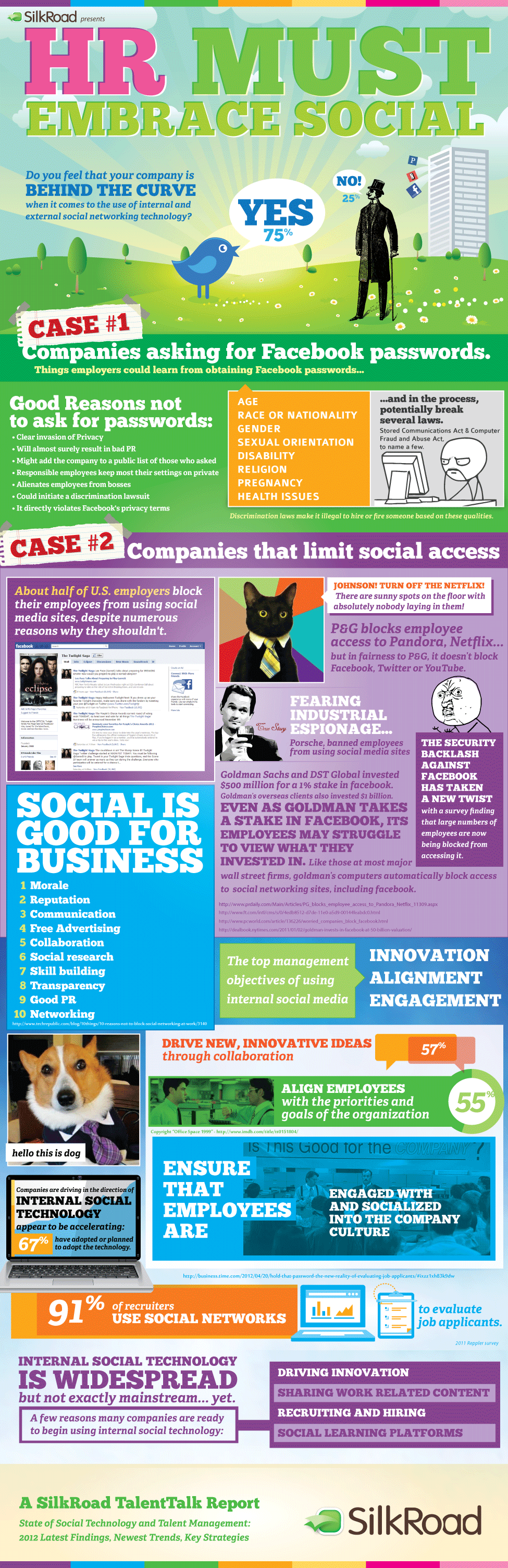
Social media and HR

Social media and HR

While social media is perfect for customer service and marketing, there’s a growing need for a company’s Human Resource (HR) team to be involved too.

I’ve written on ways HR can use social media in job searches, but that’s just one way. Increasingly, HR needs to be far more active in social media – from compliance to employee satisfaction at their jobs, and much more.

A new infographic from Compliance and Safety offers a multitude of reasons why HR needs to be more involved, along with examples of why it’s a good idea over a bad one.

Some of the statistics from the infographic include:

  • 91% of recruiters use social networks.
  • Almost half of U.S. companies block their employees from accessing social networks.
  • While Goldman Sachs invested in Facebook, it bans its employees from accessing the site.

There are some interesting takeaways from the infographic, but the key message (and one that all brands should be seriously thinking about) is workplaces actually become more effective and innovative if social media access is encouraged.

Don’t let your brand be one of the archaic ones.


From #HungerToHope – Supporting World Food Day

World Food Day

World Food Day

As bloggers, we talk a lot about the world around us.

We talk of the things that matter to us and our readers – marketing, knitting, Pinterest, motorbikes, etc. Anything and everything. And, for the most part, these blog posts do matter and is why we have readers.

Yet sometimes, we need to take a step back and really look at the things that matter. Like world hunger.

Consider these numbers:

  • 1 in 4 children in the developing world are underweight.
  • 1 in 6 people worldwide don’t get the amount of food needed to live a healthy life.
  • Hunger is #1 on the world’s top 10 health risks, killing more people than AIDS, malaria and tuberculosis combined.
  • 10.9 million children under five die in developing countries every single year.

Scary stuff, and while we know there’s a hunger and poverty problem, we often don’t know how bad a problem it truly is. And it’s not just in developing countries, either – hunger is a very real problem in first world countries, too.

While we won’t change this situation overnight, we can combat it through initiatives like From Hunger to Hope from Razoo. Even if you’re struggling financially yourself in these tough times, you can help raise awareness of the program.

  • Follow the official Twitter account @WldHungerRelief and tweet support messages using the #hungertohope hashtag.
  • Hop on over to the blogger resource centre and see how you can support across various social networks.
  • Change your profile pictures to support the official gravatar.

If you can donate financially, as little as $10 will provide a meal for 40 children, while $100 provides supplementary food to a child under 2 years old for 18 months of their life.

While we might disagree with each other’s political views, or religious views, one thing we should all be agreeing on is hunger chooses no political or religious sides. For that, we can all take a stand together and help end this tragedy in our lifetimes.

You in?

Social Influence and the Shift of the Carnegie Principle

Meet the social instigators

Meet the social instigators

When Dale Carnegie wrote the book on influence more than 75 years ago, he probably didn’t realize the impact he was about to make on society. Just ask the 15 million people that have bought the book since 1936.

But, more than just sharing some evergreen ideas on how people and ideas can really connect with each other, Carnegie also pioneered how we – as individuals – are perceived by others.

Swap that to social influence today, and brands are now looking to highlight those they perceive as influential, to market their services and products for them.

Whereas Carnegie looked to show you ways on how you could make friends quickly, get you out of a rut, and make you more effective all round, today’s influence is finding uptake with brands looking to (often) bypass the legwork that Carnegie advocated, and utilizing shortcuts instead.

These shortcuts mean quicker access to the many; identification of who can spread a message; and more cost-effective approaches to outreach programs and brand advocate partnerships.

This has led to the popularity of companies like Klout, Kred and PeerIndex, as well as niche offshoots like Reppify, Connect.me and Tawkify, to name but three. Each have their benefits, and proponents of these platforms highlight the importance of their place in today’s social media-led marketplace.

However, critics of the services point to today’s influence measurement being nothing more than activity based – the more you are online, the more you’ll be measured as influential, whether you encourage people to act on your activity or not (the dictionary standard of influence).

Perhaps the middle ground offers an insight into where Carnegie’s vision and that of social scoring metrics need to be.

Context

One of the most-discussed areas of influence in the current iteration of social scoring is that of context. As mentioned earlier, proponents of social scoring platforms point to activity being a valid metric – if you’re online a lot, you understand the nuances of the space and how it can be influenced.

Critics point to automated social feeds with little to zero engagement that – while enjoying a high influence score – would be rendered useless when it came to being an influencer to partner with in a social media campaign.

This is where the context argument plays its hand. By definition, context is:

… the interrelated conditions in which something exists or occurs.

By that definition, it’s the very thing that influence looks to do. By connecting the right people with the right brand, and sharing the right message to the right audience, the results should be favourable every time.

If the context of the message is right, and the relationship between the person and the product the message is promoting fits, then there is an immediate “belief” in the message being more than just a sales promotion.

Find the context, and the pieces of the influence bubble begin to come together.

Relevance and Readiness

If context is important, relevance is equally so (if not more so). You may trust the person/influencer sharing a brand’s message with you; you may even be the perfect audience (based on demographics and research) for that message and that product at that given time.

Until you hit the relevance angle.

  • Are you really in the market for this new product right now?
  • Are you financially available to be the customer?
  • Has your situation or taste changed since you last bought a product from this brand?
  • Are there external issues at play here?

The relevance to how ripe you are as customer is something that no influencer can bypass, no matter how much you trust them, or trust the message.

It’s why the social influence market is only just beginning to grow and mature. Activity may be an early barometer of someone’s potential to a brand and its audience – but there are far more pieces of the jigsaw puzzle to add.

Context, relevance and readiness are three – but even they’re just the start.

To truly mature the social influence – and, by association, the influencer – market, we need to remember how many aspects there were to Dale Carnegie’s seminal book and how they all had to be aligned to work their magic.

Then we can really start to move the social influence needle.

  • « Go to Previous Page
  • Page 1
  • Interim pages omitted …
  • Page 7
  • Page 8
  • Page 9
  • Page 10
  • Page 11
  • Interim pages omitted …
  • Page 38
  • Go to Next Page »
© 2026 Danny Brown - Made with ♥ on Genesis