• Skip to primary navigation
  • Skip to main content
Danny Brown

Danny Brown

podcaster - author - creator

  • About
  • Podcasts
  • Journal

Latest posts from Danny Brown

Enjoy the latest posts from Danny Brown, and feel free to add your own thoughts in the comments after the post.

Influence Marketing: Six Months On

Influence Marketing bookWhen Sam Fiorella and I sat down to write Influence Marketing, we had a very defined goal as to what we wanted to achieve.

This ranged from the tone of the book itself, to the reaction of readers, to the long-term goals for uptake of the book’s methodology.

With Influence Marketing having just “celebrated” its six month anniversary since its publication date, I thought it might be fun/interesting to take a look back and see how the book’s not only been received, but also how our original goals have fared.

Influence Marketing Commercial Success

While both Sam and I were very much focused on the reaction to the methodology we present in the book, along with how readers could implement it within their own businesses, a book still has to sell to make the publisher’s investment worthwhile.

By the end of the first week of launch, Influence Marketing had shipped its complete first print run. This took us completely by surprise – while we had high hopes for sales, we weren’t expecting such a response.

I think this can be attributed down to our pre-launch strategy.

  • We created a Google+ community where we hosted regular Hangouts on the topic of influence marketing with various leaders in the space.
  • We created a series of whiteboard videos, that shared our belief in how today’s definition of influence had to change, and put the focus back on the customer.
  • We stayed away from the typical “Buy X amount of books in return for…” strategy (although we did offer some incentives post-launch) and instead worked with organizations, Social Media Clubs, and influence marketing platforms on live events where the book’s methodology could be dissected.
  • We released a free sample chapter that showed just how deep we were diving into the influence marketing conversation.
  • We carried out a survey of more than 1,300 marketing and PR professionals on where influence is today and where it needs to go.

By doing this, we offered information and insights into where the conversation around influence was headed, versus pure promotion. For us, this less direct approach culminated in the first week’s results as well as ongoing sales.

We’re grateful that the book has continued to be well received, and last week reached #1 on Amazon Canada. So thank you for your continued interest!

Amazon.ca Best Sellers Influence Marketing

Influence Marketing Critical Success

As grateful as Sam and I were with the commercial response, it’s the critical one that was always going to be the measuring stick for us. Yes, sales were (and are) important – but sales can be inflated, with authors paying companies to help them make the New York Times Bestseller lists, for example.

Critical success – how the book is received by not only the target audience, but respected peers and publications in the industry – is, for authors, a more accurate reflection of how you met your goals.

Thankfully, we’ve seen some great results in this area too.

  • Nielsen BookScan recognized the book as one of its Top 100 Business Books in America.
  • Evy Wilkins, VP of Marketing for influence platform Traackr, quotes the book as having “…done nothing short of skyrocket the practice of influencer marketing from a misunderstood and poorly executed social media technique to a fully-fledged business necessity.”
  • The book has been picked up to be part of the curriculum at the likes of Georgetown University in Washington, U.S., and Seneca College in Toronto, Canada.

Georgetown University and Influence Marketing book

In addition, reviews on the likes of Amazon and blogs have universally alluded to the educational approach the book takes, versus a more Marketing 101-type approach that provides anecdotes and theory versus real-life empirical evidence and results.

  • “This book is a serious read and hands down the best of any of the social media books I have read to date. Danny and Sam provide facts, case studies, examples, charts, data and concepts that will likely cause a shift in the way the reader thinks about influence marketing.” Christine DeGraff.
  • “This book went further into brand building and sales acquisition than I could have possibly imagined. This will be part of my favourite ‘evergreen’ books because, in the end, this book will be relevant for many, many years to come.” David Boozer.
  • “This is a deep read that’s not for the faint of heart. Bring coffee and plan to stay awhile. However, the result will be enlightenment regarding influence marketing that goes beyond a [social] score…” Brian Vickery.
  • “This book provides fantastic analysis and details for deploying social influence models that deliver the right results. Some may think the analysis is too academic but I disagree – the world of marketing and social media needs deeper thought [and substance]. The substance included in Influence Marketing will see the book have a shelf life of several years.” Brian Hansford.

While it might seem contrary to what authors should say, both Sam and I love hearing folks saying the book is a hard read, because it should be. Influence marketing – and marketing itself – and understanding your customers takes hard work, research, and in-depth execution and measuring.

The fact this has been picked up by readers of the book is validation for Sam and I’s approach to how we wrote the book, and kudos to our publisher for allowing us to take this route versus making it a simpler read for the mass market.

Influence Marketing and What’s Next

However, this is just the start of the ongoing influence marketing conversation. While the book was the instigator of this conversation, the real “work”, if you like, is only just beginning.

We’ve seen influence platforms begin to adapt our methodology and, with the book being picked up to be used as part of academic curriculums, the next generation of marketers will be taking that methodology forward into new areas of implementation and discussion.

In the meantime, this website – and the various communities around it – will continue to be a living resource for the methodology and long-term goals of the book – to move influence marketing beyond just social influence and amplification, and into customer acquisition and real business ROI.

Coming soon, we’ll be presenting a very special webinar/workshop series with partners that are moving the influence conversation forward. We’ll also be sharing more whiteboard videos, as well as creating a resource that offers which platforms are really driving influence forward, to help you make the right decision for your needs.

Both Sam and I sincerely thank you for all your support so far – it means more than you can imagine, so thank you. Here’s to the next stage.

5 Reasons Why You Need to Be Mobile Ready for 2014

Mobile advertising

Despite statistics to the contrary, many businesses continue to ignore the need for mobile solutions when it comes to their customers.

On this blog alone, I’ve shared why you need a responsive design for your site; how mobile was already starting to be a major player back in 2012; and how design trends are being shaped by the mobile customer.

Across the web, there are countless articles and presentations that share why the imminent future is mobile and how to initiate and track mobile marketing and advertising. So, yeah, mobile is pretty big.

And yet there are still some businesses that seem to be happy to rely on desktop visits and interactions, regardless of the preferences of their customers. While this is entirely their prerogative, it’s also potentially dangerous thinking, as a recent joint study between Google and Nielsen shows.

1. Mobile and the Research Stage

As Sam Fiorella and I talk about in the Influence Marketing book, understanding where your customer is in the purchase life cycle is key to understanding what message needs to go out to them, and how it should be delivered. Unsurprisingly, with the uptake of mobile browsing, research is a key action for mobile customers.

Mobile research

  • Mobile consumers spend more than 15 hours a week researching products, deals, services and more;
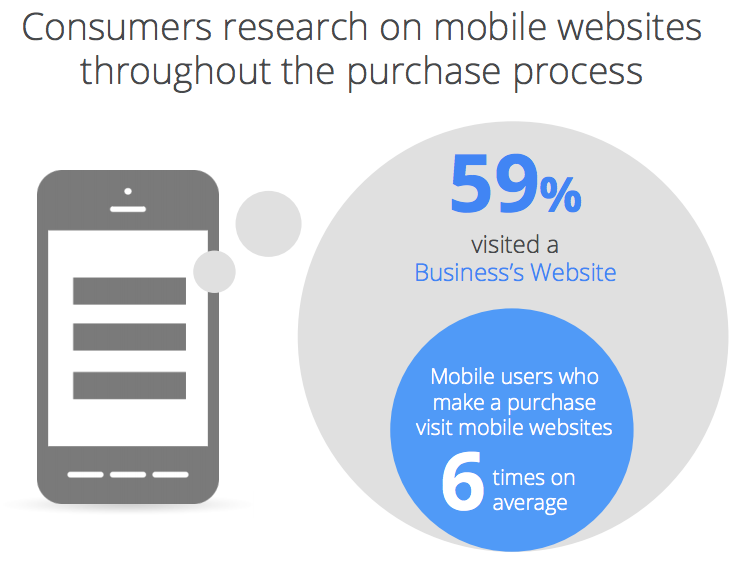
  • 59% visited a business’s website;
  • It takes up to 6 visits to a site for a mobile consumer to make a purchase;
  • Mobile web browsing is almost on a par with mobile app usage (7.3 hours per week for the former, 8 hours per week for the latter).

These are just some of the basic statistics around mobile browsing when it comes to the research stage. Taking a look at the figures, more than half the mobile audience visit sites on their phone, and make return visits to confirm/validate product research on your brand elsewhere.

If you’re not making it easy for your customers to carry out these actions, you’re simply turning them away to a competitor who will.

2. Mobile and Search

Tying in naturally with the usage of mobile for Research is the action of Search. Despite the fact that mobile web browsing and app usage accounts for a good percentage of consumer habits around your brand when it comes to research, mobile search still leads the way.

Mobile search

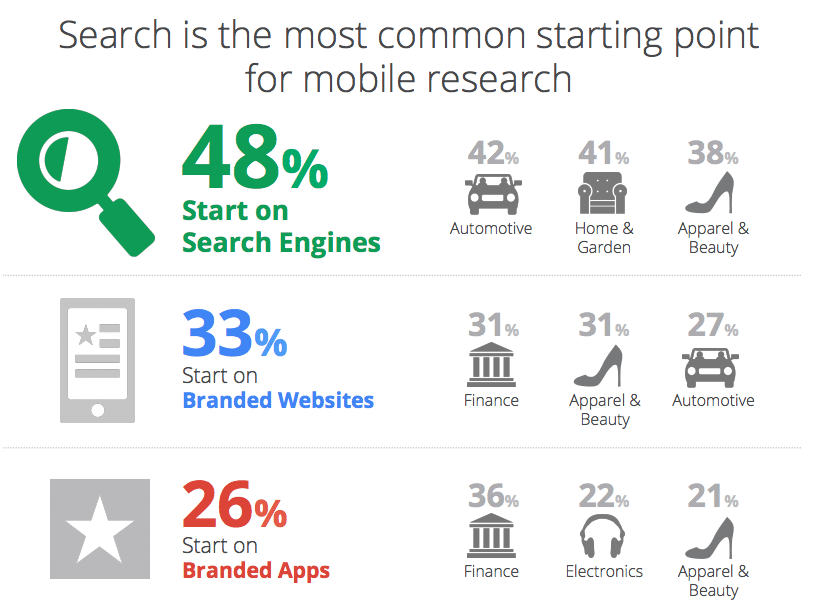
  • 74% of consumers used a mobile search engine in the overall shopping process;
  • The breakdown of mobile search versus corporate branded properties (site or app) sees mobile search lead with 48%, compared to 33% on business sites and 26% on mobile apps.

This not only helps brands answer the question of whether they should have a mobile optimized site or app, but also how they should be planning out their mobile ad and marketing campaigns when it comes to raising brand awareness at the point of search.

3. Mobile and GeoLocation Benefits

There’s been a bit of a backlash against geolocation marketing in the past 12 months or so. Platforms like Foursquare and Facebook Places have come under fire, with many questioning the benefits of mobile check-ins at physical locations and if they drive any real benefit.

While there might be some merit to this form of geolocation, today’s mobile consumer wants to know that a researched location is local when it comes to actual purchases.

Mobile geolocation

  • More than 2/3 of consumers (69%) expect a business to be within 5 miles of their radius when carrying out a search;
  • 10% actually expect businesses to be within just one mile;
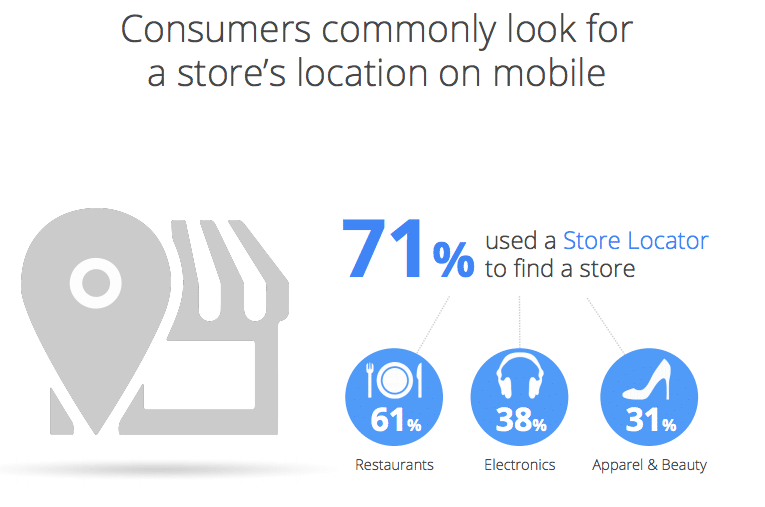
  • Store locator details on websites and searches are key, with 71% using this feature to locate their nearest location.

While both Foursquare and Facebook have mixed reviews when it comes to their geolocation services, the point is people are looking for businesses and services based on location and proximity. Having Foursquare Ads tied into geographical searches is one way for local businesses to benefit.

And with Google’s continued evolution of its search algorithms, its own Google Places for Business solution is expected to play an even bigger part for logged-in Google Apps users when using mobile search.

4.Mobile and the Immediacy of Purchase

Perhaps the biggest takeaway from the report, and one that every business should consider, is the way customers are adapting their purchasing decisions based on mobile usage.

Given that research and validation by peer reviews across social networks are now just a finger swipe away, consumers are far more immediate when it comes to purchases instigated by mobile search versus desktop browsing.

Mobile immediacy

  • Within an hour of validation (research, search, peer recommendation), 55% of consumers will make (or want to make) a purchase;
  • As many as 83% will make (or want to make) a purchase within 24 hours.

So, more than half of your potential target customer want to be at your store within an hour, and another 30% want to shop with you the next day. Do you really want to be the business that’s turning this away?

5. Mobile and the Point of Purchase

If the above statistics aren’t starting to paint a pretty graphic picture of how mobile is driving consumer behaviour, then you might as well ignore the following data, since clearly your business is one that doesn’t see the bigger (and smaller) picture of why mobile is so key to your future strategy.

If, however, you’ve been starting to take notes on how to get the right team to start implementing your mobile strategy, this one’s for you.

Mobile purchase

  • Despite mobile browsing accounting for the majority of research and validation, most purchases are still made in-store, with mobile driving up foot traffic for those businesses with a strong mobile strategy in place;
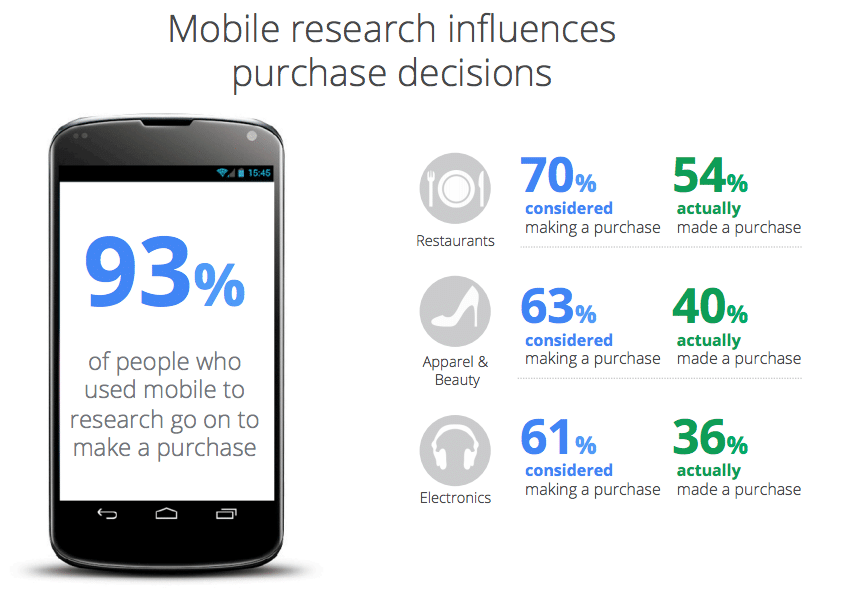
  • 93% of mobile searches and research result in a purchase of a product or service;
  • When it comes to purchasing, 82% purchased directly at a physical storefront, 45% waited until they were online via desktop or tablet, and 17% made a purchase there and then on their handset.

Make no mistake – mobile drives business as well as traffic.

What This Means for You

As I mentioned (perhaps rather glibly) at the start of point five, if you’re not considering a mobile strategy now, and these statistics don’t encourage you to consider one, then you may find yourself starting to fall behind next year and beyond.

It’s clear that mobile is fast catching up on “traditional browsing” when it comes to the key points of purchase decision-making: Awareness, Research, Validation, Intent, Purchase.

With consumers increasingly spending more time on mobile, as well as making purchases almost instantaneously upon validation, it’s not so much a question of whether businesses should consider whether to have a mobile strategy.

Rather, it should be how much of a mobile strategy is needed. The clock on that question is ticking – and the countdown has already begun.

The Nielsen/Google study was carried out across nine different verticals: Restaurants, Food and Cooking, Finance, Travel, Home and Garden, Apparel and Beauty, Automotive, Electronics, and Health and Nutrition. There were 950 participants, and each user had to be over 18 and have made a purchase within one of the verticals in the previous 30 days.?

images: Nielsen/Google

The Sunday Share: Nail Content Writing and Inspire Your Readers to Respond

5 years blogging dannybrown.me

Content marketing

As a business resource, Slideshare stands pretty much head and shoulders above most other content platforms.

From presentations to educational content and more, you can find information and curated media on pretty much any topic you have an interest in.

As a research solution, Slideshare offers analysis from some of the smartest minds on the web across all verticals.

These include standard presentations, videos, multimedia and more.

Which brings us to this week?s Sunday Share.

Every week, I?ll be sharing a presentation that catches my eye and where I feel you might be interested in the information inside. These will range from business to content to social media to marketing and more.

This week, a presentation from Barry Feldman, president of Feldman Creative.

As content continues to become an ever-increasing part of any brand’s outward strategy, this presentation shares?how to prepare, plan and pen some seriously hot content and inspire your readers to act.

Enjoy.

The Assumption of Dumbing Down the Message

Who cares

The Starsville Saga by Jaclyn Aurore

This is a guest post from my wife Jacki. She’s the author of Starting Over and Standing Up, the first two books in the Starsville Saga. A version of this post originally appeared on her blog, but I wanted to share it here as I feel the question of definition, and the assumptions we make when it comes to dumbing down our own messages, transfer well to business and marketing in general, as well as our own blog communities.

Starting Over and Standing Up, the first two books in the Starsville Saga,?are currently listed in the Young Adult (YA) genre.

As the saga progresses, the characters get older and deal with more mature things. The last book in the saga?will be in the adult genre, meant for ages 18+.

I?m not sure how the audience will react to that, but I wrote my characters the way I thought I should.

They go from junior high, to high school, to university and adulthood. I hope my audience will grow with them.

I?ve been told that Starting Over and Standing Up should be in mixed genres for the following reasons:

  1. The main character is a child.
  2. The characters have dark back stories that are too deep for young adults to understand.

I tend to disagree with both of these things.

First, the main character starts telling her story at the age of 13, but the books take place over the course of four years. Second, I believe that there is nothing too deep for the YA audience to understand. Sadly, too many people can relate to these dark issues.

YA is one of the genres I like to read for its simplicity. It doesn?t take the author 300 pages to describe the sunset. The sunset is what it is, and for that I?m happy. In general though, I find there are three types of YA authors:

  1. The authors that dumb down content for their YA readers.
  2. The authors that dumb down vocabulary for their YA readers.
  3. The good authors.

Maybe Starting Over and Standing Up deal with some darker issues, but I?m not going to dumb it down. I?m also not going to write condescendingly.

I write the way I speak. So whether you are 14 years old or 40 years old, my language will remain consistent. Minus the profanity.

I hope that’s okay with you.

Young adult fiction writer Jaclyn AuroreAbout the author: Jaclyn Aurore is the author of young adult fiction?books?The Starsville Saga:?Starting Over,?Standing Up,?Giving In,?Hanging On,?Leaving Behind, and the stand alone fantasy,?My Life Without Me.?Her books have been described as ?Wonderfully human?, ?Evokes the awkwardness of teenage life perfectly?, ?Heart-wrenching and heartwarming at the same time?, ?Twilight without the vampires?, and ?Nothing at all like Twilight?. You can read more from Jaclyn on her official website.

The Sunday Share: Writing for the Web, It’s Not the Same!

As a business resource, Slideshare stands pretty much head and shoulders above most other content platforms.

From presentations to educational content and more, you can find information and curated media on pretty much any topic you have an interest in.

As a research solution, Slideshare offers analysis from some of the smartest minds on the web across all verticals.

These include standard presentations, videos, multimedia and more.

Which brings us to this week?s Sunday Share.

Every week, I?ll be sharing a presentation that catches my eye and where I feel you might be interested in the information inside. These will range from business to content to social media to marketing and more.

This week, a presentation from e-Business and digital marketing lecturer, Charles Crouch.

Online the medium, reading habits and ease of use are all different. Writing the same way as for a magazine or book will not work. This presentation covers what to know before you start, creating compelling content, making content easy to skim and understand, meaningful graphics, and appropriate language.

Enjoy.


  • « Go to Previous Page
  • Page 1
  • Interim pages omitted …
  • Page 74
  • Page 75
  • Page 76
  • Page 77
  • Page 78
  • Interim pages omitted …
  • Page 283
  • Go to Next Page »
© 2026 Danny Brown - Made with ♥ on Genesis