• Skip to primary navigation
  • Skip to main content
Danny Brown

Danny Brown

podcaster - author - creator

  • About
  • Podcasts
  • Journal

Latest posts from Danny Brown

Enjoy the latest posts from Danny Brown, and feel free to add your own thoughts in the comments after the post.

Why We Should Make More of What We Do An Experience

Create an experience

In 2001, I went backpacking around the West Coast of Australia for six months. I was 33 at the time.

This wasn’t a journey that I had to take to “find myself”. Instead, it was just about taking the time to make an experience. I’d been telling myself since I was 19 that I was going to go backpacking, but never did it.

Coming out of a relationship at the time, and with no ties to bind me, I thought, “Fuck it – I’m going to do this before I get much older.”

So I did. And it was everything I expected, and more.

I stayed away from the typical tourist traps and roads, and used my connections over there to trek around the best places for people who wanted to live life and experience it at the pace it was meant to be experienced.

For six glorious months, I probably interacted with less than 30 people.

I was able to look at night skies and enjoy what they’re meant to look like, versus the smog-ridden versions we have today. I was able to swim, fish, camp, break a couple of [minor] bones, and feel what life is like when you want to experience it, versus just existing in it.

And I wonder why we don’t do more of that today.

Life Moves Pretty Fast…

In his 1986 classic Ferris Bueller’s Day Off, director John Hughes shared one fantastic day in the life of uber-schoolkid Ferris Bueller. The movie delivers?a great line from the title character early on:

Life moves pretty fast. If you don’t stop and look around once in a while, you could miss it.

From that premise, the movie follows Ferris, his best friend Cameron, and his girlfriend Sloane as they skip school and take a trip around Chicago. Among many stand out-moments is a scene where the three end up at the Art Institute of Chicago.

As life goes on around him, and Ferris and Sloane catch a quiet place to kiss, Cameron finds himself in front of artist George Seraut’s A Sunday Afternoon on the Island of La Grande Jatte.

The overriding message in this scene is one of living an experience. In an interview, Hughes explains the inclusion of the museum scene as “…self-indulgent. It was a place of refuge for me, I went there quite a bit, I loved it. I knew all the paintings, the building. This was a chance for me to go back into this building and show the paintings that were my favorite.”

It’s this feeling of escape, and refuge from all the issues Cameron has in his relationship with his father and where he sees himself in life, that makes this particular scene such an experience in the movie – at that moment, we feel Cameron’s solitude, his hopes, his fears, his life.

While we may not follow the same path as Ferris and his companions in experiencing one crazy day in Chicago – and if you’ve never seen the movie, get out and find it now! – we should be making experiences every single day.

The Fallacy of Too Busy

Of course, any time you mention taking the time to make an experience, there’s always the usual push-back.

  • I’m too busy
  • I don’t have time as it is
  • I can’t afford to do that
  • That doesn’t sound like me

None of them are real reasons, though – they’re simply excuses based around the fallacy of being too busy.

[clickToTweet tweet=”It’s much easier to fall back on busyness than it is to stop and live, right? Wrong.” quote=”It’s much easier to fall back on busyness than it is to stop and live, right? Wrong.”]

My wife made a great point to me the other week when I said I wanted to work out, and get healthier, but I just don’t have the time.

My commute sees me travel four hours every day, and so when I get home it’s usually play with kids, have dinner, play with kids some more, put kids to bed, spend some time with my wife, and then have my own time to do stuff. At which point sleep is usually a persuasive friend.

So, yes, I’m too busy. Except I’m not.

As my wife pointed out, if I really wanted to, I could make exercising part of playtime with my kids. We have a cool little leg workout machine where you stand on two “steps”, and move your legs apart and back in on rollers. I could do that while my kids count the steps, and maybe even throw things back and forth at each other.

I could sit at my desk and use the little arm and wrist workout thing my wife has, while reading blog posts I want to catch up on, or when watching Netflix with the kids.

There are many other things I could do – I simply choose not to, through the belief that I don’t have time to do it. It doesn’t even cost any money – we have the equipment, it’s not as if I need to pay gym fees to be healthier.

So, yes – all the reasons we give to not do are pretty much meaningless. It’s just we don’t want to admit as much, because that would mean we need to have experiences.

The World Doesn’t Know Us

Another reason we don’t want to try and experience life more, and have moments that last a lifetime, is the Fear of Missing Out syndrome, or FOMO.

We believe that if we take a day from life’s everyday humdrum, and do something for us, we’ll miss something important. Someone else will get that promotion we’re after; someone else will get that special deal we’re after; someone else will steal the girl or boy our hearts are after.

In short, someone else will do something or gain something that should have been ours, because we weren’t there.

But let’s think about this and compare.

  • Someone else gets that promotion because they’re more qualified. The extra stress that promotion would have brought you because you weren’t ready isn’t there, and your health and relationships are better because of it.
  • Someone else got that special deal you were after. So what – did you really need that thing that was so specially priced, or were you buying it because the price told you you needed it, as opposed to truly needing it?
  • Someone stole the target of your affection’s heart before you. This sucks. I’ve had this happen many times. But then I thought, If I was so right for that person, why wasn’t the feeling mutual? Love-filled hearts are two-way – did you really miss out?

We often have such an important view of our place in the world, and yet we don’t take any time to actually make ourselves a part of that same world.

We tweet, we post updates on Facebook, we make Vines of how cool our lives are, we Instagram perfectly-caught moments in time – and yet they’re more often than not a vision of who we wish we were.

If they were truly how we are, why does Instagram have so many filters to get our picture in a perfect light?

We have an inane fear of missing out through not being where we need to be (or so we believe), but in reality it’s us that’s missing out on the world.

The world isn't missing out on us; we're missing out on the world.

Add Flavour, Savour and Enjoy

In about six weeks, my son Ewan turns five.?Five.

I have no idea how he got there so fast. I was watching some old YouTube videos of him when he was my daughter’s age (she’s three), and it struck me how quickly the time has passed between then and now.

Then, he was a stumbling, finding-his-balance not-quite-baby-but-not-quite-little-boy. Now, he’s a confident little boy that doesn’t seem so little.

He has great friends and play dates. He gets dressed himself. He can get his own breakfast. He knows how to switch on the Xbox One and work it with voice-commands. Simply put, he’s independent and thinks for himself.

Yes, he still needs mummy and daddy for the important things, but he’s his own little person. And it’s great to see.

It’s also a reminder that these halcyon years will soon be gone and, while they’ll be replaced with new memories and experiences, the ones we can create now shouldn’t be put off.

The email I’m crafting can wait to give a hug. The image I’m searching for a blog post can wait for kick ball. The cleaning I’m going to do can wait until after the trip to the park while the weather allows. The newspaper can wait and be replaced by sitting on the sofa reading books.

All these little experiences we can make now. And not just little ones. We can take a train trip; draw silly pictures on our driveway; make a project out of the backyard where the kids can build their very own play area to their liking.

We can build memories.

Even for ourselves, we can do this.

  • We can hold our loved one’s hand for the simple act of doing so connects us.
  • We can smile at a stranger for the simple reason warmth is better than blindness.
  • We can sit on a hill, close our eyes and enjoy the breeze on our face.
  • We can make a meal we’ve never made before and ruin it, and smile at the failure, because who cares?

We’re building memories. We can add flavour to these memories, to make them uniquely us, and we can savour them for as long as it takes to satiate us. We can experience what it actually means to be, versus the belief of what’s meant to be.

We just need to slow down and see where that experience begins.

The Future of Content Part 4: The Return to Pure Blogging

Blogging success

As content continues to become an ever-important staple for businesses of all shapes and sizes, I thought it?d be interesting to share some thoughts on what the future of content might look like.

However, instead of sharing just my own thoughts, I wanted to bring you what the future of content looks like for some of the folks I look up to and respect in this space.

This mini-series will bring you some of the web?s most critical thinkers when it comes to content ? hopefully you?ll enjoy reading as much as I did, and these thoughts will spark ideas of your own on what the future of this thing we call content looks like.

Today?s topic is the question of “Pure Blogging”.

I’m seeing more and more content creators push back on the Buzzfeed Economy and actually want to create, and partake in, meaningful content and discussions. Focusing on content, not shares; interactions, not reactions; making people think, not thinking for them.

In essence, returning to pure blogging when it comes to their content.

[clickToTweet tweet=”Pure blogging is the focus on content, not shares; interactions, not reactions. #blogging” quote=”Pure blogging is the focus on content, not shares; interactions, not reactions. “]

Sharing their thoughts on this topic are Amy Vernon, David Kutcher, and Tonia Ries, and our round table is powered by social conversation platform ReplyAll.

If you have a question you’d like to ask the panel, drop it in the comments below and I’ll share with the guests. And if you want to be sent the transcript of?the full conversation, you can click the subscription option at the bottom of the ReplyAll conversation box.

Enjoy!

Other posts in this series:

  • The Future of Content Part 1: with Clay Morgan
  • The Future of Content Part 2: with Lisa Gerber
  • The Future of Content Part 3: with Richard Becker

Does Your Blog Really Need to Provide an RSS Feed Anymore?

Back in 2010, I published a blog post about the choices bloggers gave?when it came to how readers consumed their content.

The gist of the post was simple: should it be via RSS, or email?

My own take was bloggers should offer both (remember, this was at a time when RSS was still the #1 choice for bloggers to distribute their content). In the comments section after the post, the majority of commenters thought email was the better option too.

– I?m with you 100%! The blogs I never, ever want to miss (including yours) are ones I subscribe to via email. In addition to making sure I don?t miss anything this also allows me to read at my leisure and if I get swamped for a week or so I know which posts I still have to read. Michelle Mangen.

– Maybe it?s the Boomer in me, but I only read?on a daily basis?the blogs of those to whom I can subscribe via email, or perhaps on a blog roll. I realize, of course, that I may be missing out on some good reads; but the blogger is missing me as a subscriber. Ken Jacobs.

Even back then, both bloggers and readers were seeing the value of email, and (perhaps) the diminishing return of RSS. The thing is, though, it didn’t seem to matter – Google Reader was king and RSS feeds were the currency of any blog worth its salt.

Man, how times do change.

Alas, Google Reader, I Knew Thee Well

In March 2013, Google announced it was closing down its Reader service. For most content creators who had built a healthy subscriber base via RSS, this came as a bit of a shock.

In Google’s own words, however, perhaps it shouldn’t have been as big a shock.

We know Reader has a devoted following who will be very sad to see it go. We?re sad too.?There are two simple reasons for this: usage of Google Reader has declined, and as a company we?re pouring all of our energy into fewer products. We think that kind of focus will make for a better user experience.

When the company behind the leading RSS solution says use of its product has declined, you know it marks a change in how we, as readers, consume content. Perhaps it’s the other part of the statement that says more, though: “We think that kind of focus will make for a better user experience.”

As a long-time user of Google Reader, both as a provider of content and a consumer of one, the user experience was a major pain in the ass. Yes, you could create folders based on topics and categories, but if you subscribed to a lot of blogs, even that minimal filtering option soon became overrun and clunky.

As content moved into a cleaner, richer experience – both on the web and (increasingly) on mobile – RSS feeds and the way they’re curated became less attractive.

For me, I’d even say RSS feeds are pretty much redundant, and not worth the effort of trying to grow.

Email = Investment, Trust and Loyalty

Think about the one area you spend most of your day, personally and professionally. It doesn’t matter what job you’re in, or what social media channel you prefer over the other, or what smartphone you use – the one thing we all have in common is email.

Our inboxes rule us. Whether it’s getting notifications about a friend’s update on Facebook, or confirming tickets, or replying to a question that can’t wait until you get to the office, our email inbox is still the most-used direct communication tool we use.

It’s one of the reasons I switched my commenting solution (and soon-to-be subscription solution) to Postmatic. If it doesn’t matter where and when people are accessing email, because it’s second nature and easy to do, doesn’t it make sense to use that as your primary content distributor, conversation starter and loyalty builder?

Why would you want to continue using a clunky, increasingly-irrelevant piece of technology like RSS feeds that offer less value and less return for your content investment?

Looking at my own analytics for the last 30 days, I had just under 16,500 sessions (Google’s new name for visitors). Of that, guess how many came via RSS? 10,000? 5,000? 1,000?

Chance would be a fine thing. What I actually got, you can see below.

Danny Brown RSS

A whopping 335 sessions, or just over 2% of all traffic for the 30 day period. Worse still, the bounce rate is atrocious – RSS readers are simply reading the article and leaving my site (when/if they actually visit).

While I’ve never really used my blog as a lead generator (so I’m not particularly bothered about bounce), for any content creator looking to use their blog as a business creator, that bounce rate would be a major stumbling block.

What makes this lack of traction stand out more is when you look at some of the other traffic drivers – in particular, Twitter (which is ironic, given a recent article about Twitter’s own lack of value for traffic).

Even in the image above, you can see automated Twitter feeds (where blog posts are aggregated by RSS-to-Twitter) accounts for almost the same amount of traffic as a dedicated RSS solution like Feedly.

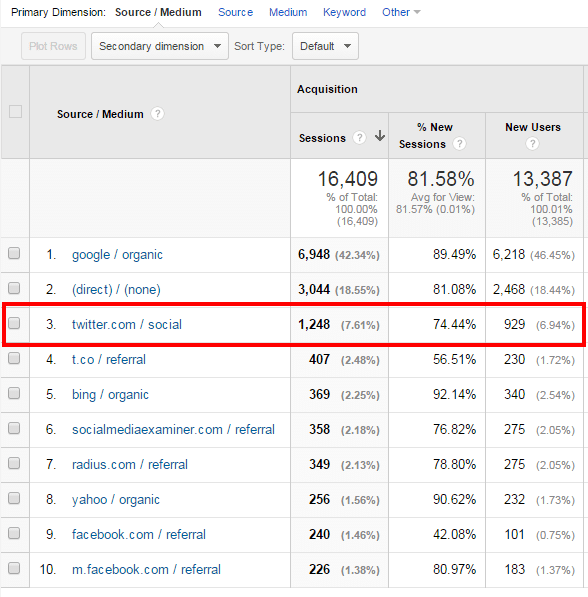
When you dig a little more into the analytics, you can see Twitter actually blitzes RSS out of the water.

Danny Brown Twitter

Direct traffic from Twitter accounted for almost 1,250 visits – almost 10x the amount from my RSS subscribers. Add in the indirect traffic using Twitter’s link-shortener, and you can see why Twitter is a better RSS solution than actual RSS feeds themselves.

In the direct stats, almost 2,500 of the 3,044 total is from my email subscribers – beginning to see a pattern? If you want quality traffic and trust in your content, RSS is not going to get you it.

RSS = Really So-over-it Syndication

Okay, it’s a play on words for what RSS actually stands for (Really Simple Syndication), but for me personally so-over-it would be a better choice of words.

Anyone can subscribe to an RSS feed. One click of the mouse, done. And (more usually than not) forgotten. When I stopped using my reader account a few years back, I kid you not – I must have had about 500+ blog feeds in there. Do you think I regularly visited them all?

Hell no – as Michelle Mangen mentions in her quote at the beginning of this post, the blogs I wanted to really subscribe to were done by email – and that’s been the way I’ve subscribed for the last 4-5 years.

There are multiple benefits to this:

  • Like I mention, anyone can subscribe by RSS. Doesn’t mean squat. Giving someone your email address, though, and trusting them not to take advantage of that? That’s the kind of investment you want in your content.
  • Email subscribers are more adaptive to change. When I recently changed my email and RSS subscription methods, I shared an update post via both email and RSS. 81% of my email subscribers updated their subscription – 81%. Guess how many RSS subscribers updated their feed? 9% – quite the difference.
  • The best relationships are those one-to-one interactions you get when someone replies to your blog post with an email about how it made them feel. I’ve had some of the most personal and powerful conversations via email after a post has gone live – RSS could never hope to achieve that.
  • When Google Reader closed its doors, I lost 6,500 subscribers overnight. 6,500! Now, given, many of them may not have visited anyway, but you take away 60% of a blog readership overnight and see what happens. Another reason I refocused my energy into email.

Content is changing. How we consume content is also changing. We don’t need “traditional” RSS anymore. We have social channels, as well as sites like This. and Flipboard, to aggregate and syndicate.

But they’re all external, and you’re competing for space with thousands of other like-minded souls. Email, on the other hand – you have these eyeballs, and they’ve chosen you over the competition already.

Now might just be the time you consider dumping that good old blog RSS feed for good or, at the very least, stop promoting it as an option to subscribe (you’ll see that I only offer email subscriptions in the box below this post).

After all, is it really doing you any good?

A version of this post originally appeared on the Wood Street Inc. blog.

When Your Five Year Old Son Asks If You’re Not Happy With Him

Ewan and Daddy summer

The other day, my five year old son Ewan came up to me, looked me in the eye, and asked me if I was happy with him.

This was after I’d told him off a little earlier for not listening and continuing to play with his toys after I’d asked him to clean up with Salem, his three year old sister.

This particular task is like a mental tug of war, with both kids starting the clean up process and then invariably getting distracted by the primary reason toys were invented – to play with them.

So then we get into the back and forth that I’m sure any parent must recognize:

Me: Clean up, please.
Kids: Okay. [Cleaning starts, two minutes later the kids are playing again]
Me: Clean up please, this isn’t cleaning.
Kids: Okay! [Cleaning resumes, now it’s down to one minute before playtime takes precedence]

This goes on for a couple more exchanges, at which point parenting takes over and leniency of play while cleaning takes a backseat.

This is usually followed by a raised voice, with a different tone, and the kids realize that daddy (or mummy) means business. So, they clean, but you can see they’re a little crestfallen (for want of a better word).

And you, the parent, take no victory in getting your kids to clean because now you’ve also made them sad.

It was after one of these recent battle of wits that Ewan asked the question about me being happy with him.

The Truth and Explanation Often Don’t Mix Well

As parents, my wife Jaclyn and I want to raise our kids knowing the very clear difference between good and bad.

We also have a very “open parenting” mindset where our kids aren’t tied to gender-specific toys and dress-up. If our son wants to play with his sister’s dolls,?or wear a Princess dress, he can. If our daughter wants to play with our son’s Avenger toys, or wear his stuff, she does.

We also want our kids to challenge us, and not be afraid to ask “Why?” when they need to do things, or when they don’t understand why we took specific actions.

In short, we’re trying to allow our kids to just be, and not conform to what certain parts of society tells kids they should be.

Part of that means we often sit down and explain things through, until (hopefully) our kids understand the reason behind certain things, and can take that and learn from it and put to use in their own lives away from the home (school, daycare, friends’ houses, etc.).

But how do you explain to a five year old the difference between “happy” as in behaviour-wise, and “happy” as in how wonderful life is now you’re in the world (sorry for paraphrasing, Elton!)?

Sure – you can try:

Sorry, Ewan, right now I’m not happy with you. I asked you to do something, and you didn’t. You didn’t listen, and you kept doing things you weren’t meant to be doing at that time. So, no, I’m not happy.

Because how long does that unhappiness last? We, as adults, know it’s temporary. And we, as parents, can tell our kids, “Okay, we’re happy with you again.”

[clickToTweet tweet=”How do we explain to children the difference between not happy right now and unhappy full stop?” quote=”How do we explain to children the difference between not happy right now and unhappy full stop?”]

But what if there was no definitive action to make us happy?

For example, the mess was still left until after dinner, and your child said something so amazingly sweet at the dinner table that made you happy, and your subsequent smile tells your child you’re happy – does that now negate the “unhappiness” you had over the lack of cleaning up?

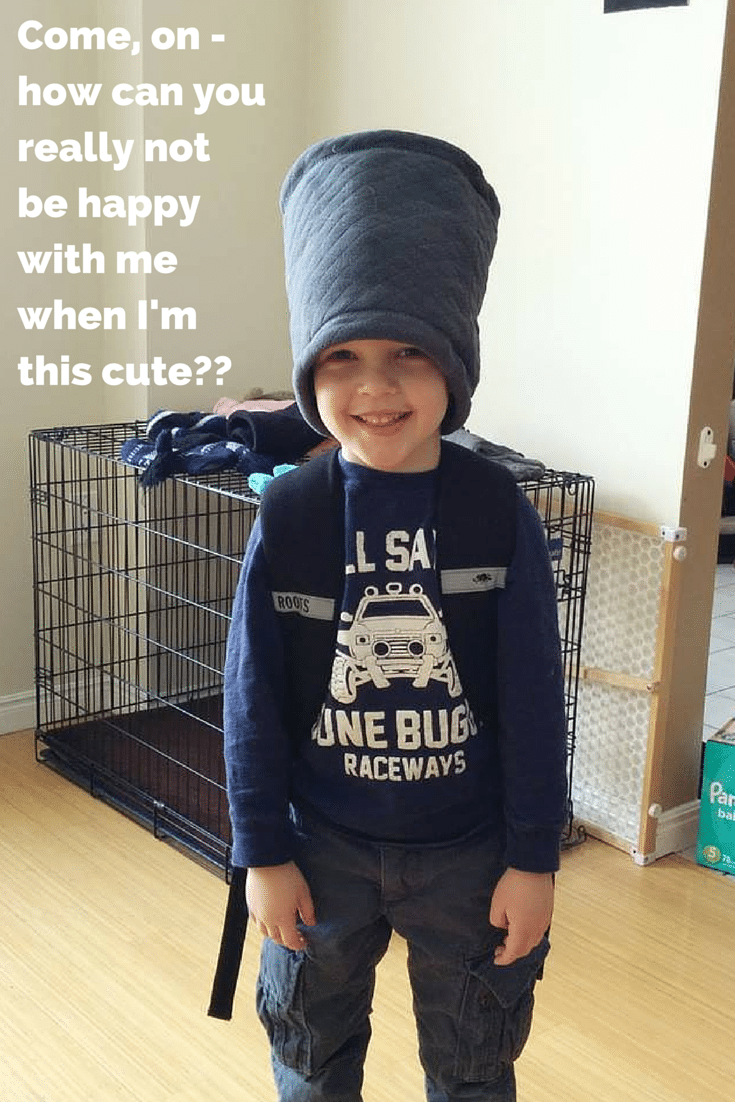
Come, on - how can you really not be

And how much does a five year old really understand and differentiate anyway? I’m no psychologist, and I’m an extremely proud parent at how smart my kids can be, but how much are they really taking in and retaining at three and five?

So, the explanation becomes a soundbite and the worry of unhappiness remains.

Am I Breaking My Son?

Of course, then there’s the follow-up to that.

If I’m trying to explain my unhappiness and why I’m not happy at Ewan, and he nods to understand but all he knows is that daddy is unhappy, and not that it’s a very, very small percentage compared to the happiness he invokes in me all the time,?am I breaking my son’s heart and spirit?

Even if I feel I’ve done the best job I can at explaining, and even if I ask Ewan if he understands why I’m not happy at that very specific moment in time, is he really understanding that I could not be happier that he’s my son – I’m just not happy at his actions?

I grew up in a household where my stepfather was an asshole, which (I think) contributed to me taking a path where I was a little shit in my early years. It was only though making changes that saw me “recover”.

Because of that, I want to make sure my own kids never have to worry about how their mum and dad feel about them. To make sure they know they’re loved, and they can grow the way they want to grow, and know it’s okay to mess up.

But if I can’t explain the difference between “not happy right now at your actions” versus “not happy with you”, will that message even come through?

Of course, I know you keep explaining, keep explaining, and keep explaining through words, actions and understanding, and that differentiation will appear.

As a marketer, though, I just wish there was an analytics program like Google Analytics for you to understand your kids’ behaviours – man, how that would make life a whole lot easier!

How about you, fellow parents – how have you approached this “landmark”? This dad is all ears.

52 Content Marketing Experts Share Their Top 100 Content Tips

Content tips

What made you click through to read this post (unless you’re reading this via RSS and already know what’s coming)?

Was it because you’ve read other posts of mine, and trust me to deliver on the premise shared wherever that might be? Was it because someone shared it on Twitter, Facebook, etc., and you trust their shares, so you automatically share too?

Or was it because of the headline, and the easy quick-fix yet often vapid information that headline suggested?

If it was any of the above, you’ve just been suckered – yet we allow ourselves to fall for this kind of click-and-bait trap all the time.

I Clickbait, Therefore I Am

Back in July 2013, leading inbound marketing and analytics company MOZ published an article titled 5 Data Insights Into the Headlines Readers Click.

In it, some interesting – and, to a large degree, sad – stats were shared.

  • On average, 8 out of 10 people will read headline copy, but only 2 out of 10 will read the rest (I wonder how many 8/10’s shared this post based on the headline…).
  • Traffic can vary as much as 500% based on the headline, according to traffic results from viral video site Upworthy.
  • 36% of readers preferred to click headlines with numbers in them, while only 15% would click a “normal” headline.

Sensing a pattern here? For the most part, many readers aren’t even caring what the content may be like – it’s the headline that drives them to a site (or not).

[clickToTweet tweet=”It’s called content for a reason – why are we allowing headlines to destroy it? #content” quote=”It’s called content for a reason – why are we allowing headlines to destroy it?”]

This isn’t really anything new – newspapers have been trying to outdo each other with creative headlines for years, to garner the sale from the rushed commuter over the competitor’s publication.

Headlines

The problem is, the success of headline attraction and clickbaiting isn’t just turning consumers of content into lazy sharers, it’s also turning the content creators into frauds that care only for eyeballs, versus providing the quality content these same eyeballs clicked over for in the first place.

This post could be viewed as a [deliberate] example of that.

But… But… Where Are My 100 Tips and 52 Experts?

Anyone that’s read this blog long enough, or is connected with me anywhere online, will know the contempt I generally have for the majority of list posts.

You know the type – “The Top List of Marketing Blog Top Lists”, “The Ultimate Guide: 50 Ways to Increase [INSERT ANYTHING HERE]”, “The Top 100 Online Web Users Any Web User Should Follow Online”, etc, etc.

Now, don’t get me wrong – some lists do offer value, and are crafted with love and care, and actually share real reasons why these lists exist.

And then there are the rest…

The problem with these lists is that they’re so clearly designed for link-bait reasons and link-bait reasons only, all while being?disguised as a vacuous attempt at offering useful information.

[clickToTweet tweet=”Admit it – most list posts are nothing more than vacuous attempts at popularity contests.” quote=”Admit it – most list posts are nothing more than vacuous attempts at popularity contests”]

It’s not just bloggers desperate for traffic either – it’s so-called reputable publications that are falling into this malaise. You only need to look at the crappy Forbes “Top 50 Social Media Influencers” list that makes the rounds every year (sometimes more frequently).

When the author of these posts admits there’s no real science behind the list, and it’s essentially based on how noisy these “influencers” are online, you know the traffic whores have won.

I’m also not a fan of the term “content marketing”, which regular readers of this blog will know. So, the idea I’d write a post that shares 52 content marketing experts and their 100 top tips is… yeah….

Which brings me back to my opening question.

We Deserve What We Click

If you clicked on this post with no prior knowledge of my content, and whether it’d either be a fit for you or, more importantly, actually deliver on the headline’s promise – why?

  • If it was because of the headline only, how often have you been disappointed by the subsequent content that failed to discuss what the headline promised?
  • If it was because you reshared it from someone whose other content you frequently reshare without reading, don’t you ever wonder what it is you’re recommending to your followers, and how they’ll perceive you if the content is crap?
  • If it was because it somehow ended up in one of the automatic curation tools you use to share content, when did you last vet the content and make sure it was the stuff you wanted to be associated with?

If you recognize any of the reasons above, is that really something you want to continue being known for? Has quality control really disappeared, and now you just want your own shares to be reshared because the title looks sexy, and the more reshares your own shares get will make you an “influencer”?

If so, be careful what you wish for – there’s only so much wool you can pull over peoples’ eyes before they get wise to you.

We frequently complain about the quality of the content on the web today, and how a lot of it sucks compared to “the golden age of blogging” 5+ years ago.

The thing is, if we’re sharing and clicking crappy content filled with lies and false promises, we’re simply reinforcing the value of that crap and its raison d’etre.

Be better than that – your audience deserves more.

An experiment for you – click the tweetable below, and then see how many of your friends/connections retweet it. Then ask them if they read the piece first. See how many fall into the 80/20 headline rule.

[clickToTweet tweet=”This is probably the best list of content marketing tips from experts I’ve read! #content” quote=”This is probably the best list of content marketing tips from experts I’ve read! “]

(And if you really do need to read 100 tips from 52 content marketing experts, you can find that here.)

  • « Go to Previous Page
  • Page 1
  • Interim pages omitted …
  • Page 48
  • Page 49
  • Page 50
  • Page 51
  • Page 52
  • Interim pages omitted …
  • Page 283
  • Go to Next Page »
© 2026 Danny Brown - Made with ♥ on Genesis