• Skip to primary navigation
  • Skip to main content
Danny Brown

Danny Brown

podcaster - author - creator

  • About
  • Podcasts
  • Journal

Latest posts from Danny Brown

Enjoy the latest posts from Danny Brown, and feel free to add your own thoughts in the comments after the post.

Using Facebook Like to Market Your Business

Why fans like Facebook pages

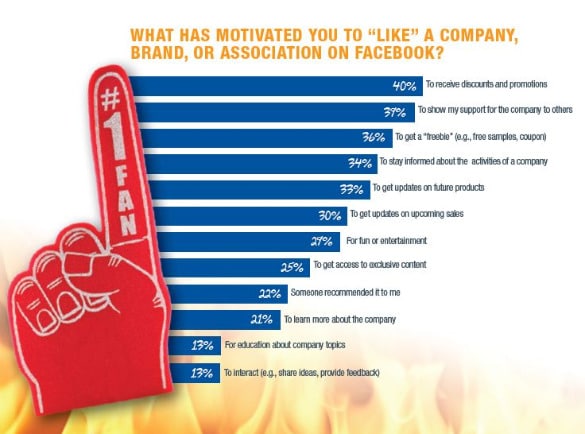
According to new figures released by a joint survey between Exact Target and CoTweet, Facebook users use the Like option for a brand for one overpowering reason – discounts and special offers.

Why fans like Facebook pages

Surveying 1,550 U.S. respondents aged 15 and older from March 2009 to April 2010, the results found that a whopping 40% of consumers like a brand or company on Facebook to “receive discounts and promotions.” When it comes to getting freebies, 36% would like a brand who offered giveaways.

Add to that 30% of those surveyed would like a brand to get updates on upcoming sales, and it’s clear that having a Facebook page offers a great opportunity for businesses to build loyalty with a willing customer base.

So how can you use this information for your business’s Facebook page?

Coupons and Customer Coding

The obvious way to market would be through coupons of your own. If you have flyers or discount coupons for your brick-and-mortar retail store, you can easily transfer that to your Facebook page.

Grab the artwork from your existing flyer (or make one unique to Facebook) and then transfer that to a tab on your page’s navigation menu. Currently this is created using the FBML application (and some HTML coding), though soon you’ll have to change to iFrame.

Call your tab something simple like Coupons or Discounts to grab attention. Then, to encourage folks to Like your page, only make the coupon or discount available to people after they like you. If you’re unsure how to do this, my friend John Haydon has a great guide on using Facebook HTML as well as hiding offers until people click your Like button.

I used this method when I offered a free Facebook Marketing ebook exclusively to folks that liked my Facebook page, and as you can see by this overview on the metrics, exclusive content definitely works.

Of course, getting folks to like your brand through coupons and discounts is just part of the process – keeping them is a whole other story.

Loyalty, Lists and Like Highlights

So now you have a bunch of folks that have liked your Facebook page because of your discount coupons or freebie offer. But how do you stop them from un-liking as soon as they have the coupon?

Simple – you market. But not just any old marketing – now you use the strengths of the Facebook page platform and make it a no-brainer for folks that like you to continue to do so.

  • Facebook Insights are available for admins of any Facebook page, and will give you information on demographics, content popularity, interaction on offers and other useful insights into how people are acting on your page. Use this to tailor audience offers and time-sensitive specials.
  • Facebook Updates are the equivalent of email lists, and will send a targeted message to people that like your page. The great thing with updates is that you can completely tailor them so that instead of everyone receiving a message, only those in a certain city, country, age range, demographic, etc, will receive the message. Perfect for gender-specific offers, or cultural events, or national holidays – anything you like, really.

On top of these two options, rotate your coupon and offers, and make sure they’re only available to people that like your page. Don’t settle into a routine – have an offer one week, then change two weeks later, then 2 days, etc. Mix it up so people will always have to be connected to your page to know when a new coupon is available.

Highlight your most valuable users as well.

Folks that interact the most; or use their coupon the most; or share your offer the most – give them special discounts and rewards to say thank you. It shows you value them, and also offers incentives to your other “fans” to become more involved.

These are just some of the ways you can be the brand that customers won’t just like, but be loyal to instead of being a fairweather friend.

And at the end of the day, isn’t that what you’re in business for?

Image: Exact Target and CoTweet

Why Affiliate Marketers Piss Me Off

Stop hiding affiliate links

Stop hiding affiliate linksFirst, a caveat. Not all affiliate marketers piss me off.
I’m not against anyone making money through products they endorse.

Heck, I promote the Headway theme and BlogOnCloud9 web hosting services (both affiliate links) because I believe they offer the best combination for WordPress bloggers.

But you’ll notice there’s an affiliate disclosure there, and that’s the part that pisses me off about certain affiliate marketers.

I’m seeing a lot of blog posts where affiliation isn’t disclosed. That’s bad enough, but you can always check if it’s an affiliate link by hovering your mouse over the link (and if it’s not a direct link but one with numbers and ID’s, you can usually bet that it’s an affiliate link).

Where I’m getting really annoyed is on Twitter. I see a bunch of recommendations for products that you just know are affiliate links and, true enough, if you click on the link you’ll see the affiliate URL before the normal one kicks in.

But there’s no mention of the affiliation in the tweet. Instead, it just looks like someone’s had a great experience with a brand, or they really like something and want to share it with their followers.

Fine, go for it. But you can’t disclose? Seriously? It’d take six characters to show it’s an affiliate link – (aff.). Would that really eat into your 140-character tweet limit? You have space for a ten-letter hashtag, but not the space to disclose the affiliation?

To me, that’s false advertising. You’re not disclosing your ties to the company, and that’s something the FTC was meant to be cracking down on in social media. Seems they still have a way to go.

Marketers get a bad rep from a ton of people, saying we’re only out to make a quick buck. Marketers in social media get much more stick, and we’re akin to the bubonic plague in some quarters.

But it’s no surprise when you see crap like this hidden affiliation happening.

Does $20 a sale really mean that much to you that you give up the decency to be honest?

  • Update Sept 1: Looks like the Advertising Standards Authority in the U.K has been listening to 4,500 pissed off users over there. Twitter and Facebook paid links will be coming under their regulation in 2011.

Image: Fr. Stephen, MSC

Note: This blog no longer runs on the Headway framework. Instead, it’s a custom WordPress design by Lisa Kalandjian of SceneStealer Graphics.

Social Media Bashing is Boring as Hell

Social media bashing

Social media bashingThere’s a fair few blog posts doing the rounds about social media.

How its practitioners are snake-oil salesmen.

Why everyone’s just out to make a quick buck.

How businesses are being ripped off by consultants who charge an arm and a leg for their time and deliver very little back in return.

One of the better headlines I spotted was Why Social Media Gurus Should Be Trampled by Elephants (check out the edited URL as well for extra emphasis). To be fair, that post makes some good points, while draped in a humorous link-bait title.

But here’s the thing.

While there are definitely crap merchants out there who wouldn’t know a tweet from a poke, there are also many more incredibly smart and business-savvy individuals and agencies that are bringing their clients huge success in social media.

You know why?

Because their clients actually had the common sense to do due diligence on who they were employing as their social media arm. Because the consultants/agencies had results and actionable strategies (with return predictions) to show. Because, simply put, the business owner acted like a business owner.

It doesn’t matter what industry you’re in. It doesn’t matter that “social media is new”, “social media is scary”, “we don’t understand social media”, or any other excuse or phrase you want to use.

If you do your job as a business owner and protect your investment, there wouldn’t be the need for any social media bashing (or any other industry bashing). You’d be asking questions that should be asked of any supplier.

  • What’s your experience?
  • Name some of the projects you’ve worked on.
  • What was the strategy used?
  • How did the results versus the projections go?
  • How will this really benefit my company?
  • What’s the time map?
  • How will you transfer your skills to my industry?

Forget how many Twitter followers someone has – that can be gamed and bought. Forget how sparkly their blog is – that can be paid for. Forget how they name drop players in the industry – is that relevant to you?

Instead, treat social media like you would any other part of your business. Carry out due diligence and don’t be sold on the first whiz-bang pitch you receive.

You’ve built your business to where it is now because you’ve been protective of your investment.

Why stop that now?

Image: What What

Around the Web

Around the web with Danny Brown

Around the web with Danny BrownFor someone who’s written about guest posting a few times, as well as recommended the benefits of it to clients when talking about Blog 101, I haven’t really done a lot of guest posting myself.

I’ve had brilliant guest authors here, but not really written too many myself. Maybe I should revisit my own post…

Having said that, I have been fortunate enough to appear on three blogs recently. Each one offers something different, while still within the realms of business, marketing and good old PR (which seems to have also taken a bit of a backseat here).

Anyhoo… The three posts can be found below, and I’d love for you to jump over and share your thoughts in the comments of the post.

A Message to PR – Don’t Be Restricted, Be Positive and Influence Change. Paul Sutton is a PR pro with more than 14 years knowledge and experience. He recently interviewed me for his Flock Friday Thought Leader series, and we spoke about PR and social media; restrictive agencies; old and new mindsets and why ethics need to start from the top. You can find the whole shebang here.

Stop Killing Your Business. Frank Dickinson is someone who I have a lot of time for. A marketer by trade, he’s also one of the kindest folks I know. Always supportive, always ready to lend a hand. For this post, I look at five things you can implement now to stop your business being another “Remember Brand X?” statistic. You can find out what these are here.

What I’d Like to See from Geo-Location Marketing. Gini Dietrich – what can you say about Gini? Smart, savvy, witty and very driven – everything a business owner should be. Gini’s a seasoned communications professional who runs her own PR/comms agency. Here, I talk about geo-location services like Foursquare, and why marketers need to up their game when it comes to creativity on offers and promotions. The juicy stuff starts here.

So there you go – a little diversity from the usual stuff, and as I say, I’d love to read your thoughts in the comments there.

The blogs also belong to three folks I admire immensely, and their blogs are always worth reading, so make sure you check the rest of their blogs out while there, and subscribe to them if you like what you see.

Have a great Friday!

Image: PaulWB

Why Loyalty and Mobile Marketing is the Future for Retail

eMarketer consumer and mobile retailing report

Loyalty card examplesYou’re a customer that does all your food shopping at your favourite grocery or deli store.

When you get there, you see the normal weekly flyer that has the current offers. Some you might be interested; others, not so much. So you flick through the flyer, then leave it at the bottom of the shopping cart.

You wander around the store, grab the things you need, then go to pay at the checkout. You might have a loyalty card for that store, so you swipe it and grab your points, and leave.

Job done for another week or so (more, if you do a large monthly shop instead). Then you’ll repeat the routine in a month’s time, and then the following month, etc.

But it could be so much more.

The Relationship to the Sale

According to a new report from eMarketer, consumers aren’t just looking for the latest and greatest offers. Sure, price plays a part in any sales process, but that’s just part of the story.

The biggest part? We want to be educated as well, as this chart from the eMarketer report shows.

eMarketer consumer and mobile retailing report

What’s interesting from this chart isn’t the fact that consumers want to know how your prices compare – that’s a given. Nor is it getting or redeeming coupons – again, that’s almost a given with any retailer.

It’s the remaining pieces of information – the parts about getting nutritional information, reading product reviews and visiting the company’s site for information.

Oh yeah – and the part that this is all via smartphones while the consumer is shopping.

So, looking at the report a bit further, it’s essentially saying we, as customers, are on our smartphones while shopping to not only see if there are any online discounts available, but to see if we can find more information about what we’re about to buy.

Now how could you, as a retailer, use that information? Because it’s clear our normal shopping methods are changing, and you need to change with that. So where do you start?

Loyalty on the Go

If you’re a retailer, there’s a good chance you already have a loyalty program in place to reward frequent shoppers (I’m looking at this from a medium-to-large retailer point of view; although smaller retailers could benefit as well from a low cost loyalty program).

But how well are you using that with mobile marketing? Are you using it at all?

In Canada, for example, loyalty programs are hugely popular, with almost 94% of consumers belonging to at least one loyalty program. If you’re a Canadian retailer (or have a presence there) that equates to almost 15 million consumers to target (working on the assumption half the population are minors or children).

We know that population is increasingly smartphone savvy – as this 2009 Nielsen report shows, Canada accounts for 12% of the smartphone market (which is probably more now that the iPhone and Android are available in Canada). This equates to about 4.8 million Canadian consumers on smartphones.

Smartphone penetration worldwide

So let’s think about that a second. Loyalty is huge in Canada; more Canadians are using smartphones – so the obvious next step is to combine the two with your marketing (and this can be across markets – I just used Canada as an example as that’s where I live).

  • Tie in your loyalty card to a mobile app. When consumers sign up for your card, advise them of your mobile app. When they download, they enter their loyalty card number and that ties their accounts together.
  • Monitor the usage of the app. Is it for coupons? In-store specials? Research? Build a database of your consumers’ use of your app, and build loyalty offers into that. Offer small tips on nutrition, product energy usage, etc, depending on the products you sell. Give shoppers a reason to stay in your store.
  • Make it easy to shop with you. Best Buy and Future Shop currently have an app that offers a ton of features to make the consumer’s experience more enjoyable. Browsing and buying options, easy check-out, barcode and billing options are just some of its features. Tie that into the Best Buy / Future Shop card, that rewards your app use with physical points, and you can see the benefits immediately. (At Bonsai Interactive, we’re currently building a bunch of apps that take this to the next level for multiple retailer industries).
  • Have price comparisons at the ready. Saying you offer the best value is one thing; showing it is another. Have mini-chart comparisons on prices for you and your competitors – that keeps consumers off your competitors’ mobile sites and interacting on yours.
  • Pro-active use of loyalty points. Because your mobile app is tied into your loyalty card, you can instantly advise consumers of when they’ve reached a certain plateau. The app recognizes how many points has been accrued and lets the consumer know via an alert. They can then buy direct from the phone with smart, targeted and mobile-friendly ads and purchases (which then gets added to the loyalty card).

And on it goes – these are just some ways you could combine your offline loyalty card with your online mobile marketing. And we haven’t even discussed where social media or location-based marketing comes into the mix – combine that with existing marketing and mobile promotions, and the sky really is the limit.

We’ve all heard the line, “Social media is changing the way we do business”. But perhaps the real line should be, “Mobile and loyalty is changing the way consumers need us to do business.”

So how far along the line are you at making your mobile customers loyal?

Image: LearnVest

  • « Go to Previous Page
  • Page 1
  • Interim pages omitted …
  • Page 176
  • Page 177
  • Page 178
  • Page 179
  • Page 180
  • Interim pages omitted …
  • Page 283
  • Go to Next Page »
© 2026 Danny Brown - Made with ♥ on Genesis