• Skip to primary navigation
  • Skip to main content
Danny Brown

Danny Brown

podcaster - author - creator

  • About
  • Podcasts
  • Journal

Latest posts from Danny Brown

Enjoy the latest posts from Danny Brown, and feel free to add your own thoughts in the comments after the post.

It Just Takes One

Bargain bin

You’re in business – you have competitors. They make a similar product, similar price – how can you separate?

How about great service, great follow-up, great proactivity? How about attracting the non-fans through acknowledging the other service as a solid competitor?

People watch; take notes, mental and physical. People remember. They remember how you work; how you react; how you talk.

Professionalism is more than just being professional to the person directly in front of you; it also means being professional about who’s around you.

People watch; take notes. It just takes one note to start a book on your approach.

Want to be a bestseller or a bargain-bin leftover?

Let’s Talk About Social Business

Social business or social crm

Social business or social crm

This post is by Joey Strawn?from Social CRM Insider.

There?s an old example many of my teachers used growing up to display a number of different points.

My teacher would show a jar on a table surrounded by a plethora of different-sized rocks. The task is to get all of the rocks into the one jar. No matter how you try, the only way that works is to put all the big rocks in first, then the medium-sized rocks, then fill the rest of the space with the pebbles.

The point of the exercise is to show the importance of priorities and how to organize your life.

Priorities are key to school, life and, of course, business. We?re going to talk about a major rock today that you need to have an understanding of if you?re going to be bringing in a Social CRM to your company or brand: Social Business.

We?re putting our normal curriculum aside today to address the issue of Social Business which, as you?ll find out, I feel is a larger goal than purely Social CRM.

Building a Business That?s Social

In her book Get Bold, Sandy Carter defines a ?Social Business? as the following:

At its core, a Social Business is a company that is engaged, transparent, and nimble. A Social Business is one that understands how to embrace social technology, use it, get value from it, and manage the risk around it. A Social Business embeds social tools in all its processes, and for both employees and clients?the entire ecosystem. A leadership company explores the social techniques that really matter to its business with a sympathetic approach, by creating a bold, unique Social Business agenda.

That?s one of the best definitions I?ve ever read and I highly suggest Sandy?s book to anyone who cares about creating a business that works with its customers. I?m not going to fill more in with what she said, but I am going to give you a couple seconds to read it again and take it all in??..

??..good.

Social Business is important and it?s vital to your brand surviving the next 15-20 years intact. I?m not going to dispute the fact that everyone needs to be paying attention to this phenomenon, but does Social Business makes Social CRM obsolete?

Social CRM vs Social Business?

A few weeks back, Michael Brito had a wonderful post focusing on this very question. Does the importance and eventual necessity of Social Business negate the need for a focus on Social CRM, or should it all be wrapped up into the same idea and eventually just be called ?business as usual??

Honestly, I agree with Michael?s post in almost every way, even though it seems at first glace we would be in disagreement.

While I may not totally agree completely on every single semantic, I think we will get to a point where Social CRM in the larger context of a Social Business is not only necessary, but expected. If you aren?t starting now with your plans, you will be left behind and a Social CRM is part of that emerging business.

Where Michael and I differ is that I believe it?s not as important to shift focus away from the components that make up a Social Business, with Social CRM being a part of that. Just as 50-60 years ago marketing was a new idea, 60 years before that the telephone was a new idea – but both?are now ?standard operating procedure? in successful companies.

We will always have to understands the components of what we do for the good of our brands and users, while at the same time understanding the larger pictures that encompass all those little things.

Social CRM may be a little component at this point and in the future be a natural aspect of all companies, but we?ll still be supplying top-notch Social CRM advice, innovations, trends, topics and strategies to help your businesses understand it now and in the future.

What do you think? Is there still a place to discuss smaller components of Social Business? Do you agree with Michael that Social Business will eventually be just ?business?? Where does Social CRM fit in?

Thoughts?

  • This post originally appeared on Social CRM Insider, part of the Jugnoo family of apps and publications to help people and businesses make the social web simple, accessible and monetizable. Joey Strawn is the Blogger in Residence at Social CRM Insider. You can read more posts here, and make sure to subscribe for the latest updates from Joey.

Is Your Business Adapting to the Fast Economy Quickly Enough?

Normally I’m not a big fan of infographics – at least ones that are poorly done, or resemble a NASCAR driving suit adorned with a million sponsor decals.

But this particular one piqued my interest, as it looks at something that’s fast (no pun intended) becoming a problem for businesses of all shapes and sizes, and that’s the rise of the fast economy mindset.

Instant America
Created by: Online Graduate Programs

While social media isn’t necessarily for everyone,?businesses still need to be aware of how their customers are perceiving them. Part of this comes from intelligence and understanding their major pain points.

As the graphic below shows, getting the chance to understand these pain points and do something about them is becoming harder and harder, especially on social channels.

The clear takeaways?

  • Even if you’re not active on social, be cleverly silent.
  • Make sure your site is mobile-optimized or, at the very least, mobile-friendly.
  • If you’re a retailer, can you get strategic about placing SMS or QR codes around the store for special offers?
  • Do you have an m-commerce site that you can use to be upfront about comparing products and prices on your own turf?
  • If you haven’t audited your service offerings recently, time to do so now before you’re called out on it.

Now, it’d be foolish to say the customer is always right and that you should pander to their every need. Sometimes the customer is anything but right.

But at least being on top of what the customer is thinking – and how long they’ll give you to remedy that – will give you a little heads-up on preempting that fast economy ire.

And that’s got to be worth anyone’s time to take care of, no?

On Loving and Giving Up On Google in Equal Measure

what do you love from Google

what do you love from Google

They say that, to be a great business, you should always leave your customer or user wondering what you’re going to do next.

I’d mostly buy into that, unless what you do next makes you appear to be both a wanky company as well as a cool one. Enter Google and their apparent goal to piss off and enthrall in equal measure.

For a company whose motto is “Don’t be evil”, it makes it doubly frustrating when they go against that and force your hand into doing exactly what they say. Or else.

The frustration is only compounded further, because then they come up with something so cool you love them all over again. Before we look at that, though, let’s start with the bad.

Google+ – You’re Stuck With It, Amigo

Over the weekend, I decided to stop using Google+. I’ve never really been enamoured with the service, truth be told, and I just found it to be another place that sucked my time up.

Not only that, but the amount of fanboy bias on there really got grating?- it became worse than the Sega vs. Nintendo debates back in the 80’s. I almost wanted to ask some users if they wanted tissues and a dark room…

So, having made the decision to not use Google+ anymore, I went to my Android to delete the G+ app, since it’s the second-biggest battery suck on my phone. Except I couldn’t delete it – because Google won’t let you.

Instead, the very best I could do was disable it.

The problem was, it then affected other Google apps on my phone because of Google’s “You WILL be signed up as a G+ user on every Google platform you use, and counted as an active one at that, because we want to pretend we have more numbers than we do.”

The biggest casualty was the Gallery app, which refused to load at all. Enabling the Google+ app allowed Gallery to work again; disabling screwed up Gallery again. Which, considering one of the selling points of Android is easy sharing of your pictures across social networks, seems stupid on so many levels.

Google has already been criticized for its all-or-nothing mindset when it comes to tying you?into their network of apps, with the only way to escape being the deletion of your complete Google account. Easier said than done, which Google knows and is playing to.

So, even though I pay for my phone and pay for its services, I can’t choose which apps I want to run (or not), because some of my other apps will be messed up if I dare turn off those from Google.

Thanks guys, awesome way to treat your customers.

Who Do You Love? Google, Sometimes

The ironic part of the negative experience highlighted above is that, often, Google gets it right in so many ways when it comes to the user experience.

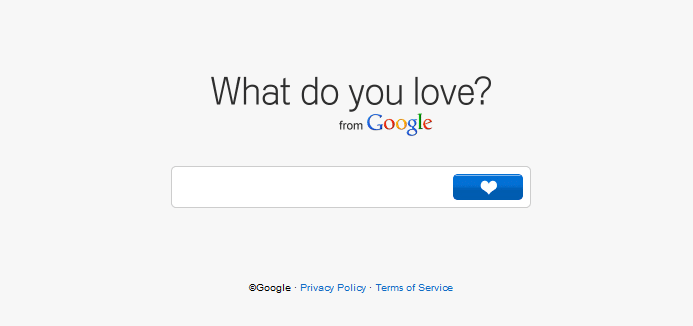
A prime example is the What Do You Love??project.

Conceived by the creative minds over at Big Spaceship, What Do You Love? is a very cool content identification and curation experience, based on topics or keywords chosen by you.

Just like the main search page for Google, What Do You Love? is clean and simple, and looks very similar to the search landing page itself with some text and a big search bar.

The fun happens when you type in the keyword, brand or person you’re looking for.

wdyl baked beans

Instead of the normal search results, you get tabbed results for pretty much everything under the sun on baked beans:

  • Pictures
  • Alerts
  • Patents
  • 3D exploration
  • Popularity of baked beans on the web
  • Videos
  • Books
  • Translations
  • Google Maps of nearby baked beans (seriously!)
  • and much, much more.

It’s quite possibly one of the coolest concepts I’ve seen, and makes search incredibly fun. What it also does, though, is allow you to set up a?research station and immediately get an overview of something you’re interested in.

While the What Do You Love? project is primarily a fun and cool way to bring a bunch of results together under one roof, the potential is much more.

Imagine using?it to monitor trends, see visual representations of your brand or business, or simply?understand how something works by seeing it in 3D. You can then take that information and plan a strategy around the results, or even just create magic of your own based on?the wealth of information available to you.

The story behind What Do You Love? is pretty cool too.

Developed outside Google (though fully endorsed by Larry Page and Eric Schmidt), Big Spaceship was allowed to rip apart the Google Apps API to come up with the WDYL? concept and execution, without any inside interference from the Big G.

The Less You Control, The More We Respond

This is where Google frustrates so much. On the one hand, they’re trying to make you a prisoner of their network by baking their products into each other so much, one won’t work without the other.

On the other hand, you have something so amazingly cool like What Do You Love? that gives you everything you need from Google’s toolset, but doesn’t force you to use them if you don’t?want to. And yet, by allowing this open path, you actually use something like WDYL? more than any other search option.

Notice the irony, Google?

I shouldn’t have to have Google+ active if I want to use my Android phone. I shouldn’t have to be an active user of Google+ if I just want to use Gmail, or share a video on YouTube.

Big Spaceship show you why the less control you place, the more a user will respond. The more response, the more use of a product – seems simple enough.

Would it really hurt to have this approach across your other platforms?

Why Businesses Should Take a Note from the Fisher Association of Marketing Professionals

Fisher College of Business

Fisher College of Business

Over in Columbus, Ohio, the marketing and advertising students at Fisher College of Business are setting the example when it comes to how business should be run.

I’ve just come from speaking at the college for their flagship Future Camp event, and I was hugely impressed with the set-up; the staff; the students; and, more than anything, the tangible passion that every student has to make a difference in the world through doing business right.

It’s clear that the combination of Dean Christine Poon and Professor Shashi Matta, who’s the Clinical Assistant Professor of Marketing at Fisher, have played a large part in this. In both their closing comments, Christine and Shashi praised the students for making their jobs so easy, so it’s clear (and great) to see the respect is both ways.

Talking to some of the students, they’re not only smart and driven, but really believe that business when done right can make so much of a difference in peoples’ lives. And they’re right.

While we might often look at business as that beast that swallows our money, there’s no denying the impact it can have on lives. Building a kidney dialysis unit; handing over a $100,000 insurance check to people whose home has been damaged; building an excavator that can dig a well in a third world country; and more.

The Fisher folks also have a strong sense of what should be done to make the experience everything, for consumers and colleagues alike. Again, it’s something that permeates throughout the air there, and I was left suitably impressed and optimistic at the same time.

To see exactly how these guys really want to be leading the way when it comes to business and the relationships that exist within, take a look at their oath below. Then imagine if every business owner adhered to it…

Thanks, Fisher College – you were a pleasure to be with, and here’s to all of your successes.

The Oath

On my honor, I will do my best to always put the consumer first.

And to never accept the status quo.

I will innovate until my audience is fully immersed.

I will act with integrity to instill awe and wonder with brand-expanding glee.

And be a kind collaborator with agencies and cross-functional teams.

To make the world a better place through consumerism.

  • « Go to Previous Page
  • Page 1
  • Interim pages omitted …
  • Page 120
  • Page 121
  • Page 122
  • Page 123
  • Page 124
  • Interim pages omitted …
  • Page 283
  • Go to Next Page »
© 2026 Danny Brown - Made with ♥ on Genesis