• Skip to primary navigation
  • Skip to main content
Danny Brown

Danny Brown

podcaster - author - creator

  • About
  • Podcasts
  • Journal

Latest posts from Danny Brown

Enjoy the latest posts from Danny Brown, and feel free to add your own thoughts in the comments after the post.

There’s Nothing Savvy About Marketing or Newsjacking Disasters

Hijacking bad things

Hijacking bad things

This week, the eastern coast of the U.S. has been battered by Hurricane Sandy, one of the biggest storms to make land in the U.S.

The states of Connecticut, Delaware, District of Colombia, Maryland, New Jersey, New York, North Carolina, Pennsylvania, Rhode Island, Virginia and West Virginia have all bore the brunt of this “superstorm”.

So far, 16 people in the U.S. are confirmed dead. One woman died in Toronto, Canada after flying debris hit her. 50 people lost their lives in Haiti and the Caribbean as Sandy’s deadly path took shape.

And this is just the early hours of the disaster. Sadly, like any storm of this magnitude, the death toll and damage is likely to be worse yet, not to mention animals and livestock caught up in the devastation.

With all this in mind, you’d think we’d be more concerned about the welfare of those in harm’s way than taking advantage of some cool marketing opportunities, right?

Then again, this is the marketing industry we’re talking about – and I say that as part of that very industry, which is why this appalls me even more.

The Opportunity of Disaster

Yesterday, the inbound marketing business HubSpot published 5 examples of companies that have “newsjacked” (the practice of taking news stories and using them to your advantage) the disaster that is Hurricane Sandy.

HubSpot themselves took some heat in the comments, forcing them to edit the post – although it’s still not worded in a terribly sympathetic way.

Examples included a Hurricane Hair board on Pinterest, to a make-up company advising you how to look great by candlelight and ensure your nails are tip top. Because chipped nails while sifting through the debris of your destroyed home wouldn’t be the done thing, right?

While none of the examples are as tacky as the Kenneth Cole Cairo tweet – and one does offer generators and air mattresses for those affected by the storm – they don’t paint a great picture of the companies either.

The comments on the HubSpot post are pretty split – some defend the companies and their “marketing savvy”, while others call out the practice as well as HubSpot for the article.

As I mentioned earlier, HubSpot felt inclined to edit the post, so it’s possible the article was more “offensive” and some of the commenters didn’t see the earlier version (at a guess).

Can Newsjacking Work?

There’s no doubt that a hot topic is a way to get yourself – personally or professionally – into the “spotlight”. Heck, marketers and bloggers do it all the time on Twitter during various tweetchats, #blogchat often experiencing some of the worst hijacking from people desperate to share their blog posts.

Yet none of these are taking advantage of disasters to sell their product or service. It’s like hacking into the 911 emergency lines to call your girlfriend to save on your phone bill.

Can newsjacking work? For sure – if it’s done right. David Meerman Scott, who wrote the book Newsjacking, offers ways to interlope into other news stories and infiltrate your brand or message, and there are great examples in there.

However, it’s also very telling that David himself commented on the HubSpot piece, with less than a favourable view:

Newsjacking something related to death and destruction is very dangerous. I’m reading this morning that 20 people have died and there is billions of dollars in damage. That’s not fun nor funny.

If your company has a legitimate tie to the disaster and you are genuinely seen as being helpful then okay. For example, a home improvement superstore could blog “just received a shipment of 250 generators in the Boston store.”

But a frivolous attempt at newsjacking to draft off the news of the storm to sell a product unrelated to the storm is bad form and may trigger a negative backlash. A restaurant that says “Storm special – 35% off all appetizers” is not a good idea.

When the guy that wrote the book on newsjacking doesn’t see the benefits of these examples, then you know they’ve missed the boat and, perhaps, HubSpot has too with their article.

Although they also had their own frivolous moment with their specific Facebook post – because, yes, company messages going out are far more important than the company making sure their employees are safe.
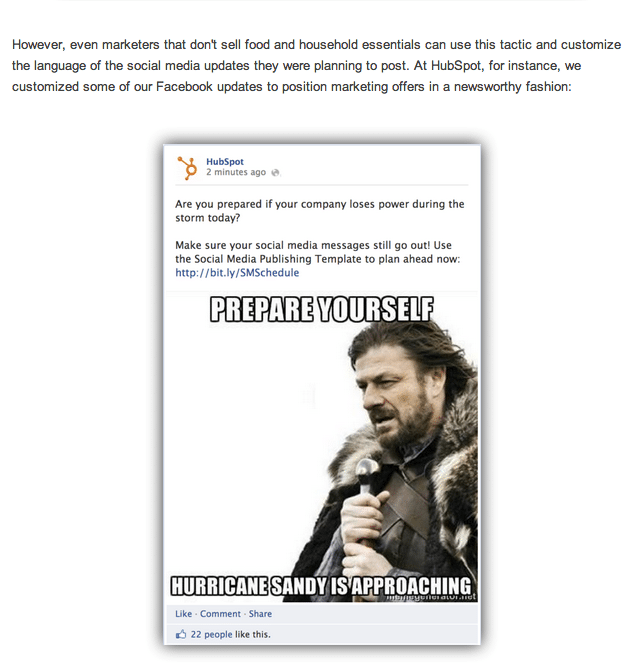
5 Hurricane Sandy Newsjacks From Marketers

So who knows..?

Additional reading: Doug Haslam, “Newsjacking” – A Good Idea with Dangerous Pitfalls

Blogging as Part of Your Marketing Strategy

Blogging and your marketing strategy

Blogging and your marketing strategy

Last week, the good folks over at Social Media Breakfast Waterloo were kind enough to invite me over to speak to their members.

The topic was crowd-sourced, and the chosen talk was on how blogging could be used as part of your marketing strategy. Since the audience was made up of every business size, from solo entrepreneurs to SMB owners and C-suite executives, it was a great topic to be talking about.

You can view my presentation below, but i just wanted to highlight the four key points that you can take away for your own blog and marketing combination.

1. Research

One of the most important things you can do before you start a business blog is research whether your customers and audience actually want one. It’s all well and good saying, “Well, our competition has a blog – we should too!”. But that’s just setting yourself up for failure.

Look at your customer base; are they the kind that read blogs? Are they mobile-led (which would suggest a blog-friendly audience)? Are they computer-literate?

A slaughterhouse in Moldova is probably not going to need a blog; a hospitality industry business probably should have one. Ask your customers if they’d be interested in a blog – a questionnaire, an email, when they’re in your store, etc.

Having a ready audience will immediately increase your chances of having a decent corporate blog.

2. Strategy

Just as important as the research angle is the strategy one. If you launch a business blog and you don’t have defined goals with it, you’re just wasting valuable time and resources in maintaining it.

Will it be for lead generation? Will it be to promote your business’ thought leadership? Is it to handle service questions, or give the latest news on product or company updates? Is it to get to know your customers better and what makes them tick?

Have a solid strategy in place on what you want to achieve, and how you wish to achieve it. Then set timelines in place to measure how you’re doing, and adapt accordingly.

You wouldn’t go into business without a clear goal and plan – why would you do anything different with another angle of your business?

3. Consistency

If there’s one thing that blog readers hate, it’s inconsistency. This can be across multiple areas – publishing posts, comment systems (yes, I’m guilty of this one!), voice, editorial, writers and more.

And there’s a simple reason for this – there are currently between 180 and 200 million blogs out there, and reader interest is becoming shorter and shorter as publications vie for eyeballs. So if you’re confusing your reader with ever-changing positions on your blog, they’ll more often than not decide it’s not worth hanging around.

If you want to keep your readers and grow your blog, be consistent.

  • If you’re going to post once a week, make it the same day and the same time of day. If you’re going to post 2-3 times a week, keep it the same days.
  • If you’re going to be primarily a text blog, remain that way. If you’re going to be a video-led blog, be that blog. You can mix things up now and again, but keep the prime focus the one you set up yourself up as.
  • Keep the tone consistent. if you’re going to be a serious blog, remain in a serious tone. If you’re looking to show the fun side of your business, highlight that with pictures and a lighter tone.

If you keep to the goals you set out with, and the way you set out reaching them, it’ll cause less confusion and encourage readers to stay with you.

4. Measurement

One of my biggest bugbears is when I speak with business owners and ask them about analytics and measurement, and how they’re tracking their success based on their goals, and they reply with a blank stare and an, “Uh….” soundbite.

If you’re not tracking your activity, how do you expect to know if you’re succeeding; where you’re succeeding; where you need to adapt and more?

The best of it is, you can track all this stuff for free (with the exception of cost of man hours to do so).

  • Use Google Analytics or Woopra to track your web visits, as well as where the traffic is coming from, what your visitors are doing while on site, where they’re going afterwards, and much more. See which content works, which doesn’t, and amend your approach accordingly.
  • Track social media success with tools like Jugnoo (I’m biased, but we do track pretty well!), Most Shared Posts, or social campaigns in your analytics solution(s). By knowing what content resonates, and where, you can be far more strategic on your approach to both your blog and that platform.
  • If you’re selling products from your business blog, use something like WooCommerce and Improvely. This can identify the source of the purchase, the referral, the costs involved and much more.

You don’t have to run a bells and whistles measurement solution – but for the love of all things common sense, please do have at least some way to track what you’re doing!

As I mentioned, these are the four key areas for any business blog to really concentrate on and get right. There are more, which the presentation looks at. But as a starting point, they should be the ones you answer if you want your business blog to succeed.

The rest is up to you.

On Listening to Those That Make Your Blog What It Is

Listening to your blog community

A couple of weeks back, I sent an email out to my subscribers asking about blog comment systems.

The main gist of the question was centered around which option readers preferred – the WordPress native system, or third-party options like Livefyre and Disqus.

The reasoning was simple – while I might provide the original content, I firmly believe that the real magic of a blog post comes in the comments afterward. It’s where new ideas can be formed; feedback given; and new friendships and relationships forged.

Simply put, content may be king but community is the whole royal courtyard.

The results and feedback from that email showed that, while WordPress native was the simplest option, people did prefer the more social aspects of Livefyre and Disqus.

Out of these two, the majority of votes went to Disqus. Reasons included:

  • The ability to answer directly from your email notification
  • Better sign-in experience on mobile browsers
  • The community aspect of knowing what your commenters were saying elsewhere and the ability to join that conversation
  • A better way to track all your comments elsewhere

While some answers preferred Livefyre for its ability to integrate social conversations into the comments, there were also concerns re. mobile reading, and a more cliquey feel to Livefyre communities (though personally I would say that’s more down to the blogger and their interactions versus the system itself).

With that feedback, it was clear that – despite my love of Livefyre – readers preferred the approach to comments Disqus takes. Hence the reason it’s back on the blog after a trial run of the new version earlier this year.

Now, you could say that it’s my blog and I can run whatever options I want on here. And that’s true – but it’s also missing the point.

A blog without a community is simply a news channel. A community without interaction is simply a dead zone waiting to go somewhere else. A dead zone is the path to oblivion for a blog.

This blog has always been about your voice and interaction too – you bring different points of view and great ideas all the time. Why would I want to limit that?

So, thanks for being here and thanks for the feedback on how you wish to be here – here’s to continued conversations.

Update 19 March 2013: After experiencing some issues with Disqus – slow load time (particularly on mobile browsers), comments disappearing and filters not working properly – I’ve reinstalled Livefyre, with its new version 4.0.

Two Awesome Examples of Promotional Campaigns Done Right

Sometimes, you just have to take your hat off to excellent examples of promotional campaigns done right.

With many folks saying advertising is dead, it’s nice to see examples like the two below and say, “Uh, really?”. Especially since both show a mix of cool and (where Audi and BMW are concerned) outright cheek.

The Audi and BMW Billboard Chess Match

This is probably one of my favourite examples of corporate fisticuffs I’ve seen. Below on the left is a billboard ad from German auto manufacturer Audi, and the response from fellow German competitor BMW (click to expand):

Audi versus BMW

Audi’s ad shows their new A4 saloon, with the challenge to BMW of, “Your move”. It’s classic advertising at its best, with a gentle poke at a direct competitor. A competitor that was clearly up for the challenge.

Up steps BMW with their response, a picture of their sporty M3 and the words, “Checkmate.” Brilliantly simple, and one that would end any “mine is bigger than yours” game.

Except Audi have their own sports car heritage, as was quickly evident in the response below (click to expand):

Audi versus BMW sports car battle

In a wonderfully cheeky piece of advertising sass, Audi put up a new billboard with their R8 supercar and the statement, “Your pawn is no match for our king.” Game over, right? not quite.

BMW has a long history in race cars, especially when it comes to Formula 1 racing. And they were more than happy to show this when they brought out a blimp with their F1 race car emblazoned on it along with the words, “Game over.”

Epic. Simply epic.

Note: Audi reached out to advise that the blimp was photoshopped into a screengrab of the billboards. Bugger. Still epic response though. 😉

The Monsters University

Scheduled for release next summer, Monsters University is the sequel to the massive hit, Monsters Inc. A prequel to the original movie, it looks at the two characters from the original movie and how they met at the titular Monsters University.

Now, normally, movies are pretty good at coming out with cool promotional campaigns, with studios trying to outdo each other on the viral effect. But Pixar and Walt Disney have really come up with something pretty cool for this one.

Monsters University

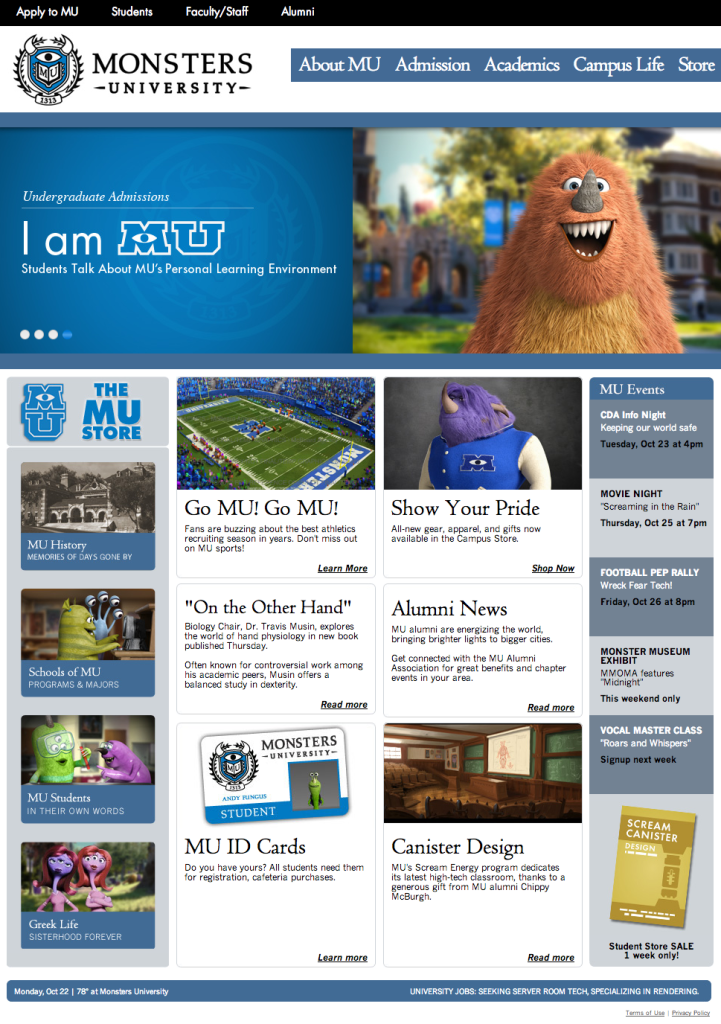
Instead of the normal movie site, Pixar has gone all out and created a fully functional University website (hat tip to Matt Andaloro for the heads-up on this).

Not only can you explore the School of Scaring, where the Monsters learn their trade, but you can check out the MU sports and athletics teams; get alumni news; check out MU events; and much, much more.

It looks and feels exactly like a University website would, adding to the realism and authenticity of actually spending time with fellow students. Which is exactly what the new movie will be about – result.

The Moral of the Story

As I mentioned at the start, many folks have decreed advertising to be dead, as social media and new media platforms look to share messages differently.

Yet, as these two examples above show, advertising is alive and well, and more creative than many of their social media equivalents.

To the naysayers of advertising and “traditional marketing”, perhaps it’s less the medium that’s dead as much as it’s just crappy advertisers and marketers that are killing creativity.

Then again, that’s true of all mediums, including social media. Here’s to creativity, especially when it’s integrated and not silo’d.

A Lack of Real Vision is Stalling the PR Industry

First, a caveat – I don’t know the folks whose quotes I’m about to use as examples of why the PR industry is struggling.

They could be (and probably are) very smart and accomplished business people.

So, this isn’t a “go” at them.

With that being said, however, this recent report/white paper does seem to highlight exactly why the PR industry is continuously seen as one that’s been slow to adapt to the new business landscape and, as such, is holding agencies and consultants back.

First, let’s take a look at the piece.

The PR Firm of the Future

As a precursor to the PRWeek Conference on November 14, Michael Lasky – senior partner and head of PR at law firm Davis & Gilbert LLP – asked this question:

What is the most important way in which the PR agency of 2017 will be different from the PR agency of today?

Michael asked 8 leaders of independent agencies. The responses included:

– Ken Eudy, CEO, Capstrat: “The PR firm of 2017 will increasingly help is clients become publishers and broadcasters… communicating directly with stakeholders without having their messages filtered through traditional media.”

– Maril MacDonald, CEO, Gagen MacDonald: “The successful firm of 2017… will be interested in relationships, not transactions. It will think about the long-term strategy, not short-term tactics. It will add value through a technology-driven collaborative dialogue…”

– Elise Mitchell, CEO, Mitchell Communications Group: “The firm of the future will be known as a business strategist with communications expertise. It will offer integrated services that create solutions… leveraging earned, owned, paid, shared and promoted media in all channels including digital.”

– Jennifer Prosek, CEO, Prosek Partners: “Practitioners in 2017 will be required to think across the marketing mix and successfully drive campaigns versus simply owning the traditional earned media channels. Firms will need to articulate the value of results that engage their audience versus simply offering impressions.

These are just four quotes I pulled from eight agency leaders. Others include:

  • “Providing value at this level is not only the key to establishing lasting partnerships, but also creates a desire… to partner with this organization”;
  • “Multidisciplinary expertise will be the firm’s leading competitive asset”;
  • “THE PR firm of the future… will deploy a mix of paid, earned, owned and shared media that can be monitored and measured directly in real time.”

All good stuff. All good advice. If this weren’t already happening today in 2012, versus what should happen in 2017.

The PR Firm of Today and Yesterday

While there are some good quotes from the assembled eight agency folks, the “problem”, if you like, is that they were asked what the PR firm of the future would look like.

So, you’d kind of hope/expect to hear stuff that no-one’s really doing at the minute, or ideas that are really pushing the industry forward.

Unfortunately, the majority of the soundbites would be futuristic if they were answers from circa 2008/2009.

Suggestions that brands become publishers and broadcasters, for example, miss how well blogs and social networks have been used by brands and agencies for the last 3-4 years.

You only need to look at programs like Sony’s Digital Dads, or Ford’s blogger outreach campaigns, to see how well this has been done in the last few years. And smaller businesses are increasingly using blogs to educate their audience and grow their customer audience and loyalty.

Then there’s the prediction that the PR firm of the future will deploy a mix of paid, earned, owned and shared media while being able to monitor and measure in real time.

When I was working on a RIM account back in 2009 to launch the Bold 9700 in the U.S., we used a collaborative strategy that saw us involve Facebook, Twitter and YouTube to create a fully interactive experience for you and your friends. This was supplemented by paid media ads as well as partnerships with BlackBerry communities.

We measured and identified where the campaign was working, where it needed help, and which communities were driving real value and worth around the promotion.

The result was millions of impressions, thousands of handsets pre-ordered and sold, and an industry award for the campaign itself.

That was in 2009 – and I know we weren’t the first to use true integration in campaigns.

The Future is Now

And this is exactly why this “prediction paper” just adds to the view that PR is being left behind, versus countering that belief.

There’s no doubt that there are great agencies doing great things. Companies like Arment Dietrich, RKPR, Mullen, Voce, V3 and more. And the reason they’re leading the way today is because they’re already practicing what’s being predicted for 2017.

They’re integrating channels and expertise now. They’re not silo’ing PR from marketing from digital from strategy from creative and more – they’re running these as fully integrated ideas from the start, and have been for years.

My friend Rick Rice, a 35-year industry veteran, sums it up best with this quote:

The PR business is in need of disruptive change and none of this generation are even willing to try.

There’s no doubt the PR industry has a perception problem, and it’s great to see it trying to move forward. I just wonder how far it can move when it still seems to be behind the curve on so many things…

  • « Go to Previous Page
  • Page 1
  • Interim pages omitted …
  • Page 103
  • Page 104
  • Page 105
  • Page 106
  • Page 107
  • Interim pages omitted …
  • Page 283
  • Go to Next Page »
© 2026 Danny Brown - Made with ♥ on Genesis