• Skip to primary navigation
  • Skip to main content
Danny Brown

Danny Brown

podcaster - author - creator

  • About
  • Podcasts
  • Journal

life

On Hot Tubs and Getting Older

Next year, I’ll be 50. What the f…?

I remember being a young man in my early 20’s, and thinking 30 was old. My 20’s and 30’s were probably my peak, at least physically.

To even consider being 50 was… no, it wasn’t even considered. It just wasn’t an age to understand.

Now, a couple of decades later, and I’m thinking – how did this creep up?

Was I just not paying attention? Not accepting it was coming? Not growing up, and still thinking of my peak years? Although one look in the mirror can easily confirm these are behind me…

So what does that have to do with hot tubs?

Maintenance, Maintenance, Maintenance…

This summer, my wife and I agreed to a major project for our back yard.

Our deck was falling apart, and our yard itself was on two levels essentially, leading to a flat back yard to the side of our house and a sloped one just beyond our deck.

This meant a few things: our kids couldn’t really play anywhere except the side of our house, it was a major pain in the ass for me to mow, and it made our backyard look smaller due to the slope.

So, we hired a landscaper to redo the deck and yard, as well as install a hot tub (something my wife had always wanted in a back yard of our own).

After a 6-8 week period, from planning to visualization and then implementation, it was done.

Our old, decrepit deck had been replaced by a beast of a two-tier deck, that allowed extra play area for our kids as well as a built-in hot tub.
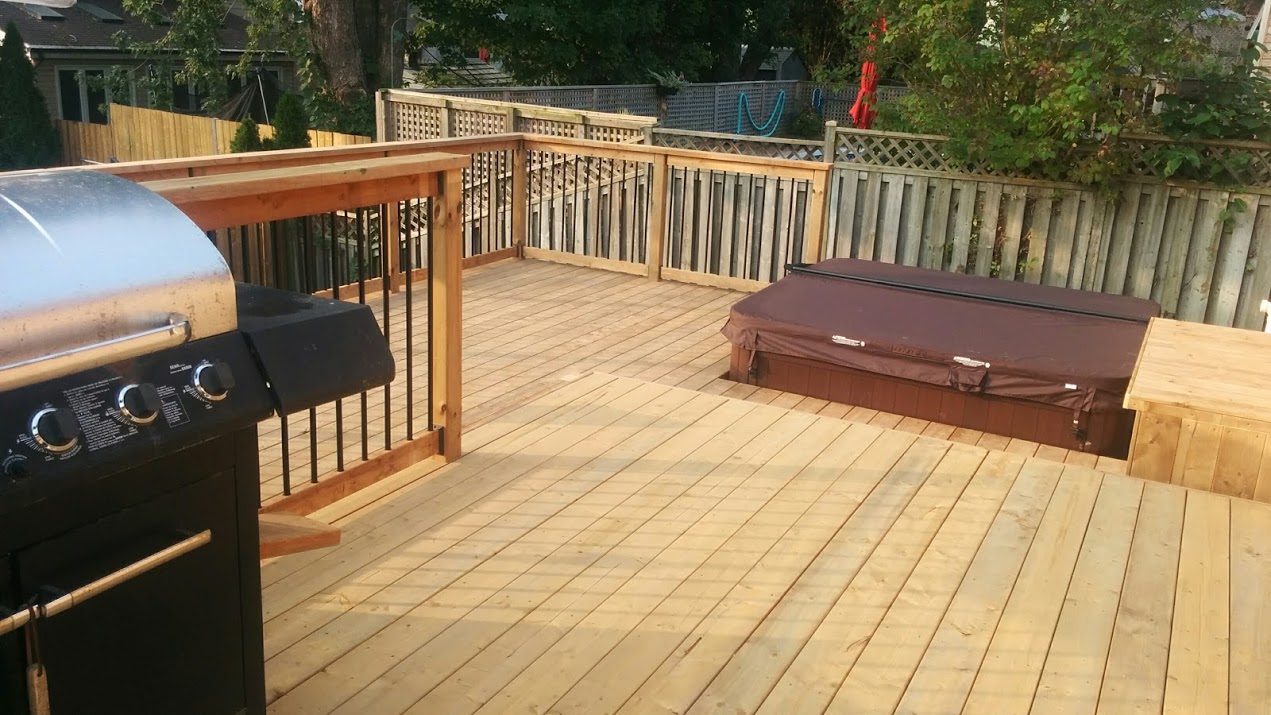
Job done, right? Eh, maybe not.

Don’t get me wrong – I love our new deck, the extra space, the entertaining area, and the hot tub. It’s just… well, I guess the hot tub reminds me of my impending aging.

The hot tub is hard work. Enjoyable hard work, but hard work none the less.

I have to keep the chemicals at a certain level; I have to keep the water level just right; and, once a quarter, I need to empty the old water, clean, and add new.

That’s not even taking into account the filters and how I need to clean and change them on certain dates.

In a way, it kinda sounds like me getting older.

Make sure you have any (meds) chemicals you need; look after your bladder and extra need to pee (water level); and ensure your younger self isn’t impacting your older self (don’t think the hot tub will look after itself in the years to come).

I’m hot tub man! 🙂

Forget the Work, Enjoy the Results

And, to a degree, being “hot tub man” sucks. I’m at the age now where I want an easy life. Or, at least, an easier life.

I don’t want regular responsibilities – if the hot tub water smells, I want it to be because a skunk pissed in it, as opposed to me forgetting to check the levels.

But… then I remember the feeling of being in the tub,

Calm. Relaxation. Peace. Warmth. Love. Safety.

And then I think, for all the work needed, maybe it’s not a bad thing. Maybe the work is needed to make the pleasure a result of the [perceived] pain.

Maybe the work is what makes it worthwhile. Much like getting older,

Maybe all the stuff I miss now – flat belly, being fit, being “hot” – was just my training ground to finding true happiness.

True love. True comfort, calm, relaxation, and all that comes with that.

Who knows? I’m just thinking aloud on a Saturday night. Not the greatest time to try and make a point, as everyone gets ready to have their happy time, at least for them.

But that’s okay.

Because I’m not thinking aloud for them. I’m just riffing for us – the older, the soon-to-be-old, and the ones that remember what it was to be young.

Much like a hot tub, it’s hard work. But the results are worth it.

Finding Moments of Silence in a Sea of Noise

The time to relax is when you don?t have time for it. ~ Sydney J. Harris

We live such busy lives. We run from meeting to meeting, sales call to sales call, school event to school event, all without question.

Instead of questioning the validity of these sprints, we simply brush reasons aside, because it’s just what we do, right?

While it may be part of our everyday life, it doesn’t mean it has to be part of our everyday acceptance of busyness over silence and time to regroup.

In fact, not taking the time to regroup can have serious health repercussions on your body, mind, and soul. Stress, anxiety, lethargy, etc. All warning signs that our bodies need to recharge and our minds need to refocus.

But in a world where silence and moments of quiet seem to be placed at the back of a very long queue, how do we find these moments?

Simple – find them when you’d normally expect them to be hiding from your view.

The Alternative Commute

In a previous job, I spent about four hours per day commuting – one bus ride and two train trips each way.

I used to spend this time catching up on emails, setting up projects for the day, answering questions on a blog post, scanning photos for perfect Instagram updates later, or just playing games on my phone

And while I was productive then, it had an impact on how productive I was later, as the inevitable crash came and tiredness negated effectiveness.

So, instead of catching up on the tasks mentioned above, I took at least half the journey to close my eyes and concentrate on nothing but whatever thoughts and images appeared in my mind at that time.

Or, I looked at the rising sun, and enjoyed the way the light touched the clouds and illuminated a different picture each day.

  • For you, think of ways you can mix up your commute. Can you take public transport instead of driving, that allows you to switch off and just enjoy the journey? Or can you park up early and walk some of the way, and enjoy the newer sights and sounds?

Moments of Silence in a Sea of Noise

On any given day, we’re surrounded by noise and commotion. Kids, the workplace, traffic, pets, city life, TV, and radio, etc.

We get distracted from what we’re doing by the lure of what others are doing or saying, and our minds jump from one point of attention to another.

By the end of the day, our minds can be so frazzled that we remain hyper, even when we know we need to rest and recharge.

One of the things I started to do was to take my noise-canceling headphones wherever I go and use them whenever I could based on seeing both the need and opportunity for silence

This allowed me to be “in the moment” of the place I needed to be, but still have the ability to switch off, catch my breath, and recharge for the moments ahead.

  • For you, identify the parts of your day when silence can be switched on. Invest in a good quality pair of noise-canceling headphones, and curate a collection of your favourite songs or soundtracks that take you to a memory that makes you happy or appreciative of life.

Let Technology Help Instead of Distract

It’s easy to look at how quickly technology has evolved to be an ever-present in our lives, and those of the people we interact with on a daily basis.

And it’s fair to say our mobile-first approach to most things today means we’re connected longer and with more frequency than we’ve ever been, and that’s not going to go away anytime soon.

But that doesn’t mean we have to let technology rule our lives the busy way all the time.

While mobile access means our busyness can be added to at any time of the day, use that same technology to remind you to be aware of your need for downtime for both body and mind.

  • For you, think of how you want to refresh yourself, and access apps that can make that happen. The Headspace program is a great way to do this and offers daily meditation exercises through mobile, tablet or desktop.

Making Time When You Don’t Have Time

We get swept up into believing lives of busyness are the norm, and we’re clearly doing something wrong if we have too many moments to pause, breathe, live.

The sad fact is, busyness is not the norm, or shouldn’t be.

  • Yes, we have deadlines.
  • Yes, we have projects that need completing.
  • Yes, we have commitments to keep.

But none of these will be met while you’re fighting to keep healthy because you refuse to step away and recharge the batteries.

None of these will be completed if your health suffers to the degree that you’re lying in a hospital bed wondering how you got there, as your body gives you the answer to your question.

We all struggle with the work-life balance. Where does one end and the other begin?

There are many different answers depending on who you talk to – but there’s only one answer that really matters, and that’s the one only you can provide.

Listen to your advice, know that you need to switch off, and learn when to take the time – even when you think you can’t.

When You’re 7 Years Old and Your World Dies Around You

Child

In the early summer of 1976, my life was as any 7-year-old kid’s life should be – fun, making new adventures, and looking forward to a long, glorious school holiday.

Then, in the space of nine weeks, that world came tumbling down.

I lost both my grandfathers and my step-dad – one grandfather and my step-dad to cancer, my other grandfather to natural causes.

While that was undoubtedly traumatic, it was the loss of my schoolfriend, Corinne, that hit me the hardest.

She died of an asthma attack during the summer holidays. One minute she was outside playing with her friends, the next she was gone. When I found out, it broke me.

I’d later compartmentalize that her death hit me hardest because I knew my grandad and step-dad were dying, and my other grandad died simply of old age, so I was “expecting” their deaths.

Corinne, though, was the same age as me – a child, enjoying the summer holiday. Kids don’t die (or, at least I didn’t think they did).

The summer of ’76 was a cruel awakening for me on that front.

The Loss of Innocence and the Recognition of Mortality

I was reminded of that summer by recent conversations with my son, Ewan, who turns seven in May.

Both he and his 5-year-old sister, Salem, are beginning to see little pieces of “the death puzzle”, either through shows or movies we watch, or characters in video games we play together (Brothers being a prime example).

One evening, a couple of weeks ago, Ewan and I were sitting at the table colouring, and he came straight out and asked,

Daddy, what’s going to happen to me and Salem when you and mommy die?

This caught me completely off-guard, and for a moment I really didn’t know what to say. Then, I put my pencil down and looked at Ewan, and we started talking.

I asked him if he thought we were going to die soon, to which he replied he didn’t think so.

I then asked him why he thought both mommy and I would die at the same time, leaving him and his sister all alone. He replied he didn’t think we would, but we might.

After a few more questions, during which he thought I’d die first because I’m older, I kind of had an idea on what to say and replied with this.

We know people die. We know some die before others, while some live longer than others. But I promise you, while I’m alive I’ll do my best to stay alive a long time, so that when I do die, you’ll have your own children to keep you company and happy.

This seemed to placate him, and we went back to colouring, and the death question hasn’t come up since.

As we coloured together, I was happy that we seemed to have passed that particular question okay, but I was also sad.

Ewan’s growing acknowledgment of death was, to me, a sign of his innocent outlook on the world beginning to change, and that he knew that the life he has now won’t always be the same life ahead.

Accepting the Future, Living the Now

However, as much as the conversation left me somewhat sad, it also made me recommit to leading a deliberate life where every moment counts.

Today, I feel healthy (if not quite the fighting weight of my younger days) and I feel good about life and where we’re at in it. I have a home full of love and a circle of friends for whom I truly care.

But that wasn’t always the case, and it could slip away at any moment.

Hearing my son worry about his mother and father dying, and leaving him and his sister all alone was a jarring experience. But it’s one that can’t – and shouldn’t – be brushed aside as something away in the future.

My promise to Ewan, about living for as long as I can, is one I intend to keep. If I do, wonderful – if I don’t… well, hopefully, I get the chance to prepare Ewan and Salem for that inevitability, and remove some of the fear and unknown.

While I am here, though, the goal is simple and can be summed up in three words – love, life, live.

  • Show those around you how much they mean to you, and love without conditions,
  • Appreciate life is a borrowed time, and spend that time well,
  • Live intentionally, and live it with those that make it count.

If those three words can be experienced as much as possible, then hopefully that will make for a lifetime of memories that more than outlive the passing of the physical when it arrives.

Which, at the end of the day, is all any of us can ever ask for.

Introducing Turn Off the Overwhelm (lead a deliberate life)

?Love people, use things. The opposite never works.??Joshua Fields Millburn & Ryan Nicodemus, The Minimalists.

Throughout my adult life (or at least the majority of it), I?ve tried to be someone who places more value on people and experiences over materialism and the status quo.

This means looking at how the every day can be a catalyst for an opportunity to learn and share in the beauty of collective connections, and what we can take away from these experiences.

I?m not always successful ? but then that?s why life is called an adventure. It?s a never-ending ride of lessons learned that we hopefully grow from by the time the ride is over.

This is the reasoning behind my new project?Turn Off the Overwhelm,.

Turn Off the Overwhelm

Our daily lives are overwhelmed with noise and distraction, serving only to remove us from the kind of connections and interactions that make us truly human.

We need to make our lives simpler so we have more time to connect to the experiences that truly matter, and lead a more deliberate life.

By turning off the overwhelm, we can foster deeper, more meaningful connections that offer more than just a brief memory, and create a series of lasting moments of a life well lived.

The goal of Turn Off the Overwhelm is to help you lead a more deliberate life through a shared vision to turn off the noise and return focus to ourselves and those around us.

[clickToTweet tweet=”We need to make our lives simpler so we can connect to what truly matters, #turnofftheoverwhelm” quote=”We need to make our lives simpler so we can connect to the experiences that truly matter, ” theme=”style1″]

Throughout life, we have a choice. We can either choose to put self and material living first, or we can live a deliberate life where others are our priority, and the things and experiences we collect are ones that bear meaning.

I hope you?ll find what you?re looking for on the site or, at the very least, get an idea of where to look. You can subscribe directly here.

Here?s to meaningful lives.

The most valuable things are the ones that make our lives simpler so we have more time to connect to the experiences that truly matter, and lead a more deliberate life.

Love People, And Use Things

Laughing mother

This weekend just gone saw the annual Family Day holiday in most of Canada. A government-endorsed public holiday, Family Day was created to “…celebrate the importance of families and family life to people and their communities.”

It’s one of the many reasons I love my adopted home (I moved here from the UK in 2006) – after all, how many countries actually offer a paid day off to spend with your family and celebrate family life?

Especially in today’s work climate, where the family can take a back seat to long hours and long commutes, as people go where the work is and that’s not always close to home.

So, yes, Family Day is a welcome respite from the overwhelms of everyday life.

Over the weekend, I took the time to watch Minimalism: A Documentary About the Important Things on Netflix.

This is something I’d been wanting to watch for a while since I’ve definitely seen a change in how I look at life and what’s truly important in it.

Living Deliberately

As my young family has grown (my son will be 7 years old soon, my daughter just turned 5), and I’ve seen close friends suffer deeply personal losses, my priorities have changed immensely.

Whereas I used to be all about online chatter and was a heavy user of Twitter and Google+ back in the day, now I don’t use either channel.

Instead, I limit my online use to Facebook, where I can stay connected to close friends and friends that are a little further away geographically, and this blog right here.

Instead of seeking some self-important validation through online “followers”, I want to foster deeper, more meaningful connections that offer more than just vacuous soundbites and so-called social proof.

In short, I want to live a deliberate life that has meaning in at least 90% of all that I do (hey, there’s always room for non-essential video game fun!).

Love People, and Use Things

As I watched the Minimalism documentary, so much of it connected with this mindset change.

The realization that we buy into a template of a life that isn’t really ours – the cars, the electronics, the big house full of unused products, the pressure of meeting a deadline that won’t mean the end of the world if missed.

By buying into this template, we ignore the most important template of all – us, and the world we inhabit.

Things take import over people, and we begin to use each other to rise to an invisible dais that we feel makes us more complete. In short, we use people to get more things.

Yet, as one of many wonderful quotes from the documentary share,

…we need to love people and use things. Because the opposite of that never works.

Think about that. “Love people and use things.”

It’s not a hard concept and yet it’s such a powerful one if we take the time to buy into it, and take action to make it happen each day, with every interaction we have.

  • Build up, instead of dragging down
  • Use technology to speak with, not dictate to
  • Smile instead of an angry look
  • Surround yourself with meaning, not meanness.

Things are material objects that more often than not simply foster immaterial needs.

The most valuable things are the ones that make our lives simpler so we have more time to connect to the things and experiences that truly matter, and lead a more deliberate life.

“Love people, and use things. Because the opposite of that never works.”

Wise words, indeed.

Note: since publishing this article, I’ve launched my new project, Turn Off the Overwhelm, which goes deeper into the thinking behind this post. I’d love for you to check it out.

  • « Go to Previous Page
  • Page 1
  • Page 2
  • Page 3
  • Page 4
  • Page 5
  • Interim pages omitted …
  • Page 8
  • Go to Next Page »
© 2026 Danny Brown - Made with ♥ on Genesis