• Skip to primary navigation
  • Skip to main content
Danny Brown

Danny Brown

podcaster - author - creator

  • About
  • Podcasts
  • Journal

effective social media

The Growing Elitism of Social Media

Recently I questioned whether we were turning into social media snobs. This wasn’t an attack on social media per se – more a valid look at whether certain people in the social media arena were beginning to try and wield a little too much (and possibly unwanted) influence over the medium.

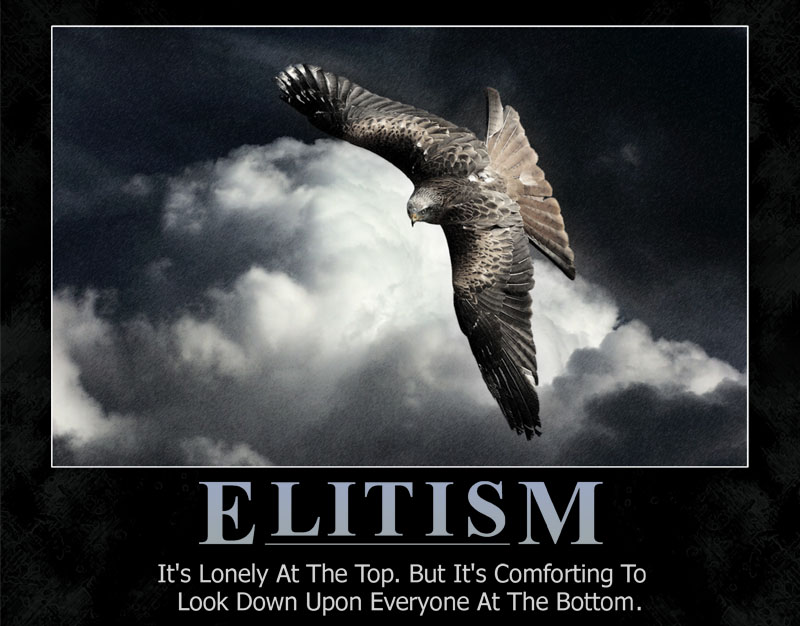
However, perhaps even more disappointing than snobbery is the elitism that seems to be creeping into social media as well. While they may share certain characteristics, they are two different beasts.

Instead of the “do as I do” approach I discussed in my snobbery post, there’s a growing trend of “I want to feel more important than you” elitism that’s becoming more apparent.

A good example is the Twitter phenomenon. At its heart, it’s an excellent tool to not only make new friends and potential business contacts – it’s also a great way to see a microscopic snapshot of someone’s life in nibble-sized chunks. The fact that Twitter only allows you 140 characters to say your piece means you have to use that space wisely. This can lead to some very inventive and humorous comments.

Yet lately Twitter has become nothing more than a virtual brothel for people to either whore themselves out or to come across as a “look at me, I’m great” type of person. As a fan of social media and all it can offer, I find that sad and a little disappointing.

I’ll be the first to admit that I’ll notify my fellow Twitter users/followers of a new blog post – but then, that’s fairly standard for pretty much everyone on Twitter.

Where the application is losing its appeal (for me) is the amount of people that shout out about how many followers they have, or how many more they need to reach 500, or 1,000, or something similar. When did Twitter become a popularity contest? Isn’t that what MySpace is for (and one of the reasons Facebook is starting to take over from the Fox-backed networking site as the most popular)?

Maybe it’s just me, but I can see from your Twitter profile how many followers you have, or how many people you are following. That doesn’t interest me – and judging by the reaction of some of my friends who have stopped following certain Twitter accounts, it doesn’t impress them either.

Instead, tell people about excellent sites or blogs they should be checking out. Tell them about tools they can use to make them more effective in either their online brand building or improving their social media awareness.

Constantly mentioning you have so many followers often emits an air of superiority that no-one really enjoys and can lead to them unsubscribing from your updates. Which kind of goes against all that social media stands for, no?

Social Media is Social – So Why Closed Comments?

Take a look at the phrase “social media” – what would your response be if you were asked its literal meaning?

The most obvious answer would be media that is social – whether that’s participating in an online group, sharing your views on a topic or leaving a comment on a blog, offering your opinion and insight. So why do so many proponents of social media come across as anything but social?

I’m mainly talking about blogs that either have closed comments, or require you to register with the site to leave a comment. Maybe it’s just me, but personally I feel that takes away the whole social aspect of social media.

My take on social media is that it’s a combination of different tools and communities, all coming together to offer an invaluable and co-operative journey with online friends. Even business social media is more about how businesses can reach their customers effectively and pro-actively, therefore building a loyal online database that ensures the company’s growth and sustainability.

So why potentially ruin this new world by sticking with the old cliquish approach of invite-only commenting?

I know that it’s down to personal choice as to whether you allow comments on your blog or not – after all, one of the negative sides of the blogosphere (at least in the early days) has been the puerile comments that are often left.

(Although thanks to the likes of BackType, the quality of blog comments should hopefully improve to a consistent level of maturity along the lines of those found on the leading social media blogs).

But isn’t this what comment filters are for? Having the option to approve all comment posts before publication eliminates (or at the very least, greatly reduces) playground-level comments.

Perhaps the blogs that have closed comments or require membership to post a response do so in the belief that it helps build their own specific community. This seems plausible, since the majority of blogs that I’ve come across with closed or member comments only do seem to be of the business variety.

I can’t help but feel that they’re missing out, though. Sure, a members-only comment option may encourage a number of people to sign up so that they can join in the discussion. Yet at the same time, you can pretty much guarantee this is a far smaller number than the amount of commentators you’d get with an open comment policy.

And if you don’t know what your readers are really thinking, aren’t you missing the whole point of building your brand and voice through the social media medium? Doesn’t seem like good business to me…

What do you think? Does it matter if comments are closed? Do you feel the need to share your opinion on something you’ve just read, or are you more interested in what’s being said as opposed to what you want to say? I’d be interested on your views.

The True Meaning of Social Media

So, social media. It can be pretty confusing, right? After all, one person tells you one thing about it while another person tells you the complete opposite not 5 minutes later. And then the day after, you have someone else telling you it’s something in-between the previous two explanations! No wonder social media is so confusing. So what does it mean?

To be honest, social media is exactly what you want it to be. You want it to be a way of finding cool and interesting websites that you would never have found before? Sign up to Stumbleupon. You want to know what blogs are popular? Get yourself a Technorati account. History of all the comments you’ve ever left? Backtype. And the list goes on.

For me, however, the true meaning of social media can be found in the way that people who would normally be business competitors offer support, knowledge and different expertise to those who need it.

I’ll give you an example. On my Twitter account, I’m probably connected to around 40 or so people from the PR and copywriting industry, whether it’s through me following them or them following me (or both, even). Now, in the “normal” business world, they would be competitors so you’d think the last thing we would want to do is help the other out.

Yet instead, Twitter sees any request for help or advice answered almost immediately, and often with information that would offer a distinct advantage if kept private. Now to me, that’s social media at its finest.

Yes, we’re all in business and we all want to succeed, but gone is the “at all costs” attitude of the last decade and beyond. With the Internet opening up a whole new world of commerce and potential customers, there really is enough to go round for everyone. And people are realizing that.

Not only that, but people are also encouraging others to succeed and offering up the tools with which to push for that success. You can’t get much more of a truer meaning of social than that, media or otherwise. Perhaps we should get the leaders of the world into social media? After all, they could use all the help they can get.


  • « Go to Previous Page
  • Page 1
  • Page 2
© 2026 Danny Brown - Made with ♥ on Genesis