• Skip to primary navigation
  • Skip to main content
Danny Brown

Danny Brown

podcaster - author - creator

  • About
  • Podcasts
  • Journal

content

The Sunday Share ? Enabling Your Google Authorship Markup

what does google want to be

As a business resource,?Slideshare?stands pretty much head and shoulders above most other content platforms.

From presentations to educational content and more, you can find information and curated media on pretty much any topic you have an interest in.

As a research solution, Slideshare offers analysis from some of the smartest minds on the web across all verticals. These include standard presentations, videos, multimedia and more.

Which brings us to this week’s Sunday Share.

Every week, I?ll be sharing a presentation that catches my eye and where I feel you might be interested in the information inside. These will range from business to content to social media to marketing and more.

This week, a short but useful Slideshare from JoannaVaiou, a SEO consultant and strategist from Greece. As Google continues to utilize Google+ as a social layer that ties all its other products together, its Authorship Markup feature has become even more important.

This presentation explains just what Google’s Authorship Markup is, why you need it, and how to enable it.

Enjoy.
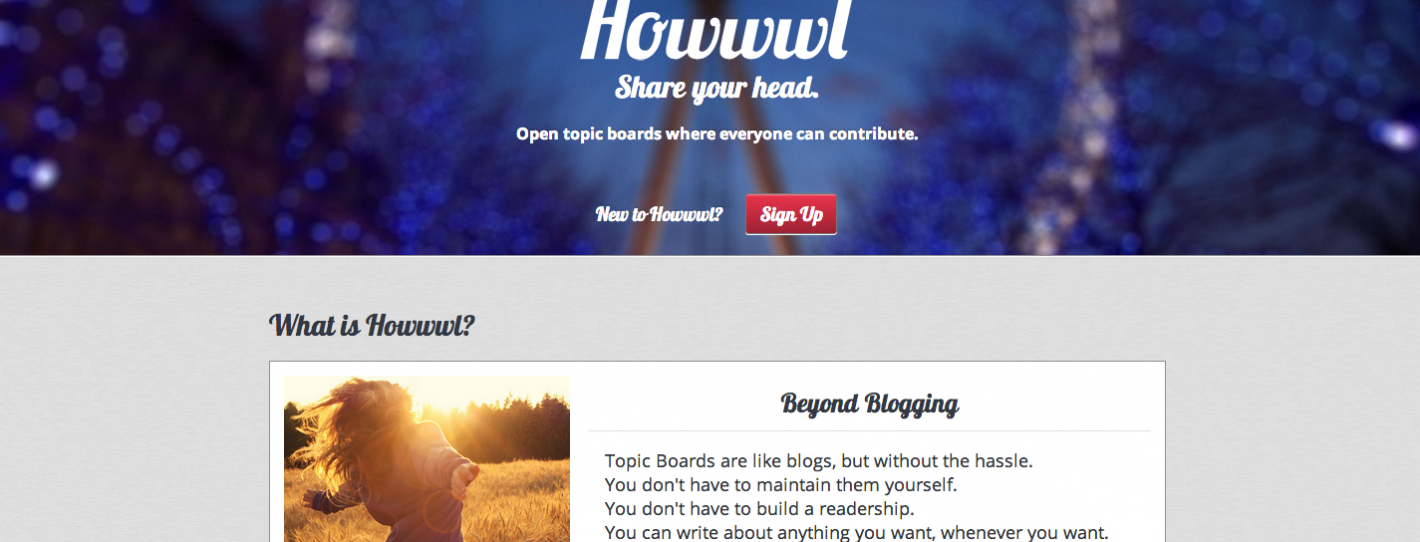
 

Blogging in 2013 : The Year of Crowd Curation?

Howwwl Share your head.

This is a guest post by Paul Mayze.

The barriers to blogging are now lower than ever. ?At least, that is the theory.

On WordPress and Blogger it takes minutes, if not seconds, to set up your blog. On Tumblr, adding content is child?s play (and if in doubt you can repost something from someone else).

Of course, the reality is that blogging is harder than ever. Assuming your intention is to generate a readership for your blog, setting up a blog isn?t the problem. ?The problem is keeping it up.

But a new breed of content publishing and curation tools is focused on tackling this issue head on.

[Read more…] about Blogging in 2013 : The Year of Crowd Curation?

Don’t Confuse Free With Free Exposure

Understand free versus paid content

Understand free versus paid content

There’s an interesting debate online at the minute about the AOL purchase of The Huffington Post for $315 million dollars.

The debate isn’t so much about the price – of the amount, $300 million is expected to be straight cash – but more around the contributors to The Huffington Post over the years, and the belief that they are owed some of that money.

The train of thought behind this is that, without the contributors, The Huffington Post wouldn’t have had anywhere near the content that led it to becoming one of the most popular sites on the web, with more than 26 million unique visitors per month.

So now there’s a backlash against The Huffington Post, and blog posts and social networks are filling up with ways to get back at Arianna Huffington for “selling bloggers and citizen journalists out.”

To me, though, this backlash is missing a simple point – the content wasn’t the property of the contributors once they signed their publishing “deal” with The Huffington Post.

Paid Content or Free Exposure

A caveat – I don’t know the contributor Terms and Conditions for The Huffington Post, but if it’s like any other main publication (or smaller one, for that matter), then there will be two options:

  • You become an official contractor for the publication, and draw either a salary or pay-per-published-post option.
  • You contribute for free, in return for the exposure and back-links to your own site or blog.

While being paid might seem the more attractive option straight up, very often the opposite is true. That’s a one-off (unless you sign a royalty and re-publish agreement).

With the exposure and authority that can come from being a contributor to something like The Huffington Post, that can set off a long-tail effect that is both constant and residual.

It’s the exchange mechanism at work – I accept I won’t be paid in hard cash, but I’m giving that up for the potential of grabbing a section of 26 million visitors to my own site, as well as being put in the spotlight for media interviews and quotes as a respected expert on a certain topic.

Pain Points or Sour Grapes?

I’ve made decisions like this in the past and will (possibly) do so again. My blog is syndicated to different networks, which has helped raise awareness of what I write about over here. I syndicate less now – or more judiciously – because the trade-off in syndication is often losing traffic to the syndicating source.

But you make that decision.

Jeff Esposito, who’s a PR Manager, makes a good point. “It’s just sour grapes of putting things on rented space since she owned the blog. It’s kind of like tumblr going down or people basing their whole community strategy on Facebook. What happens when the owner sells the site or just deletes it? You are shit out of luck either way and these folks are pissed because they only got paid in Skittles and viewers.”

Kami Watson Huyse, a 16-year PR veteran and co-founder of Zoetica, also sees it as misunderstanding of rights and property. “When you write for a portal like Mashable or HuffPo (or just on your friend’s blog) you agree to do it for the visibility and even the links back to your own site, which are a currency all their own. Many people write articles and scatter them all through the Internet on much less influential sites just for the SEO. In other words, you already accepted your ‘pay’ so move on.”

I have to agree with both Kami and Jeff, and the others that aren’t sold on the view that The Huffington Post should share the sale price with its contributors. That’s not to say I’m a fan of The Huffington Post – I think I’ve read it twice – but unless an agreement was put in place about profit share, the pay is the exposure.

Lessons Learned

Does it suck that Arianna Huffington will get millions of dollars while the people that helped build the site up to that sale price get nothing? A little, but that’s business – very rarely do 100% fair things happen when there are so many factions at play.

The Huffington Post and its contributors aren’t the first to be in this position, and they won’t be the last. Unless people take responsibility for their content and contributions.

  • Make your work Creative Commons. This means you choose how it’s used, shared and attributed. It gives you power to claim if the license is broken. This blog is Creative Commons, as shown in the sidebar.
  • Define your contract. If you want paid, make it a paid one. If it’s free for exposure, see if there’s a way you can share in profits for extremely popular content.
  • Ask for republishing rights. You give up a window of exclusivity, but after that period is over, you can republish on your own site and be truly recognized for it.

The web is awash with content and people wondering how to get noticed amongst the noise. Often the solution is to write for a hugely popular outlet and look to build awareness of yourself that way. But that means giving up a lot of your own identity in the process.

As the current argument over The Huffington Post sale shows, it’s a decision that shouldn’t be taken lightly, because everything has a price.

Whether you get a share or not is the question.

image: psd

  • « Go to Previous Page
  • Page 1
  • Interim pages omitted …
  • Page 3
  • Page 4
  • Page 5
© 2026 Danny Brown - Made with ♥ on Genesis