• Skip to primary navigation
  • Skip to main content
Danny Brown

Danny Brown

podcaster - author - creator

  • About
  • Podcasts
  • Journal

Influence

Internet Fame and the True Impact of Influence

Affiliate marketing masks

DSCN1849.JPG

You may be aware that there is a big debate going on in the social media blogosphere about ?influence? (and you can see links to several blog posts at the end of this one for examples of these discussions).

How we need to leverage influencers in our communities in order to get the word out about our causes, brands or services, etc. And that makes total sense from a generating-word-of-mouth point of view.

But hold on.

If you?re trying to do this, what if you don?t actually know who your industry influencers are? Perhaps because you?re not really immersed in your own open community, or because your community is too large or public-facing to be able to list your champions in an organic way, you?re just not seeing it?

So you begin to use some of the tools out there that purport to measure influence, and you start to think, ?This isn?t as easy as it sounds.?

Maybe you?re starting to think that influence is not about how many followers someone has on Twitter. ?Maybe you?re starting to think that ?influencer scores? are totally meaningless for your goals and objectives.

So what is influence, really?

Can it be measured (and if so, how)? How can you find the influencers in your industry? Do apps?like Klout or Twitalyzer really work to automate this? Or?is this all bunk?

A group of us are going to be talking about Internet Fame and the True Impact of Influence in a new BlogTalkRadio show on Wednesday February 9 at 10pm ET.

This new show is the brainchild of some really smart social media practitioners and consultants from various industries, and the purpose of the show is to debunk some of the social media bubble/hype around various issues. The tone will be irreverent, but the conversation and concerns around the topic are very real.

I hope you?ll be able to join us (expect the accompanying chat to be lively and extremely snarky!), or listen to the podcast afterwards (bookmark this page and come back to listen!).

I?ll be hosting this inaugural episode (uh-oh!) and Tamsen McMahon, Lisa Thorell, Allyson Kapin, Rich Becker and Olivier Blanchard will be chatting live with me on the night. But, as it?s BlogTalkRadio, anyone can call in and ask the panel questions. Lots of other people with thoughts on the topic will be listening in and participating by chat.

In preparation for the radio show, here are some of the blog posts the group may be referencing.

  • 4 Things You Need to Know About Influence ? Tamsen McMahon, on Brass Tack Thinking
  • It?s About Impact NOT Influence ? Allyson Kapin on Frogloop
  • The Influence of Trust ? Danny Brown
  • Artifacts of Influence: grassroots movements, familiar strangers and the power of the social media daisy chain. ? Olivier Blanchard
  • Flipping The Scale: Influencers Are The Most Influenced ? Rich Becker on Copywrite, Ink.
  • Klout & Critics: Time to Close the Door or Kick it Wide Open? ? Lisa Thorell on Digital, Ink.
  • Strength of Community Supersedes Influence ? Geoff Livingston
  • Why I?m 10X As Influential As Ashton Kutcher On Twitter* ? Chris Yeh, Adventures in Capitalism
  • The Holy Grail of Online Influence vs Our Current Measurement Limitations ? Beast of Traal
  • How do you evaluate influence? ? Jeremy Porter, on Journalistics

So put the kids to bed, grab your tipple of choice, and join us on Wednesday evening!

This post is derived from Maddie Grant and SocialFish.
The Influence of Trust

The influence of trust

The influence of trust

What is trust, exactly? Is it the same for everyone, or can it be different?

Can trust in a celebrity, for example, be as strong as trust in a friend or family member? It might seem a strange concept, but if that celebrity has a lot of influence over you then isn?t that just as strong as advice from a close friend?

And how about a business? Does the sales or marketing message from a business hold more sway than word-of-mouth from a friend or connection if the business hasn?t been wrong so far?

Sony, for example, used CGI-rendered demos for their soon-to-be-released Playstation 2 console back in 1999 yet claimed they were in-game graphics. When the actual games came out, they couldn?t possibly live up to the hype, yet the console would go on to become one of the most successful ever.

So can trust be overcome with huge marketing and advertising budgets and sheer brute force of numbers?

It?s often said that the capital of trust is crucial for any business success. It?s also part of what makes us who we are, and how we view others (and are viewed ourselves). But can trust be manipulated to the point that it?s difficult to differentiate between a sales pitch and a genuine recommendation?

As paid blogging and sponsored tweets continue to come under both praise and criticism, it?s clear that trust will define who is successful and who isn?t. Or will it? Does trust disappear when monetary value comes into play?

How does your trust come about? If it?s broken, is that forever or do you offer second chances? Can companies be trusted implicitly, or is it it the means to an end for selling a product?

I trust your views ? feel free to share them and let?s open up the conversation.

image: scottburnham

Influence That!

Klout and Influence

There’s a lot of negativity around online influence tools at the minute. Things like Twitter Grader, Klout and similar are coming under fire, with common complaints being how is influence decided, what metrics are used, and does it even matter anyway.

Allyson Kapin came up with a great statement, about measuring impact as opposed to influence – show us real metrics of success from your actions as opposed to success with your interactions (big difference).

There’s no doubt influence can be beneficial – think of Ashton Kutcher getting his Twitter followers to buy a bunch of mosquito nets to fight malaria, for example.

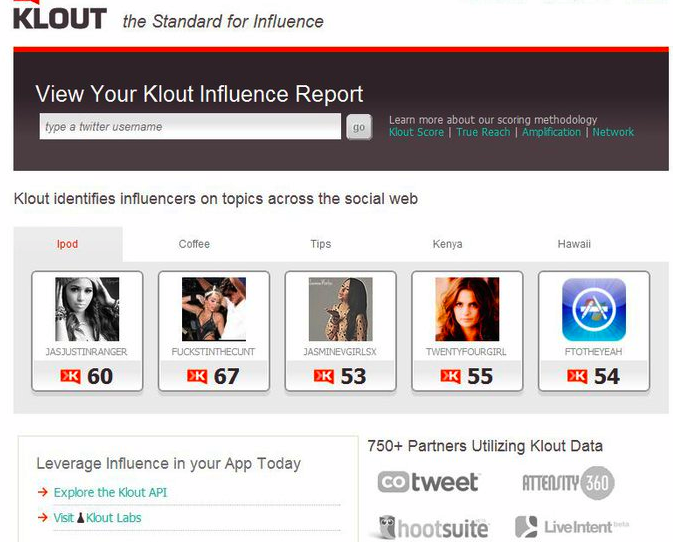
Yet, as the second image from the left below (taken from the Klout homepage) shows, there’s still a ways to go on defining influence, and sums up perfectly why influence measurement tools are coming under fire.

Unless there’s a big market for vaginal influencers…

Does Klout influence matter

The Problem with Influence

Ego and big heads

I just read something by a friend that’s both interesting and sad at the same time (and sad as in lame, not as in Bambi).

My friend mentioned that he was speaking to a well-known PR guy and author a few months back.

The topic of the conversation was a site for bloggers and authors that my friend works at. According to the PR guy, the site would never be much of a success because he (the PR guy and author) wasn’t ranked high enough.

The PR guy then went on to say that the site wouldn’t be a success because, “You have to make sure the biggest influencers are ranked at the top.”

As my friend so eloquently put it, well f*ck me sideways.

Influence Shminfluence

The problem with influence is that it all boils down to relevancy. You can’t tell me that a pig farmer in Alaska (tough old pigs out there!) is influenced by what a PR guy is saying about the 2.0 or 3.0 world.

Instead, I’d think he’d be more influenced by bacon writers and pork chefs, and analysts looking at how the pork buy trade will look in the next two years.

When it comes to influence, the folks that matter to us are the ones that are in our industry, or affect the industries of our customers and clients. That’s what influences our business and its success (or lack of it), not someone who’s in an industry that has little to no relevance to us.

There’s no doubting that the PR guy is influential in his sphere – but does that mean he should be viewed as such in all spheres, and “ranked higher” because of it?

Egos and Eggheads

And this is where the real “problem” with influence comes in – when it starts to make you feel you automatically deserve to be in a certain position, or recognized more by something or someone.

The quote my friend uses – “You have to make sure the biggest influencers are ranked at the top” – is possibly the biggest reason why influence is coming under so much flak at the minute (just Google “Klout sucks” to see some examples).

We seem to be creating an environment where people expect to “be someone” because you have some success in a certain field, which is a shame.

There’s nothing wrong with success, and there’s nothing wrong with pride in your achievements. Hell, success should be celebrated.

Ego, on the other hand (especially one where your head gets as big as an egg’s on a pin tack) is a different beast altogether. When it reaches the stage that someone says a venture won’t be successful because the influencers aren’t ranked higher – then we have a problem.

Influence and Success

We need influence. Consumers buy from their favourite celebrities and their recommendations of a product. Professionals buy from people they trust when that person makes a recommendation. Brands use “names” to help promote products and services.

So influence works. But wouldn’t it be better to be the right influence, as opposed to the type that’s defined by someone who appears to have a huge dose of self-importance?

And as for that site that would never be a success?

There are about 30,000 authors and bloggers registered with the site. The company had a great Blog World Expo, and are about to launch a new platform that (ironically) will help people like the critical PR guy connect with bloggers for PR campaigns.

Not too bad for something that defines its own influence, huh?

image: Divine Harvester

How NOT to Win Friends and Influence People

DSNR Media spams Facebook page of Danny Brown

When is sharing information useful, and when is it just spamming off the back of someone else’s community?

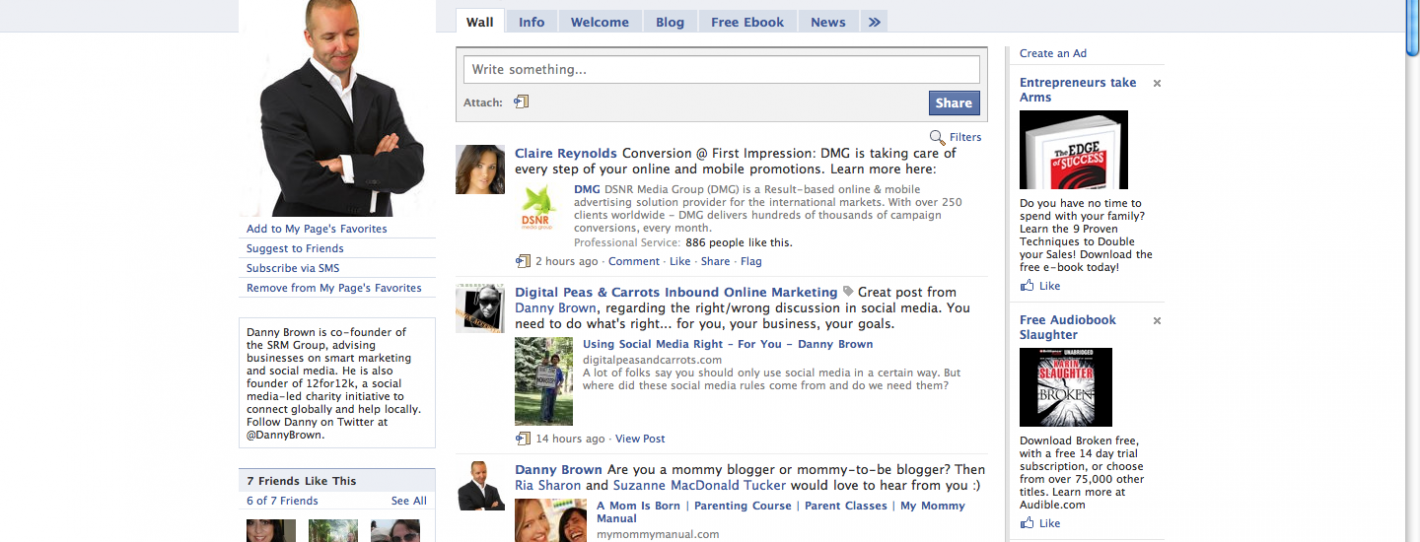
I ask because when I logged into my Facebook page today to post an update on a future Bonsai Interactive event, I was met with this at the top of my wall (click to expand).

DSNR Media spams Facebook page of Danny Brown

It was posted by Claire Reynolds on behalf of the DSNR Media Group. At least I think it’s by Claire on behalf of DSNR, since Claire’s Facebook profile has her located in the U.K., while DSNR are based in Israel.

DSNR describe themselves as “a recognized global provider of result-based online and mobile advertising solutions… with cutting edge optimization tools.” Really, DSNR?

So spamming your message onto a Facebook wall is considered cutting edge? Shilling your wares without permission is your great advertising solutions? Posting links to your service where they may or may not be relevant to the audience is ethical?

Here’s a heads-up – spam is not cool.

You can paint it whatever way you like, but you’re spamming.

You’re an online advertising company, so I’m pretty sure you’re aware of Permission Marketing from Seth Godin. Even though it was written over 10 years ago, it’s still more than relevant today. Check it out – it’s a great read and might open your eyes as to why your current spamming approach isn’t welcome.

In the meantime, I’m removing your post on my wall. I respect the community I have over there, and I don’t want them spammed by you either.

Have a great week.

  • « Go to Previous Page
  • Page 1
  • Interim pages omitted …
  • Page 12
  • Page 13
  • Page 14
  • Page 15
  • Go to Next Page »
© 2026 Danny Brown - Made with ♥ on Genesis