
Life is not about finding yourself. Life is about creating yourself.
Journal
Is Social Media Turning Us Into a Bunch of Voyeuristic Assholes?
Back when I was in high school in the UK, whenever there was a fight a group of kids would create a circle and encourage the combatants.
This was primarily for two reasons – one, to egg the fighters on and hopefully see blood (yeah, we were a civil bunch) and two, to ensure no-one would interrupt until the end of the fight.
We got so good at enabling this “circle of doom” that even teachers struggled to break up really good fights, and sometimes didn’t even try – they’d simply wait until the fight was done, and then dish out whatever punishment was relevant.
As mean as this might sound, one thing I recall would happen every single time is that, once the fight was done, the two combatants would usually smile and be friends.?Kids, eh?
The point being, there was no ongoing damage from that moment of carnage.
Jump forward 30 or so years, and now social media is enabling us to return to that schoolyard environment, but with one key difference – now we’re just being voyeuristic assholes, and the damage isn’t being limited to a few bruises and cuts.
It’s Social Media, There’s No Such Thing as Privacy
Earlier this week, Twitter (and the subsequent social web and entertainment rags) lit up with the live tweeting of a couple’s break-up on a delayed flight.
While waiting on the tarmac for the flight to take off, allegedly a guy broke up with his girlfriend, and their 90 minute exchange was shared across Twitter by New Yorker Kelly Keegs.
The live tweeting started with the image below (I’ve blurred the heads of the couple involved):

This was followed up by a whole bunch of tweets that gave a play-by-play account of what was happening.


Eventually, according to Keegs, the couple started making out and ordered a round of drinks for the flight when it finally took off.
But this wasn’t the end of it.
As Twitter users got hold of the “story”, it started trending, and people started following Keegs to get updates. By the end of the “event”, her Twitter followers had at least doubled (stats by Twitter Counter).

Which kinda says a lot about the kind of people we’ve become, when we see a young couple’s emotional distress as entertainment fodder.
Yet should we be surprised? This isn’t the first time this kind of thing has happened.
I’m Bored, Let’s Stroke My Ego a Bit
Back in November 2013, TV executive Elan Gale live tweeted his exchanges with a passenger on his flight.
Much like the flight Keegs was on last week, Gale’s flight was also delayed. By his account, a female passenger named “Diane” became agitated and demanded special treatment.
This frustrated Gale, and once they were on their flight, he started sending notes to Diane about how awful and selfish she was.
As it turned out, this whole “exchange” was a complete fabrication (many people are thinking the same of the Keegs example, too) made up by Gale.
Much like Keegs, Gale’s Twitter following during the event jumped from 35,000 followers to over 175,000.
Clearly, social media enjoys a humiliating sideshow, real or otherwise, as evidenced by the amount of favourites and retweets both Gale’s tweets about “Diane”, and Keeg’s tweets about the emotional couple, show.

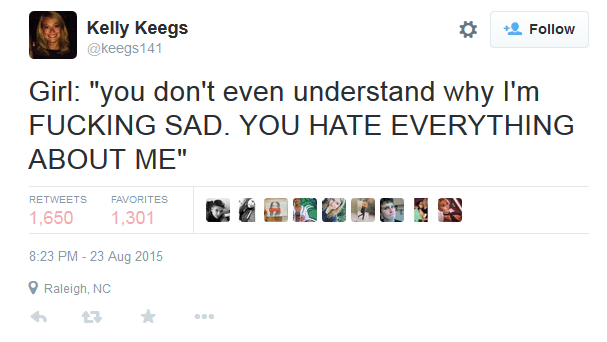
Of course, these are just simple passive endorsements – anybody can like, favourite or retweet.
It’s when you look at some of the commentary around these things that the assholery of our current love for social media voyeurism comes to the fore.


So, not only are we moving from an encouraging-the-chaos-to-continue-to-be-shared mindset, we’re actually laying the blame for all of this on the victim(s).
Like when others decide to stand up for those being humiliated further in the name of social media entertainment, and the peanut gallery tries to deflect this empathy by (once again) blaming the victim.

Because, yes – public place and all that jazz. Except there’s a very big difference between a public place that’s limited by confinement, and public on social media.
Forget Empathy, Give Me My Internet Fame!
Jumping back to Keegs and her live “commentary” of the couple breaking up opposite her,?she seems to have taken all the recent attention in her stride and celebrated it.
From getting all giddy at her Twitter count jump, to saying the worst part about the whole affair was having to apologize to her nana for the profanity in the updates, there’s very little empathy or sympathy on display for the couple in question.
(Note: I haven’t watched any of her TV appearances, or listed to any of her radio interviews, as I have zero interest – she may well have shown sympathy then.)
Which does seriously make me wonder if she didn’t make the whole thing up to get attention – after all, you’d need to be a pretty shitty human being to take joy from someone else’s suffering, right?
Internet fame can be alluring, after all – just ask the countless number of people who try and create viral Vines, or share outrageous memes and social updates in the name of stoking follower count (even through controversy).
But let’s take the viral side of things away for a moment, and look at what’s really happening.
It’s Not Following Along, It’s Voyeurism, And It Can Be Damaging
In the case of the alleged break-up shared by Keegs, this is about a young couple going through one of life’s toughest moments – a romantic break-up.
If you’ve ever broken up with someone – or, more specifically, been broken up with by someone – you know the pain and anguish you immediately feel.
Your heart is broken. Your soul feels empty. Your skin feels like it belongs on someone else. Simply put, you cease to be who you were just a few seconds before.
Now, as bad as that is, we (eventually) get over that. Our friends help us forget and move on, and our family provides the emotional cushion that only they can truly give.
And the reason we’re able to get on with our lives is that the pain and fallout has been kept in a very limited and reasonably private bubble.

Now consider one of your worst moments in life being shared to thousands on Twitter. Not only described in words, but “enhanced” by a picture of you and your soon-to-be-ex breaking up.
Then think of all the abuse coming your way to protect the sharer of your break-up, just so the voyeurs of that break up can justify it by saying it’s in a public place.
That’d suck, right? So why do we encourage others to share the very thing that would break our hearts if it was us?
[clickToTweet tweet=”Why do we encourage others to share the very thing that would break our hearts if it was us?” quote=”Why do we encourage others to share the very thing that would break our hearts if it was us?”]
Take it just one step further.
Someone is emotionally raw, vulnerable. They’ve just had their heart broken. They feel life is over. And then they learn that it’s been not only shared but celebrated on social media.
Mainstream media too, going by the interest in Keegs’ little Twitter adventure.
And then the abuse starts piling up. And the shame, and humiliation, and strangers saying you deserved all you got because clearly you’re highly strung and your boyfriend (or girlfriend) is well shot of you.
You already feel life is over, because the love of your life no longer wants to be with you. So why not actually make it over?
A little far-fetched? Examples around the web would suggest otherwise – all so we can get our voyeuristic kicks.
It’s Not the Same As When We Grew Up
In drafting this post, I shared on Facebook that I was writing a piece on how social media has turned us into voyeuristic assholes.
One of my friends who I respect a lot for his measured take on things is Ike Piggott. He suggested something that I’ve heard a lot of in the last 12 months or so, when this kind of topic is raised.
“Rubbernecking” always existed before automobiles, it just got more pronounced and easy to spot when we were all lined up and going the same way.
The point Ike makes (and it’s correct) is that assholes have always existed – it’s the environment that determines how many assholes are visible.
Social media, by its sheer raison d’etre, merely enables assholes to have the kind of audience they could only have dreamed off pre-2006.
And yet… does that really offer an excuse? Does that essentially agree with the premise that, hey, it’s in the public so it can be shared?
Perhaps, at least legally. Different countries have very different viewpoints on what’s classed as an invasion of privacy versus something along the lines of “fair use”.
And maybe that’s what we, as a generation, have signed up for when we openly share the private moments that otherwise would only have been seen by family and friends. Pictures of our kids on Facebook, for example, or that goofy vacation photo.
But that’s the difference – we choose to share, as opposed to some attention-hungry stranger who gets their kicks out of the misery of others.
Yes, we’ve all seen something happen in the supermarket, or at a bar, or in a park, and we’ve talked about it with our partners, our work colleagues, our friends.
But that’s always been within a very closed circle, with zero targeting of, and abuse to, the person or people in question. That doesn’t make it right, necessarily, but it does “protect” them.
Today, there’s no such protection. Today, everything is fair game. Today, everything and anything can be shared so we can claim our 15 minutes of digital fame.
If you think that this isn’t a big deal, and that it’s simply fun and will soon be forgotten, ask yourself this:
If it’s your son or daughter that’s the object of the voyeurs of social media, would you laugh at them and tell them to stop being such drama queens?
Think about it.
My Social Media Story: How Blogging Saved My Life

This is a part of a special series looking at how social media has impacted the lives of its users. This week, the story comes from Nancy A. Davis.
A few years ago, life dealt me some tough blows. I lost my home. I wound up in a highly abusive relationship, and as I worked to get free from that, I got hit by a car and nearly died.
The scariest thing about being in that hospital for four days by myself was that no one knew what happened to me. I simply fell off the face of the earth so to speak.
At the time of the accident, I was also living in a homeless shelter. I was scared and alone. What was I going to do? How would I survive all of these feelings?
As well as having?to go to court to obtain a restraining order, I also had many doctor appointments – how would I stay sane?
My Blog Kept Me Sane
Writing saved my life. Simple as that.
When I first got back to blogging, I did so under a different name because my ex-boyfriend was stalking me online.
Each day, I either used a friend?s laptop or went to the public library to go on Facebook and my blog to see how people were doing. The response I got and the support of my friends kept me going.
So many days I wanted to quit.
So many times I looked to the sky and screamed about my fate.
Being on that blog allowed me to let those feelings out. The love and support I experienced on my Facebook and my blog kept me afloat more days than I can tell you.
The Joy Is In The Journey
After being in the shelter for a year, I was finally able to move out. Living in a place like that taught me so much.
First of all, not all homeless people are drug addicted alcoholics. The number of individuals who have no place to go keeps rising.
Part of what I wanted to do with my blog was give others hope that they can get out of these situations that seem impossible. The biggest success of my blog is that I can give my voice to a group of people overlooked by society.
If I can encourage one person to not give up, I have succeeded.
Life When It’s Different
I have a beautiful apartment that I share with my boyfriend and our two cats. I no longer have to worry about where my next meal will come from.
These victories I share on my blog and on Facebook.
Signing that lease was one of the happiest days of my life. To be able to share that not only with my offline friends, but my online ones as well really made it even more special.
Online Friendships Are Real
Before I lost my apartment, six of my online friends got together and sent me a check trying to help me stave off eviction.
One of the women I became friends with through her blog messaged me and asked what my boy would like for Christmas that year.
I cried tears of pure amazement. This was something I never expected to get from social media.
I have role models who watched my life go from bad to worse, yet they never judged me. I hope they know how much they all mean to me. That support in my darkest hours kept me alive.
So, when people tell me blogging is my hobby, I tell them no – blogging saved my life.
 About the author: Nancy A. Davis is a homemaker, blogger, and the shortest person she knows with the biggest mouth. She lives with her boyfriend Frank and their two cats in Western Massachusetts.
Her biggest goal in life is to finish writing her book. You can read more from Nancy on her blog, or connect with her on Twitter.
My Social Media Story: What Seems Like the End is Often the Beginning
This is a part of a special series looking at how social media has impacted the lives of its users. This week, the story comes from Randy Milanovic.
It was 2009. The world was being thrown into a ‘downturn’, and my visual?communications?firm was starting to feel it. I was focused on my work and burning the candle at both ends.
That was of course, until I was admitted to emergency and received a stage IV cancer diagnosis. My doctors advised me to get my will in order.
10 days later I’d lost 60lbs, was skeletal, and struggled to remain conscious while suffering from excruciating pain.
On that 10th day, a man I’d recently met through my business visited me in hospital. As I lay in my hospital bed, he pulled up a chair next to me and put his hand on my shoulder.
Almost immediately I felt heat – as if he’d put a hot water bottle on it. He sat with his hand on my shoulder for what I imagined was around 6 hours. The heat steady and strong.
Each time I moved or tried to mumble a few words, he advised me to lay still and keep quiet. He said he was giving me energy.
While he sat there, I felt my mind drift?uncomfortably?downward. At roughly half way, very deep down, the pain disappeared.
For the first time since being admitted to emergency my mind?cleared – became sharp almost – and everything was silent.
I heard a voice ? my own ? boom into that silence,?“I haven’t accomplished enough yet.?
I agreed, and with that I began to drift back upwards. Back into the pain and into a battle for my life.
The Steps to Recovery
Upon surfacing, my visitor abruptly lifted his hand and matter-of-factly stated,??Well I?m done. I?d better get back and help my wife with the renovation.”
Many long months of chemotherapy, anti-bug cold rooms, and endless hours spent staring at the second hand of the clock on the wall, I was released from hospital.
Emaciated from my battle, with not enough strength to climb the stairs to my bedroom, I spent day and night on a recliner in my living room while my family tended to me, fed me, helped me to the washroom, kept the fevers cool and the room warm.
And I got a new puppy who would climb up and wrap himself over my shoulders, keeping my neck?delightfully?warm.
[insert]  [/insert]
With time, I became strong enough to leave the recliner. Using my mobile?phone, I studied. I was determined to return to work wiser (forever an entrepreneur) and rebuild by communications business.
Over the next 18 months, I improved my strength, continued to expand my knowledge of all things on the web, and began planning to make something of the new opportunity I had promised myself.
Not a gym-goer, I sought out alternate exercise options. Sure I could walk and even hike, which was a good start to?improving my health, while unfortunately doing almost nothing for my upper body fitness.
Being on the water in canoes and kayaks as a youth in BC, it wasn’t long before I eyed and purchased a pair of kayaks. Yes, a pair. I would encourage others to join me.
To this day, I extend invitations to family, colleagues, neighbours and even strangers to join me for a paddle. When on the water, I find we are all filled with peace and calm, and it is an incredible way to?recharge.
Life and New Beginnings
In late 2010, I was able to return to work, a few hours at first. My colleague and I?went door to door to generate new?business. We won enough work to stabilize.
That new work paid the bills but didn?t change anything. I didn?t see anything in those projects that would present opportunities to accomplish??more?, as had motivated me to survive the Cancer.
What would change things I believed, was a concept that was swirling around in my mind. One of how I might combine my twitter?account with my portfolio and blogging to attract new clients.
I then happened by a Forrester study that talked about Paid, Owned and Earned media.
And everything clicked.
I would focus on attracting new business in a downturn, simply by sharing knowledge.
A Google Adwords coupon arrived in the mail. A $20 crutch I felt I needed. I beefed up my website, started tweeting, and wrote about the new?business we?d recently earned via my blog.
A week or so later, we earned $12,000 in new business, for a return on my $20 investment of roughly 600x.
Along with that return came a realization that the Adwords weren’t needed.
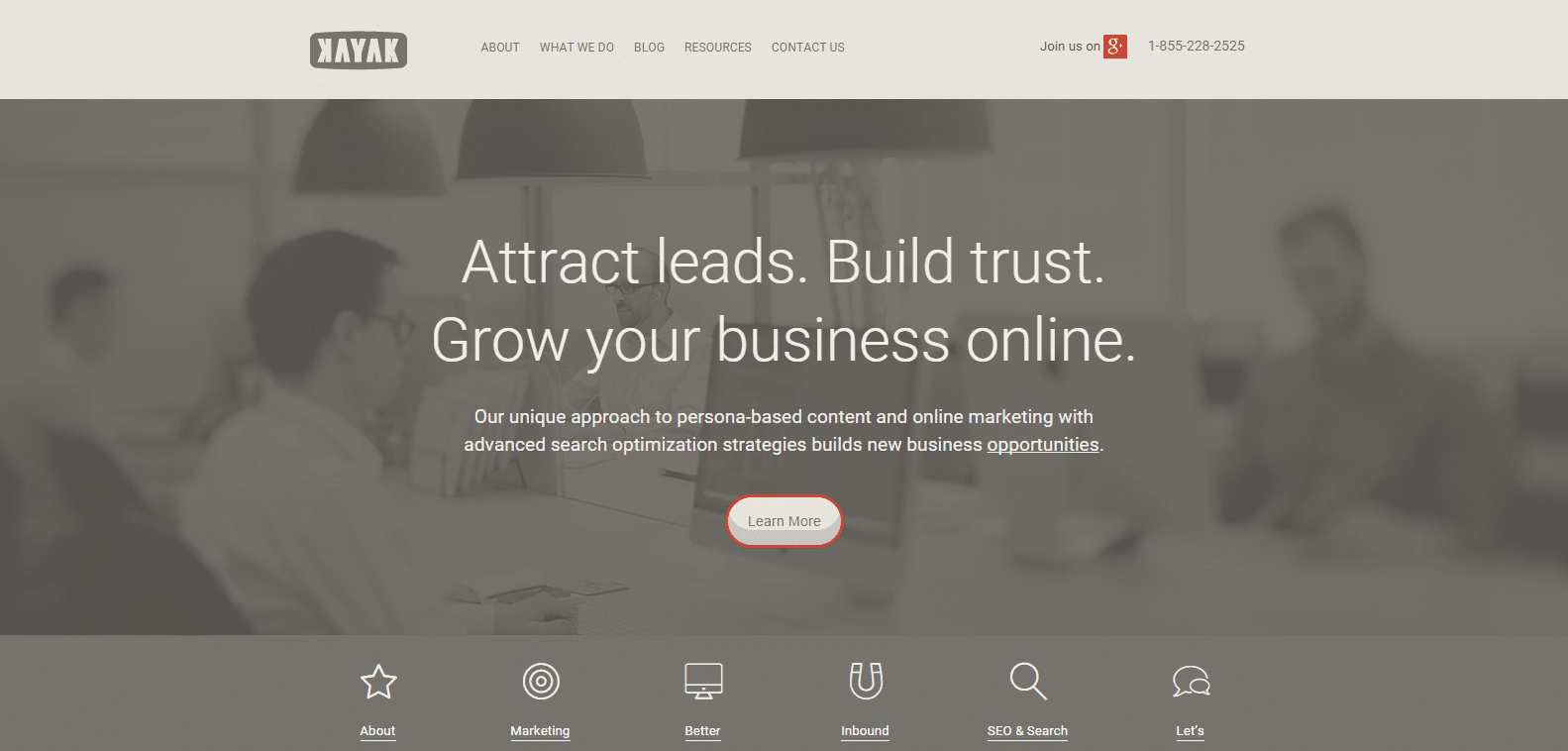
Simultaneously aware of the unsellable position I’d put my small?communications?business in by making it about??me’, on the strength of?our initial Inbound success, I made the difficult decision to close my now 13-year old visual?communications?firm, and open Kayak Creative Services Inc. (KAYAK).
I then reinvested the $12,000 in a new hire, started writing content, eliminated Adwords, and very quickly earned close to $300,000 all entirely Inbound, this time generating roughly 25x my initial investment.
Refining the Model for Business and Life
We?d managed to institute an improved business model that included service and education along with projects over a term, eliminating the feast and?famine rollercoaster traditionally associated with creative businesses.
Central to the taming of the roller-coaster was the decision?to?engage and empower our clients to collaboratively work alongside us.
In effect, turning the traditional agency model of project-based services for a fee, into one of true ongoing collaboration where clients participate in all efforts, from content creation, to search optimization, and social engagement, through to campaign deployment.
Truthfully, the model hasn?t been a win for every client, though the vast majority have gone on to attract new?business generating millions of dollars in new business.
In late 2011, I was introduced to HubSpot?via?an article I came across. The company’s co-founders, having coined the term??Inbound”, had?developed a methodology that expanded my understanding of the concept.
I was an instant fan, consuming their material?voraciously.
At the same time, I began telling people about my online journey, convinced that SEO and content were merging, and in 2013, wrote my first book??Findability: Why Search Engine Optimization is Dying + 21 New Rules of Content Marketing?, which was the subject of a very complimentary article on?Forbes.com?by Jason DeMers.
Three months later, Google released their Hummingbird?algorithm, revealing that I?d been perfectly correct in my insights on the subject.
The book briefly saw position number one in Amazon’s Canadian and US stores, number 3 in Japan, and is currently available in a dozen languages via Kindle.
Past, Present, Future and Beyond
KAYAK was nominated for the 2013 Calgary Chamber of Commerce Small Business Awards, in both Breakout Business and Small Business of the Year categories.
We went on to become a finalist for both receiving coverage by the Calgary Herald, Financial Post, Rogers Media, Ottawa Citizen, and?numerous smaller media outlets.
Following that, I?ve gone on to write hundreds of articles on topics surrounding?marketing, business, social, seo, and creating premium lead capture websites that help our clients open real opportunities for business growth, believing in a give-and-you-shall-receive philosophy.
Now?three and a half years on, as a HubSpot Partner Agency, KAYAK is focused on a lead?generation, content marketing, and search optimization niche.
We’ve swiftly risen from unknown – passing local competitors – to become an internationally-recognized player in our field, attracting business from across North America and beyond.
More recently, I was nominated by E&Y for their Entrepreneur of the Year honours. (We’ll have to wait for October to know how far I make it.)
The next time I face my maker, I’m determined to look back over the wide range of successful ventures, careers launched and paddles enjoyed, thankful for my second chance and knowing I made the most of it.
And, if?you’re curious about my hospital room visitor, I did manage to corner him one day many months later. He offered this explanation to my pestering,?“Somebody did it for me.”
 About the author:?Randy Milanovic is an entrepreneur, marketer, author, and blogger of online marketing, SEO & social engagement topics. ?He’s a stage IV Cancer Survivor, Social Media Today contributor, and advocate for client empowerment.
You can read more from Randy over at KAYAK, or connect with him on Twitter, Google+ and LinkedIn.
A Blog is Exactly What We Wish It to Be
When I first started blogging “seriously”, it was a continuation of a public relations blog that I had, back in my early solo consultancy days.
The goal was simple ? to share thoughts and ideas on social media and where that fit in the business world.
For the first six months or so, I was probably way too myopic for my own good ? everything was based around social media in the purest form: Don?t do this; be like that; it?s all about the conversation, blah blah blah.
And you know, perhaps at that time it was okay to write about things that way. But everything?s fluid ? we need to keep moving. Staying in the same place leads to boredom and stunted knowledge.
Looking back, I probably listened to and read too many kumbaya social media blog posts and bought into the mantra.
I come from a traditional marketing and communications background, where everything is set in stone and the relationship to the sale is a true and trusted path.
Yet this path doesn?t allow for too much veering off to try new things, so seeing the risks people were taking (or appearing to take) in social media was a bit liberating.
However, it soon became apparent that these risks weren?t truly born with any business acumen ? it was more from a ?I?m pretty popular with this stuff I?m saying and I?m just making shit up ? maybe I?ll keep this up a while!?
Once that realization kicked in, the tone of my blog changed quite a bit and I was determined to make my little part of the web one that?s always evolving, and letting its vision, voice, whatever you want to call it, be shaped by the readers and commenters as much as it was by me.
Thankfully, that?s worked so far.
Being Wrong is Okay
Most people hate to be wrong. Most people hate to admit they?re wrong even more. For many people, admitting you?re wrong is a sign of weakness.
And if you?re a blogger and you admit you?re wrong, then why should the community you?ve built up hang around?
Yet it?s okay to be wrong.
In fact, we need to be wrong more and celebrate that fact ? because it?s the only way we grow.
I?ve written posts where I?ve been cocksure in my belief that the opinion stated in it is the right one. Heck, perhaps the only one. But, of course, that?s bullcrap.
None of us have all the answers. Hell, very few of us have a decent amount of answers when it comes to most things.
[insert] [/insert]
So why do we feel we should be right the majority of the time when it comes to our opinions?
The biggest learnings I?ve taken from my own blog is when someone comments on a post and completely blows my point of view out the water, whether from their opinion or from backing it up with facts and statistics.
Does it make me look an idiot? Sometimes. But ignoring the better opinion or statement when it?s right there in front of you and everyone else that reads the post is more idiotic.
If we truly want to grow as people, whether personally or professionally, we need to be open to other points of view. If we?re putting our thoughts out for the world to see, we really need to be open to other points of view.
Otherwise, why even share in the first place?
The Fallacy of Numbers
We get so wrapped up in numbers at times.
At Christmas, we want more presents than we got the year before ? same goes for birthdays.
In high school, we want to lose our virginity at a younger age than our friends (and then have more girlfriends/boyfriends than them). At work, we want to get bigger raises and more recognition than our colleagues.
And yet, numbers are so superficial.
Sure, they may make us feel better and enable us to have a better ?life?, but that depends on your definition of what a better life is (for me, it?s being able to spend evening and weekend time with my wife and kids).
When I first got serious about blogging, I was so wrapped up in checking the numbers that everyone says matters ? new subscribers, new social shares, unsubscribers, comment count, etc.
And, sure, I still afford a little smile when a new subscriber joins, since that offers an opportunity to get to know them in the comments and see what makes them tick.
But this concentration on numbers hurts us. Just as chasing more presents at Christmas turns us into spoiled brats, so does chasing blog numbers turn us into the blogger we don?t want to be.
- We start writing generic list posts, just to try and hit that viral social share gold.
- We stop being opinionated and lose the voice that attracted readers in the first place.
- We write linkbait and ass-kissing posts so the highlighted folks will come by, say we?re great, share and then maybe, just maybe, invite you to their next conference.
Do we really want to be that blogger? Is that why we started in the first place, and continue when others stop?
By all means, care about how your content is perceived ? but don?t let the numbers rule you.
Now when I get email alerts that tell me someone has unsubscribed and they offer the reason why, it simply tells me we?re not a good fit anymore and they?d be better catered to elsewhere.
And that?s okay, and the way it should be.
A Blog is Just a Blog
We hear so many people (and I?ve been guilty of this) telling us what we should do when it comes to our blog. ?Build your list!?; ?Cover it with ads!?; ?Sell shit!?. And, yes, we can do all that.
But we don?t have to.
[clickToTweet tweet=”The great thing about a blog is that we control what it is and what it does for us #pureblogging” quote=”The great thing about a blog is that we control what it is and what it does for us”]
As I mentioned earlier, blogging has taught me that being wrong is okay. It?s also (I believe ? feel free to disagree!) made me a much better writer and thinker than I was six years ago.
Simply put, blogging has enabled me some wonderful opportunities, for which I?m eternally grateful.
It?s allowed me to meet some of the funniest, smartest, humblest, caring and downright awesome people, either in the comments, discussions around the web, or at speaking events I?ve been invited to because someone was kind enough to read something here and ask me to come out and speak.
But, at the end of the day, a blog is just a blog.
Don?t let anyone tell you your blog needs to be about this, or you need to do that, to make it a success.
I know people who don?t give a crap if their blog is read or not ? it?s an escape valve for their innermost thoughts and fears, and just getting it out of their system into something physical makes their lives easier.
A blog is what we wish it to be ? and every choice is the right one, for us. It can be world-changing globally; it can be world-changing personally.
And isn?t that all that really matters at the end of the day?