• Skip to primary navigation
  • Skip to main content
Danny Brown

Danny Brown

podcaster - author - creator

  • About
  • Podcasts
  • Journal

Latest posts from Danny Brown

Enjoy the latest posts from Danny Brown, and feel free to add your own thoughts in the comments after the post.

Remembering Jacob Weiskopf – A Personal Post for National Suicide Prevention Week

In memory of Jacob Weiskopf

“Phoebus is dead, ephebe. But Phoebus was a name for something that could never be named…the sun must bear no name, golden flourisher, but be in the difficulty of what it is to be.” – Wallace Stevens

Life at 17 is meant to be so different. You’re young; vibrant; full of life; a whole new world awaits you.

The cute boys and girls awaiting you at college; the adventures you’re going to have in your first car; the experiments in forbidden fruit; the sports you’re going to excel at or the geekdom you’re going to embrace instead (or maybe both).

17 is a time for celebration; it shouldn’t be about being remembered for the things you enjoyed and feeling helpless and bitter for the ones you were yet to discover.

Remembering Jacob Weiskopf

Jacob Weiskopf was just 17 when he took his own life a few short months ago on July 19. The son of my friend Anne Weiskopf, everyone that knew him spoke of him through fond and special words.

When I was driving home from work early last night, there was a single star in the sky. Normally it would have been too light out to see any stars, but this one was was the brightest I’ve ever seen. To Jacob, the baddest bitch in heaven – you outshine everyone else. I hope you know how much we all love and miss you.

Jacob was the best at weird compliments/declarations of affection.?My two personal favorites that he used on me were: ?”You’re my heroine and crack”?and ?”You know I love you more than Lana loves sweaters that fit well”.

I met Jacob when he was a patient in my office. So full of laughter and always smiling. I came to love that young man as if he were my own. Every time he came in he would come around to my desk and say “here I am” and I would get the biggest hug. Always made my day.

He had a cat named Obi Wan?? Why am I just finding out about this? Omg… This makes me love him that much more.

These are just a few of the words taken from the wall of the In Memory of Jacob Facebook group set up after Jacob’s death. Looking through the assortment of pictures and memories shows a young man full of life, happy and mischievous.

In memory of Jacob Weiskopf

Sadly, like many others that shine bright on the outside, on the inside Jacob battled the darkness of depression. Despite the love and support surrounding him, and the arms that were ready to catch him every time he fell, on July 19 Jacob’s depression won the battle. His smile and infectious character was gone.

But we can help his memory live on, and help others that take their own lives through depression, through a special project by the IMAlive project.

Giving Hope and Strength to Others

The Kristin Brooks Hope Center operates a service called IMAlive. It?s?the first online crisis chat centre?- a place where people in dire need?can get instant help from trained volunteers. It?s not a cure-all; it?s?first aid that can help someone get to more lasting assistance.

While anyone can use the IMAlive service, it may be particularly useful for young people. And young people are especially vulnerable to depression and suicidal.

  • More than 1 in 10 young people in the US have a depressive disorder.
  • Depression can lead to distorted thought patterns and suicidal thoughts and behaviours.
  • Suicide is the tenth most common cause of death in the United States?and Canada.
  • For every death from suicide, 11 attempts are made.
  • Only homicide and traffic accidents cause more death among those 15-24 in the US.
  • Providing information about care resources and referral to professional is an effective way of preventing a suicide attempt.
  • 11 % of young people in the US have a depressive disorder, and suicide in in the top three causes of death for those 15-24.

But the good news is that treatments and support are out there that can help young people deal with their depression.?And you can help.

The IMAlive 24-7 Giving Challenge?gives those who are at their lowest ebb access to trained volunteers online. A chat may be the first step to help, and the end of a downward spiral.

If we can raise $50,000, the Kristin Brooks Hope Centre will be able to keep their chat service up and running 24 hours per day, 7 days per week, until next August. Currently, the total stands at just shy of $25,000, with a little less than a week to go.

Here’s how you can help:

I?m a member of Team Jacob, a group of people touched by the loss of?Jacob Weiskopf.?We?re participating because we want?to help keep young people like Jacob around as long as we possibly can.?Your donation can help IMAlive reach that goal.

Do it. Click here, or use the special Team Jacob widget below, to?donate between September 8 and 14, National Suicide Prevention Week in the US.?There are prizes and draws for donors. If you?re interested in those you?can learn more at the Challenge home page.

As someone who’s spoken about my own suicide attempt when I was just a few years older than Jacob, I know how important a project this would be for people in that situation.

Thank you. Your donation may be the difference between grief and joy.

Raise money online for Get punky for Team Jacob!

The Sunday Share: 20 Jobs of the Future

Future careers

Future careers

As a business resource,?Slideshare?stands pretty much head and shoulders above most other content platforms.

From presentations to educational content and more, you can find information and curated media on pretty much any topic you have an interest in.

As a research solution, Slideshare offers analysis from some of the smartest minds on the web across all verticals.

These include standard presentations, videos, multimedia and more.

Which brings us to this week?s Sunday Share.

Every week, I?ll be sharing a presentation that catches my eye and where I feel you might be interested in the information inside. These will range from business to content to social media to marketing and more.

This week, an interesting Slideshare from creative advertising/marketing agency Sparks and Honey.

Careers are now complex, fragmented, specialized, collaborative and ever evolving. More often than not, our work life will be made up of a portfolio of micro-careers. This presentation shares a snapshot of 20 careers that will likely come of age in the next 10 years.

Enjoy.

image: Danny Howard

Social Business or Humanizing Your Business Through Social?

creating a social business

Along with the term Big Data, “Social Business” has become one of the terms du jour when it comes to how organizations work.

Several agencies and organizations have come up with their definitions of what a social business is.

As we begin to be able to measure the degree to which employees collaborate in helpful ways through social technology, we will be able to build improved reward mechanisms to drive the desired behaviours and break down long-standing cultural barriers. Nigel Fenwick, VP and Principal Analyst, Forrester.

An organization must promote a business culture of transparency and trust from senior leadership to those working in the field. It must work to encourage a culture of sharing as well, employees need to feel comfortable sharing their sentiment and collaborating across teams and departments. Sandy Carter, VP, IBM.

Stop focusing on the technology and move into?how people work… [in] their day-to-day tasks. Luis Suarez, Social Computing Evangelist, IBM.

A social business is something altogether different as it embraces introspection and extrospection to reevaluate internal and external processes, systems, and opportunities to transform into a living, breathing entity that adapts to market conditions and opportunities. Brian Solis, Principal, Altimeter Group.

As you can see, there are several takes on what defines a social business, yet they all have a common theme – the people behind the business.

It’s these people that both agencies and organizations alike are recognizing the need to empower with decisions and deeper interactions within the business, and to be able to do the work they’re best at and be provided with the tools – more often than not, social tools – to help them do just that.

Make that happen, and you have a far better culture, internally and externally. Achieve that culture, achieve more success.

Except, that’s not really what a social business is all about – instead, that’s more about humanizing your business through social collaboration. And there’s a difference.

A True Social Business

Perhaps it shouldn’t be too surprising that so many seem willing to jump onto the social business definition as the one highlighted by the above examples. After all, social media has been a constant when it comes to definitions outside original scopes:

    • Return on anything (Relationship, Influence, Connection, Empathy, etc.) except what matters to the bottom line – Investment;


  • Explosion in marketing terms (Content, Influence, Social, Social Media, Empathy, Relationship, etc.). Even though they all have a singular goal – results through marketing.

These are just two areas where social has – forced or otherwise – changed the language while not really changing the methodology or meaning behind the new terms. Social business is a little different, though.

A true social business isn’t about using collaboration, social tools and technology to improve the culture of an organization. Instead, a true social business can be defined as such:

[A business] created and designed to address a social problem (with social being societal).

[A business that is] a non-loss, non-dividend company (either financially self-sustainable, or profits are reinvested in the business, or used to start another one, with the aim of increasing social impact).

The above descriptions of what a social business looks like come from Nobel Peace Prize laureate, Professor Muhammed Yunus.

Muhammed Yunus

Given that the actual term “social business” was defined perfectly in his books Creating a World Without Poverty – Social Business and the Future of Capitalism (PublicAffairs, 2009)?and?Building Social Business – The New Kind of Capitalism That Serves Humanity’s Most Pressing Needs (PublicAffairs, 2011), I think it’s fair to say these definitions are the ones that truly identify what a social business is, and does.

Adding to this perception of social business are respected business professionals across various sectors.

That’s how I define it – not the social media one. Doing social good while making a profit. It’s why I love Beloved Beadwork in South Africa; they are a true social business and I love their energy and drive to make the world a better place. Anne Marie van den Hurk, Principal, Mind the Gap PR.

Unfortunately, web marketers got hold of the term and confused the meaning. Jon Aston, Consultant and Social Change Agent.

So if the definition of social business is that of a business looking to make a social impact, and better the world around them, where does that leave today’s term and its buzz?

Humanizing Your Business to Be More Social

Perhaps agencies and organizations need to look just a little more closely at their definition of a social business. By doing so, they’ll realize that what they’re actually referring to is two separate yet complementary terms – humanizing and socializing.

In their excellent book Humanize – How People-Centric Organizations Succeed in a Social World (Que, 2011), authors Maddie Grant and Jamie Notter?share their years of combined experience in changing organizational culture to be more about its people.

In detailed analysis, Grant and Notter highlight why organizations struggle in today’s socially-savvy world, and where they need to improve. From the book:

We like being human. We like having the capacity to publish our own thoughts and to create things and share them with the people in our communities who actually matter to us. One of the reasons social media has grown so fast is that it taps into what we, as humans, naturally love and need and want to do – create, share, connect, relate.

Our organizations, however, are not as enthusiastic. We see the potential that social media has for our organizations, because of the energy and attention social media attracts, but we are having a hard time trying to fit these new practices into our existing systems. The challenge is to make our organizations more human.

Grant and Notter go on to break down what this challenge looks like, and how to overcome it.

By diving into all facets of the organization – Human Resources, management, hierarchy, silos, behavioural management, and decentralizing closed cultures for open ones – Humanize becomes the essential roadmap to change culture through collaboration and social tools.?Sound familiar?

Yep, it’s exactly what today’s “social business” definition looks like.?The closest organizational comparison to the social business meaning as defined by Yunus is “social enterprise”.

[A term used to describe] commercial activity by socially-minded organizations. -?Wikipedia.

For example, a social enterprise may run employment schemes and opportunities to help those that would normally come up against barriers to that work. Additionally, by supporting the local community or sponsoring aid programs either at home or abroad, organizations can write off certain income and reinvest.

Having said that, even a true social enterprise goes beyond these two examples.

[A social enterprise] applies commercial strategies to maximize improvements in human and environmental well-being, rather than maximizing profits for external shareholders. Social enterprises can be structured as a for-profit or non-profit, and may take the form of a co-operative, mutual organization, a disregarded entity,?a social business, or a charity organization. – Wikipedia.

Which closes the loop and circles back to Muhammed Yunus’s definition of a social business.

The Future of Business is Social. Or Humanizing. Or Both

That’s not to say that businesses need to reconsider calling what they do today “social business”. After all, they may have a philanthropic involvement with either the local community or a need further afield.

Perhaps they allow employees time off for community projects, or they allocate their Christmas Party money to the local food bank. At its heart, these are the actions of a true social business.

But let’s not confuse how organizations are creating culture changes (humanizing their business) with real societal impact (social business) by and for business owners, employees and stakeholders.

The world of social media consultants and agencies already have enough adoptions of differing terminologies – it’d be nice to keep one that really matters true to itself.

image: James Dellow

The Sunday Share: How to Build and Showcase Your Community

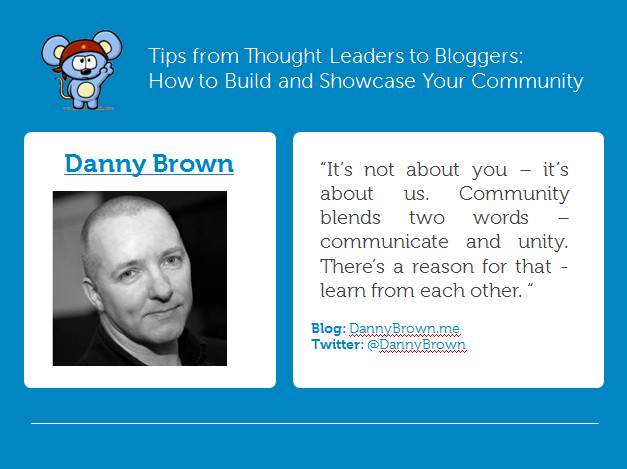
Danny Brown Rebelmouse community quote

Danny Brown Rebelmouse community quote

As a business resource,?Slideshare?stands pretty much head and shoulders above most other content platforms.

From presentations to educational content and more, you can find information and curated media on pretty much any topic you have an interest in.

As a research solution, Slideshare offers analysis from some of the smartest minds on the web across all verticals.

These include standard presentations, videos, multimedia and more.

Which brings us to this week?s Sunday Share.

Every week, I?ll be sharing a presentation that catches my eye and where I feel you might be interested in the information inside. These will range from business to content to social media to marketing and more.

This week, a Slideshare I was grateful to be a part of from the Rebelmouse team, the company that allows users to create their own “front page” and visually curate their social feeds and updates.?

With content an ever-growing part of any online strategy, personal or professional, growing an interactive and valuable community around your content is key. This presentation shares short, punchy ideas from a varied collection of marketers, branders, content creators and more on building and showcasing that community.

Enjoy.

Webfluenz Brings Social Media and Influence Analysis to the Masses

When it comes to social media analysis and influence marketing, and the ability to use software to identify and track potential influencers for your brand, one thing that always comes up as a stumbling block is the cost usually associated with it.

Because of the data required to filter and rationalize the findings of platform-specific algorithms, costs usually range from the $700 per month mark to anywhere between $3,000-$5,000 per month. So far, this has meant the benefits of social analysis, as well as true influence marketing, has been limited to mid-to-Enterprise-level businesses and organizations.

One company aiming to change this is Singapore-based Webfluenz.

Addressing the Cost of Social Data

The pricing model makes Webfluenz an attractive solution for businesses of all sizes, but especially smaller-to-medium ones that don’t have the financial muscle a mid-to-large Enterprise-type business has.

Webfluenz pricing

For a solo entrepreneur or professional, the free account is a great starting place, with a lot of features that you’d expect to find in a premium solution: sentiment tagging, demographic locale and ad-hoc filtering.

However, when you move up a scale, either to the $299 per month option or the $499 one, this is where Webfluenz really starts to show its benefits, not to mention advantages over similarly priced competitive solutions.

Meeting Multi-Level Business Needs

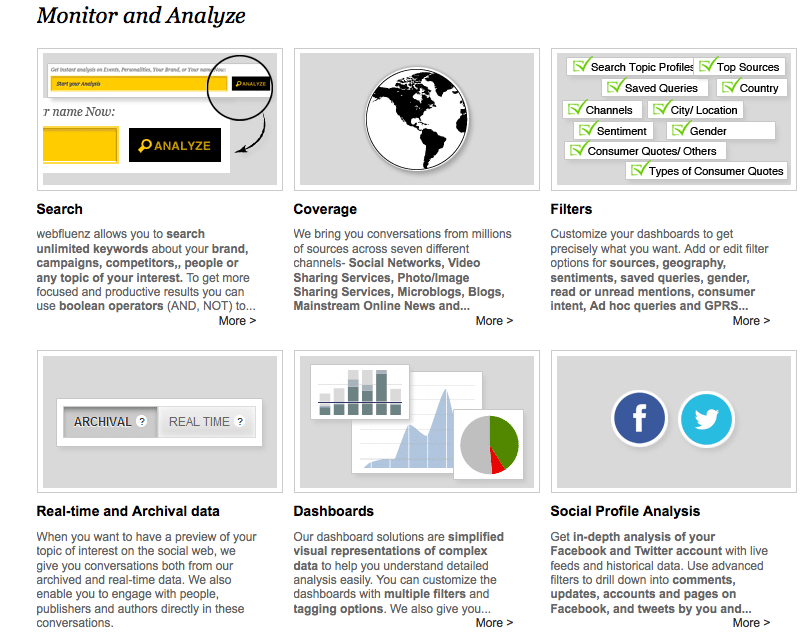
Let’s say you run with the $299 per month option – ?this is much lower than industry leaders like Radian6 or Sysomos. Heck, even the $499 per month option is. So what are you getting for that, and are you losing features because of the lower cost? Short answer to the features question – no.

Webfluenz monitor and analyze

Multi-lingual sentiment tagging

Supporting 24 languages of the world’s Internet population, Webfluenz allows you to track around 90% of global languages and allocate sentiment tracking to these conversations. Its proprietary technology breaks common language down into real meaning, as opposed to generic mentions and word definitions.

Qualitative analysis for influencer campaigns

I’m not a fan of judging influence by the amount of amplification an online user can generate. Bots and scripts can inflate numbers. Instead, I’m more impressed by business actions taken based on content shared – sales, leads, downloads, etc. Webfluenz tracks these actions, and the impact on your business, as well as identifies the intent of your target customer (research, compare, buy), enabling a far more effective influencer message can be crafted.

Engagement history

The key to building any kind of business loyalty – online or offline – is the amount you invest in the core relationships that matter. Customer, employee, colleague, stakeholders, etc. Webfluenz tracks all of your enagegements, their levels, frequency, etc., and makes sure you don’t let the most important connections disappear.

Webfluenz Engagement WorkFlow?

Just these three features alone would make an already-attractive price point worthwhile, but the additional features Webfluenz provides takes it up yet another notch.

The Complete Digital Business Suite

One of the biggest complaints around any of the social tools available today is that none of the offer an all-in-one solution.

If you want social monitoring, you need a dedicated monitoring platform. If you want social engagement, you need a good conversation dashboard like a Hootsuite. If you want influence tools, you need ?a Traackr or an InNetwork. If you want a CRM platform, you need a Nimble. And so on.

And this makes sense – it’s rare for any platform to offer an in-depth solution to multiple business needs the way the platforms mentioned above can, in their individual categories.

I’ll give Webfluenz credit here, though – they make a great attempt at answering this criticism.

Competitive analysis

Knowing what works for your competitor, and how they’re driving traffic and sales from their digital efforts, can help you refocus yours and adapt on the fly. Webfluenz shows comparison reports on competitor buzz and growth, while giving you current performance data on your campaigns.

webfluenz - Competitive Benchmarking Analysis? 2013-08-29 15-34-21

Team collaboration and workspaces

Using a simple workflow process, you can assign team roles and duties within the Webfluenz dashboard, as well as follow up on assignments and use this information across internal teams to improve your internal set-ups.

Dashboard reports

If there’s one thing that any business needs, it’s easy-to-understand reports that deliver the kind of data you can act upon. From Deep Dive Reports to Competitive Benchmarking, as well as Comparative Benchmarking and results, Webfluenz has you covered here.

Webfluenz and You

That’s just a sampling of what’s on offer – the full suite of tools, and the ease in which almost any level of user can start diving in, is what helps Webfluenz stand out in an already crowded marketplace.

Add in a detailed user guide, as well as a hands-on support team and account management guide, and you’re going to be pretty hard pushed to find as cohesive a platform at the price Webfluenz is currently being offered for.

If you’re already using a social analysis platform and you’re happy with its performance and features, then you’re probably not going to change anytime soon.?If you’re currently looking for a new suite of tools, though, and you don’t want to break the bank while doing so, I’d definitely recommend checking Webfluenz out.

If they’d create an open API to connect with other tools, it’d be an even better solution that it currently is. The UI could also be a bit slicker when it comes to the engagement dashboard. But?I’ve mostly been impressed so far and, as a demanding grumpy Scotsman, that’s never an easy thing to do.

Nice work, guys.

Edit, August 30: Just heard from Rachana Khanzode, head of social marketing at Webfluenz, and seems the platform does offer an open API, so integration with other platforms should be good to go.

  • « Go to Previous Page
  • Page 1
  • Interim pages omitted …
  • Page 78
  • Page 79
  • Page 80
  • Page 81
  • Page 82
  • Interim pages omitted …
  • Page 283
  • Go to Next Page »
© 2026 Danny Brown - Made with ♥ on Genesis