• Skip to primary navigation
  • Skip to main content
Danny Brown

Danny Brown

podcaster - author - creator

  • About
  • Podcasts
  • Journal

Latest posts from Danny Brown

Enjoy the latest posts from Danny Brown, and feel free to add your own thoughts in the comments after the post.

The Sunday Share: Analyzing the Culture of Selfies

Selfie culture

Selfie culture

As a business resource,?Slideshare?stands pretty much head and shoulders above most other content platforms.

From presentations to educational content and more, you can find information and curated media on pretty much any topic you have an interest in.

As a research solution, Slideshare offers analysis from some of the smartest minds on the web across all verticals.

These include standard presentations, videos, multimedia and more.

Which brings us to this week?s Sunday Share.

Every week, I?ll be sharing a presentation that catches my eye and where I feel you might be interested in the information inside. These will range from business to content to social media to marketing and more.

This week, an interesting look at the culture of “selfies” from Tim Stock, Managing Partner at scenarioDNA.

The rise in popularity of photo apps like Instagram has created a new culture – the selfie (self portraits taken in a variety of environments and poses). This presentation takes a look into the mindsets of selfie afficionados.

Enjoy.

image: Billy Abbott

The Demand Metric 2014 Outlook Study: Highlights and Horizons

Danny Brown research stations

2014 outlook study from Demand Metric

As a global marketing research and advisory firm with over 38,000 marketing professionals, CEOs and business owners using their services, Demand Metric is perfectly placed to gather the kind of insights and data few advisory firms have access to.

This can range from custom research studies (like the one shared here today), to a repository of business tools, templates and more to help businesses align their goals with the right data, strategy and technology.

It’s from this data that Clare Price, VP of Research at Demand Metric, has collated and released their benchmark 2014 Outlook Study: Highlights and Horizons, which shares insights from 2013 and where that’s taking us in the year ahead.

The Highlights of 2013

If there were two major impacts on the business landscape last year, it was the year that the customer really came to the fore.

Sure, social media has enabled the average consumer a bigger stage on which to better communicate with brands – but now these brands had much stronger tools to analyze and learn from these conversations.

Additionally, it was also the year that saw Marketing consolidate its position at the forefront of revenue production, as well as enabling the customer life cycle to be better understood across all facets of the business.

As a result, some key shifts began to happen.

Quality Lead Generation is Playing a Bigger Role

While a digital strategy is still primarily about growing brand awareness and driving web traffic, lead generation is enjoying increased importance.

Better leads

Not just lead generation, but better quality leads, showing that segmentation and remarketing is being used properly in digital marketing campaigns. Conversion still needs to increase to complement the lead, but as data analytics improves, so should the lead to conversion ratio.

Making Digital an Experience

Because digital marketing has the advantage of being more fluid over more traditional methods, the customer experience is key in relation to revenue and growth.

Better customer experience

Instead of the typical spray and pray approach that marketing and advertising has been known for, now it’s about far more sophisticated data and building an experience around that (think of Canadian beer company Moslon and their beer fridge around the globe for Canadian passport holders).

Get the experience, get the mindset of the customer.

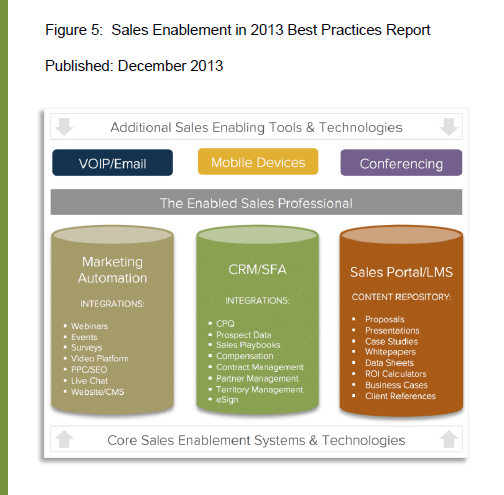
Enabling the Sales Team

Marketing is nothing without sales. We can get all the campaigns right, all the product or service in the right place, all the offers ready – but without a sales team to make it happen, marketing is simply a mindmap waiting to become physical.

Businesses are realizing that enabling the sales team for all possible outcomes (or as good as) offers an immediate advantage.

Enable sales team

Customers can take pre-sales research and compound their decision with a savvy sales rep; customized content makes for better presentations at corporate sales meetings; and marketing and sales are far more aligned in goals and what needed to happen, as ooposed to being silo’d.

The Horizon of 2014

So what does this mean for the next 12 months? To find out, Demand Metric took their findings of the past year and combined it with predictions from various stakeholders, clients and analysts/directors at the company.

These predictions include:

We’re moving towards a concept that I like to call ‘slow media’. Slow media compels your customers to want to hear what your brand is saying because you’re creating meaningful media that has context and relevance to your customers. – Jessica Ann, Senior Research Analyst, Demand Metric.

We now have linguistic mapping tools that allow us to… understand what the customer wants, connect archival history with our brand’s core business or competitors, and at what stage of the buying cycle they’re at, so you can prime your message for that exact moment… [allowing us] to truly take advantage of that technology and deliver. – Danny Brown (me!).

The results of predictive analytics, trends and patterns will be questioned when the ‘advice’ of these applications do not match reality. – Christine Crandell, Research Director, Demand Metric.

In 2014, I foresee a more equal share of marketing budget invested in both offline (store) and online (web) with an emphasis on linking the offline audience to online campaigns through smartphones and interactive media. – Han Verbaas, SVP Europe & Middle East, Demand Metric.

These are just some of the predictions (or Horizons) included in the report, and each prediction is combined with what the person saw as a key shift in 2013 and how that plays into the year ahead.

The Demand Metric 2014 Outlook Study offers an interesting look at where we’ve come from, and where we need to go to continue to grow not only the marketing discipline, but the integrated business discipline if businesses want to truly succeed in the ever-changing business landscape we find ourselves operating in.

You can download the full report for free here.

Disclosure: I’m a Research Director at Demand Metric on the topics of digital, social media, and data analytics.

The Sunday Share: 50 Random Twitter Tips for Business

danny on twitter

As a business resource,?Slideshare?stands pretty much head and shoulders above most other content platforms.

From presentations to educational content and more, you can find information and curated media on pretty much any topic you have an interest in.

As a research solution, Slideshare offers analysis from some of the smartest minds on the web across all verticals.

These include standard presentations, videos, multimedia and more.

Which brings us to this week?s Sunday Share.

Every week, I?ll be sharing a presentation that catches my eye and where I feel you might be interested in the information inside. These will range from business to content to social media to marketing and more.

This week, a useful collection of Twitter tips from Ksenia Dobreva, who handles social marketing for webmeup.

While Twitter is now almost a decade old, there are still new users to it every day. Additionally, businesses are still looking for the best ways to use for their needs. While I don’t agree with every tip (replying to every tweet, for example), this presentation offers a nice collection of tidbits for exactly these users.

Enjoy.

The Battle for Social Ad Revenue – The Potential Winners and Losers

Social ads battle

Social ads battle

As the dust settles from Twitter’s recent IPO, one of the surprising outcomes was the news the microblogging platform is on track to post?global ad revenue figures of $1 billion by the end of this year.

In the U.S. alone, Twitter’s ad revenue showed an increase of 93 percent over the same period the previous year, with?$277 million posted for the first three quarters in 2013.

With mobile becoming ever more pervasive as the browser of choice for Twitter users, and mobile ads growing less intrusive and more natural, it’s clear that Twitter has moved from the social network that has a “monetization problem” to one that’s set to give the likes of Facebook and LinkedIn a run for their revenue money.

But will it be the “winner” in the upcoming social ads battle?

Why Social Ads Are Big News

With social media finally becoming a staple in the marketing and advertising departments at businesses, reliance on traditional advertising has begun to swing to digital channels.

While media buy and print/television/radio advertising remains important,?budgets are increasingly being allocated to digital spend.

As these budgets shift and consumers turn to social media to not only research products and brands, but either buy directly from a social media-led offer or click through to a landing page, the networks are looking at ways to take advantage of this shift and be the go-to ad partner for businesses and marketers.

Social ad budgets in the US

It’s not surprising that the bean counters over at Facebook, Google, Twitter and the rest are so keen to attract advertisers to their platforms?by 2017, it’s predicted that social media ad spend worldwide will exceed $10 billion.

Add in mobile spend and it’s a piece of the pie that will literally cost the networks millions if they’re not part of it.

Social Ad Spend And Revenue By Network

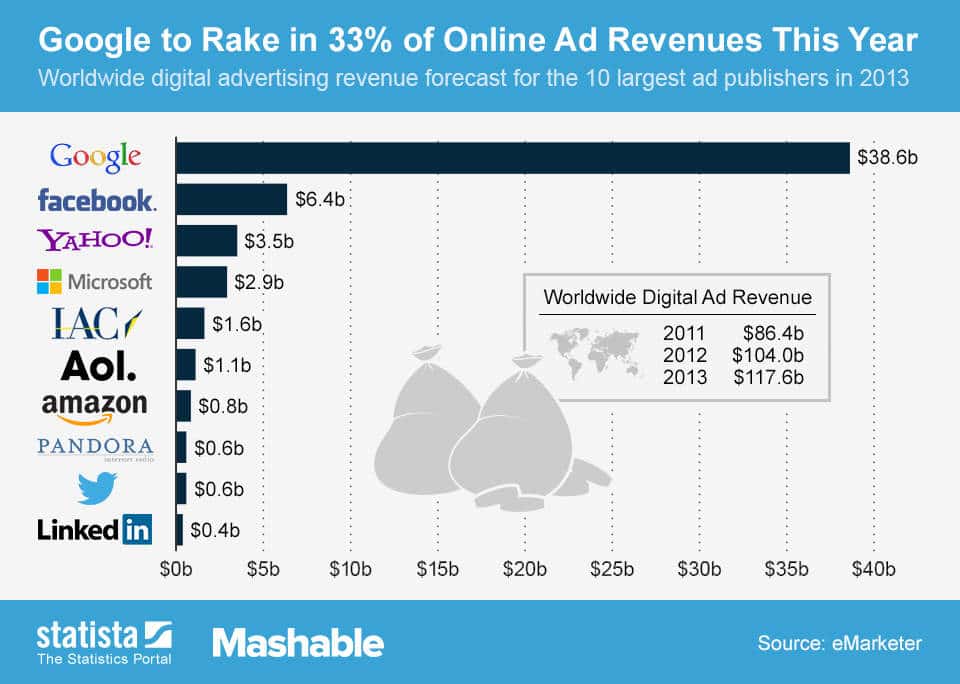
If you look back at how the networks fared in 2013, there’s one clear winner and that’s Google. A study by eMarketer at the beginning of this year predicts Google to account for a third of all online advertising, easily outstripping its nearest competitor, Facebook.

Digital ad revenue

While Facebook shows a strong second with almost $6.5 billion in online ad revenue, both Twitter and LinkedIn trail with a distant $0.6 billion and $0.4 billion respectively. Yet that doesn’t really tell the full story.

Google’s online ad revenue is made up of multiple factors and platforms. For example, while the majority of its revenue still comes from AdWords and AdSense, there’s also the revenue from advertisers on its YouTube property.

Speaking of YouTube,?Google launched a Paid Channel option?for any user with over 10,000 subscribers, where channel owners could charge subscribers $0.99 or more per month for access. Google is reported to receive around 45 percent of channel subscription costs, adding to its online revenue stream.

Compare the “Big Four” social networks?Twitter, Facebook, LinkedIn and Google+? and Google has a clear advantage by the number of revenue streams it earns from. Add in the recent +Post Ads announcement that meshes Google+ content with Google’s ad network, and it would seem they have the social ad market sewn up.

However, the others are starting to make inroads into this advantage, certainly by number of additional revenue streams if not quite actual revenue yet.

Twitter?Revenue Potential

As mentioned earlier, the microblogging platform has (perhaps) surprised many, by sharing some?excellent revenue figures. Advertising revenue has increased 124 percent on a year-over-year basis; advertising revenue makes up 91 percent of total revenue, an increase of 4 percent; and gross margins increased.

While operating losses increased and data licensing revenue decreased, Twitter is still in good shape to make a healthy profit in 2014 and beyond from social ads, especially given its acquisitions of companies like Bluefin Labs and Trendrr, with the potential of social ads making their way into TV engagement via Twitter.

Facebook Revenue Potential

The first major network to successfully transition to an IPO, Facebook has used both the money from that as well as increasing focus on its developer labs to continuously introduce new social ad revenue.

While the company has received criticism over its mobile experience versus the desktop one,?Facebook has still made great strides in revenue?from this part of its social monetization strategy.

While it’s still a ways behind Google?but then again, who isn’t??Facebook’s mobile ad revenue has tripled in the last year, making it the most impressive when it comes to growth in this vertical.

Additionally, with news that ads from Instagram (Facebook’s first major acquisition)?aren’t being received as negatively as Facebook may have feared, the potential for revenue from this channel is something to keep an eye on.

LinkedIn Revenue Potential

While Facebook, Twitter and Google are natural fits for social ads with their consumer-led audience, LinkedIn has always stood apart as a professional business network.

As such, it’s been one of the bigger success stories for social media/network revenue, although its?most recent financial reports?show one of its first declines in year-on-year reporting.

However, LinkedIn knows it needs to expand beyond premium accounts and services for recruiters for its monetization and has begun to implement a series of changes to focus on that. Its new focus on content is a clear shift in how it wants to double its ad revenue in the next two years.

Additionally, the introduction of a LinkedIn Advertising API will make it easier for brands and agencies to advertise on the network. That’s not even taking into account its mobile plans, with an aggressive update of its app to make the mobile experience as seamless as the desktop one.

Who Will The Social Ad Winners Be?

Just looking at the (current) top four?Twitter, Google+, Facebook and LinkedIn?and the smart money would be on both Twitter and Facebook to make the most progress.

Acquisitions and channel partners, as well as their plans for mobile advertising to continue to add to the revenue stream, should see Twitter and Facebook eat further into Google’s current dominance.

While there’s no doubt that Google+ is increasing in user numbers, how social ads will play into the experience remains to be seen. LinkedIn, meanwhile, still needs to make the experience sticky enough to keep users engaged.

And what about other platforms?

Pandora, for example,?continues to see growth in its ad revenue?and with other networks globally enjoying large, engaged user bases expanding their geographic audience, it can’t be too long before the current top four look very different.

Thoughts?

A version of this post originally appeared on OPENForum.

image: LaDonna Coy
image: Business Insider
image: eMarketer/Mashable

Stop Scoring Influence, Start Creating Influence Paths

Disruptive influence

A few months ago, I sat down with?Steven Sefton, Digital and Social Media Director for?Zap Designs, to discuss a variety of topics including the differences in cultural marketing based on location; the changing face of influence; where influence marketing is heading; and much, much more.

Below, you can find part two of that chat (which?originally appeared?on The Social Penguin), centred around influence marketing, the need to move away from generic social scores, and how brands are focusing on the wrong “influencer”.

I hope you enjoy, and you can find the first part of the interview?here.

?????????

You?ve written the book Influence Marketing with Sam Fiorella. What made you?write this book?

It was a mix of being disappointed at what was classed as influence today ? social?scoring platforms like Klout ? and the realization that businesses would continue?to get poor results from that kind of ?influence marketing?. The focus was on?the wrong people ? it?s not influencers that make your brand successful, it?s?customers.

We wanted to take back influence, if you like, from non-descript social scoring?algorithms, and place the focus back squarely on the customer. Understand?where they are in the purchase life cycle, and who impacts their decisions at that?point. Understand that, and you know who you truly need to connect with and?how that person can help sway your customer?s thinking, and move them along?the purchase path to the next phase, whether that?s Awareness, Research, Intent?to Buy or something else.

How do you see influence marketing changing in the future?

Moving past scoring platforms and truly understanding what your customer?needs, and working back from there to find who influences them and how. We?re?tired of empty metrics likes impressions and social shares ? we need to see real?deliverables from our investments.

This is why scoring platforms fall down when?it comes to real influence ? they lack the data and connections that show the real?context behind a relationship. The likes of Klout are selling social impressions,?nothing more.

Do you think it?s going to become harder or easier to find relevant influencers?

If brands are willing to put in the legwork and avoid the quick-hit buzz-driven?approach to influence, it does actually become easier. Instead of generic, scoredriven ?influencers?, you?re identifying those that truly impact your customer?s?decision-making process, no matter where they are in the purchase life cycle.

This works at every level ? the brand isn?t paying for non-targeted campaigns,?and has a far higher rate of success, and the customer is being helped at the?exact point they need that help to make their decision. It?s not rocket science?to run successful influence marketing campaigns; it?s just that some folks and?technology vendors would have you think it is.

Can you be an influencer in many areas or will it come down to the super niches?

That?s the beauty of bypassing today?s ?social scoring as influence? model,?and really understanding what influence is and how to identify who really is?influential. Klout goes for the topic approach ? but that?s too generic, because?human beings are way too complex to be tied to just a few topics.

Mindsets?change based on peer pressure ? does a guy start to try and like Justin Bieber to?influence how a girl he?s interested in looks at him? That?s a simplistic example,?but a valid one about the problems facing influence today.

Because real influence is based on who and what sways decisions at a given?time in a person?s life, we are all influential in multiple areas. I?m not a??daddy blogger?, but I have two kids under four years old, a boy and a girl.

My?experience in this area would mean I may be able to offer insights into what?it takes to raise two toddlers, but I?d never be picked up by scoring platforms?because I?m viewed as a marketer, or whatever.

THAT, for me, is where influence is going and needs to be ? our topics and level?of knowledge around these topics change all the time. So, because of that, niches?aren?t needed ? understanding of where we are in life is, and offers the bigger?return.

How can brands better adopt influence marketing as a tactic?

Simple ? buy our book!! Failing that?

Our studies, and discussions with both?brands and organizations, show that they?re still in the mindset that scoring is?the best way to run influence marketing campaigns, promotions, call it what you?will. While they can offer a decent starting point, you need to go deeper than the?data they offer to really start to understand true influence.

Additionally, brands are still seeing influence marketing as a buzz creator, and?using it with the mindset of short-term campaigns. Influence offers so much?more than this, and should really be used to move towards advocacy and longterm relationship building.

By using the methodology outlined in the book, and really understanding who?influences your customers the most, and how that maps back to your goals, it?becomes less a hit-and-hope tactic and more a defined, results-driven strategy.

To steal a line from the book, brands need to stop scoring influence, and start?creating influence paths.

  • « Go to Previous Page
  • Page 1
  • Interim pages omitted …
  • Page 69
  • Page 70
  • Page 71
  • Page 72
  • Page 73
  • Interim pages omitted …
  • Page 283
  • Go to Next Page »
© 2026 Danny Brown - Made with ♥ on Genesis