• Skip to primary navigation
  • Skip to main content
Danny Brown

Danny Brown

podcaster - author - creator

  • About
  • Podcasts
  • Journal

Latest posts from Danny Brown

Enjoy the latest posts from Danny Brown, and feel free to add your own thoughts in the comments after the post.

Why Your Brand Looks Foolish When You Don’t Walk the Talk

Klout - meh

There are two things that mostly define a brand – their reputation and their actions. Each are intrinsically tied to one another – your actions impact your reputation, and your reputation defines what action you need to take.

Get one wrong, and the other can follow suit pretty quickly, and make you look foolish – which is exactly what the so-called “Enterprise Engagement Alliance” looks like with their current outreach tactics for one of their books.

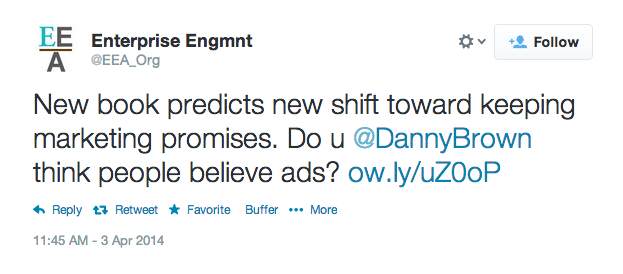
Check out this tweet from them.
EEA spam

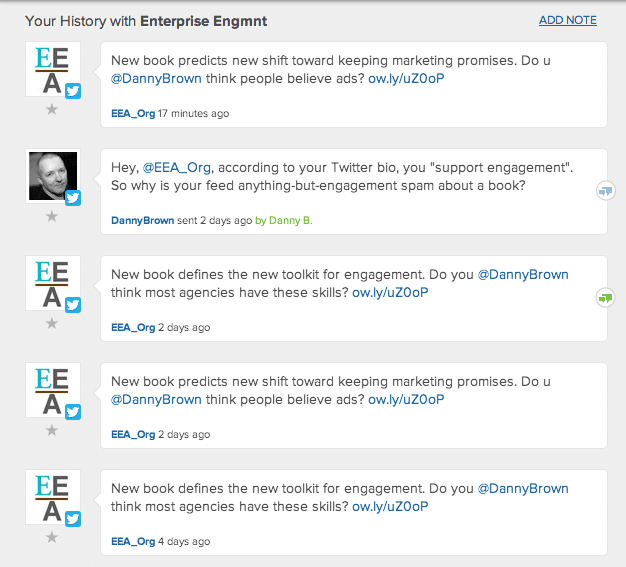
Seems innocuous enough, right? They have a new book, and they ask a question regarding the topic in order to pique interest. Except, it’s not innocuous, as this grab from their stream shows.


While there might be slight differentiations in text, the result is the same – sandblasting out tweet after tweet after tweet, regardless of audience, interest, and accepted best practices for outreach today.

For an organization that claims to have engagement at the fore of their efforts, their Twitter feed sure goes against that premise, as shown by my attempt to reach out to them about their methods.
Enterprise spam

Instead of getting an answer, I simply got more of the same crappy spam blasting that makes me believe Enterprise Engagement Alliance represents not engagement, but everything that’s wrong about brands that just don’t “get” social media.

A Lesson in REAL Engagement and Outreach

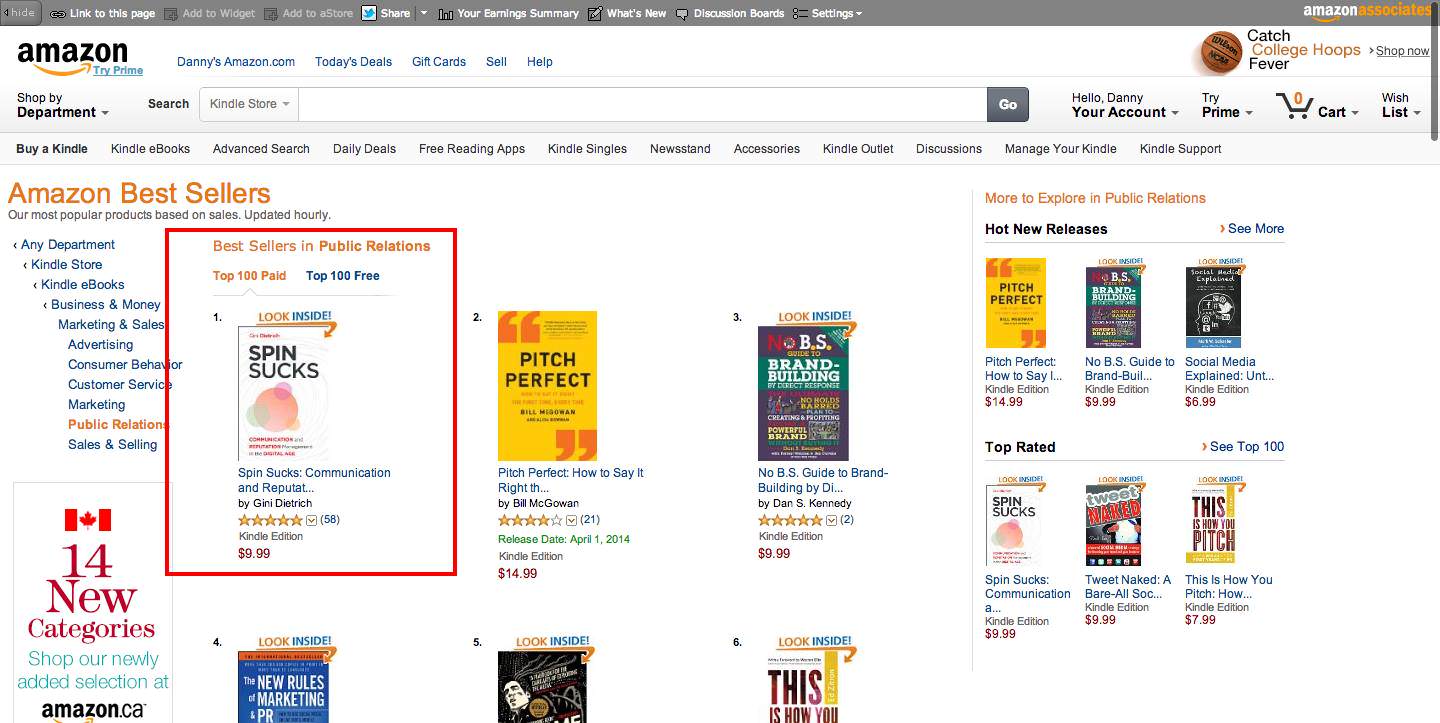
Compare EEA’s approach to that of Gini Dietrich, and how she promoted her new book, Spin Sucks, and worked with her target audience to help her own the PR category on Amazon on launch day and continues to sit high in the rankings today.

  • She created a treasure trove of value for anyone who bought the book;
  • She created a social media sharing resource with potential tweets, updates, rich media and more;
  • She created an easy-to-use Facebook app to spread the news;
  • Most importantly of all, she made it easy for her audience to be Spin Sucks brand ambassadors and really be part of the book’s success.

The results speak for themselves.
Spin Sucks launch day

Now, given, Gini’s a professional whose business is all about crafting the right message and best way to communicate that message, so you’d expect her to be a pro at this.

But that just makes the approach from EEA all the more disappointing – after all, this is an organization who has been quoted as being able to,?“…someday rival advertising in scale.?

It just goes to prove, being bigger doesn’t mean being better – and saying one thing but doing the complete opposite simply erodes any belief that your business is up to the job of doing what the bio on your spam-laden feed says you can do.

image: Lamda Chi Alpha Fraternity

Stop Scoring Influence, Start Creating Influence Paths

Robots replacing humans

A few months ago, I sat down with?Steven Sefton, Digital and Social Media Director for?Think Zap, to discuss a variety of topics including the differences in cultural marketing based on location; the changing face of influence; where influence marketing is heading; and much, much more.

Although Klout seems to be no more, social scoring is clearly still a driving tactic by brands when it comes to influence, given the news that LinkedIn has created its own scoring solution – which makes revisiting this interview kind of timely.

Below, you can find part two of that chat (which?originally appeared?on The Social Penguin), centred around influence marketing, the need to move away from generic social scores, and how brands are focusing on the wrong ?influencer?.

I hope you enjoy, and you can find the first part of the interview?here.

?????????

You?ve written the book?Influence Marketing?with?Sam Fiorella. What made you?write this book?

It was a mix of being disappointed at what was classed as influence today ? social?scoring platforms like Klout ? and the realization that businesses would continue?to get poor results from that kind of ?influence marketing?. The focus was on?the wrong people ? it?s not influencers that make your brand successful, it?s?customers.

We wanted to take back influence, if you like, from non-descript social scoring?algorithms, and place the focus back squarely on the customer.

Understand?where they are in the purchase life cycle, and who impacts their decisions at that?point. Understand that, and you know who you truly need to connect with and?how that person can help sway your customer?s thinking, and move them along?the purchase path to the next phase, whether that?s Awareness, Research, Intent?to Buy or something else.

How do you see influence marketing changing in the future?

Moving past scoring platforms and truly understanding what your customer?needs, and working back from there to find who influences them and how. We?re?tired of empty metrics likes impressions and social shares ? we need to see real?deliverables from our investments.

This is why scoring platforms fall down when?it comes to real influence ? they lack the data and connections that show the real?context behind a relationship. The likes of Klout are selling social impressions,?nothing more.

Do you think it?s going to become harder or easier to find relevant influencers?

If brands are willing to put in the legwork and avoid the quick-hit buzz-driven?approach to influence, it does actually become easier. Instead of generic, scoredriven ?influencers?, you?re identifying those that truly impact your customer?s?decision-making process, no matter where they are in the purchase life cycle.

True influence

This works at every level ? the brand isn?t paying for non-targeted campaigns,?and has a far higher rate of success, and the customer is being helped at the?exact point they need that help to make their decision. It?s not rocket science?to run successful influence marketing campaigns; it?s just that some folks and?technology vendors would have you think it is.

Can you be an influencer in many areas or will it come down to the super niches?

That?s the beauty of bypassing today?s ?social scoring as influence? model,?and really understanding what influence is and how to identify who really is?influential. Klout goes for the topic approach ? but that?s too generic, because?human beings are way too complex to be tied to just a few topics.

Mindsets?change based on peer pressure ? does a guy start to try and like Justin Bieber to?influence how a girl he?s interested in looks at him? That?s a simplistic example,?but a valid one about the problems facing influence today.

Because real influence is based on who and what sways decisions at a given?time in a person?s life, we are all influential in multiple areas. I?m not a??daddy blogger?, but I have two kids under four years old, a boy and a girl.

My?experience in this area would mean I may be able to offer insights into what?it takes to raise two toddlers, but I?d never be picked up by scoring platforms?because I?m viewed as a marketer, or whatever.

THAT, for me, is where influence is going and needs to be ? our topics and level?of knowledge around these topics change all the time. So, because of that, niches?aren?t needed ? understanding of where we are in life is, and offers the bigger?return.

How can brands better adopt influence marketing as a tactic?

Simple ??buy our book!! Failing that?

Our studies, and discussions with both?brands and organizations, show that they?re still in the mindset that scoring is?the best way to run influence marketing campaigns, promotions, call it what you?will. While they can offer a decent starting point, you need to go deeper than the?data they offer to really start to understand true influence.

Additionally, brands are still seeing influence marketing as a buzz creator, and?using it with the mindset of short-term campaigns. Influence offers so much?more than this, and should really be used to move towards advocacy and longterm relationship building.

By using the methodology outlined in the book, and really understanding who?influences your customers the most, and how that maps back to your goals, it?becomes less a hit-and-hope tactic and more a defined, results-driven strategy.

To steal a line from the book, brands need to stop scoring influence, and start?creating influence paths.

The Sunday Share: The Beginner’s Guide to PR for Startups

getting visibility

As a business resource,?Slideshare?stands pretty much head and shoulders above most other content platforms.

From presentations to educational content and more, you can find information and curated media on pretty much any topic you have an interest in.

As a research solution, Slideshare offers analysis from some of the smartest minds on the web across all verticals.

These include standard presentations, videos, multimedia and more.

Which brings us to this week?s Sunday Share.

Every week, I?ll be sharing a presentation that catches my eye and where I feel you might be interested in the information inside. These will range from business to content to social media to marketing and more.

This week, an excellent presentation from startup consultants Onboardly.

Customer acquisition can sometimes be a challenge for your startup, especially when your energy and resources are focused on other things. This presentation shares best practices on getting great PR for your new venture.

Enjoy.

image: -Reji

THIS Is How You Do Brand Storytelling

Take time to stop

One of the current buzz terms being bandied about by businesses today is that of “brand storytelling” – how brands can use storytelling to share their core values, win more customers, and outstrip the competition.

Never mind the fact that brand storytelling is as old as the first advertisement (not that that’s ever stopped social media hijacking old and proclaiming it as new), everyone’s talking about making the business human through stories.

The problem is, too many brands use storytelling poorly – the McDonald’s “Writer” ad being one such example where you were left questioning what the brand values were (a ?key part in successful brand storytelling).

Get brand storytelling right, however, and you connect not just the dots between customer and brand, but the audience overall. Which is why the “Moments of Warmth” ad from Duracell Canada is so successful.

https://www.youtube.com/watch?v=-mQZqKLiMIg

Why Moments of Warmth Works

This winter has been one of the harshest, coldest winters in recent memory for a lot of people, and the term “Polar Vortex” became mainstream.

Recognizing this, Duracell Canada played to everyone’s weariness of winter, and – for a moment – brought a little warmth into peoples’ lives. The trick, though, was that moment wasn’t just meant to be for the duration of their stay in the bus stop.

Instead, by playing out a bigger message – “we all need each other” – it says even when things are at their toughest, we can make it through if we stick together.

By promoting human connection as the glue that makes everything tick – versus individual actions – Duracell Canada not only shares their corporate values, but also how they see world around them, and our ability to work together to make a difference.

Best of all, it’s not even a hard sell on behalf of Duracell Canada – instead, it focuses on the people (customers) and how Duracell can help (by being there when you need them). It’s a softer sell, but still effective – I know which batteries I’ll be stocking up on next visit to the hardware store.

Kudos.

The Sunday Share: Robots Replacing Humans (Our Automated World)

Robots replacing humans

As a business resource,?Slideshare?stands pretty much head and shoulders above most other content platforms.

From presentations to educational content and more, you can find information and curated media on pretty much any topic you have an interest in.

As a research solution, Slideshare offers analysis from some of the smartest minds on the web across all verticals.

These include standard presentations, videos, multimedia and more.

Which brings us to this week?s Sunday Share.

Every week, I?ll be sharing a presentation that catches my eye and where I feel you might be interested in the information inside. These will range from business to content to social media to marketing and more.

This week, a short yet fascinating presentation from Sean Robinson of in-motion automation systems vendor QMI Services.

Robots have now replaced many daily functions of humans. Our world has become more automated than ever with machines that do some amazing tasks – functionally and just for fun. This presentation looks at how robots are replacing humans in an increasingly automated world.

Enjoy.

image: University of Denver

  • « Go to Previous Page
  • Page 1
  • Interim pages omitted …
  • Page 64
  • Page 65
  • Page 66
  • Page 67
  • Page 68
  • Interim pages omitted …
  • Page 283
  • Go to Next Page »
© 2026 Danny Brown - Made with ♥ on Genesis