• Skip to primary navigation
  • Skip to main content
Danny Brown

Danny Brown

podcaster - author - creator

  • About
  • Podcasts
  • Journal

Latest posts from Danny Brown

Enjoy the latest posts from Danny Brown, and feel free to add your own thoughts in the comments after the post.

Translation Marketing

Jump of the CliffWhen you’re selling something, how do you do it? Are you keeping it simple or are you overselling?

In other words, are you using translation marketing or not?

In his post today, Chris Brogan discusses the sales cycle and where social media fits into it. Prospects, awareness, leads, customers and evangelists. All great stuff and well worth reading. But that’s internal talk. Yes, the aim is to take that internal talk and transfer it to external listeners.

But when you’re trying to grab these external listeners, are you talking their language or double Dutch?

Marketing seems to have gone through a metamorphis over the last few years. More are trying to be clever with their message – unfortunately, many are coming across as too clever and the message is being lost.

Nothing needs to be complicated. People by nature are simple. We like simple things. Confusion might be fun in a mystery movie or a game of Cluedo. But when it comes to businesses marketing to us, confusion just turns us off you and onto your competitors.

Yet it doesn’t need to be this way.

The Like Factor

Years ago, when I first got into marketing, one of my mentors taught me about The Like Factor. It was a pretty straightforward concept and one I’m sure was widely used. Maybe it still is today, but I’ve seen few examples if it is.

People are more comfortable when they relate to something. Personal experiences tell us whether we like something or not. So use that and turn The Like Factor into your own translation marketing so we don’t have to translate your message.

Compare these two messages:

  1. “It is important to manage the performance and availability of your critical Web applications to deliver consistently superior services aligned with your business goals. Meeting this challenge requires a new approach to application performance management, where IT becomes a strategic service provider and an innovation partner of the business organization.”
  2. “You know that feeling you get when you go out and you can’t remember whether you turned off the gas or not? We’ll be the guys that make sure your gas is looked after in your IT kitchen.”

They’re the same message aimed at the same people – IT managers. The first one is a marketing spiel given by an IT provider, the second is something I just came up with to use translation marketing.

You’re the customer. Which one would you relate to more? Do you prefer marketing talk or translation marketing?


Creative Commons License photo credit: greg321

Real People, Real Adverts

The advertising industry is like many other creative industries at the minute. Advertisers are looking at new ways to reach their audiences as the print industry continues to suffer and new mediums challenge ad agencies to think differently.

Some agencies are doing this better than others by letting real people tell real stories.

Instead of going for a celebrity endorsement, Visa Europe opted to go with Brooklyn-based artist Bill Shannon as part of their Life Flows Better campaign. Bill was born with avascular necrosis, a degenerative hip condition that destroys the joints of a bone. Despite this, Bill has made dance his unique art form by dancing on skateboards and crutches.

As Visa themselves mention when talking about Bill and his involvement in their ad:

“Bill Shannon is for real, he isn’t gliding along on wheelie shoes and he isn’t a stunt man. The beauty of Bill’s movement is as inspirational as it is mesmerising. The fluidity of his dance moves meant that it didn’t take us long to realise that he was the perfect embodiment of Visa’s flow campaign.”

So, Visa are saying that it’s real people who matter. Real people, doing real things. Real people doing inspirational things every day through normal events.

And it’s working for them. Feedback is extraordinarily positive about Bill’s involvement. Profits are up 35% since the Life Flows Better campaign began in earnest. Visa is being seen as a card for people. People that are also customers.

Make your customers feel like people and they’ll talk about your product. Doesn’t seem that hard, does it?

Better Blogging and Community Spirit with Scribnia

A little while back, I shared some tools with you that I thought helped enhance the community spirit for bloggers.? One of those tools was Scribnia, which I described as your “personal feed recommendation”. Having sat down with it a little more since then, it’s clear that it’s a lot more than that.

At its simplest, Scribnia allows members to find blogs and authors and rate them. So far, so what? After all, BlogCatalog offers the same feature with their star rating system.

This is where Scribnia separates itself from much of the pack, by using “contextual ratings”. Instead of just rating a blog between one and five stars, you have three slide bars to choose from: the contextual ratings system. The context of the blog defines what rating descriptions you can use.

For example, if you were to review my blog on Scribnia, the contextual ratings you’d be offered are Technology, Approach and Radicalness:

  • Technology – are my posts on marketing targeting e-marketing or print and billboard campaigns and companies
  • Approach – do I tend to offer more low budget or high budget solutions
  • Radicalness – are my views mainstream or radical

You then use a slider for each one and offer the higher score to the rating that suits me best for each context. It’s a novel way of letting other readers know at a glance what a blogger or author’s writing style is like. So far, people see me as more e-marketing, lower budget and a bit of a radical – I can live with that!

But as cool as their contextual ratings system is, Scribnia is really about building transparency, trust and community for bloggers and authors, by offering honest reviews. You’ll also find some great new writers and blogs you may have missed – something I’m all for.

Once you register for an account at Scribnia, you can either add your own blog or browse the authors and publications that are already on the site. To make it easier, you can browse by categories or niches. Then you can start reviewing your favourite bloggers and give them a wider audience.

What’s really cool about Scribnia is that you can actually add your favourite bloggers if they’re not already there. Simply fill out the details needed in the Add an Author section, hit submit and that blogger you feel deserves a wider audience is there in front of Scribnia’s members.

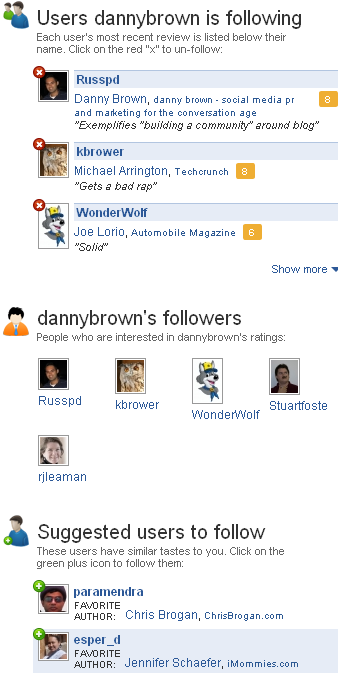
Another nice feature once you’re on your Scribnia homepage is the Suggested Users to Follow box.

As the term suggests, this shows you other Scribnia members that have similar tastes to you. Normally these kind of things are just token little add-ons to fill out your admin area.

With Scribnia, however, it does seem to work pretty well.

The system recommeded members to me whose favourite authors were Chris Brogan and Jennifer Schaeffer – two people I read quite a bit.

So far, I have to say that I’m impressed with Scribnia.

It’s bringing new bloggers to a wider audience; its rating system is encouraging you to write to a higher level each time; and it really does foster a sense of blogging community.

What more could you want? How about trying it yourself to see?

For tonight and tomorrow only, the good folks at Scribnia have opened up the Alpha site for readers of this blog. All you need to do is create your account and then when it asks for the Alpha password, type in “dannybrown” without the quotation marks.

You can then use the site’s features or write a review. Feel free to add your review of this blog – or just drop by and say hello. You’ll find me right here.

Note: This review of Scribnia is not an endorsement. I mentioned to David Spinks (the community manager at Scribnia) that I was writing a follow-up post to my initial mini-review and he kindly arranged the alpha pass for my readers.

Virtual Stalking – A Real World Problem for Social Media

Would You Die For The Glory Of Russell's TeapotSocial media is great. Social media brings people together. Social media opens the conversation. Social media puts you in the eyes of the world. Social media gives you a voice.

All true. All valid. All beneficial.

But what happens when the eyes that social media puts you in front of aren’t the friendly kind? What happens when being transparent in social media opens you up to harassment, abuse and virtual stalking?

Sadly it’s a very real problem. Even sadder, some of the social networks seem very slow to react to this problem. Does this mean they’re not taking it seriously, and if so, will virtual stalking be the straw that potentially breaks the social media camel’s back?

Online Friend? Case Study

People are friendly by nature. We want to connect and meet others – it’s in our genetic make-up. The last few years have made this easier than ever.

Sites like Facebook, Twitter, Ning, MySpace, Friendfeed and more open up the world to us. Our blogs are our own private community in a public setting. Online forums and chat rooms mean there’s no such thing as physical walls or barriers.

Which makes targeting someone easier.

Karen* is a blogger who owns her own business and also runs a Moms community online. It allows other bloggers to take part in community discussions, write, sell and buy products and generally acts just as an offline community would.

Last year, she invited a new girl to join the community. For Karen, this is what happened next:

  • Her business was reported as unethical and fraudulent on Ripoff Report
  • The girl set up fake social network accounts to spread lies about Karen’s business
  • Karen is followed on every network and forum by the girl, who publishes false information on Karen and her business

These are just some of the ways Karen has been targeted.

Why doesn’t she have the lies taken down from Ripoff Report or contact the police? Unfortunately, the owner of Ripoff Report Ed Magedson seems more interested in traffic to his site than actual facts being reported.

I’ve written about why Ripoff Report is just as big a ripoff before, and the fact that the site won’t take down old reports says it all about their integrity.

As far as Karen reporting her stalker to the police, she’s more afraid for her little girl’s safety as well as the continued anguish cross-state law cases would cause. The cost is prohibitive as well.

Karen isn’t the only example. On Twitter, I’ve seen first-hand examples of guys throwing sexual abuse at female users, with graphic descriptions of what they’d like to do to the user. I’ve seen other users bombard accounts with profanity, racial slurs and more.

I know that these cases have been reported to Twitter’s support team and nothing’s been done about the abuser, who instead continues to add new people to their account to abuse further. This says a? lot about the customer service support that sites like Twitter has. Or doesn’t, as is abundantly clear.

We’ve also read the stories about suicides from MySpace bullying and Facebook groups spreading malicious and hurtful lies.

So what’s the answer? Some people have suggested that the very transparency that is advocated on social media is part of the problem. By offering too much information, we’re feeding the abusers and the harassers and the stalkers.

Is this true? Can our openness be used as an excuse for virtual abuse? Personally I don’t buy into that argument. I can see why it’s suggested but no excuse can make up for the type of mental anguish people are put through for being honest.

I don’t have the solution. But there are questions that can be asked to work toward a solution.

Do we make it more difficult than just signing up with a false email account? Should social networks be more pro-active at responding to reports of abuse? Can we as a community highlight and name and shame abusers?

Websites like Jodi’s Voice help raise awareness but they’re currently the few among the many abusers.

Like I said, I don’t have the solution. It’s clear that one is needed though, before the likes of Karen and others like her become another real-life statistic from a virtual hate campaign.

Ideas?

* Karen is a pseudonym to protect the real identity of the person behind her. Her stalker has admitted to Karen that it’s jealousy behind her hate campaign. It’s still continuing today.

Creative Commons License photo credit: Dude Crush

You Can Find Me…

…over at John Haydon’s blog today and tomorrow.

After having my blog hijacked by the mysterious Jack Tweet, I’ve finally managed to get around his firewall and take back control.

While I give the blog a thorough search for any hidden clownware, I’ll be looking after John’s blog while he’s at the SobCON event over in Chicago. Feel free to drop on by and say hello.

  • « Go to Previous Page
  • Page 1
  • Interim pages omitted …
  • Page 238
  • Page 239
  • Page 240
  • Page 241
  • Page 242
  • Interim pages omitted …
  • Page 283
  • Go to Next Page »
© 2026 Danny Brown - Made with ♥ on Genesis