
• Skip to primary navigation
  • Skip to main content
Danny Brown

Danny Brown

podcaster - author - creator

  • About
  • Podcasts
  • Journal

Latest posts from Danny Brown

Enjoy the latest posts from Danny Brown, and feel free to add your own thoughts in the comments after the post.

12for12k Supports Jodi’s Voice to Combat Stalking

Jodi Sanderholm

Jodi SanderholmTwo years ago, I wrote about virtual stalking and how it was becoming an increasing problem in social media. The comments in that post, and the examples shared by readers of it, showed that it was probably a bigger problem than even I thought it was.

Two years later, I’m honoured that our social media-led charity initiative 12for12k is once again helping to raise funds and awareness for an organization right at the heart of the problem of stalking.

Jodi’s Voice

Jodi’s Voice is an organization led by the amazing Angela Daffron. I’m a little biased in my description of her, as I consider her a good friend, but the determination and strength in feeling she has about Jodi’s Voice, and the serious issues it deals with, make her pretty inspiring.

Jodi’s Voice was set up out of tragedy. It was named after Jodi Sanderholm, who was murdered by a stalker that had been watching her for ten years. Jodi was only 19 when she died – which meant she had been watched by her killer since she was only nine years old.

Sadly, this is commonplace among stalking victims. Many victims begin being stalked when they are young. In Canada, for example, 11% of women aged 15 and older have been stalked. In the U.S., 14 in every 1,000 women of 18 and above are victims of stalking.

And these are only the reported ones.

Sadly, for Jodi, it was too late, although her memory lives on in her family. Her sister gave birth to the family’s first grandchild while Jodi was missing, and her brother became a police officer to help others.

And through the organization Jodi’s Voice, we can help make sure Jodi’s tragic death is one that helped change the way the law deals with stalkers.

How You Can Help

On June 23, Jodi?s Voice will be having a massive event in Las Vegas called Fight Stalking in partnership with Sky Combat Ace. Celebrities from the world of entertainment will be going up against each other in aerial combat. Supporters of each celebrity can back their champions with donations and messages of support, and the funds raised will go to Jodi’s Voice.

For 12for12k, we’re looking to achieve the following, and this is where we need your awesome support! Between now and June 23, you can help in these ways:

  • If you or someone you know has been the victim of stalking and you wish to share your story, share in the comments (anonymously if you prefer) or on our Facebook page.
  • Add a 12for12k Twibbon to your Twitter or Facebook profile picture. Details can be found here along with instructions on how to change your picture.
  • Write a blog post of your own, and either share your story or highlight what we’re trying to achieve for Jodi’s Voice. You can either link back to this post, or the main Jodi’s Voice page on the 12for12k website.
  • Make a donation to Jodi’s Voice, a full 501(c)3 registered charity (we’re talking with a few organizations to make a matching grant). You can use the ChipIn widget below, and it will go direct to Jodi’s Voice and you will receive a tax receipt (payments can be made via Paypal or credit card) – just click on the green ChipIn button. You can also embed the widget on your own blog by using the Copy option.

  • Embed the video below on your blog or share the link on Twitter and Facebook, and help raise awareness of some of the statistics around stalking.

These are just a few ways you can help. You can also share this with your friends and family, and we’ll be giving you more details soon on the event and other ways to help, as well as follow our 12for12k Twitter stream or Like our Facebook Page for more information.

Thanks guys – you’ve always been amazing in your support, and Jodi’s Voice is a cause that can really make a change with your voices too.

[youtube]http://www.youtube.com/watch?v=qfd0_zCK6Ck[/youtube]
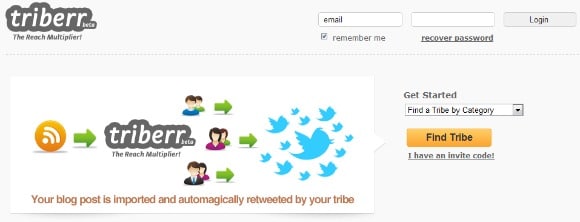
Why I’m Hesitant About Triberr

Triberr - The Reach Multiplier

Triberr - The Reach Multiplier

This is a guest post by Neicole Crepeau.

Triberr is taking the blogging world by storm. And my hat is off to its creators, Dino Dogan and Daniel Cristo for trying to help smaller bloggers like myself get exposure.

I can definitely understand the appeal of Triberr, Twitterfeed, and other RSS auto-post systems. I find myself hesitant to use them, though. As a content curator, they don?t meet my needs?and?I?m worried they?re just adding to the noise.

Triberr, Twitterfeed, and Similar Tools

Triberr offers a quid-pro-quo arrangement with other bloggers. You become part of up to four tribes. They tweet your blog posts (the timing handled by Triberr), and you tweet their?s. By default, this just happens automatically without you having to think about it.

(Note that Triberr recently did add a feature that allows you to change your settings so that you can choose which content to tweet. It was built for and optimized for auto-tweeting, though, and that?s the scenario I?m discussing.)

Triberr makes the quid-pro-quo arrangement explicit?and fun. These kinds of arrangements have been taking place informally for a long time. ?Most of us active in content creation also share other people?s content on a regular basis, and we naturally end up with a specific set of bloggers or sources whose content we tend to read and share.

Reaching a Larger Audience

Of course, we all want our content to reach a larger audience.?It?s one of the key reasons we participate in social media. It?s one of the reasons that we share other bloggers? content.

Triberr touts the increased reach that bloggers get by joining tribes. Its tagline is ?The Reach Multiplier!?. So,?ultimately, like an advertising network, it?s about getting views and clicks. I have no doubt that using Triberr, or any quid-pro-quo system, will get my links in front of more people. The problem is two-fold:

  • Are my links getting in front of the right audience?
  • Am I short-changing my audience to do it?

Content Curation versus Content Inundation

As I said, I consider myself a content curator. I am selective about the posts that I share. ?I take pride in reading each one before sharing it. ?I share content that I think my particular audience, or the audience I?m trying to build, will find of value. I know they are flooded with content. I like to think they trust that what I share is going to be worth clicking on.

There are bloggers whose content I routinely share. Even with those bloggers, though, I don?t share every post. Even for the blogs I helped start (SMB Collective)?or am a regular contributor to (Mark Schaefer?s?Grow blog), I don?t share every post. I share those that are?relevant to my audience and?of high quality.

If a person auto-tweets every post from my blog, then they aren?t being selective. They aren?t choosing the posts relevant to their audience. I bet they don?t have a quality bar, either. Yes, I want my content to be shared. But?what I really want is for my content to be shared by someone whose judgement his or her followers trust, and whose audience is the target audience I?m trying to reach.

We are inundated with information, links, content. The problem is just getting worse. When people auto-share every post from everyone in their network, they just add to the problem, inundating people with more links.

The Value of the Curator

That?s why I personally think that?true curators are going to become more valuable. As we try to filter out all the junk and focus our time on consuming really good content, we will rely on selected tools and selected individuals.

Some websites and applications are trying to help surface the best content to those who are seeking it. There will be a role for these tools: Flipboard, Zite, Alltop, and the like. They will be locations for people to go to when they are in the consumption mode, actively looking for information on a topic or ready to sit down and do their daily reading.

More and more, though,?people get their content primarily in small snippets, through friends and their online networks. They receive it in small chunks: a post on Facebook, or LinkedIn, or Twitter. They click because a particular headline grabs them.

There is evidence to suggest that we are?becoming more selective about the pages we Like. Similarly, as content marketing and the content volume grows,?we?ll become more selective about the people we follow. As a blogger or curator trying to build an audience, it will become even more important to pick your niche and create and share quality content about your selected topic. People will choose to follow and to really pay attention to the content shared by curators who have proved themselves trustworthy.

For that reason, and just my own personal integrity, I?m not willing to auto-tweet. I don?t want to be part of the problem, and I want to maintain my own reputation?because I think?having a reputation as a good content curator is going to become more and more valuable.

What about you? Can automated syndication work, or does manual curation seem the better approach?

Neicole CrepeauAbout the author: Neicole Crepeau is a speaker, blogger, columnist at {grow}, and co-founder of SMB Collective. She works at Coherent Interactive on social media, website design, mobile apps, & marketing. Connect with Neicole on Twitter at @neicolec.

Planning Ahead

Crazy driver

Crazy driver

I took this picture on the way to a meeting the other day. As you can see, the lady driving the car has her little dog right up front with her in the driver’s seat.

Because we were driving (and I know how some of our local drivers are – think New York cabbies!), I couldn’t help but think of some of the things that could go wrong:

  • A car suddenly brakes in front of her.
  • A child runs out in front of the car.
  • She’s rear-ended by the driver behind.
  • The dog sees another dog and starts going wild.

All of these scenarios – and probably a few more – would all lead to the same result, and it wouldn’t be pretty for either the driver or her dog.

Because she didn’t plan ahead.

She didn’t take into consideration what might happen, so she let everything go to fate. Fair enough – but sometimes we need to make sure that planning ahead is core to all we do. Some of this could include:

Planning Ahead For Your Business

We like to think we’ll know what to do when our business hits a rough patch. But do we? Do we know to have X amount set aside to pay the bills, employees, contractors and ourselves? Do we make our business and/or marketing plans flexible enough to be able to change on the fly? Do we plan for trends in the marketplace and how we’ll overcome them? Do we plan ahead on changes in the administration of our countries and different mindsets to our current business approaches?

Planning Ahead In Your Job

There used to be a time when you had a job for life. No more. Now, you’e lucky you’re at the same place for more than a couple of years. So how are you planning ahead for that? Are you taking a night school course to expand your skills for a new career? Are you keeping on top of industry news about your employer or their industry? Are you planning ahead in case your employer goes bust tomorrow? Are you planning how to use the contacts you’re making when/if push comes to shove?

Planning Ahead On Your Blog

If you blog, you may or may not have a blogging schedule. Myself, I pretty much write when an idea comes to me and I’ll write almost there and then – I don’t have any drafts. But what if I fell ill, and my blog was dead for a month or more? Are you planning on having a back-up plan for you falling ill? Or vacations? Or if your server goes down, or your host goes out of business?

Planning Ahead In Your Life

Okay, this is probably the hardest to plan ahead for, since life is pretty good at throwing us curve balls. But there are still ways we can plan ahead, either for us or for those around us. For instance, have you planned how much extra you can put to the mortgage to make your home your own faster? Or how you’ll cope if your partner falls seriously ill, and you have children? Who can you reach out to? Or how about the discussion that’ll arise if your son or daughter comes home one day and says their views on a topic you’re passionate about have changed and they’re in direct – and possibly harmful – conflict with you?

Your Turn

These are just some of the ways we can all plan ahead, whether in our personal or professional lives, or somewhere in-between. There are many more – the main point is that they’re all related. What happens at work affects your home life, and very often vice versa.

Planning ahead might not stop certain events from happening; but it sure as hell can prepare you better. After all, you never know when you’re going to get hit by a flying dog…

How about you? Are you planning ahead, and if not, should you be, at least just a little?

On Giving a Damn

Giving a damn

People will agree or disagree with you. People will agree or disagree with how you do things. That?s how it should be ? none of us have all the answers.

The trick is in deciding who you give credence to, and who you let pass by because they offer nothing of value except repetition.

But the ?trick? is actually pretty easy to work out.

In your personal life, you give a damn about your loved ones ? friends, family, partners.

In your professional life, you give a damn about your business partners, your colleagues, your clients and your customers.

If you blog, you give a damn about your community.

If you?re on social networks, you give a damn about people you connect with.

And all the above includes your critics too. Your?valid critics ? you give a damn about them too, because they help you grow.

Everyone else? Meh. There are better things to spend your time on.

How To Guarantee ROI On Your Biggest Business Investment

New starts

Leon NooneThis is a guest post from Leon Noone.

How valuable is your biggest single business investment? What return are you getting on that investment? You need to know. Return on investment ? ROI ? is a perfectly reasonable management expectation. That includes investment in people.

ROI And Your Laptop

Let’s say you want to buy a new laptop: top of the range. You’re prepared to spend up to $1500. At that price wouldn’t you make sure it had all the bells and whistles you wanted and expected before you parted with your hard-earned? After all, $1500 is a significant figure. You’d expect a clear return on your investment.

ROI and New Investment


What would you say to a manager who said, “Boss, I want to spend $50,000 a year on a new machine. And I want you to commit a further $50,000 a year in maintenance costs to keep the machine running. Incidentally, I can’t guarantee that we’ll get any ROI, or even break even. Even if the new machine works very well, we’ll still need that $50,000 a year to keep it going.” Well: what would you say?

The Other Machine

A laptop is a machine. It’s a resource you need for better business results. We also have a special name for the $50,000 a year machine that the manager’s asking for. We call it “employee”. And it often costs much more than $50,000 a year to maintain.

The ROI Contradiction

It’s interesting. We spend a one-off $1500 on a laptop and expect it to perform admirably without further investment. We spend $50,000 annually merely to keep an employee. What ROI do we expect from that investment?

ROI And the Employee Resource

Permit me to make position clear. Work is not a “love-in”. Every resource you use, whether a machine or something else, should make a measurable contribution to business success.? Employees are a resource. Therefore ?.ROI is essential for what you invest in employees. But the “machine” resource and the “employee” resource aren’t quite the same.

Machine Expectations

Your new machine is inert. It wants nothing from you. Install it properly. Look after it well. It’ll do what you expect ?. perhaps a little more with careful attention and care. And you expect a good ROI from it.

Employee Expectations

The employee resource is different. It has emotions, opinions, expectations, ambitions, values. It has responsibilities outside of the workplace. It’s easily distracted. You can’t just plug it in, switch it on, let it run and wipe it down if it looks a bit tired. That’s not enough.

But it’s still one of the most expensive investments you’ll ever make. All up, total employee costs are one of the biggest ? if not the biggest ? single expense in your business. It’s essential that you get your ROI.

Some Tips For Employee ROI

  1. Decide exactly what results you expect from each employee.
  2. Tell each employee exactly what you expect.
  3. Decide, together with the employee, how you’ll measure whether the employee has achieved the expected results.
  4. Set performance standards so that employees can tell, daily ? yes daily ? “how they’re going”.
  5. Put systems in place to enable employees to implement the performance standards perfectly.
  6. Provide resources to enable employees to operate the systems.
  7. Reward successful employees as well as you possibly can.
  8. Let them get on with? giving you what you want.
  9. Once they achieve the results and meet the standards, give them the autonomy and independence necessary to continue to do so.

Why Bother?

Employing people is a huge investment. You owe it to everyone involved to get a good return. But there’s another, equally good reason.

Employees need to know that they’re making a positive and effective contribution to business success. They also need you to acknowledge that contribution. Finally, they need to be satisfied that their contribution is well rewarded.

The Major ROI Benefit

The real benefit is that it enhances employee self esteem and professional competence. It provides great, to use an old expression, “job satisfaction”. It enables employees solid opportunities for genuine self development. These are positive consequences of this ROI approach.

The Major Payoff

Bear this in mind. If, like most managers, you’re always looking for more time to “manage the business”, you’ll only get it when you develop “perfect employees”. That’s what this ROI approach will give you. You, the manager, are a major beneficiary.

Conclusion

It sounds simple. It can be demanding. But it’s much less complicated than some of the gurus would have you believe.

Leon NooneAbout the Author: Leon Noone helps managers in small-medium business to improve on-job staff performance without training courses. His ideas are quite unconventional. Read his free Special Report “49 Practical Tips for Removing Employee Apathy, Aggravation And Resistance In Your Business”. Simply visit?www.staffperformancesecrets.com/ and download your free copy now.

NOTE: Sadly, Leon passed away on December 26, 2014. I will miss his voice and insights greatly. Here’s to you, Leon.

  • « Go to Previous Page
  • Page 1
  • Interim pages omitted …
  • Page 141
  • Page 142
  • Page 143
  • Page 144
  • Page 145
  • Interim pages omitted …
  • Page 283
  • Go to Next Page »
© 2026 Danny Brown - Made with ♥ on Genesis