• Skip to primary navigation
  • Skip to main content
Danny Brown

Danny Brown

podcaster - author - creator

  • About
  • Podcasts
  • Journal

Latest posts from Danny Brown

Enjoy the latest posts from Danny Brown, and feel free to add your own thoughts in the comments after the post.

How to Kill Your Blog in 10 Easy Steps

How to kill your blog

So you’re bored with blogging. You have other things to do – like eat, sleep, go out, work. You know – boring “real life” stuff. Besides, thinking about it, blogging is for computer nerds and failed writers.

Not to worry – help is at hand. Here are 10 ways to kill your blog. Let’s begin.

1. Stop Writing

What? That’s too simple – of course your blog will die if you stop writing? Well, yes, if you stop writing altogether. But be smarter about it – change your writing habits. If you write daily, change to once a week (and vice versa). If you want to lose your readers, confuse them.

2. Be Obnoxious

People like to be respected – your readers are no different. So be obnoxious. This can take many shapes – talking down to them in comment replies (if you reply at all); using made-up words that make you sound wanky; and making them feel you’re a hundred times smarter than they are. Be mean – and keep those pesky readers away.

3. Close Your Comments

People like to be heard, and we especially like to be heard when we read something that either inspires or polarizes us. So take away that option from your blog, and make your site a talking head instead. Unless you’re Seth Godin or Leo Babauta, you’ll soon see your blog’s popularity shrink, wither and probably die.

4. Use Captchas

When I was younger, I used to love stuff like the Rubiks Cube and 10,000 piece jigsaw puzzles. Now, though, since time is a precious commodity, I like things to be simple and easy to do. So install a crazy ass captcha on your blog that no-one can decipher and make people pull their hair out from frustration – great way to scare readers away!

5. Limit the Options

When blog readers read a great post, very often they want to share it. Of course, if you’re trying to kill your blog then you don’t want that sucker shared a lot. So limit the amount of sharing options – instead of making it easy to share on whatever networks the reader wants to, limit it to Facebook and Twitter. After all, they’re the only real social networks that are important to bloggers. Right..?

6. Screw Formatting

Because blogs can be read on different browsers and computer screen resolutions/displays, there’s no real point in formatting your post – it’ll never look good on every reading option. Instead, bunch all your words into one long-ass paragraph; don’t use images; and make your font 9-pixel Copperplate. Job done.

7. Die, Navigation, Die

Think of the world’s biggest maze. Then think of the world’s biggest maze at night. Then think of you trying to navigate the world’s biggest maze, at night, in a blindfold. Now – make your blog’s navigation that much fun, and make it easy for your readers to get lost and not know how to get back home. Lost readers = frustration = see ya!

8. Search What Now?

If you really want to kill your blog quickly, you could even combine a couple of the ways here. For example, if you have crappy navigation, make sure you don’t have a Search Box to at least let your readers find what they’re after. Add in no Archive section and boom, you have one heck of a lost blog happening!

9. Subscribing is for Wimps

When you set a blog up, generally it’ll come with a standard RSS feed. Thing is, the standard RSS feed doesn’t always work on certain browsers, so using something like Feedburner or Feedblitz is better. But you don’t want better – so leave the standard feed and make sure you don’t have any subscribe options in your sidebar. If your readers can’t subscribe, they won’t know when you have a new post. Blog death on the horizon.

10. Repeat Yourself

We all run out of ideas, but often you can find things to blog about to share with your readers. But if you’re trying to lose readers and kill your blog, then you don’t want fresh ideas. Instead, copy a post from your Archives, change the minimum amount of words up, and you have a new-but-not post to pan off on your readers. Tip – don’t use a Related Posts option here, as you can get found out and look stupid.

As you can see, there are a bunch of ways to kill your blog, so you don’t need to worry about pleasing these damn readers of yours anymore.

Of course, if you actually want to have a blog worth visiting, and one that sees you respected and visited and recommended, then ignore all of the above and do the exact opposite.

Your choice.

image: shiner.clay

Google+ Is the Social Network That?s All About Search

Google Plus

Google Plus

This is a guest post by Sean McGinnis.

Did you hear that Google launched a social network called Google+? Of course you did!

In the past, Google took a stab at social by purchasing Orkut. Later, they launched both Google Buzz and Google Wave with little success. Now comes Google+.

Kinda seems like Google is the Elizabeth Taylor of the social world, doesn?t it? They?re going to keep trying until they get it right. Given those four trips down the social aisle, and the fact that employee bonuses are tied to getting social right this year, it?s pretty clear Google is borderline obsessed about social.

I wonder why that is?

So have a lot of other people.

In fact, there?s been a lot of handwringing and hypothesizing about why Google launched Google+. Some believe it is designed to kill Facebook; others that it will kill Twitter; still others view it as a play to move everything into the cloud and take on Microsoft and Apple.

I?m not convinced.

I think Google+ is a forward thinking play to keep search market share. Coincidentally, it also opens up billions and billions of new real estate to sell Google ads against, but that?s secondary (believe it or not).

Google Makes Money By Selling Ads

You see, Google has one objective; to sell advertising. Google brought in over 28 billion dollars in ad revenue in 2010 ? 96% of total revenue for the year; and that number is already growing roughly 30% this year.

One of the things we all know is that you make more money when more people see your ads, whether that?s a TV show or a Google paid click within a search result.

Google AdWords

Google?s goal of selling ads is directly served by making services that are as valuable as possible. But, what?s valuable in the context of search?

Think about search for a minute. You ask a question?you expect an answer; a correct answer. That is why you go to a search engine, isn?t it? I know that?s why I go to a search engine. I?m looking for something and I need to find it. So, the more accurate the search results, the more people will want to use a given search engine.

The question is how does one go about creating a better search engine?

One Question. One Answer.

Think about it for a minute. If Google were God (not to stretch credulity too far or anything), you?d ask one question and get one perfect answer. They wouldn?t need to serve you 10 or more possible answers to your question. They would know exactly what you were looking for, even if you were unclear in how you presented your question.

I mean, God would know your intent, right? God would know exactly what you were looking for. I?m really not trying to compare Google to the Omnipotent One, but I am suggesting that in a perfect world they (along with every other search engine) would like to be able to divine what you were looking for and present it to you as fast as possible, maybe even before you asked for it.

(But maybe make you click through an ad in order to get the answer).?

Even more importantly, they would know that what I was looking for may not be what you were looking for.

Enter Personalized Search

The quest for search perfection began long ago. Google made great strides in this direction by including the concept of authority into their algorithm. By indexing the link structure of the web and calculating the value of the structure, Google (unlike many other early search engines) was able to eliminate a lot of spam from their search results.

But it wasn?t enough.

Website owners became wise to the value of links to influence search results and backroom deals, link purchases and other unsavory activities began unduly influencing search results. So, in 2005, Google released a feature called Personalized Search.

Personalized Search

It was a new and shiny object at the time. It represents (to me) the first push down the slide we are accelerating down today. Google started to present back to you (provided you were signed into your Google account when you ran a search) results that were marginally different from other users. They started to personalize those result to you.

Think about that for a minute. What better way to ensure a search engine could answer your question?

In 2009 Google extended Personalized Search to all users, whether logged into their Google account or not.

Over the past 6 years personalized search has improved some of the search experience, but only on the margins. There?s a number of reasons why Google and Bing chose to move slowly in the area of personalization, but that?s fodder for a different post.

A New Dawn for Personalized Search

Here?s the thing about personalized search. The more Google knows about all of us, the more they know about our like, dislikes, profession, connections, friends, enemies, content types, areas of influence, etc? the more they can customize the search experience.

In addition to Google+ giving all that information and more to Google, the introduction and proliferation of the +1 button allows Google to gather signals across the web of what you like and don?t like.

When we use Google+, we are creating data, all of which is within the Google network. No longer is Google relying on facebook or twitter data to learn more about you. That?s why it is so critical that Google get social right. Because social is where the data action is. It?s where we freely give up information about ourselves; where we create the connection nodes that Google can learn from and serve up a better search experience.

So while Google+ may represent a number of things tactically, the business strategy behind it is, in my view, directly correlated to their core business ? search.

More eyeballs means more ad revenue, and the best way to secure eyeballs is to have a near flawless search experience; intuitive, fast and predictive. The only way that happens is when a search engine LEARNS your tendencies ? and social is the best way to glean those tendencies.

That and it creates a few billion extra pages to sell ads against.

What do you think?

Sean McGinnisAbout the Author:?Sean McGinnis consults with businesses on digital customer acquisition and loyalty programs at?312 Digital.?Sean spent much of the last decade leveraging his law degree and 12 years of digital marketing experience by assisting law firms across the country create compelling online marketing programs. He is also co-founder of the group blog?12 Most. Sean currently serves as Managing Director and CMO?of?Multistate Edge, an online bar exam preparation company. You can find Sean on Twitter at @SeanMcGinnis.

Should Facebook Remove Holocaust Denial Groups?

Against Holocaust Denial Laws

Against Holocaust Denial Laws

When the Allied forces began to turn the tide of their conflict against Hitler’s Germany in 1944, one of history’s most disturbing events was about to be discovered.

Named the Final Solution by the Nazis, and subsequently known as the Holocaust around the world, concentration camps were found by Allied forces advancing toward Germany. The first major camp was Majdanek, which was found by the Russians in July 1944. This was followed by other camps in 1945.

The concentration camps were built for one reason – the extermination of the Jewish race by Hitler, in an attempt to breed the perfect Aryan race of blond hair and blue eyes.

While the exact number isn’t known, over six million Jews died in these camps – two thirds of the Jewish residents of Europe at that time. Of this number, one million children perished, along with two million women and three million men.

However, the numbers could be far more – many scholars feel the genocide of other ethnic groups by the Nazis, such as homosexuals, disabled people, Romani and other cultures, should be included. This would mean around 11 million people were murdered in the Holocaust, all because of one man’s twisted vision.

Over the years, there have been many claims by groups and individuals that the Holocaust never happened and that it was a myth created by Israel. Despite the public video footage; the images taken by Allied troops; the admittance of guilt by past Nazi generals – many still believe the Holocaust never happened.

It’s a viewpoint that’s raised questions on free speech and opinions and if, by denying the right to deny the Holocaust, people are having their own right to speak abused.

Now that debate and fight is involving Facebook.

Facebook and Free Speech

A caveat. I’m a huge believer in free speech and differing opinions, and often get shit on because of it – c’est la vie. I will admit I don’t agree on all speech being free – clear hate and sex crime/hate, for example, are some areas I feel opinions step over the line. But then does that make me against true free speech? Possibly.

That’s a personal opinion, though, and would affect very few people in the grand scheme of things (and only if I spoke out). A social network like Facebook, with over 700 million users, is a different kettle of fish. It’s a public platform that allows anyone and everyone to post (and access) status updates, thoughts, views and more.

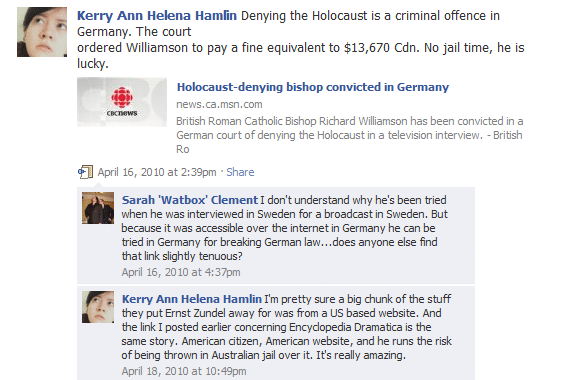
Holocaust denial

Facebook’s policies look to encourage free speech and opinion, and rightly so. But is there a limit to which this should stop, and a different policy invoked?

That’s one of the questions currently being asked of Facebook by survivors of the Holocaust, in a plea to Facebook to remove groups that have been set up to deny the Holocaust ever happened.

In an open letter posted on the Simon Wiesenthal Center website, the survivors ask Facebook to re-evaluate their approach to what’s classed as free speech versus hate speech so that the atrocities of the past aren’t repeated.

In dialogue so far between the survivors group and Facebook, a Senior VP at Facebook has advised of the importance to “…maintain consistency in our policies, which don’t generally prohibit people from making statements about historical events, no matter how ignorant the statement or how awful the event.”

I’m not sure I can buy that.

Free Speech or Road to Conflict?

As I mentioned earlier, I’m a huge believer in free speech and opinion – yet should all speech be free? Opinion is different – you can keep that to yourself. But, by definition, speech is public and has the ability to change mindsets and start movements.

A speech by Hitler in 1938 led to a movement. It resulted in the deaths of at least six million people.

I’m not naive enough to believe that had the speech never happened, the Holocaust wouldn’t have. Hitler was determined in his path to the Final Solution, and if that speech hadn’t happened, others would have (some did). Nazism was much more than words from a balcony.

But if there’s one thing that history can teach us, it’s that words can be dangerous. When hate is powerful enough, it can see words become a powerful weapon. The world saw its results from Nazi Germany. It sees its results in countries where dictators rule by force, and people live in fear of their gender, sexuality, beliefs and religion being used against them.

Free speech is important – it differentiates true freedom from state-defined freedom. The question is, if free speech is silencing voices and historical fact – and has the potential to incite violence – should it still be free?

I don’t have the answers, just my opinion. You?

Polarization, Fanboys and the Non-Middle Ground

One of the advantages that blogging holds over other forms of media is the often unfiltered voice it allows. From bloggers themselves, to those that comment afterward, the best blog posts – much like the best interviews – allow for some stimulating and thought-provoking discourse around a topic.

It’s always been one of the key reasons that blogs have enjoyed the kind of popularity that they do, since authors – at least the good ones – will allow all sides of an “argument” to be heard, while maintaining a level of respect between the debaters.

Or at least, it used to be.

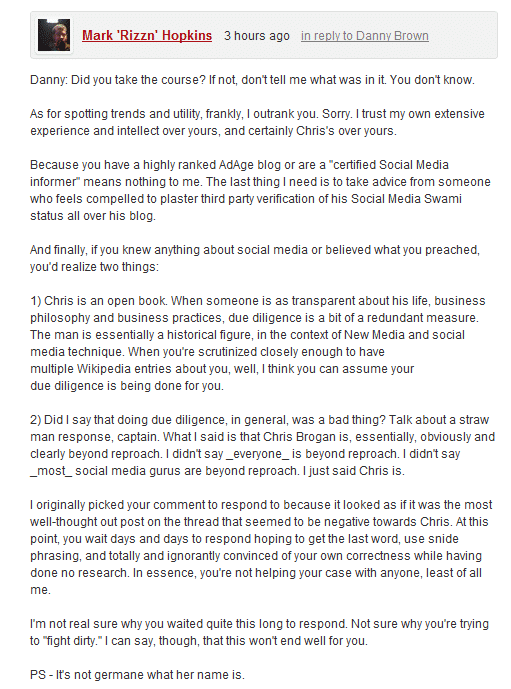
Sadly, many discussions now seem to dissolve into he said, she said kindergarten posturing, as opposed to reasoned discussion. Add to that the “the person you’re talking about is above reproach” (as shown by the image below), and it makes you wonder what happened to agreeing to disagree.

Tunnel vision mindsets

(FYI, Mark – in answer to your question, I took 6 days to reply as I was doing what I get paid to do for my clients, and spending time with my wife and son. I put that first over everything).

There’s nothing wrong with disagreeing. There’s nothing wrong with defending your friends. I’d say both are qualities that should/need to be encouraged more, to ensure healthy debate is allowed and everyone’s voice is heard.

When you start saying someone should apologize for stating their viewpoint, though, or that someone is above reproach, there’s something messed up (as long as the original viewpoint isn’t inciting hate or similar). It takes away the very thing most Internet users celebrate – freedom of opinion and the ability to see all points of view respectfully, whether you agree with them or not.

Instead of questions being asked or viewpoints being shared, you’d be left with people afraid to speak because, clearly, only the opinions of the few and those above reproach are valuable.

Sorry, but I don’t buy that.

Do that, and you might as well start letting the infographics win (hat tip to Marc Girolimetti?for that quip). And just ask Jon Aston what he thinks of infographics to see whether that’s a good thing or not.

Mind you, a lot of this could probably be avoided if bloggers did a better job of looking after all of their blog’s community, and not just the adoring ones…

Note: For the context of the conversation the image represents, click here.?

The Ten Songs The Rolling Stones Wrote About Social Media

The Rolling Stones social media

The Rolling Stones social media

This is a guest post by Marjorie Clayman.

It’s been a weird year. Grand in many ways. Here’s an example. So, Mr. Brown here, he asked me to guest post on this site you’re looking at, and I thought, “Wow, what an honor!!”

Shortly thereafter, I was playing on Google+ and I got invited to a hang-out with Mick Jagger and Keith Richards. I hadn’t even circled them! How did they know where I was?? Anyway, I agreed to hang out with them because, well, who wouldn’t. Unfortunately, I found out they were not very happy with me.

See, a while back, I wrote a post about how the Beatles had been really ahead of their time because they wrote 20 songs about Social Media engagement. I had written it as a kind of funny joke-type post. Well, as it happens, the Rolling Stones really did write songs about Social Media because they really were that far ahead of their time. I had no idea.

In order to fix this great pain I have caused, I thought I would record here, on Mr. Brown’s site (they didn’t want to be on my site cuz the Beatles were there) my conversation with the Rolling Stones, which mostly was about the 10 songs they really did write about Social Media (they insisted in a follow-up that the Beatles wrote 2 songs for every 1 of theirs).

Oh yeah, and MJ = Mick Jagger, KR = Keith Richards, and MC = me.

1. Can’t Get No Satisfaction

MJ: Right, so the first song we wrote about Social Media was actually Can’t Get No Satisfaction.

KR: Can’t get no…

MJ: You know, we just knew that people would never be satisfied online, no matter how much they achieved. Oh, you got your post tweeted out by God? Well, that’s still not good enough, probably. You do try to get satisfaction, but it just never works, does it?

2. Ain’t Too Proud to Beg

MJ: Sometimes we found a song someone else had done and thought, “Aye, that has to do with Social Media!” – that was what happened with Ain’t Too Proud To Beg.

KR: Yeah, you know, it’s ironical, because uh…because…uh…because a lot of people do beg, don’t they?

MJ: Right, people beg to have their posts tweeted out, people beg for attention. The Rolling Stones would never do something like that, so we covered this song and made it our own. You shouldn’t beg, by the way. It makes you look silly.

3. Waitin’ On a Friend

KR: Yeah, we wrote Waitin’ on a Friend because that’s what Social Media is all about isn’t it?

MJ: Well, you don’t get money off of friends unless you sell ’em, mate.

KR: Yeah, but having friends online is really nice, you know. It makes it fun and sweet and *sniff*

MJ: Are you crying?

KR: Naw.

4. Paint It Black

MJ: Well, Keith’s turn to being morose reminds me that we wrote Paint it Black because we knew that people online would have the tendency to see the dark side of everything and exhibit the darker sides of their nature. It’s really a shame, isn’t it, because positivity could spread really fast online.

KR: Maybe we should have written Paint it White to give people the idea.

MJ: Go wipe your nose, Keith.

5. Wild Horses

MC: Well, not every song you guys wrote could have been about Social Media. I mean, how would Wild Horses relate, for example?

MJ: Cor, you’re daft though aren’t ya? Wild Horses couldn’t tear me away. That’s the Social Media experience, isn’t it? Everyone says, “Ohhhh, I hate it.” But they’re still tweeting that, aren’t they?

MC: So you knew about Twitter in 1969, eh?

KR: I saw into the future.

MC: OK.

Time

6. Time Is On My Side

MJ: Did you know that we wrote Time is on My Side?about Social Media? Very few people get this connection but it’s really true. We wanted people to take their time growing their strategy, their plan, their presence…

KR: And their egos. Heh heh heh.

MJ: Well….yeah. That’s true. But mostly the first things I said.

7. Pleased To Meet You

MJ: We were really shocked that people applied such a mean and dark translation to Pleased To Meet You (Sympathy for the Devil)...we really meant it as a reminder to introduce yourself to new people in the online world, and the “guess my name” part was ironical again. Your name should be close at hand when you’re online, shouldn’t it?

KR: Yeah…

MJ: I wasn’t asking you.

KR: Right.

8. Under My Thumb

KR: We wrote Under My Thumb because the keys are always going to be under your thumb. Heh heh heh.

MJ: Keith, I think there’s a guitar over there that needs tuning.

KR: Where?

MJ: Right, so we really wrote Under My Thumb to reflect the power struggle that goes on in the online world, right? You always want to beat the person above you and manipulate them in some way. It’s crap that people spend their time that way. Anyway, we thought if we would really talk about controlling someone and getting them to do everything you want, it would make a point to people. But people just said, “Oh yeah, great idea, mate. I think I’ll try that.”

KR: People are SO stupid.

MJ: Yeah, really they are.

9. Honky Tonk Woman

MC: Well, okay, what does Honky Tonk Woman have to do with Social Media? I mean, there can’t be a connection there, right?

KR: Oh you’re an ignorant twat. That’s about two things we knew would happen in the online world. First, unprofessional and profane behavior. And second, uh…

MJ: Second was the rumor-mongering aspect of Social Media. You know, “People say…” that part. All about online rumor-mongering.

MC: Of course it is.

MJ: I don’t like you.

MC: I know. That’s cool.

10. Mixed Emotions

MC: So what’s song number 10 in this line-up, gentlemen?

MJ: Well, the last song we wrote about Social Media *specifically* was Mixed Emotions. And there’s a lot of meaning in there. For example, we knew people would often have mixed emotions about Social Media. You love it, you hate it. It’s so much work but so much fun. But also it’s, you know, we say “You’re not the only one,” so it’s…

KR: It’s a reminder that you’re not an island, you’re a person in a big group of people and you should pay explicit attention to what people are doing around you. I mean what are you thinkin, you’re the only one with a bad day or an irritation in your life? Toughen up and look out for other people for a change how about it ya great waste of life?

MJ: Uh, yeah. That about sums it up.

Alright, so, those are the ten songs Mick and Keith say they wrote about Social Media. Once they got going, though, I really felt like they may have written more. It was just too hard to keep Keith’s attention throughout the interview.

So I need your help now. What other songs did the Rolling Stones write about Social Media? Did they actually write about it more than the Beatles? What do you think?

Margie ClaymanAbout the author: Marjorie Clayman works for her family-owned agency, Clayman Advertising, Inc., where she represents the third generation! Margie is the resident blogger at MargieClayman.com, and can be found on Twitter at @MargieClayman.?

image: Melvin Starbrook
image: pietroizzo

  • « Go to Previous Page
  • Page 1
  • Interim pages omitted …
  • Page 135
  • Page 136
  • Page 137
  • Page 138
  • Page 139
  • Interim pages omitted …
  • Page 283
  • Go to Next Page »
© 2026 Danny Brown - Made with ♥ on Genesis