• Skip to primary navigation
  • Skip to main content
Danny Brown

Danny Brown

podcaster - author - creator

  • About
  • Podcasts
  • Journal

Latest posts from Danny Brown

Enjoy the latest posts from Danny Brown, and feel free to add your own thoughts in the comments after the post.

52 Cool Facts About Social Media – 2012 Edition

More cool facts about social media

Back in July 2010, I wrote a post called “52 Cool Facts About Social Media”. I wanted to have a look at some of the mind-boggling and truly impressive numbers from this space we play in.

I also wanted to offer a fun fact for every week of the year, for anyone playing social media trivia games.

At the time, the Big 5 were (arguably) Facebook, Twitter, LinkedIn, YouTube and Blogging. My, what a difference two years make!

So, to bring some of these figures up to date, as well as include some of the newer names on the scene, here are 52 cool facts about social media, the 2012 edition. Enjoy!

Facebook

1. 85% of women are annoyed by their friends (note – I don’t think this is just limited to Facebook!!).
2. Links about sex are shared 90% more than any other link.
3. More than 350 million users suffer from Facebook Addiction Syndrome.
4. 25% of users don’t bother with any kind of privacy control.
5. The average Facebook user has 130 friends.

Statistics from Economist, Social Times, CNN.

Twitter

6. 750 tweets per second are shared on Twitter.
7. The original Twitter beta was launched on the birthday of CEO Evan Williams.
8. If Twitter was a country, it’d be the 12th largest in the world.
9. 30% of Twitter users have an income of more than $100,000.
10. Twitter handles more search queries per month than Bing and Yahoo combined (24 billion versus 4.1 billion and 9.4 billion respectively).

Statistics from Compete, Twitter Press Centre and BNN News.

LinkedIn

11. Two new members sign up to LinkedIn every second.
12. LinkedIn has 161 million members in more than 200 countries and communities.
13. Members are on track to make more than 5.3 billion searches on the platform in 2012.
14. LinkedIn’s revenue has doubled every quarter for the last two years.
15. There are more than one million LinkedIn groups.

Statistics from LinkedIn Press Centre.

YouTube

16. YouTube was founded to share dinner clips of a party due to the files being too large for email.
17. The most watched video is Lady Gaga’s Bad Romance, with 470 million views.
18. The most watched non-commercial video is Charlie Bit My Finger Again, with over 458 million views.
19. The average visitor spends 15 minutes per day on YouTube.
20. It originally started life as a dating site and was influenced by the Hot Or Not website.

Statistics: Techzine and YouTube Archives.

Blogging

21. 3 million new blogs come online every month.
22. 60% of bloggers are aged between 25-44.
23. 20% of bloggers have been blogging for more than 6 years.
24. Professional bloggers upkeep an average of four blogs.
25. 35% of corporate bloggers worked in a journalism, media or professional writing role.

Statistics: Technorati State of the Blogosphere 2011.

Pinterest

26. Pinterest drives more referral traffic than YouTube, Google+ and LinkedIn combined.
27. Users spend an average of just under 16 minutes on the site.
28. The most popular age group is 25-34 year olds, accounting for 27.4% of the user base.
29. Pinterest receives 1.3 million visitors per day.
30. 97% of the fans of Pinterest’s Facebook page are women.

Statistics: Modea

Instagram

31. 25% of Instagram users upload more than three pictures per day.
32. Over 5 million images are uploaded every day.
33. President Obama is on Instagram, having joined in January 2012.
34. Earlybird is the most popular filter, with 12.5% users preferring it (zero filters is the most popular way to use Instagram, with more than 47% of users going au naturel).
35. There are 575 Likes per second.

Statistics: Instagram Press Centre, ReadWriteWeb, Social Media Delivered.

Google+

36. “Student” is the number one occupation of Google+ users.
37. More than 2/3 of its users are male.
38. The Google +1 button is used more than 5 billion times per day.
39. Google+ is adding 625,000 new users every day.
40. More than 42% of Google+ users are single.

Statistics: Google Blog, Techcrunch, Google Investor Reports.

Social Media Influence Platforms

41. Klout has 50 times more traffic than PeerIndex, its closest competitor.
42. Kred tries to measure offline influence by allowing you to add achievements away from your online activities.
43. Klout changed its privacy model to allow opt-out from its service after a negative backlash in 2011.
44. Empire Avenue has users in more than 150 countries.
45. Justin Bieber is the only person with a perfect Klout score of 100 (says it all, then).

Statistics: Social Media Today, The Next Web.

The Mobile Web

46. 42% of phones in the U.S. are smartphones, with 44% of European users on a smartphone.
47. More than 110 million smartphone users in the U.S and Europe access social networks and blogs on their phones.
48. Tablets took just two? years to reach 40 million users in the U.S. – it took smartphones 7 years to reach this figure.
49. China is the number one country in the world for smartphone use, with approximately 1 billion users.
50. In the U.K., there are twice as many smartphone users than cigarette smokers.

Statistics: ComScore and SoMobile.

Bonus Facts

51. Social gamers are expected to buy $6 billion in virtual goods in 2012.
52. One in 5 couples meet online; 3 in 5 gay couples meet online.

Statistics: eMarketer and Stanford University.

So there you have it ? the updated 2012 edition of 52 cool facts about social media, offering a nugget for every week of the year.? Just in case you need it for your next presentation or tweet-up, and want to let folks know why social media isn?t so dorky after all.

Cheers!

Related articles
  • 11 Shocking New Social Media Statistics in America (convinceandconvert.com)
  • Some Small Businesses Are Making One BIG Mistake, And Other Hot Topics (blogs.constantcontact.com)
  • Know Your Numbers, but More Importantly Know What They Mean (inklingmedia.net)

Sunday Shorts – Facebook Edition

Facebook

Facebook

It’s been quite the couple of weeks for Facebook – from the long-awaited launch of its IPO offering, to chief egg Mark Zuckerberg getting hitched, and the announcement of its own photo app just weeks after buying Instagram.

Here’s a short recap of what’s going on in Facebook’s world.

Was the IPO Really All That Bad?

By now, everyone and their mother will know that Facebook launched itself onto the publicly traded stage with a lot of fanfare and then promptly fizzled out. Shares in the social giant topped at around $42 (after coming out at $38) and are currently sitting around the $28 mark – losing a third of its value since the launch.

So a complete disaster, right? Maybe not a complete one. The IPO market when Facebook launched was a shaky one – Dealogic said six IPO’s were stopped before going public around the time of Facebook’s offering because of market conditions.

Additionally, last year there were only 80 IPO’s in the U.S.,which is a third of the number between 2004-2006.

Given that one in 10 IPO’s normally trade at least 20% below their offering price, and there’s still probably life left to reinvigorate Facebook yet before we call it a complete failure.

Counters and the Truth About The GM Pull Out

Part of Facebook’s shaky entrance into the public stock exchange was believed to have been the after-effect of the announcement that General Motors had pulled their Facebook ad campaigns to the tune of $10 million.

GM’s official take was that “the ads on Facebook have little impact on consumers’ car purchases.” The reactions were quick, with many pointing out the flaws in the ad model at Facebook for brands.

But how much of GM’s statement was a bigger issue for brands, and how much of it was down to GM’s failings themselves?

For example, while $10 million isn’t chump change by any standards, it pales in comparison to GM’s overall ad budget globally, which stands at $1.8 billion.

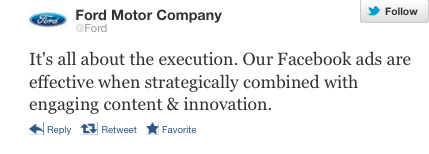
Then take a look at their big rival Ford, who wasted no time in piling on the agony for GM by saying their ads work just fine – because they have a strategy. Ouch.

Ford and Facebook

The most interesting part, though, is Facebook’s take on the matter. They claim that GM wanted full page advertising, as opposed to the more subtle Sponsored Stories approach that brands and advertisers currently use. Facebook said no, citing user experience as more important than GM’s budget.

If this turns out to be true, it’s a major win for Facebook in the eyes of their users, and a warning to brands that old school advertising isn’t welcome on their platform. Works for me.

Money Well Spent?

Short recap. Facebook buys photo app Instagram for $1 billion. Cue gnashing of teeth from Instagram users about the platform being ruined, and assurances from Facebook the app will be left alone. Looks like Facebook was right.

Shortly after the purchase of Instagram, Facebook announces its very own photo app, called Facebook Camera, whose features make it sound an awful lot like Instagram. So why bother purchasing them in the first place?

Simple – kill the competition and buy your way into the mobile market fast. Facebook’s mobile experience so far has been crap, to say the least, on all platforms. Their official Facebook app sucks, and many of the core features aren’t usable on third-party apps.

By buying Instagram, they take over one of the best way to share photographs on Facebook and combat Google’s easy upload feature to Google+ via that platform’s superior app.

Then, by announcing Facebook Camera, they now have a bona-fide app that will make the mobile experience on Facebook (and not just image sharing) a lot smoother than it currently is. Everybody wins – Instagram users keep their beloved app and Facebook users who don’t have Instagram get their own version.

So, quite the few weeks for Facebook, and this is bound to be just the start. Who says all the interesting stuff is happening over at Google+?

Game on.

Related articles
  • Facebook Might Make 2 More Acquisitions (newser.com)
  • Facebook launches ‘Instagram rival’ camera app (telegraph.co.uk)
  • FACEBOOK FALLOUT: These Companies Just Got Downgraded (FBZNGA) (businessinsider.com)

You Are Not the Story

Not the story

You are not the story. You never have been. Not even in the ?bad old days? before social media were you ever the story.

You may have thought so. You may have fooled your clients into thinking they were lucky to have you because everyone listens to you.

You may have blinded them with newspaper clippings and media endorsements.

But that could just mean you know one good contact at a publication or TV and radio station.

Your name very rarely belongs in a news release. Sometimes, but rarely. You do not belong in front of the camera. Hogging the microphone does not help your client. You may think so, but all that does is make people ask, ?Who?s this story about??

If you want to show off so much, make your client show off for you. Make their results your vindication. Put it up on your achievement page on your website, or in your company portfolio. Scream it from the rafters all you want from there.

But the story? That belongs to the client. Every time.

You do understand why, don?t you?

Why Excellence Starts From the CEO Down – Or Should

Excellence starts from the top

Excellence starts from the top

When something isn’t right at a business, usually you tend to find that the person viewed as responsible takes the fall.

So, for example, a marketing campaign that fails could be tied back to the agency, or Marketing Director, or team lead. Similarly, a new employee appointment that turns sour can be traced back to HR, or the manager that interviewed the candidate for the position.

Yet, while there’s definitely accountability to be taken by those directly in the front line, there’s (increasingly) also the option of some accountability and involvement going back to the top, at CEO level.

Pipe dream? Maybe. Unrealistic? Maybe. But it can be (and is) done on a growing basis. And when the CEO takes an active role, everyone benefits.

The Ford Example

My friend Marc Girolimetti will always be happy to tell his Ford experience if you ask him and, given the story, rightly so.

Marc was in the market for a new car, and as a staunch Audi supporter until then, was looking to release from the German manufacturer again. Unfortunately, the local dealer wasn’t great, to say the least. So Marc looked around.

He noticed Scott Monty talking about “the new Ford” a lot on Twitter, and decided to check out their cars for himself. Again, though, he had a less than stellar experience at two local Ford dealers.

So, for fun, he tweeted Scott and advised he was in the market for a new Ford and asked him to get Alan Mulally (the Ford CEO) to call him to discuss. And guess what? Call him he did. That’s led to a great relationship and loyalty between Marc and Ford, and probably over $250k in sales from Marc’s referrals.

It’s Not Easy, But It Can Be Done

Now, I’m a realist. I know CEO’s are busy people, and they hire smart folks like Scott to do the work that they can’t do themselves, due to time constraints and other business needs.

But knowing exactly what your customers are thinking, and acting on it, doesn’t (shouldn’t) need to be left to the front line folks all the time.

Sure, they’re the guys that can often dictate a business’s success from their reactions and actions. But they can only do so much.

Often, the real change comes from the very top, or at least the power to make the change real. And, as Ford’s experience shows, having an active CEO immediately adds another bow to your business arrow – especially in the social media-led world we live in, and the public image that can be both created and destroyed in a heartbeat.

Something to keep in mind the next time your customer reaches out to you.

The Commoditization of Expertise and Why You Should Never Trust a Guru

Trust and gurus

Trust and gurus

This is a guest post by Ryan Hanley.

The Internet is a canvas for Creativity…

Using the Online tools of today’s age, thought-leaders the World may never have otherwise known are given the opportunity to?paint their picture of success.

It’s amazing really…

But for as much as I love the Internet and the possibility for greatness it presents, there is a dark pattern forming that troubles me deeply. ?This may not be news for those of you that’ve been in the blogging game longer than myself… But its systemic and horrifying none the less… A true Internet nightmare.

The black plague of idea…

The rape of creativity…

The death of original thought…

The Commoditization of Expertise!

Everyone’s an Expert

So what’s this scourge of the Internet?

What could be so horrible that I would give it such a dramatic intro? Here it is…

Online… Everyone’s an expert. All you need is the most basic computer skills and an Internet connection and anyone can become an instant expert in the Online world.

How??

Easy… You call yourself a Guru.

That’s it.

Read a couple A-List bloggers like?Danny Brown?or?Marcus Sheridan,?regurgitate a few of their concepts, throw the word Guru on your About Page and BOOM… You’re an expert.

It’s that easy.

Now the truth is your blog will suck. ?But some people will find you and read your writing and consider you a thought-creator… then a dog will be kicked, a baby’s candy will be stolen and?an Angel will lose its wings.

Well maybe that last bit is an?exaggeration?but certainly all the rest.

The result is the Commoditization of the Expertise. ?A few great minds creating ideas and concepts that get chopped up and spit out over and over and over again… ?Their ideas, thoughts and creativity exploited by a thousand hacks trying to capitalize on a knowledge thirty public.

For a visual, picture the Pits of Hell scene from the movie Constantine?(yes… I’m an unashamed Keanu Reeves fan), now hold that image except replace the demons with bloggers and the lost souls with content.

Gruesome…

Why is the Commodization of Expertise a problem?

Over time it’s hard to discern the Expert from the Hack…? Marinate on that thought for a couple minutes.

Never Trust a Guru

In my very humble opinion… Guru is a terrible term.

I put Guru in the same bucket as Rockstar and Ninja. ?The first person to call themselves a social media Ninja was wickedly awesome and creative… everyone else since then is simply lame.

So my advice…?Don’t trust the Guru, trust the person.

“Ryan… A Guru is a Person?!”

Technically… Yes. ?But really they’re not. ?People who pump themselves as a Guru or Rockstar or Ninja are trying to play a roll. ?Guru is a costume… Guru is a character…

Guru is a front that attempts to tap into your inner desire for inspiration and success…

…and that makes a Guru dangerous.

The Guru calls themselves a Guru because they?re own content isn’t interesting enough or original enough or inspiring enough for people to see them as a Guru.

So they brand themselves Guru and instantly become an expert Online

Why Expertise Commoditizing Gurus are Bad for us All

(If this were my blog and not a Guest Post I’d call this section “The Rub”, but it’s not, so I won’t, but I guess I kinda did anyways)

Right now you’re probably thinking to yourself:

“Ryan… Don’t hate the player, hate the game.”

or

“Ryan… You’re drinking some Hater-Aid”

But the truth is I have no intention of playing the Guru game and I have no idea what Hater-Aid is.

What I do know is?Expertise should be Celebrated.

We all know about Malcom Gladwell and the 10,000 hours thing, right? ?Basically, in his book Outliers, Malcom Gladwell?(Google him if you?re not familiar)?theorizes that it takes a person 10,000 hours of practice to master a task.

10,000 hours is a lot…

What I want… What purpose of writing this post was when I first started is to provide a simple and sincere warning to those of you that thirst for knowledge Online.

Beware the Guru.

Don’t let the commoditization of expertise cloud your judgment when putting faith in a resource.

There are dedicated, inspiring individuals who’ve put in the time, who’ve done the work and deserve the title Guru.

Celebrate their Expertise.? Learn from them.? Allow their thoughts to help you shape your thoughts so you too can Succeed Online!

Thank you and Good luck,

Ryan H.

Ryan HanleyAbout the author: If you found value in this article, I encourage you to connect with Ryan on Twitter at @RyanHanley_Com or visit his website to read more about Content Warfare – Win the Battle for Attention Online. You can also subscribe to Ryan?s free newsletter, How to Blog Your Business.

  • « Go to Previous Page
  • Page 1
  • Interim pages omitted …
  • Page 114
  • Page 115
  • Page 116
  • Page 117
  • Page 118
  • Interim pages omitted …
  • Page 283
  • Go to Next Page »
© 2026 Danny Brown - Made with ♥ on Genesis