• Skip to primary navigation
  • Skip to main content
Danny Brown

Danny Brown

podcaster - author - creator

  • About
  • Podcasts
  • Journal

user experience

Why Our User Experience Should Be Determined by Data

Crazy Egg Danny Brown

Anyone that follows this blog regularly will know there’s a wee bit of a running joke at how often the site design changes.

What started out as a semi-regular update (say, once or twice a year) to keep the look fresh, and the content front and centre, has become almost as regular an occasion as Facebook platform updates messing up everyone’s privacy settings.

Now, while I’m really happy with the current design and the way everything flows, there’s a reason behind the recent design changes, tweaks, and community feedback – simply, data informs our decisions and user experience.

Yes, gut instinct comes into play too, but when it comes to content and how that’s displayed and acted upon, for me data analysis, community feedback and AB testing is key. Here’s why.

The Data of Trends

The world is ever-changing. What we found popular and best practices 10 years ago is nothing like the best practices and popular trends of today. Heck you could halve that timescale at least, and find we move in a constantly-changing cycle of new trends, methodologies and preferences.

This is particularly true when it comes to content.

While there are several areas where the consumption of content has changed in recent years – curation, syndication, and accessibility, for example – perhaps the biggest game changer is how advanced mobile browsing has become. For example, in a study from June this year of U.S. consumer habits:

  • 76% access social networks, with 46% using a mobile browser versus an app;
  • 68% access news sites, with 63% using a mobile browser versus an app;
  • 56% watch video, with 58% preferring to use a mobile browser versus an app;
  • 41% read/access blogs, with a whopping 75% using a mobile browser versus an app.

Make no mistake, mobile is fast becoming the default browsing option for many of the platforms where we create and share content today. If we’re not ready for that, we’ll lose visitors, readers, subscribers and customers.

Web access preferences

From my own analytics, mobile visitors now make up 27% of my audience. If my site wasn’t set up to accommodate these folks, that’s a big potential loss in traffic just waiting to happen.

From that angle, and from the continued advances in the way people consume content on the web, the move to responsive design was key.

The Data of Analytics

I’m a data geek. It’s what got me into marketing to begin with, and it’s what drives me today. By understanding the data we have access to, we can make informed decisions on pretty much everything around us.

When it comes to content, that’s a given – or should be. It’s the one single biggest piece of advice I recommend whenever people are talking about blogging, whether they’re new bloggers-to-be, or existing ones: always be tracking and watching your analytics.

Analytics are key for several reasons:

  • They offer knowledge into how your content is being received and where it’s lacking;
  • They offer information about your visitors and their behaviour on your blog (entry point, pages visited, actions taken, exit points);
  • They offer actionable insights into improving your audience reach, interaction and participation (comments, shares, subscribers, downloads);
  • They offer opportunities to new audiences, based on external discussions (trackbacks, bookmarks, referrals).

Simply put, without analytics, you’re essentially producing content in the dark, whether that be blogging, video production, podcasting, or similar. And if you’re doing that, you’re wasting good resources that could be put to better use elsewhere.

From my own analytics of the first half of this year, the following became clear:

  • While traffic was good, people weren’t staying on site long enough;
  • The entry page was usually the same as the exit one, so people weren’t exploring;
  • My bounce rate (how long people stay on site) was horrendous.

DB JanJun13

Digging deeper into my analytics, especially around the stats highlighted here as concern areas – Pages Visited, Duration of Visit and Bounce Rate – a few things became clear.

  • The incentive to check out other pages wasn’t prominent enough;
  • Certain “drivers of traffic” were doing anything but (more on that shortly);
  • The content wasn’t conducive to long stays and participation.

Clearly things had to change. So they did.

  • I changed to a design that had a sticky navigation menu, where the Page tabs would follow you all the way down the post. This increased additional page clicks;
  • I stopped using Triberr, the content curation / blogger platform;
  • I deliberately changed to longer form content, as opposed to the standard 300-600 word approach.

The results? While it’s just one month’s analysis, they’re encouraging (click to expand).

Dashboard Danny Brown

As you can see, the three key metrics I wanted to improve have done so:

  • Pages per Visit rose from 1.40 to 2.23;
  • Average visit duration rose from 1.09 to 1.37;
  • Bounce rate dropped from 81.45% to 35.68%.

Now, it’s early days, but the signs are good. If I keep tracking where visitors hover their mouse/keypad, and what actions encourage them to stay on-site, I can optimize even further and improve these stats even more.

The Triberr thing? I applaud the guys over there for what they’re trying to do for bloggers, but I’ve been finding – both myself, and with other bloggers I talk to – that Triberr is referring less traffic, and simply adding to social proof. ?The number of tweets may be up, but the desired action – traffic to the blog – isn’t.

Indeed, Triberr placed at a lowly #73 for traffic sources, and accounted for a mere 9 visits in the last 30 days.

Triberr Google Analytics

Then again, looking a little bit deeper into one of the larger Tribes I was part of, it perhaps shouldn’t come as a surprise that the level of traffic provided by Triberr was so low.

Triberr inactivity

As you can see, the activity within the group is very low, and it almost appears that people have left, or forgotten about the group, or simply don’t share anymore.

Looking at my own Google Analytics, visits from Triberr had a high bounce rate and low site duration time, so by removing that option, it added to the positive impact on these stats.

However, this is my own experience, and I’m sure Triberr woks well for some folks.

The Data of Community

For any content creator, but especially bloggers, the community around the content is hugely important to the success of the blog. Without a community, there’s pretty much nothing there except a part of the web that’s for an audience of one.

From regular readers to occasional commenters, and discussions elsewhere via Twitter discussions, Google+ threads, Facebook wall comments, etc., a community not only helps promote content, but improve its creation as well as its presentation.

This was evident from the excellent feedback and suggestions I received when I implemented my new design last week. After finishing, I dropped an update on my social networks, asking for thoughts, feedback and suggestions – and got great advice.

    • On Google+, marketer and blogger Ana Hoffman mentioned the font size of the headlines looked great on mobile, but looked too big via desktop browsing. After analyzing, I agreed, and dropped the pixel size down a few points. And Ana was right!


  • On Twitter and by email, social strategist Mila Araujo really delivered, with some great advice on dropping the Archives tab for a Topics one (to improve access to content), as well as advising of some areas that weren’t showing up on mobile. This information helped immensely, as did the suggestions to offer a separate tab for each of my books, particularly useful for mobile browsing.

By asking for, and acting upon, the fresh eyes of my community and their suggestions to improve the user experience, I was tapping into a rich source of data that helped improve the presentation of the content here, which should (hopefully) build upon the improvements on how it’s consumed.

Data is Everything and Everything is Data

Like I said at the start of this post, I don’t discount gut instinct at all when it come to making decisions. Some of the best experiences in my life happened because I acted on gut instinct over logical reasoning.

But for content, or for anything that has some form of marketing slant, for me data is everything.

By utilizing the data I had access to – archival analytics, visitor behaviour, trends in browsing, etc – I could immediately see where changes needed to be made. By accessing the experience within the community around this blog, I had even more data points from which to make choices to.

For me, this is invaluable, and can only help us grow, improve, and continue to make the user experience more enjoyable. Which, at the end of the day, is what really matters, no?

image: Marketing Charts
What Posterous Could Learn from Gravity Forms About Service

Customers and employees are your two most important ingredients in a successful business. Without one, you can’t have the other.

Customer service is an especially hot topic for me, as I’ve worked in improving how service is measured and improved at a few companies, where previously it was maybe in third or fourth place when it came to that company’s priorities.

Your employees are your best customers, and your customers are your best employees. They’ll defend you; market for you; endorse you; and be your voice where you might not currently have a presence.

If you look after them. Something blogging platform Posterous could improve on.

A Week is a Long Time in Business

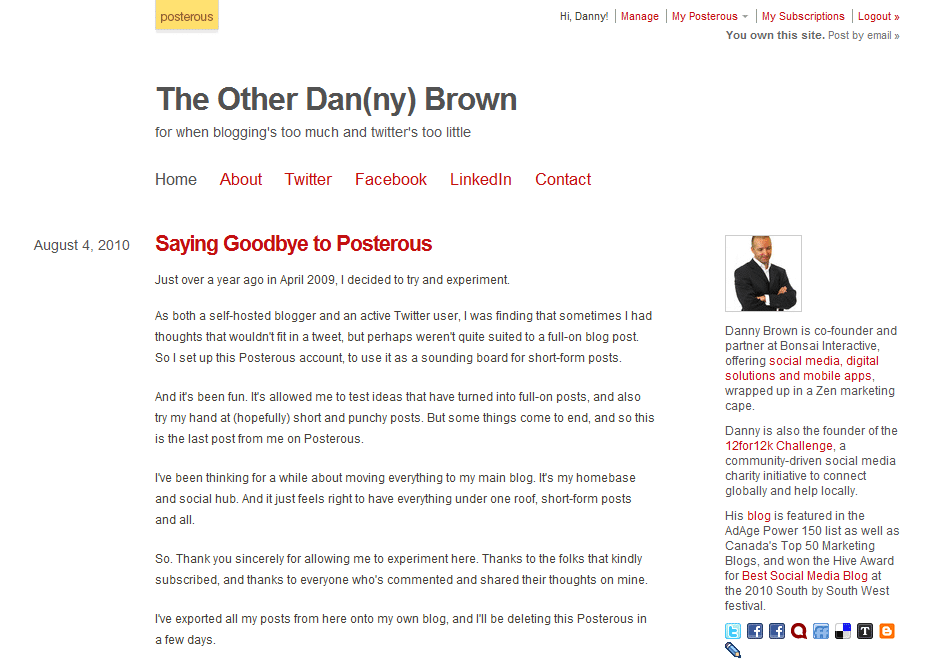
Almost two weeks ago, I decided to stop posting short-form blog posts over at Posterous, and move all my blogging back to my blog right here. While I had enjoyed experimenting with Posterous, this is my homebase. And I wasn’t keen on a third-party “owning” my content.

So, I wrote a post about why I was leaving Posterous and made the decision that I’d delete my account there within a few days, to allow anyone to come and subscribe here if they wished.

And that’s where the fun begins.

I tried deleting my account, and kept getting an error message. No worries, the message mentioned Posterous had been emailed about it, and it’d be resolved soon. Except it wasn’t.

For a week, I tried to delete my account – I even made it my secondary one since I was informed that primary accounts at Posterous need you to contact support to delete the account for you.

Still no joy. Frustrated, I reached out to Posterous via their Twitter account. No reply there, so over to contacting their helpdesk.

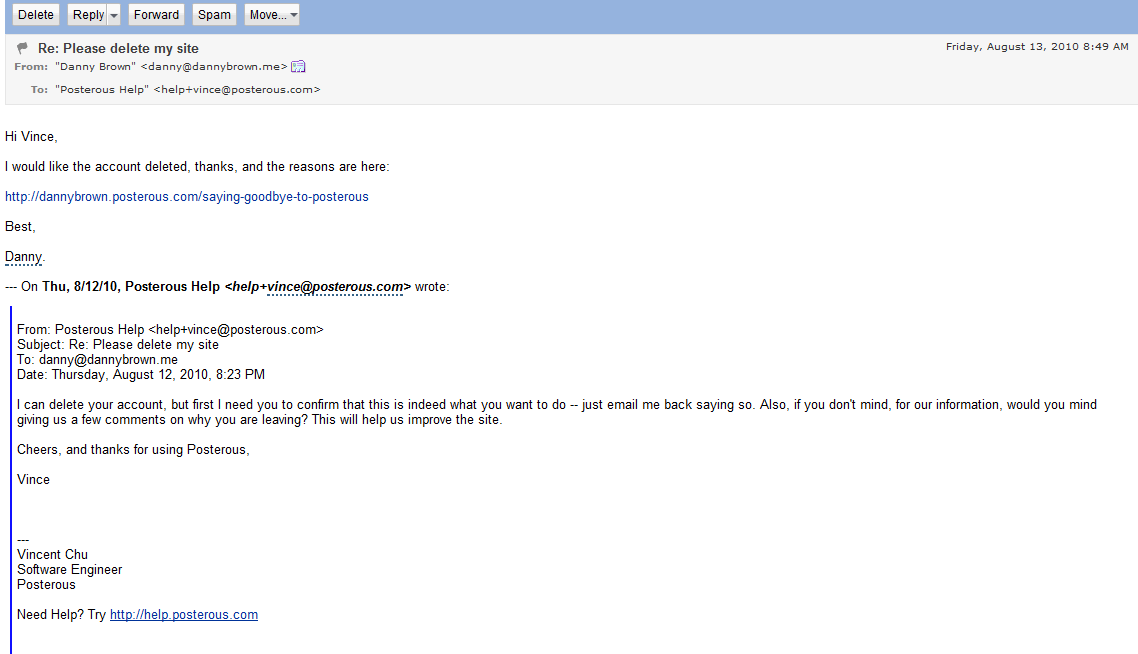
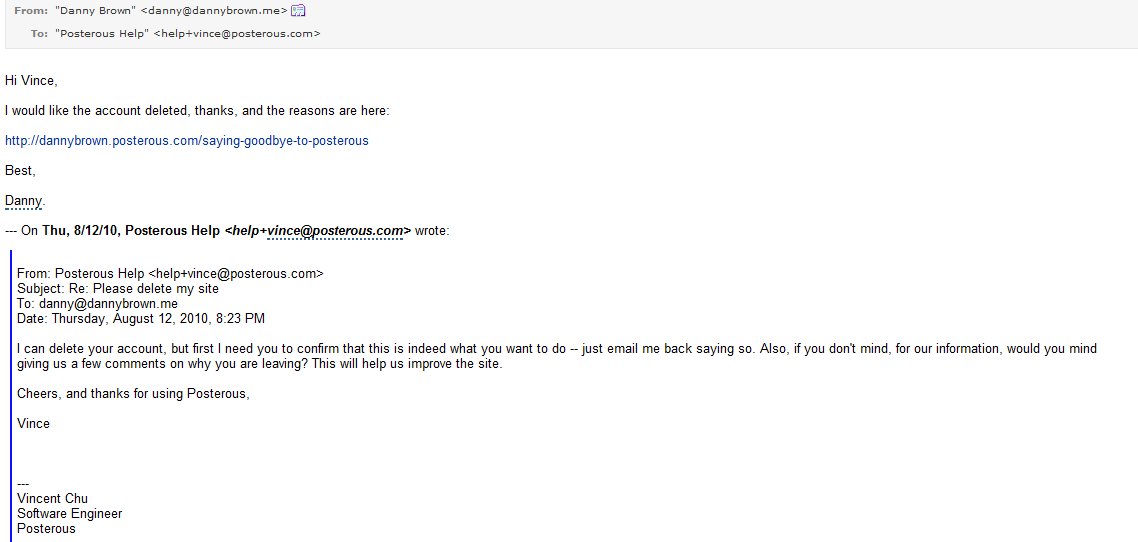
In all fairness, their representative Vince got back to me seven hours later. Yet it wasn’t to delete the site right away – that would only happen if I confirmed that this was what I wanted to do (click to enlarge).

So, I mention that yes, I do want to delete my account and I pointed Vince to my post on their platform as to the reasons why.

This was on Thursday, August 12, and as of writing, my Posterous account is still live.

Customers Hate Obstacles

So now I’m pretty frustrated with Posterous. I no longer want to use their service, but I’m still “using it” if you visit my account there. And the company isn’t making it easy for me to stop using their service.

It’s like me signing you up to my newsletter, and then making you jump through a bunch of hoops to unsubscribe, in the hope you might give up and stay with me for convenience’s sake.

And it’s a shame. I’ve written before how Posterous offers an easy way in for folks to experiment with blogging, and I’ve pointed clients their way in the past that wanted to see if blogging is for them. But not now – my experience with Posterous has been soured by something that should be pretty straightforward.

As customers, we can be a complaining bunch, but at times the complaining could be easily avoided just by taking away the obstacles companies put us through. Some get that spot on.

The Gravity Forms Experience

I started using Gravity Forms recently for my contact forms. I’d heard good things about them and I wanted to check them out, so I bought the single user license. I loved how they worked, so I wanted to upgrade to the multi-site license instead.

I used their contact form to ask how easy this was, and what the steps would be. Within 10 minutes, Carl Hancock had an emailed answer and easy-to-follow steps on how to upgrade. Within 30 minutes, I had a coupon code to use that would deduct my original purchase from the multi-site one.

But what really stood out for me is that this all happened late at night. I contacted Gravity Forms at 11.28pm, and by 11.58pm I had my coupon code and purchase instructions.

Thirty minutes.

That level of service turns me from a simple customer to a brand advocate. If anyone asks me about forms for blogging, I point them in the direction of Gravity Forms. Every time.

Simple Sells

It may be that Posterous has a larger userbase than Gravity Forms. It may be that their platform needs more technical nous than Gravity Forms. It may be that there’s a certain timescale before something can get done.

But to customers, that doesn’t always matter. All we want is a simple product, and one that we can stop using at any time if we choose to do so. Making us go through hoops just ensures we won’t return to your product in future, and will probably use your competitors instead.

You could say that Posterous is a free product, and so the support doesn’t need to be as good as that of a premium product. But let’s say at some stage they’re looking to make it a paid service – how they look after you now defines how you’ll perceive paying for their service.

Marketing might sell a product, but service is the gold that repeat sales come from.

Compare the Posterous and the Gravity Forms approach – which one would you be a loyal customer of?

Update – my account has been deleted after Rich Pearson of Posterous kindly stepped in and explained the delay.

You Don’t Say…

running into the game...Pop quiz. How many of these phrases do you recognize?

– It’s all about the dialogue.
– You have to fish where the fish are.
– You have to engage.

– You can’t measure the ROI of social media.
– Look at Zappos / Dell / Best Buy / Jetblue / Comcast as examples of how to do it right.

– Etc, etc, etc… (okay, this last one isn’t really part of the phrases!)

Now, second part of the pop quiz. How many times a day do you see or hear these phrases being used on a social network or blog? Once? Twice? Ten times? More?

My guess is that it’s quite a bit (and, I’ll be the first to hold my hand up and say I’ve been guilty of it in the past). I’ll try my best to steer clear of these areas – if I slip (and don’t quantify why I’m using one or more of these terms) then feel free to shout me down.

My point?

There are three audiences when it comes down to it – the early adopters of social media, the ones that have been using social media for a while, and the ones just starting to dip their toes in. And it’s time to bring these three audiences together. Faster. Starting today. Because really, there’s no need for differences when you think about it.

The toe dippers are looking for help and advice. Good, actionable advice. The kind that can take them from testing the water to the comfort zone that is the mid-term users. Where the theory is understood; the why isn’t in question; and the next step is the how part of the equation.

Which leaves the early adopters, who can bring bring all the pieces of the puzzle together. So let’s see that happening. Here’s how.

  • Experienced folks – instead of just saying, “You have to fish where the fish are”, enable the fishermen. Show them exactly how you fish where the fish are. And, if you’re a new fisherman, question people that say this and don’t offer a boat to take you there.
  • Quit using the “you can’t measure social media ROI” soundbite. If it can be deployed, it can be measured. Compare previous non-social media strategies with those now using it – did you save promotional money? Did you see an increase in website traffic? Did you reach more of your targeted audience? Was the process more streamlined? How many downloaded your mobile app? Did brand loyalty increase? Did your customer service satisfaction level increase because you had a virtual call centre? These are just some of the basic questions that can be answered when it comes to measuring ROI – but they’re good starting points.
  • Change the soundtrack. Yes, it’s wonderful that businesses like Comcast, Zappos, Dell and others like them are held up as examples of social media success stories. But their stories are old now. What about the ones we don’t hear but should? What about family farms? Or innovative approaches to consumer wholesale food? Or delivery firms? Or, if you still want to talk fish, how about an actual fishing company? There’s a whole world of success stories out there – isn’t it about time we shared the small ones that are (probably) more relevant to most social media business users (at this minute)?

Everyone pretty much agrees social media isn’t a fad – it’s showing new ways to do business and connect locally and globally. So why are we still hanging on the coat tails of where it was this time last year?

We know the why – every business entering the social space is there for a reason. There’s not an awful lot of the how, though. So – let’s change that. Let’s stop accepting soundbites and the same old examples. Let’s move to actionable processes and where that can take us instead.

In short, let’s not be afraid to open up and really get this wealth of information to all users.

What say you?

Creative Commons License photo credit: sugu

© 2026 Danny Brown - Made with ♥ on Genesis