• Skip to primary navigation
  • Skip to main content
Danny Brown

Danny Brown

podcaster - author - creator

  • About
  • Podcasts
  • Journal

twitter

Why Jason Calacanis is the Ultimate Twitter Fail Whale

I don’t like openly criticizing people, but Jason Calacanis is the equivalent of the Twitter fail whale.

Now I’ve mentioned Calacanis in this blog before, and actually stated that while he may not be my cup of tea, I did find his “never-say-die” approach was better than a negative one. However, all that has changed and for the award for the human version of the Twitter fail whale, Jason Calacanis takes first place.

Why? Simple – his recent actions have shown him to be a pretty shallow creature.

Never one to back off from blowing his own horn, Calacanis recently had to let 10% of his employees go due to the current lack of advertising in the online market. Calacanis is the CEO of Mahalo, a “human powered search engine” that needs advertising income.

At the time, Calacanis stated, “It’s my responsibility to make this hard decision and I don’t take it lightly.” He also mentioned, “We’ve got a significant amount of cash on hand… The net result of this effort is we are giving Mahalo another year…”.

Reading that, you may feel that this is the difficult and upsetting decisions that many CEO’s have to make when times are tough – to keep the company going, sometimes people have to be sacrificed. It’s not pleasant, particularly for those let go, but then if the company can survive and then re-employ at a later date, it’s a decision that has to be made.

You would have thought that. Until you learn that Jason Calacanis is picking up a new $109,000 Tesla Roadster this weekend. Until you learn that Jason Calacanis is boasting about picking up his car and asking his Twitter followers if they know any media types that would be interested in going along to record the pick-up.

If Calacanis was really interested in the best interests of his company and his employees, then he wouldn’t be wasting $109,000 on a frivolous purchase. Yes, even in times of difficulty businesses still need to spend money to try and keep the business going. Yet this is normally for new IT systems that can improve performance, or core company-specific needs.

A $109,000 sports car? I don’t think so.

So enjoy your new car, Jason. Enjoy the “fresh from the showroom” smell and the adoring looks in the mirror. For when your company goes through even tougher times and you have to lay off more employees – the people who really make your business – at least you’ll have a nice car to drive to your computer to send out another sob story.

So, congratulations. For the inaugural Twitter Fail Whale Award – Jason Calacanis, come on down.

If Only Twitter Had an Interactive Status Bar

I’ll come right out and say it – I’m a huge fan of Twitter. I think it’s one of the simplest yet most effective networking tools anywhere in social media. Such a simple networking concept as well – 140 characters to have a conversation (Tweet) or recommend a blog, website, person, business or product. Yet like any popular application, Twitter has its downside as well.

This ranges from the people who follow you simply to spam you with pitches for their business or latest money-making venture, to the Twitter users for whom having the largest amount of followers is more important than the conversation.

This is a major no-no in my book – after all, social media is all about the conversation, whether it’s from a business or personal point of view. But there could be a solution…

I’m not a technical person by any stretch of the imagination, but I wonder how easy it would be for the Twitter programmers to make their status bar interactive? At the moment, it’s just the standard “What are you doing?” that greets all users. But what if it was tied into each Twitter user’s comments and updated accordingly?

You could the have an instant view of what that person is like on a scale of 1-10 (10 being the best kind of user who gives as much as takes, and 1 being the George W. Bush of the Twitter world). Some of the messages could include:

  • Why would you ever follow me? This would be reserved for the users who Tweet incessantly every minute and all about their own product, blog or business. Conversation for them died with women getting the vote. Why would you follow them indeed?
  • Why won’t you love me? Perfect for Twitter users who are simply in it for bragging rights to their friends about how many people are following them. The only Tweet you see from them is the “Who wants to be number 10 / 20 / 30?” and so on.
  • Why 8/10 Whiskas cats prefer my Tweets. This would be for those Twitter users that embrace the true meaning of social media. They share, they advise, they interact, they converse – simply put, they socialize.

Of course, you could have an infinite amount of status bar messages. The Tweets that people sent out would have their own analytic measurement – using keywords, links and hash tags – and the status would change accordingly.

Like I said, I’m no technical whiz. But I’m sure either the guys at Twitter itself, or one of the numerous and highly talented application developers using Twitter, could come up with something. What about you – think it’d catch on?

Changing Lives Can Be As Easy As A… B… Tweet

Recently I wrote a blog post against poverty for Blog Action Day 2008. At the time I wrote that I would be continuing to raise the issue of poverty via social media in whatever ways I could. The wonderful people at One Home Many Hopes have given me the perfect opportunity.

Founded by Boston newspaper columnist Thomas Keown, One Home Many Hopes – OHMH – is a non-profit organization that offers orphaned former street girls in Mtwapa, Kenya a safe environment to try and reclaim their childhood. Simple things we take for granted like education and family support are sorely missing from these girls’ lives – OHMH offers them a lifeline to enjoy these things.

One of the many challenges facing OHMH is funding, like any non-profit organization. However, thanks to Twitter users Vanessa Leong and Shelley Greenberg, as well as Boston-based social media blogger Graddon Tripp, OHMH could be $20,000 better off within 30 days. Together they have come up with the following challenge.

Dubbed Race to 20k, OHMH is hoping to raise the afore-mentioned $20,000 in 30 days. And with social media, that should be pretty easy. Think about it – if just 1,000 Twitter users pledged $20, the figure would be met in no time at all. Even just donating $10 would only take 2,000 Twitter users. With the popularity of this medium, $20,000 has to be a realistic target.

If you want to make a difference, here’s what to do. Visit the OHMH donation page and pledge your $20. Then send out a Tweet to your Twitter friends, or write a blog post about the event – with the widespread scale of social media, making people aware of this great cause should be pretty easy. Become friends with both Vanessa and Shelley on Twitter to keep updated.

It only takes a minute to make a difference – but that small difference can last a lifetime.

If you enjoyed this post, please consider leaving a comment and subscribe to my RSS feed or via email to ensure you can enjoy the latest post(s).

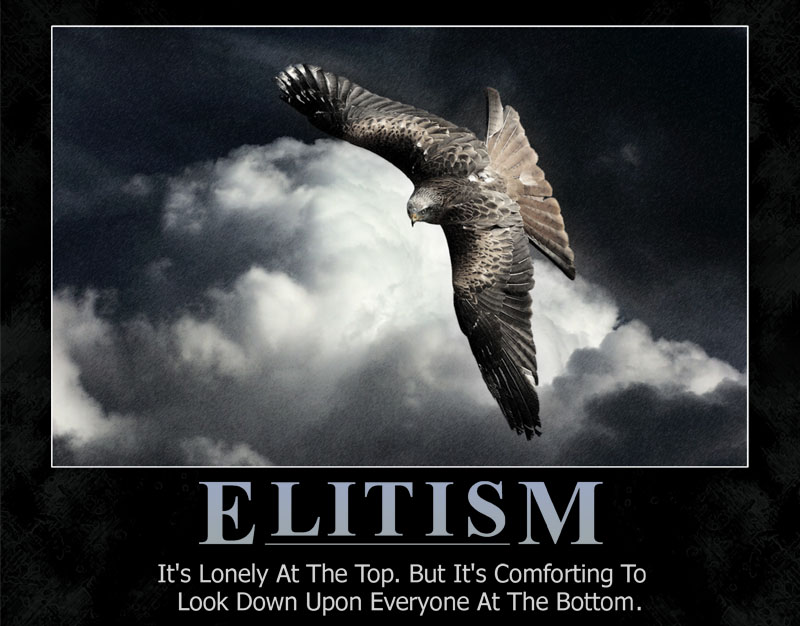
The Growing Elitism of Social Media

Recently I questioned whether we were turning into social media snobs. This wasn’t an attack on social media per se – more a valid look at whether certain people in the social media arena were beginning to try and wield a little too much (and possibly unwanted) influence over the medium.

However, perhaps even more disappointing than snobbery is the elitism that seems to be creeping into social media as well. While they may share certain characteristics, they are two different beasts.

Instead of the “do as I do” approach I discussed in my snobbery post, there’s a growing trend of “I want to feel more important than you” elitism that’s becoming more apparent.

A good example is the Twitter phenomenon. At its heart, it’s an excellent tool to not only make new friends and potential business contacts – it’s also a great way to see a microscopic snapshot of someone’s life in nibble-sized chunks. The fact that Twitter only allows you 140 characters to say your piece means you have to use that space wisely. This can lead to some very inventive and humorous comments.

Yet lately Twitter has become nothing more than a virtual brothel for people to either whore themselves out or to come across as a “look at me, I’m great” type of person. As a fan of social media and all it can offer, I find that sad and a little disappointing.

I’ll be the first to admit that I’ll notify my fellow Twitter users/followers of a new blog post – but then, that’s fairly standard for pretty much everyone on Twitter.

Where the application is losing its appeal (for me) is the amount of people that shout out about how many followers they have, or how many more they need to reach 500, or 1,000, or something similar. When did Twitter become a popularity contest? Isn’t that what MySpace is for (and one of the reasons Facebook is starting to take over from the Fox-backed networking site as the most popular)?

Maybe it’s just me, but I can see from your Twitter profile how many followers you have, or how many people you are following. That doesn’t interest me – and judging by the reaction of some of my friends who have stopped following certain Twitter accounts, it doesn’t impress them either.

Instead, tell people about excellent sites or blogs they should be checking out. Tell them about tools they can use to make them more effective in either their online brand building or improving their social media awareness.

Constantly mentioning you have so many followers often emits an air of superiority that no-one really enjoys and can lead to them unsubscribing from your updates. Which kind of goes against all that social media stands for, no?

  • « Go to Previous Page
  • Page 1
  • Interim pages omitted …
  • Page 10
  • Page 11
  • Page 12
© 2026 Danny Brown - Made with ♥ on Genesis