• Skip to primary navigation
  • Skip to main content
Danny Brown

Danny Brown

podcaster - author - creator

  • About
  • Podcasts
  • Journal

twitter

Have You Been Tweetbombed on Twitter Yet?

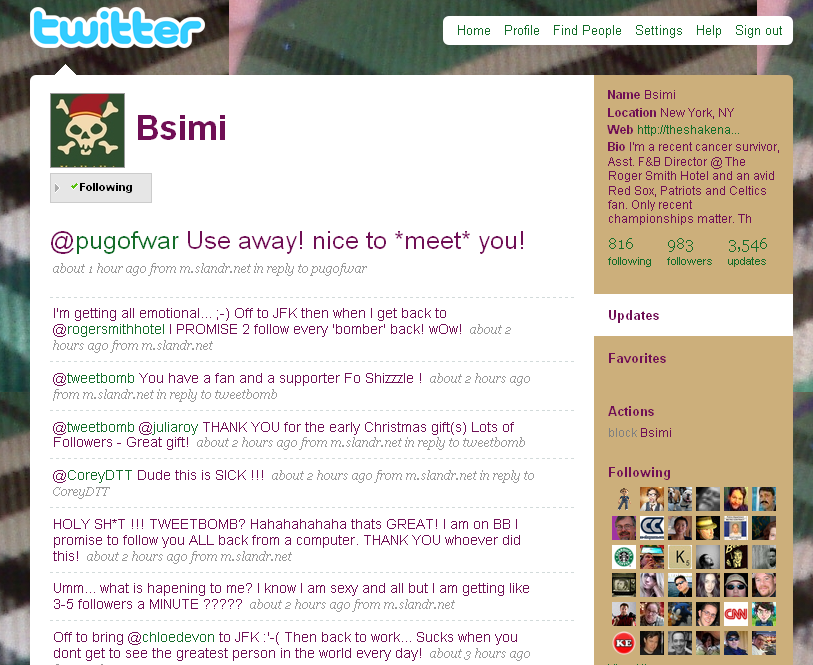
For an off-the-wall way to use Twitter, new craze Tweetbombing may just take the award for the most fun. Like the best crazes, Tweetbombing keeps it simple and open to everyone and so far the formula is working, with the Twitter profile for Tweetbomb already enjoying over 1,000 followers.

So what is Tweetbomb and why is it so much fun?

At its simplest, Tweetbomb is nothing more than a harmless way for Twitter users to play a game almost junior school-like in its approach. Twitter users follow Tweetbomb, and at exactly 3.33pm Eastern time (EST), a message is sent out to all followers with the name of the Twitter user to be Tweetbombed that day.

Everyone then sends out a blank Tweet – the Tweetbomb in question – to that user. No message, no hello, nothing – simply a blank Tweet and that’s it. Live results of how many Tweets are sent are provided via the Twitter search tool, while the user in question has no idea what’s going on until informed later.

As a way of encouraging new connections, Tweetbomb delivers (Tweetbombers often befriend the person that’s just been targeted). As a fun way and harmless way to use Twitter, Tweetbomb also delivers.

And isn’t having fun and meeting new people what makes Twitter so popular in the first place?

  • UPDATE 30 NOVEMBER 2008: The Tweetbomb account has been suspended by Twitter pending investigation into misuse. While the idea behind Tweetbomb seems to be innocent fun, as Lucretia Pruitt points out in the comments it could perhaps be costly for someone receiving cell phone updates from Twitter. Until a way of voluntary and non-cost Tweetbombing is found, perhaps it needs to go back to the drawing board?
Why The Black Friday Madness Has To Stop

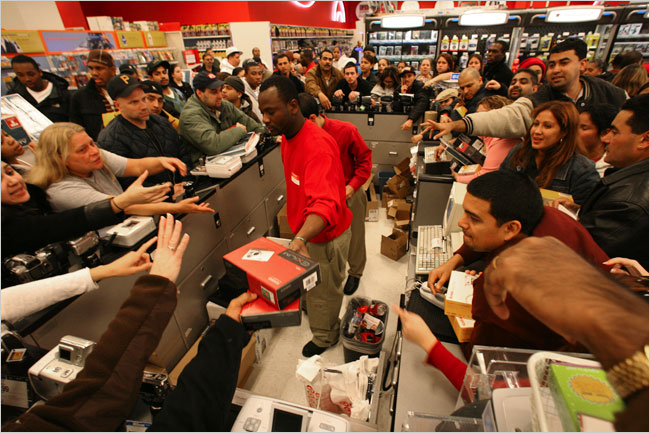
I’ve never been a fan of one day rush sales like the Black Friday ones. Having been in retail many years ago, sales time was always a hectic and stressful time.

For those working the shop floor, it meant a long day of shoving and pushing and often bruised bodies at the end of the shift. The stories making the news from this year’s Black Friday are testament to why this craziness needs to stop.

What sales push could possibly be worth the death of a shopworker and the miscarriage of a woman’s baby? What does it say about both humanity and the greed of retailers?

The defining message in social media is that of sharing and helping others to better themselves. How many of the people that continued to barge by the dying shopworker are Twitter users, or Facebook members? Does the message of sharing and making ourselves better stop at social media? Doesn’t it have a place in the real world?

Many people have said that Barack Obama is “the social media President”. Not only did he use the medium to great effect during his campaign, he also offers a parallel to social media through his “Vote for Change” policies. Empower everyone, make the world around us a better place through caring and sharing.

If this is the case, he needs to make one of his promises more widespread. Instead of just focusing on corporate greed, he needs to look at why retailers hold back on prices until sales days like Black Fridays. If retailers can afford to offload so much stock at crazy prices one day a year, there’s nothing to stop them having these prices throughout the year.

I know it’s a tough market – as a business owner myself, I know profit is becoming even tighter as the economic bite kicks in.

But is any profit worth the death and injury we saw yesterday? People scramble for Black Friday sales because the retailers (and, to a degree, the manufacturers) fix prices throughout the year and offer less reasons to buy. Shoppers therefore wait until sales time, whether it’s Black Friday, Boxing Day or other sales periods.

We need to stop this process now, before anyone else gets hurt. Is that too much to ask?

Social Media is a Language of Its Own

Grandiose

This is a guest post from my wife Jacki. I thought it’d be interesting to get the views of someone who has no real interest in social media and let them explain why. And one thing I love about Jacki is her no-nonsense approach to everything. To learn more or connect with Jacki, please visit her blog Just Kickin’ It.

I was recently asked my views on social media and all the glorious tools therein. Truthfully, my mind went blank. I couldn’t tell you the difference between Twitter and Stumbleupon.

I understand Google as a search engine, so when someone says ?She found me on Google? ? well, that makes sense. But what the heck does ?She sent me a tweet? mean?

This is a hypothetical question, don?t answer it ? I don?t care and will likely forget what it means anyways. If I need to find something I Google it. If I?ve read something I liked and am able to comment I will, if not, well my opinion doesn?t mean a whole lot anyways. I?m not overly devastated if I don?t get to share it.

I recently started a new blog. I still don?t fully understand what that even means. What I do is I write a virtual journal, I rant about the latest current affairs, I discuss in great detail all of the things that irritate me and what the world could do to improve. Mostly it?s social etiquette and common sense.

When I?m bored and feeling creative, I might tell a story or two, involving a little bit of research on my part. I assume since it?s on the Web, anyone can read it. Great, go for it. I just learned what it meant to ?tag?, something which makes sense, but I still don?t know how to do it. So if you can?t find me, well I guess that?s my fault too.

For this I use Blogger. I tried to post a couple of pictures on my recent blog and what a pain that was. I think I?ll stick to journal format from now on in. It?s a personal blog, not professional. It doesn?t have any business purpose, so I?m not trying to draw in any clientele.

My other blog, I run with a couple of other ladies. This is a virtual book club. It?s a bit different than the regular book clubs but it suits its purpose. We use WordPress for this. I can honestly say that after playing with it a bit, it?s far more user-friendly than Blogger. And I?ve mastered the art of adding pictures. I think that deserves a pat on the back right there.

Facebook is a given. But someone listed a bunch of other nonsense:

  • Twitter
  • Stumbleupon
  • Digg
  • Friendfeed
  • LinkedIn
  • Delicious
  • Reddit
  • Google Alerts
  • Google Reader
  • Monitter
  • Technorati

What is all of this? It?s a foreign language to me. If you want me to read something, send me a link. I really couldn?t care less what you use to spread the word, or what format you put things in. I?m glad it works for you, really I am. But are all these things really necessary?

Take Stumbleupon for example. There was probably about a month where my husband went nuts with sending me a bunch of things he stumbled upon. One day I watched him send out an email. He had to cut here, paste there, click a few buttons and voila! Seems simple, right? Why the heck couldn?t he just paste the link in a normal email and send that out? Why go through Stumbleupon at all?

And Twitter? This one I can?t get over because it?s all the new rage amongst Social Media Experts and PR Gurus. I guess I don?t understand the Internet world, and what is the point of learning it when it changes on a daily basis?

I use Blogger, WordPress and Facebook. But really, if I want to write something and share it, is there any difference if I use Microsoft Word or Notepad? Couldn?t I just use that and send it off to whomever I want to read it?

If I want it to go public, then using some domain might be an idea, but does it really matter one way or the other what the heck I put it in? Can you tell the difference between Blogger and WordPress, as a reader? Maybe one is more appealing to the eye than the other but it?s more of the same.

So go on and speak your language. But in plain English, you could just tell me, ?Here? read?.

Thanks for listening.

It’s a Crisis – Where Are You?

Financial Crisis / Finanzkrise
Image by alles-schlumpf via Flickr

One thing that’s irrefutable is that social media never sleeps. A good example of this is the recent Motrin video ad that upset a selection of mothers who felt it was demeaning. Cue an uproar on Twitter that was akin to the best viral marketing campaign and soon everyone was looking for the Motrin ad, and not for the right reasons.

What made the Motrin example particularly interesting is that for almost 48 hours there was no response from either the company or the ad agency responsible for the video.

While the Internet was ablaze with blog posts, forum discussions and Twitter conversations about Motrin and its agency, the silence from both was deafening. When Motrin eventually acted by removing the video, they also said that one thing they had learned from it all was how important it is to listen to what’s being said online.

I find this just a little scary, and yet sadly I’m not surprised. Too many companies are in the same boat as Motrin were – they’re not really listening to their audience. They haven’t connected with social media and it’s hurting them and their reputation.

As Motrin realized, once social media picks up on something it’s an instant result. Yet if they or their agency had had any kind of crisis control in place, they could have reacted to all the negativity coming out about them much more effectively.

Perhaps they do have a crisis control plan in place – yet evidently it didn’t include weekends. If someone had been monitoring their brand, the whole episode could have had a very different outcome. Instead, Motrin and the agency were left with a damage limitation exercise that, while it may not have been avoided, could have been easier to manage.

So what do we learn from this? For any business, large or small, listening is key. Your brand is your name and reputation and what makes you stand out from your competitors – you have to protect it fiercely.

I often hear the reason many companies are so slow to react to a crisis like this is because of the international time zones. I don’t think businesses can afford to let this be the case. As the Motrin example and others like it show, social media and conversations don’t take into account different timezones – why should businesses?

For large businesses that have have international offices, this weakens that argument even further. They of all people should be monitoring their brand worldwide. For smaller businesses it may not be so easy, but there are ways to stay on top of things.

For example, why not outsource on an “as needed” basis? There are many professional freelancers and virtual assistants worldwide who can act as your eyes and ears. If you can outsource to the main countries that your business deals with, surely that has to be worth the cost involved?

They can act on your behalf and come out with a company response, and depending on the severity of the crisis you can either deal with it the next day, or have someone from your company be on call to deal with it immediately.

By using tools like Google Alerts, Twitter monitoring software and other applications, your source will know as soon as something needs to be dealt with. They can then take the appropriate course of action. And because it’s on an “as needed” basis, there’s no extra expense except when it’s required.

It may not stop crises like the Motrin one from happening in the first place, but it would ensure that it was dealt with sooner rather than later. That’s got to be worth any business’s time, hasn’t it?

If you enjoyed this post, please consider leaving a comment and subscribe to my RSS feed or via email to ensure you can enjoy the latest post(s).

Reblog this post [with Zemanta]

How Do You Boil Your Social Media Egg?

One thing I used to love when I was growing up was breakfast at my grandma’s. She’d make toast soldiers and boiled eggs.

(Just in case anyone doesn’t know what toast soldiers are, it’s when you make normal toast and then cut it into about 4-5 strips. You then butter these strips and use them to dip into eggs or beans).

The reason I liked having breakfast at my grandma’s was because she always gave me a choice of how I liked my eggs boiled. Unlike my mum who always hard-boiled her eggs, which was okay when I was in the mood for them. But every now and again, you just want to get a runny egg and dip some toast in it.

This is where my grandma stood tall.

If I wanted runny eggs, she’d boil for three minutes and then I’d have my runny yolk. If I wanted hard-boiled, she’d keep them on the heat for six minutes and you sure got one solid egg!

It may not sound like much, getting the choice between soft or hard-boiled eggs, but trust me – for a 6-year old kid, it was everything. I felt that I had a voice, and my grandma really wanted to know my choice, as opposed to me having to like something just because everyone else did.

Social media’s kind of like the boiled egg. Initially, it can be a tough shell to crack if you’ve never tried it before. You wonder what’s the best approach – should you slice the top open and dig in slowly from there, or try and break it open evenly and absorb it whole?

Deciding how you want to use social media can be a lot like choosing your yolk. Do you want to just dabble and maybe use a mix of Twitter and Facebook? Then you’ll just want the three minute boil. If you really want to get something to dig your teeth into, though, and you want to try all the different tools and sites that social media has to offer, you better give your egg an extra three minutes.

But you know what? It doesn’t matter how you like your social media egg. Just like my grandma always gave me the choice, so you have the choice too. Because both ways are right. There is no wrong. Social media is your egg to boil as you choose – the main thing is that you enjoy it when it’s done.

  • « Go to Previous Page
  • Page 1
  • Interim pages omitted …
  • Page 9
  • Page 10
  • Page 11
  • Page 12
  • Go to Next Page »
© 2026 Danny Brown - Made with ♥ on Genesis