• Skip to primary navigation
  • Skip to main content
Danny Brown

Danny Brown

podcaster - author - creator

  • About
  • Podcasts
  • Journal

Social network

The Best Way to Get Involved in Social Media

jacobmThis is a guest post from social media consultant Jacob Morgan.

The best way to get involved in social media can be summed up in one word – act. Spending 6 months researching and planning your social media campaign is not the best thing to do. Now I?m not saying don?t have a plan – I?m saying have a plan that you can put together and act on quickly and effectively and make it actionable sooner rather than later.

It?s always a good idea to start listening and getting a feel for your landscape and surroundings, I consider this a part of acting as it involves engaging in the social media space. Every day you spend ?planning? is a day where you are potentially missing hundreds or thousands of conversations/relationships that you could be engaging in.

You have to remember that social media is very dynamic.

  • New tools emerge daily
  • Your competition isn?t going to sit still
  • Brand/company sentiments can change rapidly
  • You are going to miss out on the conversations that are going on now if you wait
  • Part of succeeding in social media is about trying new things, it won?t be ?perfect?
  • There is no formula for success

Your plan is most likely going to change once you actually engage in social media and begin interacting with your users and customers. In fact, your users and customers SHOULD dictate some of your plan; they will tell you what they want, how to build it, who they want to talk to, and what they expect (among other things).

The best thing to do is start small (even while you are still formulating and constructing your plan) because at least you can begin engaging in conversations and building relationships. For example, you may want to create a Twitter account for a customer service representative that can monitor conversations and engage in them. Maybe you want to create a customer facing blog that the company can use to provide some unique company or industry information.

While these conversations and relationships are building you can think of larger more strategic ways to engage with your users, i.e. building microsites, creating your own social network, promoting products/services via social media channels, etc.

Creating a plan is good – acting is better.

  • Jacob Morgan is a social media marketing consultant and runs a team of Technical SEO’s. Jacob has founded a start-up in the social media space and has worked with brands such as Adobe, Conde Nast, Sandisk and Salesforce. He is an avid and passionate blogger on all things social media and marketing related. He also loves meeting and building relationships with people so say hello and let him know if he can help you! You can connect with Jacob on:
    Twitter
    Facebook
    LinkedIn

If you enjoyed this post, please consider leaving a comment and subscribe to my RSS feed or via email to ensure you can enjoy the latest post(s).

Reblog this post [with Zemanta]

How to Sell Twitter to a Client (Or Even Your Own Boss)

Sell, Sell, Sell album cover
Image via Wikipedia

It’s one of the current axioms doing the rounds online – “I love Twitter but how do I sell it to my client or boss?”.

You can see the benefits because you use it every day, but just how do you transfer that message to those who wonder where the benefit of 140-character conversations are found?

Perhaps that’s not the question to ask – instead, how about asking why you even have to justify it at all.

Think about it for just a moment – your client or your boss’s success has probably had a lot to do with business relationships built up over the years.

Additionally, being aware of the business market around their industry will also have played a large part in their success. And you can be pretty sure that both these reasons are continuously worked on and monitored to sustain that success.

Now think of why Twitter is so beneficial to you.

Are you building relationships with great contacts? Are you keeping abreast of the latest news in the industry because people are talking about it in their Twitter stream? Are you finding content and advice that helps you grow both personally and professionally because of the information you’re a part of through your Twitter contacts and the information from their contacts?

I’d hazard a guess that the answer to all of these questions is a fairly comprehensive “Yes.” So why should it be any different for your client, boss or anyone else you’re trying to extol the virtues of Twitter to?

The next time you want to get your client involved in Twitter, or your boss dismisses it as nothing more than a fad for people having banal conversations, ask them a couple of simple questions:

  • How do the majority of your customers find you?
  • How do they then communicate with you?

You’ll probably find that the majority of the answers to the first question are “Via Google” and the majority of the answers to the second question will be, “They’ll call us or email us an inquiry.”

In short, they’re looking for specific goods or services and want to open up a dialogue with the hope of fulfilling that need.

The next step is usually a customer service representative calling back, or perhaps even a member of the sales team calling to discuss the (potential) client’s needs. Then, with a bit of luck (and sometimes depending on the skills and motivation of the person calling them back), that potential client may turn into a physical one.

But that’s the NORMAL practice.

What if it wasn’t down to luck? What if it was down to the interaction and genuine interest you showed in conversing with that client? Instead of just seeing them as another dollar bill through the business doors, they actually felt important to your business? That’s what Twitter offers.

Finding a company on Google (or any other search engine) is no different from finding that same company using the search feature on Twitter. And the inward communication regarding their needs? Imagine if the (potential) client could open up a two-way dialogue that was instantaneous and could cover everything in one conversation?

Instead of the customer service representative putting the caller on hold to ask sales a question, or check marketing’s latest offer, that department could be instantly engaged in the conversation with a Twitter “@ message”. And with the functionality of Twitter, even getting hold of someone out of the office is easy enough with Twitter alerts by cellphone.

Of course, there might be an argument that this is too simple a suggestion – there would still be the problem of the caller in question not being on Twitter. If so, put yourself in their shoes for a moment.

If you were a potential customer of a company and you were faced with a customer service line that may be engaged or a Twitter stream that costs nothing and is always open, which would you prefer? I know which I’d go for.

Of course, this is for the future – the immediate need is to convince your client or boss of Twitter’s value. So just ask them what offers more value than knowing what your customer base is thinking. What offers more value than answering concerns or questions that their customer base may have?

And perhaps most importantly of all, what offers more value than being able to answer these questions before your competitors answer for you?

The answer(s) should be simple.

Paid Blogging and the Art of Transparency

kosmic blogging in samsara (redux)
Image by ~C4Chaos via Flickr

I couldn’t help but notice that there’s a little bit of a discussion going on at Twitter at the moment with regards paid blogging.

As with any discussion, there are two sides that are equally as vociferous when it comes to their views on the topic.

The reason a lot of the discussion started was due to leading social media blogger Chris Brogan writing a sponsored post for K-Mart.

The gist of the argument on Twitter is whether Chris has lost any “value” because he wrote a review that was paid for. K-Mart gave Chris a $500 gift voucher and asked him to figure out what was cool to buy with it at their store, and then write about it. Seems straightforward enough, particularly when Chris himself even mentioned on the blog itself that it was a sponsored post, although all the views were his own.

As I said, where it gets interesting on Twitter is that there have been a few people that feel let down by Chris, and have either stopped following him or made their feelings clear that they’re disappointed. So it got me thinking about paid blogging, and if it does actually lose the reviewer any authority or credence because they’re being paid for what they’re writing.

Honestly, I don’t see what the problem is.

I’m a blogger myself, and I write pretty regularly. But I don’t do it for the money (if I did I’d be bankrupt!) – I do it because I enjoy the conversations that can then take place afterward. I love to write and when someone joins in and adds to the conversation via the comments after each post, then that’s one of the most satisfying parts of blogging. After all, I’m just the conduit – many of the comments are even more interesting than the post itself. It’d be nice to get paid, but that’s not why I’m here.

So I can see why paid blogging could be so attractive. After all, you’re still doing the same thing you’re always doing – writing – with the only real difference being that you’re actually receiving some financial outlay for it. And with the economy like it is, isn’t the ability to make some more money for your family – or, in Chris’s case, buy some Christmas gifts – worth it?

As long as the blogger is upfront and transparent about the post being sponsored, then I don’t have an issue with paid blogging. The bloggers I read, I’ve read for a while – you get to know their writing style and I’d soon spot if Chris (or anyone else) was writing BS. And if I thought that was the case, I’d be the first to call him on it.

But the fact that it was called as sponsored and there was no heavy sales pitch in the post itself? If people can make money on their blogs by writing sponsored posts yet still keep it honest, more power to them.

And for anyone that feels let down by sponsored blogging? I liken it to the indie band syndrome – the band’s great while they’re your secret, but the moment success and money becomes involved, you don’t want to know. Which begs the question – were you really a fan in the first place?

It’s Nice To Be Nice

The world can be a tough place to live in at times. We try our hardest to make it work, but things don’t always work out to plan. It’s a fast-paced environment where people get left behind or ignored, or simply forgotten about. If you don’t fit into a stereotype, you’re not one of the “in-crowd”.

(And you thought that stopped at high school.)

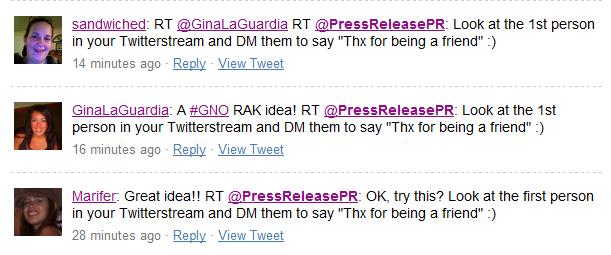
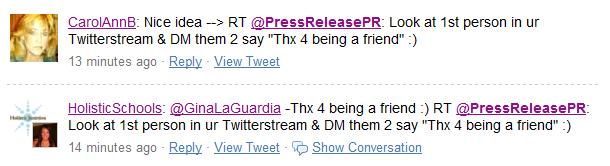
But you know, as fast as the world is and as unfair as it can be, we can still make it better in our own little ways. Nothing mind-breaking; nothing rocket science in nature. For example, this morning on Twitter I suggested this:

“Look at the first person in your Twitter stream and Direct Message them to say thank you for being a friend.”

Simple, easy and maybe just offering a little fun into our lives and the people around us. What was really nice to see was that people picked up on it.

If we can pick up on something as simple as this with people we may never have met physically, shouldn’t it be just as easy to do so with those we know? So let’s try it.

Look at the last “proper” email you received, reply to that person and say, “Thank you for being a friend.”

Look at the first name in your phonebook and call them to say, “Thank you for being a friend.”

Look at the first person on your Facebook friend list and say, “Thank you for being a friend.”

It’s easy to do. It doesn’t take much. Yet in a world that does its best to put us down at times, it can brighten up a whole day. And just so you know?

Thank YOU for being a friend.

Have You Been Tweetbombed on Twitter Yet?

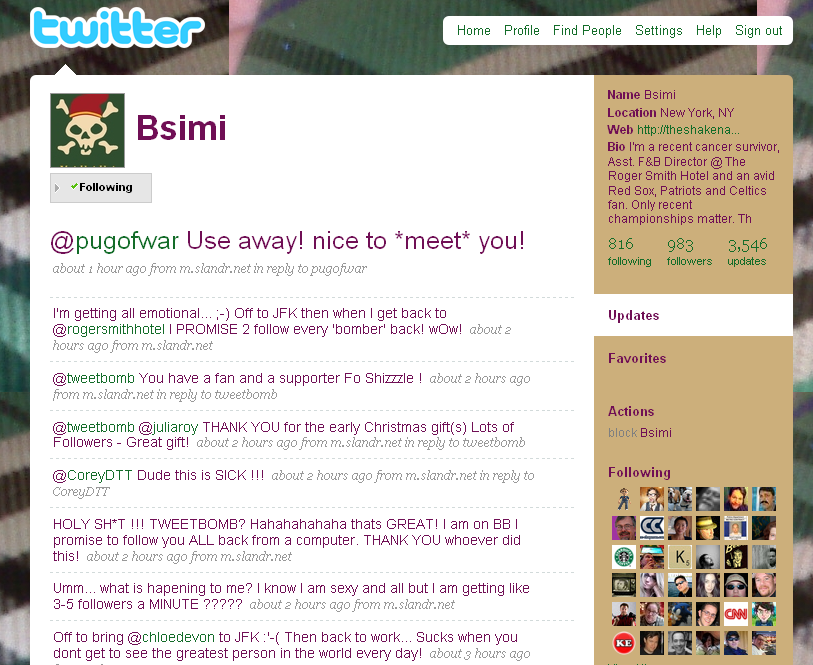
For an off-the-wall way to use Twitter, new craze Tweetbombing may just take the award for the most fun. Like the best crazes, Tweetbombing keeps it simple and open to everyone and so far the formula is working, with the Twitter profile for Tweetbomb already enjoying over 1,000 followers.

So what is Tweetbomb and why is it so much fun?

At its simplest, Tweetbomb is nothing more than a harmless way for Twitter users to play a game almost junior school-like in its approach. Twitter users follow Tweetbomb, and at exactly 3.33pm Eastern time (EST), a message is sent out to all followers with the name of the Twitter user to be Tweetbombed that day.

Everyone then sends out a blank Tweet – the Tweetbomb in question – to that user. No message, no hello, nothing – simply a blank Tweet and that’s it. Live results of how many Tweets are sent are provided via the Twitter search tool, while the user in question has no idea what’s going on until informed later.

As a way of encouraging new connections, Tweetbomb delivers (Tweetbombers often befriend the person that’s just been targeted). As a fun way and harmless way to use Twitter, Tweetbomb also delivers.

And isn’t having fun and meeting new people what makes Twitter so popular in the first place?

  • UPDATE 30 NOVEMBER 2008: The Tweetbomb account has been suspended by Twitter pending investigation into misuse. While the idea behind Tweetbomb seems to be innocent fun, as Lucretia Pruitt points out in the comments it could perhaps be costly for someone receiving cell phone updates from Twitter. Until a way of voluntary and non-cost Tweetbombing is found, perhaps it needs to go back to the drawing board?
  • « Go to Previous Page
  • Page 1
  • Page 2
  • Page 3
  • Go to Next Page »
© 2026 Danny Brown - Made with ♥ on Genesis