• Skip to primary navigation
  • Skip to main content
Danny Brown

Danny Brown

podcaster - author - creator

  • About
  • Podcasts
  • Journal

social media

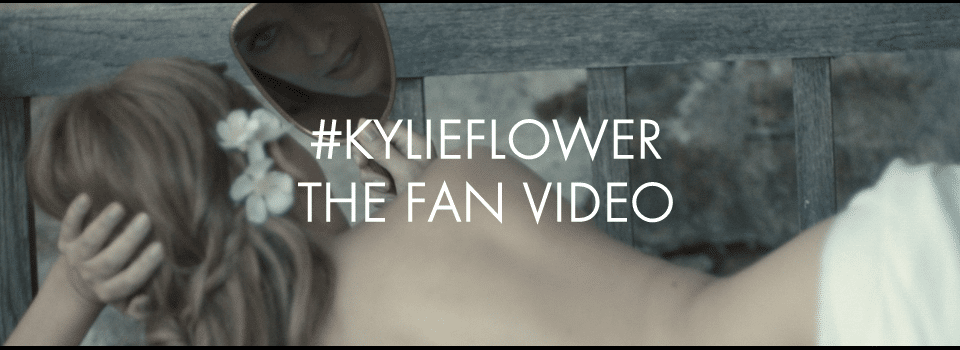
Kylie Minogue and the Cool Social Media Promotion for New Song Flower

Kylie Minougue Flower fan video promo

Kylie Minougue Flower fan video promo

I’ll admit to being a little biased here – I’ve had a huge crush on Australian songstress Kylie Minogue since her acting days way back when in Australian soap Neighbours.

That crush continued into her singing career and unforgettable Agent Provacateur video… uh huh. Anyhoo…

I got an email yesterday that caught my eye about Kylie’s video to promote her new single, Flower. As well as being her directorial debut, it’s also utilizing social media in a pretty cool way.

Fans can get involved in the video by posting images on Twitter and Instagram using the hashtag #KylieFlower. Additionally, fans can upload a video (up to 10 seconds long) to YouTube with the #KylieFlower hashtag too.

The goal is to upload images and videos (by October 9) that reflect the person’s interpretation of what Kylie’s song is about, in whatever imaginative form that might take.

Kylie’s creative team will then put a special Flower promo video together, and share on the singer’s official website as well as social channels on October 25th.

As a way to engage fans and truly have them involved in the brand – in this case, Kylie and her music – it’s a great promotion where everybody wins. And as a use of social media to foster a bigger connection between fan and brand, it wins too.

See, I knew there was a reason I liked Kylie more than an ongoing schoolboy crush…

You can check out the promotion here.

The Science Behind Social Media, Natural Language and Big Data (#Infographic)

Social media measurement

One of the biggest challenges in social media today – apart from ROI, depending who you ask – is that of natural language.

The art of being able to extrapolate intent (purchase), actions (influence), and outcomes (predictive analysis) offer just some of the reasons why technology companies like Jugnoo and others are working on deciphering this holy grail of online language.

The problem is, it’s a hell of a lot harder than it sounds!

It involves a whole lot of legwork, mind work, scientific work and work I’ve never even heard of, never mind hope to understand!

To give you an idea of just what goes into understanding the nuances of social media conversations and grabbing the nuggets from them, we created this infographic below.

And if you want to know more about the topics discussed below, and how they can help your business with lead generation in social media, there are two posts over at the Jugnoo blog you should check out:

  • Kickstart Your Social Media Lead Generation with Machine Learning Part 1: The Engine
  • Kickstart Your Social Media Lead Generation with Machine Learning Part 2: Best Practices

Enjoy!

Jugnoo Machine Learning infographic

  • To embed the Machine Learning infographic on your own blog, simply copy/paste the following code:

<a target=?_blank? href=?http://join.jugnoo.com/social-media-marketing/?><img src=?http://me2.jugnoo.com/file/image_collection/default/154/images/7fe4c55c-de1a-4db5-8973-962bcba8ea1a.jpg? border=0></a>

How to Counter Fake Social Media Reviews

Fake social media reviews

According to leading business analysts Gartner, as many as 10-15% of social media reviews will be fake by 2014.

Instead of honest customer reviews, praise and feedback on sites like Yelp and Google Places, we’ll have professionally-paid for reviews, either from a company trying to damage a competitor, or raise their own profile by posting multiple glowing reviews.

The report does mention that this will probably be more in the Enterprise market, but what’s to stop smaller businesses hiring interns and specialist agencies to post a review for them?

Mind you, perhaps we shouldn’t be surprised at this analysis – as social business continues to take a stronger grip in the mainstream consumer business world, it’s perhaps stranger to ask why these percentages aren’t already in place now (maybe they are).

The good news is, there are steps that can be taken to protect your reputation as a business, as well as stay on the right side of the law when it comes to this newer form of peer and customer recommendation.

Make Social Media Reviews Socially Accountable

On this blog, you’ll see I use the Livefyre comment system. Now, currently I have it set to accept guest comments – however, by a flick of the switch in my admin area, I can change that up and only allow readers to comment after logging in via the likes of Twitter, Facebook, LinkedIn, etc.

So, when it comes to posting reviews on the likes of Yelp, Google Places and elsewhere, make it the same process.

If you want to leave a review, you have to log in with your Facebook profile, or LinkedIn account. This immediately adds accountability to the process – your name and business is inextricably tied to your review. This makes it far easier to see which is a valid review, and which belongs to a fake.

For instance, let’s say Joe Smith left a crappy review on Yelp for Acme Restaurant, Toronto. The owners of the restaurant can see the review, and then check Joe’s profile on Facebook.

If it’s a valid one, they can then ask Joe to come in with his receipt and they’ll refund the cost of the meal. What, Joe doesn’t have a receipt because he was never there?

Gotcha – that takes us on to the second part of the process.

Build a Digital Ethics Agreement

In the last couple of years, social media has attracted the interest of organizations like the FTC (Federal Trade Commission) in the U.S., the ASA (Advertising Standards Authority) in the U.K., and the Office of the Privacy Commissioner in Canada.

These organizations are forcing the hands of advertisers and marketers in social media to be above board when it comes to how they’re targeting consumers in the space and, in the case of the Privacy Commissioner, making Facebook change their privacy terms when it comes to sharing information about its users.

So, there are already governing procedures under way and ongoing when it comes to making sure the medium isn’t being used in questionable ways.

The problem is, they’re splintered. The FTC has no real jurisdiction outside of the U.S, and vice versa with the U.K. and Canadian equivalents (although they can work with each other in cross-border cases).

So, technically, a Canadian business could operate around U.S. consumers and (unless picked up) be outwith the legalities of that country. This is where the fake social media reviewers (solo or agency) would win.

However, the Internet is one big global community when it comes to e-commerce. I don’t care if I need to buy a British import CD from Japan to complete my Canadian music collection using Bitcoin – it’s a global market and I’ll use whatever means I need to.

Now, while this may be too simple in actuality over theory, if there was a global Digital Ethics Committee that handled stuff like online reviews, social marketing, etc, and created a governing law that applied to online transactions and subsequent reviews – well wouldn’t that help counter the fake reviews?

The businesses that are caught paying for fake reviews are banned from review sites for X amount of years, with a disclaimer on their Yelp or Places page that advises visitors why there’s no official presence.

By naming and shaming (as well as the obligatory fine and damages paid), consumers can see which companies live by their product and which live by their producing of lies.

As Consumers, We Need Protecting

It may be that these two suggestions are too simple for such a legal minefield. And, despite the Internet’s global reach, the arms of it at a country and cultural level are still too disparate for the simple approach to work.

For now, anyways.

But as we move into a more socially-led and active world, and the stakes continue to rise as to those businesses that will succeed versus those that will flounder, the playground needs to take a stand now.

While social sign-ins may not be the answer (although it’s a lot easier to spot a fake Facebook or LinkedIn account than it is to filter a bogus email), and cross-border integration into a single unit might be a ways off, it’s important we start to think of solutions today.

Otherwise, that tomorrow of 2014 will come a lot quicker than we think, and it’s more than just our reputations at stake – it’s our very future business success.

The 7 Phases of Twitter

Twitter noob

This is a guest post by Matt Andaloro.

Twitter, the never-ending story.

It’s a platform I find myself pitching to my friends and family more and more, as it has increasingly become a platform that the general public has become more open to using on a regular basis.

As a result of this, people I know have been gradually joining this social media snowball.

Which, truth be known, is pretty exciting because it means this social network is simultaneously becoming more powerful in general, and more personally pertinent for myself.

Along with this, If I look at who I follow, I am able to see a snapshot of different people I know in various stages of their journey through the Twitterverse.

This has caused me to think about my own trip through Twitter and what I considered the evolution of my Twitter experience. After putting some serious (but not too strenuous) thought into my Twitter milestones, I found that I was able to break my entire experience into 7 distinct phases.

Phase 1: The Beginning

The beginning is literally where it all started for me, from the initial set-up, the choosing of that first (sexy) avatar, following several celebrities, news sources, and friends who are already on the platform. Then came the daunting task of sending my first tweet, which I CLEARLY put so much thought into:

Matt Andaloro on Twitter

This tweet was followed by several weeks equally as insightful tweets, until some combination of the novelty of this new toy wearing off, and a lack of understanding of the platform induced a dormant and update-less Twitter-state.

Phase 2: The Second Push

After the 10 month dormancy came my second push into Twitter. For whatever reason, maybe another social media account has asked me to link up my various accounts, or I was simply harassed by some people in the social sphere, interest was sparked again.

This time I started discovering many more interesting people to follow, and my Twitter feed began to become much more interesting (and more tailored to my tastes), and it began to dawn on me why Twitter is so? Magical.

To quote a friend on his own dawning moment he said:

When I was on Twitter and I saw a David Bowie Official tweet right below a CBC News tweet, and I thought to myself: Oh? I see why people love this.

Suffice it to say, I was hooked like many of those before me had been.

Phase 3: Learning How To Tweet

The quality of my tweets didn?t see any remarkable improvement in the first little while, mostly because I was sitting in front of my computer trying to sound insightful or make meaningful observations.

It wasn?t until I got Twitter on my phone and started relaying actual observations that I received my first non-gratuitous re-tweet!

It was a big day. Tears may have been shed.

From that point on, my tweets became less angst-y, and my thoughts were those that more than one person could share, as I learned more Twitter-oriented ways of expressing myself.

Phase 4 ? 5: Searching and Engaging

Phase 3 was arguably the longest phase of my Twitter experience, as I spent month after month content with my micro-blogging and my information ingestion.

One fateful day, however, I was scrolling through my Twitter feed, and I wanted to talk to someone and I realized that the amount of people I was following who would actually message me back was very low, so phase 4 became finding and following real people.

I started with Hamilton, Ontario, then searched for people from my University, and then drilled down even further to people in my classes trying to find anyone to interact with. Phase 5 then became actually reaching out to these new connections I?d formed and starting ?actual- conversations.

The results led to phase 6.

Phase 6 ? Twitter IRL

The people I started connecting with online started connecting with me in real life!

(Note: Prior to this, being a very recent transfer into the Communication Studies program, I knew very few of my new classmates.)

I connected with a bunch of people and was afforded the opportunity to establish a common ground that I had been unable to do previously while a professor was lecturing. This then built into several relationships.

The power of this platform simply continued to grow.

Phase 7 ? The Present

Which brings me to my present phase. Although I recognize that it may be the seventh phase of my Twitter adventure, I still find myself plagued with nearly as many questions as I had in phase one.

  • How do I create valuable content?
  • What value do I bring to online interactions?
  • How do I interact successfully in a professional manner?

I even find myself re-facing some of the questions from the previous stages, if only at a greater stage.

  • How do I create messages that my audience will jive with?
  • Do I sound cool enough?
  • Is what I am talking about old news?
  • Am I too sensational?
  • How do I make sure my personality bleeds through?

Whether or not I?ll find answers to these questions in this phase, or in an unknown phase in the future (The 10,000th tweet? Building a Following? Becoming a Source?), remains to be seen.

All I can do right now is work at it while trying to enjoy the journey as much as possible.

If you made it to the end of this story, I would love to hear your story. Do your phases reflect any of mine? Or did you have an entirely different experience? Do you have any advice for someone entering phase 7?

Thanks for reading.

Matt AndaloroAbout the author: Matt Andaloro is currently a Marketing Analyst and an aspiring blog writer at Jugnoo. A lover of magic, learning, stories, and the intricacies of interpersonal communication, Matt is an avid rock climber, a part-time improviser, and a self-proclaimed outdoorsman. You can converse with Matt on Twitter, but be forewarned, he is exclamatory and excitable!

Justin Bieber, Green Bananas and Upsetting Canada – All in 30 Minutes

Social media talks

Social media talks

It seems strange to think that?Jugnoo?s Social Mix event?was way back in July.

It still seems so fresh, and we?re continuing to get great feedback and praise today, almost two months later.

There?s no doubt it was an incredible day, with lots of lessons learned and shared.

On a personal level, I feel really fortunate to have been able to speak and share the stage with people I both admire and look up to, as well as long-time friends and peers.

So what did I talk about?

Your Business Is Not The Story

People often credit social media for making businesses realize they?re not the story ? but good business owners have known this all along.

You are not the story. You never have been. Not even in the ?bad old days? before social media were you ever the story.?But the story? That belongs to the customer. Every time.

This would ? to me ? seem obvious, and yet you see examples every day of where businesses take their customers for granted, fail to address issues and plough on the path they want, as opposed to the path their customers need.

And then they wonder why their sales are down?

Think like a customer, be the customer, and you?ll get and keep the customer.

Being Human in a Non-Human World

While the tools like Twitter, Facebook, YouTube, etc ? as well as more advanced?Social CRM platforms?? allow us to connect and engage with our customers like never before, we?re still human beings.

Automated systems and the bits and bytes that make up these social platforms are all well and good ? but it still takes the handshake (real or virtual) of human-to-human connection to solidify the relationship that leads to the sale.

People are not conducive when it comes to creating an ideal world for brands to operate in. We?re too human for start.

Instead of canned responses and sterile corporate voices, we need to bring the human aspect of our offline personas online to our business ones. After all, who ever bought from a diode?

My talk is below ? I hope you enjoy, and would love to hear your thoughts in the comments on the bigger picture the video discusses.

Cheers!

[youtube]http://www.youtube.com/watch?v=vUGH_rGC7h4[/youtube]

Related articles
  • Using Social Media to Manage Relationships Through the Sales Funnel (jugnoo.com)
  • Who Shouldn’t Worry With Social CRM (socialcrminfo.com)
  • « Go to Previous Page
  • Page 1
  • Interim pages omitted …
  • Page 5
  • Page 6
  • Page 7
  • Page 8
  • Page 9
  • Interim pages omitted …
  • Page 55
  • Go to Next Page »
© 2026 Danny Brown - Made with ♥ on Genesis