• Skip to primary navigation
  • Skip to main content
Danny Brown

Danny Brown

podcaster - author - creator

  • About
  • Podcasts
  • Journal

social media

The Continuous Challenge of Social Influence

The influence of trust

Matt Hixson

This post from Matt Hixson of Tellagence originally appeared on the Jugnoo blog.

I was flattered (and a bit surprised) when? Jugnoo asked me to speak at their summer social media event in Toronto, Social Mix 2012.

We?ve been in conversation about the challenges around measuring the marketing effect of social media since we met. I guess I said something of interest.

So what did I speak about? My presentation was titled “Influence: Today and Beyond”.

When I was first asked me to speak about influence I thought, “Either people are going to be excited about this or they are going to want to punch me in the throat.”

I hear from enough people to know that the market is fed up with the influence conversation but they know they need to be able to get their messages heard and acted upon in social networks.

[Read more…] about The Continuous Challenge of Social Influence

6 Small But Sweet Updates to Jugnoo and Other Stuff

Jugnoo social crm

Over the last few months, lots of folks have asked why they’d want to use Jugnoo versus their current platform of choice (say, Hootsuite, Tweetdeck, Trackur, etc).

It’s a fair question – all are good platforms with their own strengths. The easy answer (at first) is to make clear that Jugnoo is more than just a social dashboard or search platform – it’s a full-on business solution.

The next thing to show is that everything at Jugnoo has been built from the ground up to work in tandem with each other. Our social dashboard doesn’t just allow you to keep up with your networks, but also shows sentiment and intent that’s normally reserved for social monitoring.

Our social monitoring solution doesn’t just keep you on top of what’s being said about your brand or competitors, it also ties into our visual data solution that creates context out of disparate conversations online.

Jugnoo buzz visualyzer
(click image to expand)

Our visual data solution not only shows you in clear, buzz-driven analysis what’s being said and by whom, but it also connects that information to our patent-pending lead generation platform, where we can help you identify where an opportunity is as well as track all the actions that happened around that lead after your connected with them.

Which brings us back to the social dashboard, where you can continue that connection, as well as create specific promotions for that audience using our Social Hub (for example, if you wanted to help promote your charity goals, like the SMAC! Sock Monkeys Against Cancer campaign).

When you compare all we offer against all others offer, it starts to paint a picture of why you might want to check Jugnoo out, especially when it comes to the current pricing model while still in beta we’re due to come out of beta mode before the end of the year).

So, sure, we have all the “big stuff” taken care of – but that’s how it should be. It’s the little things that make the difference to the user experience, and we’re taking care of that too. Here are just six ways we’re doing that today.

1. Facebook Comments as a Stream

Jugnoo Facebook Comments stream
(click image to expand)

One of the great things about our users is they’re always helping us improve the platform. A suggestion we had after our last update was to enable the option of saving Facebook comments as a separate stream in the dashboard. This would allow users to have select conversations open and keep up-to-date with these, as opposed to trying to jump back into updates later. We thought that was a great idea, so we’ve implemented that feature.

2. Rich Media Embed

Jugnoo video embed
(click image to expand)

No-one wants to have to jump through hoops to view something online. You wouldn’t go to a blog, see a small part of a feature image or video and have to click to another site to see it in full. Social dashboards should be the same and, yes, we were a little behind the game here while we focused on our bigger visual data solutions. But consider that corrected now, with the ability to view images and watch videos in-stream.

3. Twitter Followers Stream

Jugnoo twitter followers
(click image to expand)

Another request from our users was to enable the option of a stream dedicated to your Twitter followers. This allows you to see your new follows (making it easier to thank them), as well as the profiles and tweet history of that person, to see if they’re a fit for you. A simple change but one that can help you connect just that little bit better.

4. Full Twitter Profile Information

Jugnoo twitter profile
(click image to expand)

When we updated the last time around, we introduced the social profile box across accounts. This let you see at a glance the key information on the user you’d just connected with. However, again, Twitter was left wanting a little as we concentrated on Facebook and how its open graph gave us more information to play with. Now, though, you get the same full experience on Twitter – timeline, mentions to that person and their favourite tweets. It’s not a huge update, but it is one we should have launched earlier. Lessons learned!

5. Predictive Twitter Usernames

(click image to expand)

Unless you’re already in a conversation with someone on Twitter, or you know their username outright (not always an easy thing), it can be a pain to locate someone to start a conversation. This is where the predictive username feature comes into play – simply start typing the first letters of the person you want to chat with and Jugnoo will offer you options to select from. Choose the user and send your message.

6. Link Previews

Jugnoo link preview
(click image to expand)

One of the downsides of social media can be the amount of phishing that goes on, especially on Twitter – sending someone a link to you (usually by DM) that allows the sender to hack your account and take over your profile (if you click the link). Additionally, you don’t know if a link to a blog post is something you’d be interested in reading before you click through, wasting time if it does turn out to be a wet noodle of a post. The new link preview option lets you see what you’re clicking through to and help you prevent both phishing attempts and crappy content views. Bonus!

And There’s More…

These are just six little updates that make the bigger Jugnoo user experience in general a lot smoother and cleaner, but they’re just a very small part of what’s coming in the next few weeks.

As I mention in the post, integration and collaborative solutions are a key part of what we’re trying to achieve here. We already have social teams to allow multiple users on the same account, and this will be enhanced with workflow, so you can allocate the right task to the right person and keep track of progress.

One of the things we’re really excited about, and one that ties everything together, is how we’re going to be integrating the dashboard stuff with the more visual solutions we provide. While I can’t go into too much detail at the minute, get ready for social dashboards to really be taken to the next level, both visually and operationally…

We have some fun times ahead – maybe it’s time to check us out and see for yourself how we can help you with your goals on social media.

Note: the features above are scheduled to be released to users a week today, on November 14.

Why HR Needs to Address Social Media (Infographic)

Social media and HR

Social media and HR

While social media is perfect for customer service and marketing, there’s a growing need for a company’s Human Resource (HR) team to be involved too.

I’ve written on ways HR can use social media in job searches, but that’s just one way. Increasingly, HR needs to be far more active in social media – from compliance to employee satisfaction at their jobs, and much more.

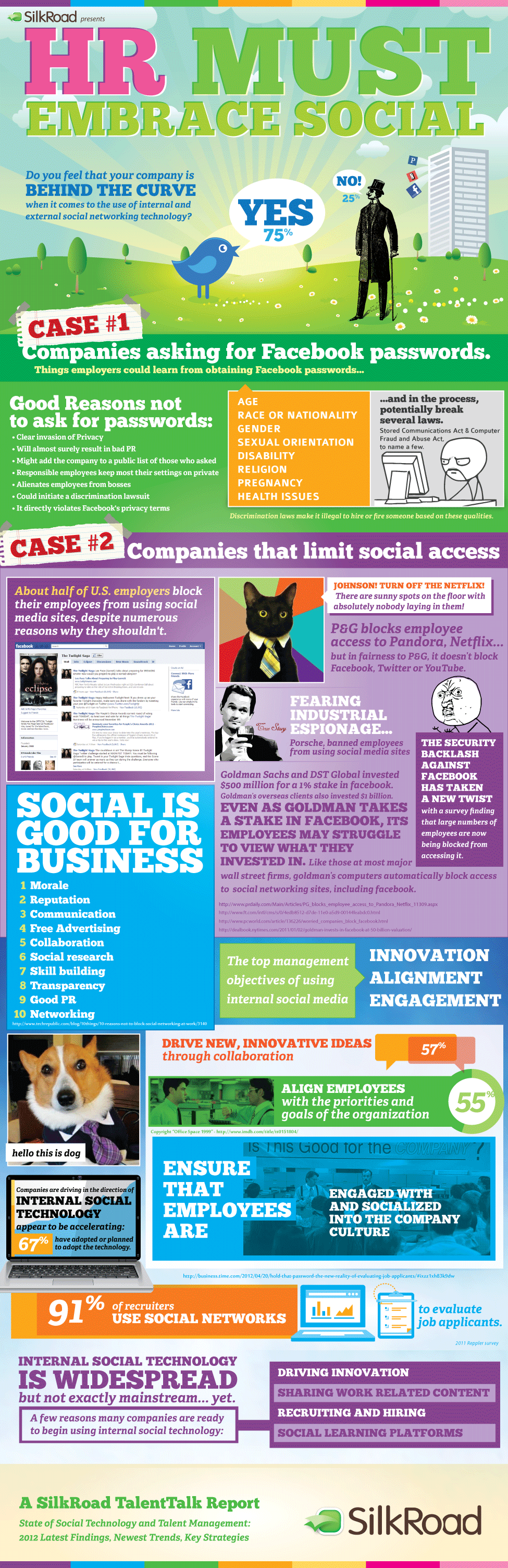
A new infographic from Compliance and Safety offers a multitude of reasons why HR needs to be more involved, along with examples of why it’s a good idea over a bad one.

Some of the statistics from the infographic include:

  • 91% of recruiters use social networks.
  • Almost half of U.S. companies block their employees from accessing social networks.
  • While Goldman Sachs invested in Facebook, it bans its employees from accessing the site.

There are some interesting takeaways from the infographic, but the key message (and one that all brands should be seriously thinking about) is workplaces actually become more effective and innovative if social media access is encouraged.

Don’t let your brand be one of the archaic ones.


A Lack of Real Vision is Stalling the PR Industry

First, a caveat – I don’t know the folks whose quotes I’m about to use as examples of why the PR industry is struggling.

They could be (and probably are) very smart and accomplished business people.

So, this isn’t a “go” at them.

With that being said, however, this recent report/white paper does seem to highlight exactly why the PR industry is continuously seen as one that’s been slow to adapt to the new business landscape and, as such, is holding agencies and consultants back.

First, let’s take a look at the piece.

The PR Firm of the Future

As a precursor to the PRWeek Conference on November 14, Michael Lasky – senior partner and head of PR at law firm Davis & Gilbert LLP – asked this question:

What is the most important way in which the PR agency of 2017 will be different from the PR agency of today?

Michael asked 8 leaders of independent agencies. The responses included:

– Ken Eudy, CEO, Capstrat: “The PR firm of 2017 will increasingly help is clients become publishers and broadcasters… communicating directly with stakeholders without having their messages filtered through traditional media.”

– Maril MacDonald, CEO, Gagen MacDonald: “The successful firm of 2017… will be interested in relationships, not transactions. It will think about the long-term strategy, not short-term tactics. It will add value through a technology-driven collaborative dialogue…”

– Elise Mitchell, CEO, Mitchell Communications Group: “The firm of the future will be known as a business strategist with communications expertise. It will offer integrated services that create solutions… leveraging earned, owned, paid, shared and promoted media in all channels including digital.”

– Jennifer Prosek, CEO, Prosek Partners: “Practitioners in 2017 will be required to think across the marketing mix and successfully drive campaigns versus simply owning the traditional earned media channels. Firms will need to articulate the value of results that engage their audience versus simply offering impressions.

These are just four quotes I pulled from eight agency leaders. Others include:

  • “Providing value at this level is not only the key to establishing lasting partnerships, but also creates a desire… to partner with this organization”;
  • “Multidisciplinary expertise will be the firm’s leading competitive asset”;
  • “THE PR firm of the future… will deploy a mix of paid, earned, owned and shared media that can be monitored and measured directly in real time.”

All good stuff. All good advice. If this weren’t already happening today in 2012, versus what should happen in 2017.

The PR Firm of Today and Yesterday

While there are some good quotes from the assembled eight agency folks, the “problem”, if you like, is that they were asked what the PR firm of the future would look like.

So, you’d kind of hope/expect to hear stuff that no-one’s really doing at the minute, or ideas that are really pushing the industry forward.

Unfortunately, the majority of the soundbites would be futuristic if they were answers from circa 2008/2009.

Suggestions that brands become publishers and broadcasters, for example, miss how well blogs and social networks have been used by brands and agencies for the last 3-4 years.

You only need to look at programs like Sony’s Digital Dads, or Ford’s blogger outreach campaigns, to see how well this has been done in the last few years. And smaller businesses are increasingly using blogs to educate their audience and grow their customer audience and loyalty.

Then there’s the prediction that the PR firm of the future will deploy a mix of paid, earned, owned and shared media while being able to monitor and measure in real time.

When I was working on a RIM account back in 2009 to launch the Bold 9700 in the U.S., we used a collaborative strategy that saw us involve Facebook, Twitter and YouTube to create a fully interactive experience for you and your friends. This was supplemented by paid media ads as well as partnerships with BlackBerry communities.

We measured and identified where the campaign was working, where it needed help, and which communities were driving real value and worth around the promotion.

The result was millions of impressions, thousands of handsets pre-ordered and sold, and an industry award for the campaign itself.

That was in 2009 – and I know we weren’t the first to use true integration in campaigns.

The Future is Now

And this is exactly why this “prediction paper” just adds to the view that PR is being left behind, versus countering that belief.

There’s no doubt that there are great agencies doing great things. Companies like Arment Dietrich, RKPR, Mullen, Voce, V3 and more. And the reason they’re leading the way today is because they’re already practicing what’s being predicted for 2017.

They’re integrating channels and expertise now. They’re not silo’ing PR from marketing from digital from strategy from creative and more – they’re running these as fully integrated ideas from the start, and have been for years.

My friend Rick Rice, a 35-year industry veteran, sums it up best with this quote:

The PR business is in need of disruptive change and none of this generation are even willing to try.

There’s no doubt the PR industry has a perception problem, and it’s great to see it trying to move forward. I just wonder how far it can move when it still seems to be behind the curve on so many things…

Is Your Market Strategy Wile E. Coyote or The Roadrunner?

getting visibility

Get your marketing right

When I was growing up, one of my all-time favourite cartoons was the one with Wile E. Coyote and Road Runner.

For anyone not familiar, Wile was (as his name suggests) a coyote, and he was always trying to catch his titular nemesis, the Road Runner (a large bird whose signature sound was ?meep meep?).

The problem was, no matter how many times Wile tried to catch Road Runner (and they were numerous!), he always seemed to fail in ways almost as spectacular as his plans were. It usually ended with Wile being flattened, falling off a cliff, being run over by a train or truck and more.

So what has this to do with taking social media and marketing from theory to operational? More than you might imagine.

Planning for Prolonged Success is Crucial

One of Wile?s biggest failings is that he only saw the immediate future and what he could do to make Road Runner his next meal. While short-term goals are fine for your business, it?s the long-term strategy that will see you succeed or fail.

Going for the quick hit may result in initial success, but you have to really plan for prolonged success.

Being fluid with your plans

Twitter and Facebook may be the golden child now, but you only need to look at MySpace and Friendster to see how the mighty can fall. You wouldn?t put all your eggs in one basket offline ? why act differently online? Watch to see how networks are being viewed by the analysts and be ready to change ahead of any meltdown.

Building partnerships for profit

Wile relied on Acme Products for some of the traps he put together to ensnare Road Runner. Having a loyal client partnership is one thing, but again, do you really want to just have one partner? Look at what your marketing needs are; look to see who?s enjoying significant success in the social space with tools that will meet your marketing needs; and build partnerships with each. Be prepared so if one partner falls, you won?t fall with them.

Having a solid back-up plan

Every time Wile failed to catch Road Runner, he?d move onto his next harebrained scheme, which was also doomed to fail. As the economic meltdown last year showed us, we never know what can happen ? but we can be prepared. Make sure you?re not relying solely on social media to make your business a success. You still need to adhere to the Four P?s of Marketing ? Product, Price, Place and Promotion ? and build upon your offline success with this matrix. Some products and services just aren?t built for a social audience ? use the Four P?s to define whether yours is or not.

Operation Social Audit

While on paper it might look like Wile had everything planned to a tee, the truth was a lot different. He didn?t really have any QA measures in place, and his projections on project success were always way off.

Again, he was blinded by the target and the possibilities as opposed to the mind of the target and the potential pitfalls.

Your success in mixing your marketing needs with the social media space can be defined early on by a social audit. This allows you to get into the minds of your target and also catch any pitfalls before you trip up on them operationally later on ? something Wile could have learned from.

The target is not the only thing to shoot for

Any business needs to know its target audience, sure ? but you also need to know how to aim properly. Connect with your existing audience before adapting to any social tools and ask if they?d benefit from you being there. If not, and you?re not aiming for a new audience altogether, do you really need to pull the trigger on an empty target?

Social media is not cost-free

No matter how many times you?re told social media is inexpensive, it?s not. It may save you on ?traditional? advertising or marketing costs, but the time expense and the strategy meetings, research and follow-through all cost money as well.

A poorly executed social media strategy could cost you much more money in the long run as you count the cost of wasted man hours, talent, development and
execution. The Price part of the Four P?s is very evident here ? make sure you scope your long-term investment costs and how you?ll measure return.

Another way to make social media operationally viable for you is to think how you can service your clients. Wile failed because he never had anyone in a similar situation to share his views with, and they could have corrected or recommended other methods to his approach, and taught him from their experience.

Your success so far has been because of your expertise in your sector. Clients and customers trust you. Why not use that trust and build on it?

Share some of your social marketing success with your clients and help them grow. Ask what?s worked for them. Build ideas together, both brick and mortar and online.

There?s no success more solid than shared victories and strengthened partnerships; as your knowledge and social marketing success grows so can that of your partners and clients, all led by you.

The Why of social media and marketing is long gone; the How is the now. Plan ahead; plan for longevity; build strong partnerships and best practices.

Learn from Wile E. Coyote and be the Road Runner. Be that one step ahead.

  • « Go to Previous Page
  • Page 1
  • Interim pages omitted …
  • Page 4
  • Page 5
  • Page 6
  • Page 7
  • Page 8
  • Interim pages omitted …
  • Page 55
  • Go to Next Page »
© 2026 Danny Brown - Made with ♥ on Genesis