
• Skip to primary navigation
  • Skip to main content
Danny Brown

Danny Brown

podcaster - author - creator

  • About
  • Podcasts
  • Journal

social media

Because You Need To

Find your customers LBS

Just because

A lot of questions often get the same answer.

Why do I need to be on social media??Because you need to.

Why do I need to blog??Because you need to.

Why do I need to make videos as a promotional tool??Because you need to.

The funny thing is,?because you need to?is often mistaken for?because I have no idea what the right strategy is for you.

Might want to keep that in mind the next time someone tells you because you need to.

image: LEOL30

On Standing Up to Cyberbullying

Fighting cyberbullying

Earlier this week, my ArCompany colleague Hessie Jones wrote a damning blog post on the state of social networks and their approaches to cyberbullying.

It’s a powerful read and looks at both sides of the coin – is it merely down to platforms to tackle, or users of the platforms as well, by speaking up when they see something wrong happening?

As someone who’s suffered bullying as a child, it struck home with me, especially now since online personas make it easy to target victim(s) behind a veil of anonymity.

Which is why I’ve started a Clipsi board around the topic of cyberbullying and where social networks fit in. I’ve covered the value of Clipsi as a news resource on this blog previously, so it made perfect sense to use this new platform.

Some statistics around the topic of cyberbullying:

  • Nearly 43% of kids have been bullied online. 1 in 4 has had it happen more than once.
  • Girls are about twice as likely as boys to be victims and perpetrators of cyber bullying.
  • About 58% of kids admit someone has said mean or hurtful things to them online. More than 4 out 10 say it has happened more than once.
  • Bullying victims are 2 to 9 times more likely to consider committing suicide.

That last statistic is tragically pertinent, with recent high visibility news stories highlighting the impact of cyberbullying on teens and what they see as the only way to escape.

Of course, cyberbullying isn’t restricted to teens, with adults coming under unwanted and threatening scrutiny. Clearly there is a major problem with today’s society and easier accessibility to people.

While we can’t stop it overnight, we can continue the process to eradicate it – or, at the very least, make it something that won’t be ignored. This Clipsi board is my way of joining the battle.

If you have any resources you’d like to share, please leave them in the comments below and I’ll add to the board. To follow the board and suggest resources, simply create a Clipsi account for yourself and hit the “Follow” button.

Let’s get started.


image: kid-josh

Social Media Intelligence, The UK / North America Digital Divide, and Social’s Impact on Influence

Social media measurement

Social media and HR

With a long weekend coming up here in this part of Canada, I’m about to take some downtime with my family and switch off for a few days. So, to end the week, I thought instead of a normal post here, I’d point you in the direction of three recent guest posts / Q&A’s elsewhere around the web.

I was grateful to be asked to contribute to three very different blogs in recent weeks – Canyon Communications, Salesforce and The Social Penguin – and the results can be found below. They cover different yet connected topics, so hopefully you’ll find use in at least one of them!

Cheers, and see you next week!

How Social Media Impacts Influencer Marketing

My guest post for the Salesforce.com blog takes a look at how influence is being skewed by the ever-growing noise and ambiguity of the social web.

By creating systems where noise and amplification is rewarded, and social impressions are currencies versus dollar return, are we creating an ecosystem where brands can no longer pinpoint who can help them reach, and meet the needs of, their target customer base?

Read the full article here.

Social Media Intelligence Isn’t Exclusive to Interaction and Participation

Over at Canyon Communications, the topic of discussion is determining business value and the return on investment for your social media efforts.

Often business are out off from entering the social space because of the “engage or die” mindset that often pervades their participation. This fear of scale, interaction, negative feedback, etc., stops many businesses from enjoying social’s benefits across multiple verticals.

This post shares three ways to overcome that fear and use social media intelligently – Social Research, Social Listening, and Social Influence. But more than just marketing examples, it shares how to optimize data insights, company culture, customer retention, crisis communications and much more.

Read the full article here.

Social Media, Digital, and the UK / North America Digital Divide

The last, but not least, post can be found at UK-based The Social Penguin, and is part one of a two-part Q&A.

While many companies are using social media as an integral part of their bigger business strategy, others are lagging behind or struggling to adapt. This can be for many reasons, all of which may have some validity but more often than not are simply used as a fallback.

In part one of the Q&A, I discuss why conflicting information and the fear of selling is social media’s biggest detractor; an example of a great social media campaign that delivered results; the differences between the UK and North America when it comes to digital and social; and why we need to break the silos of PR, social, SEO and content.

Read the full article here.

And with that, I bid you adios!

Why Social Software Platforms Fail

Salem crappy product quote

Salem crappy product quote

In my role as Chief Technologist over at ArCompany, and from a love of technology in general, I test, play with, compare and recommend all sorts of different platforms, software technologies and solutions.

There’s just something about the promise and potential of data and technology – when used properly and for the benefit of customers as well as the business – that gets my motor running (sorry, Steppenwolf fans!).

An interesting side effect of this is you get to see firsthand why certain social software technologies succeed while others fail, even though on paper they may look the same.

The ironic thing is, the ones that fail could easily avoid their fate – or at least have a better chance of avoiding it – by simply being better prepared.

They Don’t Understand the Space

One of the biggest mistakes where I see companies tripping over is building a platform for a space they have no experience in. Being a great coder or developer is one thing; being a great developer or coder for a space you don’t understand is another.

With social media offering a real-time and often pervasive invitation to look at how people converse with each other, and what opportunities this offers for brands and organizations, the potential for true customer understanding is huge.

But this level of understanding comes at a price – you need to understand text analytics, ontology, and how these two interconnect when it comes to identifying emotional triggers in a conversation.

Because each social platform has its own little nuances, this task becomes even more convoluted. If you, as a software company, don”t have the personnel that understands these nuances and what that means for data analysis and filtering, your platform will be rendered ineffective.

Too many companies would rather place this important part of the puzzle in the hands of developers only, instead of partnering developers with the kind of data analysts and human language scientists that can turn a so-and-so platform into something so much better at connecting the human dots.

This immediately limits the usefulness of the platform. After all, you wouldn’t ask a learner driver to get behind the wheel of an F1 race car, would you?

They’re In It Just for the Money

Businesses need to make money. That’s a given. As I’ve said several times before when talking about influence marketing and how companies should be using it, I challenge any business to stay afloat on goodwill and social proof alone.

But here’s the thing – when you create something purely with the intent of making a lot of money, and not really caring about the quality of the product or the customers that will be using it, it will more often than not bite you in the ass.

While he receives a lot of criticism about his platform, Facebook CEO Mark Zuckerberg always struck me as having the right mentality when it came to this issue.

We don?t build services to make money; we make money to build better services.

Fourteen words. A simple mission statement in fourteen words. Yet it’s one that has seen Facebook become – arguably – the biggest social software platform in the world.

It’s a mantra the likes of Apple and Google follow. By putting the needs of the user first, and building solutions that will actually benefit them and solve their problems, success is the organic end result.

User experience

The way Apple products seamlessly connect to each other via the iCloud platform; the way Google+ drives every Google product touch-point when it comes to interacting with Google’s customers.

It wasn’t luck or chance that saw these three companies, and others like them, make this focus on the end user the core product feature. Each company knew that by offering something that just works, and isn’t complicated or trying to be something it’s not, money would follow.

Too many social software platforms enter the space thinking that social media is the golden goose for profit. It can be; but not if the sole intent is to make money and to heck with the user experience.

They Don’t Understand Community and Content

For many startups, marketing dollars are a luxury. While some companies are fortunate to have generous investors from day one, the majority of startups, especially in the social space, don’t enjoy that umbrella.

For these companies, content and community are two of the core methodologies for getting people to know about you and/or your product, and why they should use you over your competitors who have been established for a while.

Not only that, but you’re walking the talk as well as just sharing cool soundbites. This is just as true for established companies – the social space is a hive of conversations, groups, communities, chats and more. Get the right people for that part of your company’s growth and you’re giving yourself a fighting chance of success.

Look at companies like Marketwired, with Sheldon Levine; or Salesforce MarketingCloud, with Trish Forant; or InNetwork Inc., with Daniel Hebert and Kelly Jennex. The first two companies are well-established, while InNetwork Inc. has just come onto the scene in the last few months.

All three, though, share the mindset that content and community will help them not only grow awareness of their products and what their company does, but also create a loyal user-base as well as drive innovation through the feedback from their communities, and the content that community leaves points of view on.

Listening to your blog community

Too many social software platforms, unfortunately, see content and community as a burden rather than an opportunity.

So instead of hiring the right people that can truly drive this part of the strategy, they instead do nothing or, perhaps worse, hand over the reins to engineers or developers that – through no fault of their own – are clearly out of their depth.

The three companies mentioned above show what happens when your social footprint strategy is as key as the social software you’re developing.

Wake Up or Break Up

In the last 12-18 months, there’s been a lot of consolidation in the social space. Some of this is through choice; some, through financial needs.

Either way, these companies have continued to evolve and, for the most part, improve. Because they’ve continued to keep the right people; stay on the right path; and concentrating on the user experience as much as the cool development experience.

Newer platforms coming into play continue this mindset. Guys like oneQube, TrendSpottr and SqueezeCMM, for instance, place utility and solutions over features and vapourware.

They understand the marketplace: ?what works, what doesn’t, and – more importantly – why. It’s not rocket science, yet so many social platforms make it look that way.

Then again, they only have themselves to blame. A CEO of a company that’s struggling in the space right now once said to me,

It doesn’t matter what we build. Good marketers can market shit.

While that might be true, it’s also a damning statement on your goals and vision, or lack thereof. While you might be able to sell shit, customers and users that can’t use that shit will soon move elsewhere, where their needs are actually met.

Leaving you to wonder why it’s your company that’s now in the shit…

UX image: headspace

Social Media Doesn’t Create a Crisis – Companies Do

If you type the term “social media crisis” into Google, you’ll receive about 1.7 million results. Remove the quotation marks, and you’ll get almost 700 million results.

Social media consultants will point to the likes of Motrin, Chick-Fil-A, Applebee’s, Kenneth Cole, United Airlines and others like them as examples of a social media crisis, where a business has come under heavy fire online on their own social channels, as well as blog posts and social updates elsewhere.

While it’s true that social media amplifies a crisis when it happens, it doesn’t actually create the crisis – the company does.

Social Media Crisis or a Crisis on Social Media?

Over the last few days, two more companies have found themselves the target of online unrest and extremely vocal criticism of their business practices.

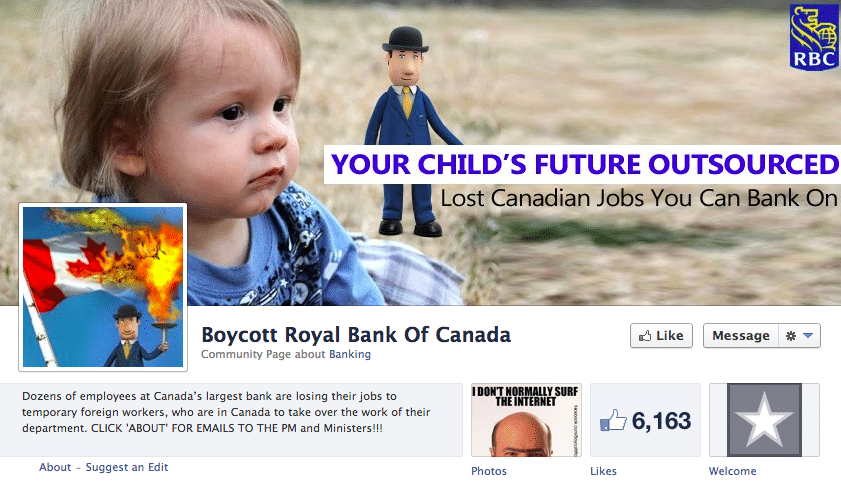
The Royal Bank of Canada – RBC – is currently facing a firestorm of vitriol surrounding media reports that they’re laying off full-time employed Canadian workers and replacing them with temporary workers from abroad.

This is counter to a Canadian government Temporary Foreign Worker Program that only allows such workers to be used if there are no suitable Canadians. As someone who kind of went through this process when I moved to Canada, I understand why they have it in place.

According to the media reports, RBC is bypassing this program by using an outsourced company based in the U.S. to hire temporary workers, and then have the current full-time workers train the temporary staff to replace them.

The response on social media has been swift and forceful.

Boycott Royal Bank Of Canada

On Facebook, a “Boycott Royal Bank of Canada” page went up and has (at the time of writing) garnered more than 6,000 likes in less than 24 hours.

The page shares links to articles on how this situation arose, other related content in the provincial government’s part, and stories from current customers looking to close their accounts.

RBC, for their part, issued a statement on their Facebook page, but unfortunately that fuelled the flames even more (click to expand).

RBC Facebook page

It’s not just RBC that’s under fire today. Fellow Canadian company Hootsuite, developers of one of the leading social dashboard’s, is facing criticism for using unpaid interns.

In a recent “job listing” on their careers page, Hootsuite offered the following:

Note this position is a three month internship at present with a commitment of Monday to Friday with core hours of 9 a.m. -5 p.m. and that the role is unpaid.

The word “internship” divides a lot of business owners, as well as potential interns. In the past, internships were mostly unpaid – the applicant would normally be a college student looking for work experience, and for that experience they would provide free labour to the business that “employed” them.

However, in recent years, unpaid internships have become a hot topic of debate, with calls for them to be abolished and students paid accordingly.

In Hootsuite’s case, where the main outcry has gained even more steam is that it’s illegal in the Canadian province where Hootsuite are based to not pay for the work the interns would be doing.

The British Columbia Employment Standards Act states:

…employees must be paid at least the minimum wage (currently $10.25 per hour), and an intern performing duties and responsibilities that would normally be assigned to an employee must be paid the same wages and benefits that an employee would collect.

The key point from that statement is “…performing duties and responsibilities that would normally be assigned to an employee…”.

Since the original internship ad was for positions covering “affiliate marketing”, “strategic accounts analyst” and “social media coach”, it’s a pretty safe bet to assume these would normally be handled by full-time employees.

While Hootsuite has since removed the ad, and their CEO responded to the criticism that the process is “under review”, their social channels are pretty quiet, particularly Facebook where questions are being asked.

Hootsuite Facebook criticism 1


Hootsuite Facebook criticism 2

It’s not that these questions have simply been missed – Hootsuite is still answering questions on Facebook, but they’re just skewed towards non-negative ones.

Hootsuite Facebook positive response

The two examples above, and the ones from the introduction of this post, are core reasons why it’s not social media that causes a crisis, but the actions of a business.

Business Practices Are What Cause Outrage

While social media is the perfect channel for amplification of criticism and the kind of outcry we’re seeing here, it’s not the instigating channel.

Instead, that lay with the executive decision at RBC and the hiring policy of Hootsuite. Both of these decisions are made offline.

The fact they’ve now made their way online and are evoking such vocal condemnation – more so with RBC – is a perfect example of how social communications may have changed the way we do business, but the underlying business practice is the one that still defines a company’s perception.

My friend, and super smart communications professional, Ann Marie van den Hurk offers some insightful thoughts. Ann Marie is Principal of Mind the Gap Public Relations, as well as author of upcoming book?Social Media Crisis Communications: Preparing for, Preventing, and Surviving a Public Relations #FAIL.

Business practices are what cause outrage against companies. Outrage is outrage, regardless of where it starts. It could start online or offline and then move to social media and spread. It doesn?t matter. It is real either way. It is the business practices and then their response to customers’ concerns and anger. Or, in this case, lack of response to the outrage.

As shown by the lack of response (so far) on both RBC and Hootsuite’s Facebook pages, silence from a brand can do more damage than interaction. The ease of social media in enabling people to vent their frustrations – and vent even more if/when these frustrations are unanswered – can make life pretty uncomfortable for brands caught in this kind of crossfire.

Social media is a perfect tool for outrage exasperation. It is a better tool than any other channels for spreading outrage. People are more linked. The cost of access is very low. People who were angry at an organization or a situation before social media had limited options. Instead of shrugging it off and throwing up their hands, the outraged can now use those same hands to take to social media, expressing themselves and organize with like-minded individuals.

This is the new battlefield brands continue to find themselves in today. Some are better prepared for it; others, less so.

While both RBC and Hootsuite have posted official “responses” on either their own Facebook pages or to specific media channels, the bigger bulk of the questions being asked – from individuals – are being left unanswered.

In Hootsuite’s case, answering “positive” questions while bypassing critical ones during the same time phase could be seen as avoiding the issue, despite the communication from Hootsuite elsewhere.

Organizations are slowly getting more sensitive to outrage and are putting a higher priority on dealing with it; however organizations aren?t moving that the same speed as those outraged. The open, interactive attitudes of social media and the traditional business culture aren?t exactly well matched. Most organization?s management teams have not been able to keep pace with the explosion of social media usage and are ill equipped to manage community outrage.

As Ann Marie points out so eloquently in all three quotes above, social media is a challenging space when it comes to crisis communications.

It can be a very fine line to tread – when do we respond, who do we respond to, and should we respond or will be be flaming the fire even more?

In some cases, there really is no victory to be had by the brand, regardless of how well they respond, which doesn’t help matters.

One thing we can learn, though, is social media will continue to be the torch bearer to hold companies to task. Perhaps the lesson is to look internally first and improve the business practice (perceived or real), before the external voices react to the internal actions.

Time will tell.

Note – my sincere thanks to Ann Marie for her time and sharing her expertise.

  • « Go to Previous Page
  • Page 1
  • Page 2
  • Page 3
  • Page 4
  • Page 5
  • Page 6
  • Interim pages omitted …
  • Page 55
  • Go to Next Page »
© 2026 Danny Brown - Made with ♥ on Genesis