• Skip to primary navigation
  • Skip to main content
Danny Brown

Danny Brown

podcaster - author - creator

  • About
  • Podcasts
  • Journal

social media

52 Cool Facts About Social Media

As social media continues to gain acceptance as a bona-fide communications platform, I thought it might be fun to have a cool fact about it for every week of the year.

So, here are ten facts about the five most well-known social media outlets – Facebook, Twitter, LinkedIn, YouTube and blogging – with two more bonus facts thrown in just for fun. (And to get to the figure of a fact a week for a year).

Enjoy!

52 cool facts about social media - FacebookFacebook

1. The average Facebook user has 130 friends.
2. More than 25 billion pieces of content (web links, news stories, blog posts, notes, photo albums, etc.) is shared each month.
3. Over 300,000 users helped translate the site through the translations application.
4. More than 150 million people engage with Facebook on external websites every month.
5. Two-thirds of comScore?s U.S. Top 100 websites and half of comScore?s Global Top 100 websites have integrated with Facebook.
6. There are more than 100 million active users currently accessing Facebook through their mobile devices.
7. People that access Facebook via mobile are twice as active than non-mobile users (think about that when designing your Facebook page).
8. The average Facebook user is connected to 60 pages, groups and events.
9. People spend over 500 billion minutes per month on Facebook.
10. There are more than 1 million entrepreneurs and developers from 180 countries on Facebook.

Statistics from Facebook press office.

52 cool facts about social media - TwitterTwitter

11. Twitter’s web platform only accounts for a quarter of its users – 75% use third-party apps.
12. Twitter gets more than 300,000 new users every day.
13. There are currently 110 million users of Twitter’s services.
14. Twitter receives 180 million unique visits each month.
15. There are more than 600 million searches on Twitter every day.
16. Twitter started as a simple SMS-text service.
17. Over 60% of Twitter use is outside the U.S.
18. There are more than 50,000 third-party apps for Twitter.
19. Twitter has donated access to all of its tweets to the Library of Congress for research and preservation.
20. More than a third of users access Twitter via their mobile phone.

Statistics from Twitter and the Chirp Conference.

52 cool facts about social media - LinkedInLinkedIn

21. LinkedIn is the oldest of the four sites in this post, having been created on May 5 2003.
22. There are more than 70 million users worldwide.
23. Members of LinkedIn come from more than 200 countries from every continent.
24. LinkedIn is available in six native languages – English, French, German, Italian, Portuguese and Spanish.
25. Oracle’s Chief Financial Officer, Jeff Epstein, was headhunted for the position via his LinkedIn profile.
26. 80% of companies use LinkedIn as a recruitment tool.
27. A new member joins LinkedIn every second.
28. LinkedIn receives almost 12 million unique visitors per day.
29. Executives from all Fortune 500 companies are on LinkedIn.
30. Recruiters account for 1-in-20 LinkedIn profiles.

Statistics from LinkedIn press centre and SysComm International.

52 cool facts about social media - YouTubeYouTube

31. The very first video uploaded was called “Me at the Zoo”, on 23rd April 2005.
32. By June 2006, more than 65,000 videos were being uploaded every day.
33. YouTube receives more than 2 billion viewers per day.
34. Every minute, 24 hours of video is uploaded to YouTube.
35. The U.S. accounts for 70% of YouTube users.
36. Over half of YouTube’s users are under 20 years old.
37. You would need to live for around 1,000 years to watch all the videos currently on YouTube.
38. YouTube is available in 19 countries and 12 languages.
39. Music videos account for 20% of uploads.
40. YouTube uses the same amount of bandwidth as the entire Internet used in 2000.

Statistics from YouTube press centre.

52 cool facts about social media - BloggingBlogging

41. 77% of Internet users read blogs.
42. There are currently 133 million blogs listed on leading blog directory Technorati.
43. 60% of bloggers are between the ages 18-44.
44. One in five bloggers update their blogs daily.
45. Two thirds of bloggers are male.
46. Corporate blogging accounts for 14% of blogs.
47. 15% of bloggers spend 10 hours a week blogging.
48. More than half of all bloggers are married and/or parents.
49. More than 50% of bloggers have more than one blog.
50. Bloggers use an average of five different social sites to drive traffic to their blog.

Statistics from Technorati’s State of the Blogosphere 2009.

Bonus Facts

51. 90% of Internet users know at least one social network.
52. The average social user has 195 friends.

Statistics from Online Media Gazette.

So there you have it – a fact for every week of the year, just in case you need it for your next presentation or tweet-up, and want to let folks know why social media isn’t so dorky after all. And as an added bonus, here are some ways you can use these stats for your business’s strategy.

Cheers!

Not Right Now

233/365 Nearly ready?We should be in social media – just not right now.

We should start a company blog – just not right now.

We should be making our website more user-friendly – just not right now.

We should be doing a lot of things – just not right now.

Not right now – it’s the phrase that companies and executives/decision makers use when they know they’re behind in the game but they’re not sure how to get into it.

It’s the excuse that takes the heat off the boardroom meetings when asked about the new platforms that are emerging (or have emerged) and is it something our company should be looking at.

It’s the fallback of folks that could make it happen right now if they wanted to, but it seems like a lot of work.

Besides, there’s too much that can go wrong to make the risk (or perceived risk) worthwhile.

True. There is a lot that can go wrong.

There is a lot of work involved.

There is stuff that will be completely out of your hands.

But look at it another way. When you first started your business, was there a chance things could go wrong? Did it involve a lot of work, and long hours, to make it happen? Were there things you couldn’t control, no matter how much you planned ahead?

Of course there were, yet you’re still here.? Because you put the effort in and took the risks. Because you knew that not everything will always goes to plan; you just need to make sure you’re ready with a back-up.

So if you’re caught in the not right now dilemma – either yourself, or with someone that makes the decisions for you – take the chance and think differently (or try and show the not right now’s how to think differently).

  • You don’t need to jump in and participate in social media right away – but you can listen.?Twitter Search, Facebook Groups, Google Alerts and other free and simple platforms can help you see if you should be in social media, and where, and when.
  • If you can use email you can blog. Platforms like Posterous and Tumblr allow you to write a blog post simply by emailing in your thoughts – their tech guys will do the rest. Five minutes of your time today can turn you into a thought leader for tomorrow.
  • You can change your website now and relatively painlessly and have the most user-friendly platform for both you and your customers. Better still, you’ll be in control and not tied to some web guy’s timescale.

Not right now is easy – anyone can say it, and make a pretty good case for it as well. That’s why it’s used so often.

But while you’re saying not right now today, your competitors are jumping in right now and owning tomorrow. So when does not right now become not now, not ever, because you’ve simply been left behind?

Creative Commons License photo credit: photoverulam

Blog Awards, Recognition, And Your Part in It

Young Entrepreneur Top 10 Marketing Blog

Teamwork?When I first started this blog just under two years ago, I had one clear goal – fostering thought connections.

Sure, I’d be using it to offer my views on the still-emerging (at the time) social media platform, as well as ideas and solutions on how you could get the most out of the new networks and tools that seemed to be popping up all over the place.

But the overriding factor would be to have my blog as a focal point where ideas could be shared; viewpoints could be discussed; friendships and connections made; and a community built that wasn’t afraid to challenge thinking to help each other grow.

What I didn’t expect was how the blog would grow in that timescale.

Today I found out that this blog was one of the recipients of Young Entrepreneur’s Top 10 Marketing Blogs Award. While I was uber-happy to be recognized by such an organization to start with, my jaw literally dropped on the floor when I saw the company I was keeping – Seth Godin, Andy Beal, John Jantsch and Valeria Maltoni among others.

These are marketers and bloggers that I look up to immensely, so to be sitting alongside them is pretty mind-blowing. What’s even more mind-blowing is how the Young Entrepreneur award is part of what’s been an incredible first half of the year for this blog.

  • In January, it was voted PostRank’s Top Marketing and Social Media Blog.
  • In February, it came in at number three as one of the Top 50 Canadian Marketing Blogs.
  • In March, it received the Hive Award for Best Social Media Blog at South by Southwest.
  • In April, it came in at number six as one of Cision’s Top 100 Social Media and Internet Marketing Blogs.

Couple that with its syndication across the Social Media Today, WebProNews and Newstex business networks as well as its inclusion on the AdAge Power 150 list, and this blog has taken on a life that I could never have foreseen back in September 2008.

Now, while I could lay claim to having done it all myself and how the content has spoken, blah-de-blah-de-blah, even it if were true it’d only tell half the story.

As I mentioned at the start, the aim of this blog has always been to foster a community that would not only question and offer views, but would help the blog grow because of that questioning and view sharing. And these awards and recognition are proof that’s exactly what has happened.

If you didn’t come here and read my thoughts; if you didn’t come here and offer yours; if you didn’t question my viewpoint and make me think differently and strive to be the best I can every time, none of the recognition or award-winning would have happened. I’m not that dumb.

So.

From the bottom of my heart, thank you. Thank you for giving me the time from your life to make me think better. To make me question my thoughts. To make me learn and improve daily.

And thank you even more for helping foster what is, without question, one of the best resources of knowledge, expertise, thought leadership and more – our community.

Your community.

Here’s to you.

Creative Commons License photo credit: blentley

Putting the I in Social Media

Whenever I used to meet with a potential new client that was interested in a social media program, I always used to take a piece of paper with a little drawing on it.
The surprise on their faces was always entertaining when they’d ask for my ideas for them, and instead of presenting a huge multi-slide PowerPoint, I’d show them this piece of paper and the four words on it.

The reason for keeping it simple was simplicity itself – if they couldn’t see the benefit of each point, they probably couldn’t see the benefit of social media.

I’ve since upgraded that piece of paper a little, but the message of the four points on it still works today.

Identify

There are so many different social media tools and applications that it can often be like trying to work your way around a maze. So many different turns to take, easy to get lost with all the options available ? which is why it?s important to take the time to identify what will work for you. Decide what you want from social media and then use the appropriate tools.?

Identity

Having an easily identifiable brand is key for anyone both online and off. Although this is usually applicable to business, personal branding offers an invaluable way of building a reputation as someone to go to for a certain niche. So your identity should be the same across whatever platforms you use ? from bio, to profile, to picture, to logo ? keeping the same identity across social media platforms will help people remember you more easily.

Invest

There?s an old saying that says, ?You get out of it what you put into it.? While this can be used for most topics, it?s particularly true of social media. It?s not something you can dip into now and again ? it changes too fast for that. Instead, to really see the fruits of your labour, you need to invest time into it.

A big part of social media is all about building relationships ? and just like relationships in real life, the best ones take time to foster. Use this mindset with social media, place proper investment into it, and you?ll see the benefits fall into place.

Interact

It may seem an obvious thing to say, but there are only two words in social media and one of them is social. Yet still so many people ? businesses, usually, more than individuals ? are missing this key fact. Instead of simply broadcasting yourself, interact with the community and actively take part in social media.

Read and comment on blogs, both inside and outside your niche; converse on Twitter instead of just spamming your latest blog post or affiliate deal; share helpful news with people instead of keeping it to yourself for your own benefit.

Social media can often be a difficult thing to navigate, with different uses for different people. One thing it is to everyone, though, is a wonderful opportunity for all parts of you or your client’s business.

How are you helping others understand their opportunities?

Creative Commons License photo credit: Eva the Weaver

Facebook Fan Page Evaluation Fun with Vitrue

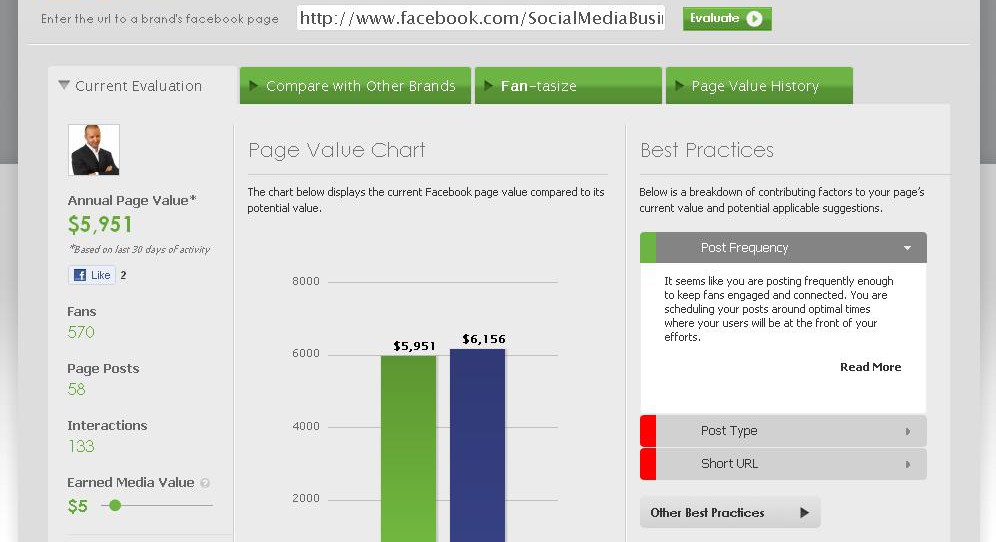
Danny Brown Facebook page evaluator

One of the reasons I set up a Facebook page was to offer an outlet where folks that were more comfortable on Facebook could connect and interact.

Yes, my blog is my home space, and then there’s also Twitter, LinkedIn, YouTube and other social profiles where we can connect. But not everyone likes reading blogs; not everyone’s on Twitter; some folks don’t like to get too involved with LinkedIn, and so on. So, making an outpost available where you’re most comfortable was a no-brainer.

So far, it seems to have worked pretty well. There’s a good mix of extended blog posts, shared resources, exclusives and connections, as well as folks that add comments or make suggestions of their own about resources that may be interesting to those that like my page. And I can’t ask for much more than that.

However, it’s always cool to see how anything we do online is perceived. After all, if we’re not measuring (or at least evaluating) our progress, how can we see where we’re going wrong and correct, or what we’re doing right and build upon?

That’s why something like Vitrue’s Social Brand Evaluator is so interesting.

At its heart, the evaluator is a simple method to see how your Facebook page rates for interaction, social value, and the potential for future marketing or monetary worth.

It also highlights some of the best practices for growing your page, as well as give you a breakdown of page value history (so if you’ve had your page a while, you can see if you’re going in the right direction or not).

While it’s not a direct replacement for proper metrics and measurement, it is a solid enough little app that can show you how you compare to others in your niche or industry. So if there’s someone you really admire, then Vitrue’s evaluator will let you see where you need to be headed to get closer to that page’s social value.

The main problem with it as it currently stands is that it doesn’t really tell you what these figures mean. For example, what does the Annual Page Value indicate – what the page is worth to advertisers, or how much you have the potential to make with offers to those that like your page?

The same goes with the Earned Media Value slider – again, is this for advertisers, page owners, a mix of both or none of the above? A little more clarification on the evaluator would be really useful (though maybe Vitrue is saving that for paid client work instead).

Either way, it’s a decent look at how your Facebook page is being used and viewed, and that’s always useful.

Here’s my social value. If you have a Facebook page, check out the evaluator for yourself and see where you currently sit and where you could either change or improve interactions. And I’d love to hear what you think of the tool and its use.

Danny Brown Facebook page evaluator

  • « Go to Previous Page
  • Page 1
  • Interim pages omitted …
  • Page 27
  • Page 28
  • Page 29
  • Page 30
  • Page 31
  • Interim pages omitted …
  • Page 55
  • Go to Next Page »
© 2026 Danny Brown - Made with ♥ on Genesis