• Skip to primary navigation
  • Skip to main content
Danny Brown

Danny Brown

podcaster - author - creator

  • About
  • Podcasts
  • Journal

social media monitoring

An Open Discussion On Social Media Monitoring and Ethical Data Mining

Blurred lines

As a marketer, I’m excited when I see advances in social media monitoring technology and the way we can use tools like text analytics, ontology and Natural Language Processing (NLP) to really understand our audience and their behaviours.

This level of data mining allows businesses to go way beyond the existing information they have not only on their existing customers, but potential ones, and really laser in on the kind of promotions, products and services that consumer is looking for.

However…

As a consumer, I’m increasingly concerned at that same level of data, and how technology can be used (often without our strict permissions) to define us as a person and make us a “target” (even though it’s for products and services we’re interested in).

Consider these points:

  • Does Google really need us to answer so many personal questions when activating an Android phone?
  • Does Facebook really need to allow apps to delve into our accounts and those of our friends (without their knowledge)?
  • Do social media monitoring technologies really have our best interests at heart, or simply those of the businesses they sell to?

As a marketer, I know the benefits targeted marketing and advertising can offer. But I also see the data some people may not want to have public.

For example, should a gambler or alcoholic be targeted by keywords and natural search, even if it’s by an Alcoholics Anonymous group or responsible gambling organization? What if their details were accidentally made public?

Should teens be targeted to see what their brand preferences are, to tailor the next generation of advertising for these soon-to-be-consumers? Or should we just let them be teens and loop back in a few years time?

Or do we benefit by the level of data that’s available? After all, it’s the open research web now, so this is just a by-product of that and results in us being served better and more relevant ads.

I’m really curious to hear your thoughts on this – where do the lines blur between useful data and invasive data?

Let’s start the conversation.

image: Sri Harsha Meghadri

Simple News Aggregation with Guzzle

As more businesses get used to social media and how they can utilize it for their needs, news aggregation and brand monitoring has become a key part of the puzzle.
While there are a host of premium models available, including Radian6, Meltwater Buzz and the recently released IBM model, these can often be prohibitively expensive for smaller businesses.

Then there are the free platforms, like Surchur, SocialMention and Trackur.

The problem is, while these platforms offer great information, the way this information is presented can be a little confusing to anyone not used to using the platforms. Additionally, they’re more geared to social media mentions and interactions, when all a company might be after is more news related.

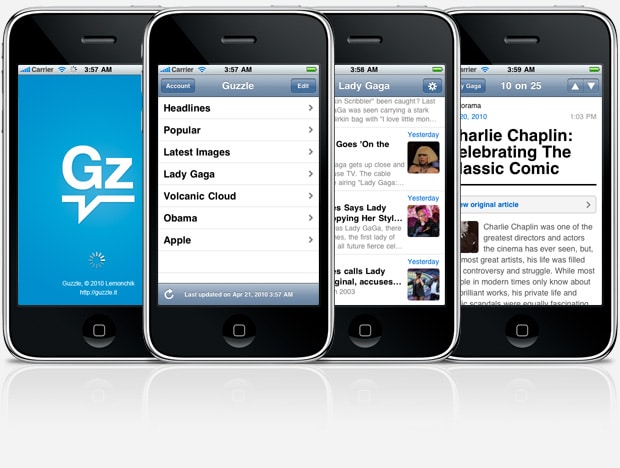
Step up Guzzle, from Marca Tatem of French web developers Lemonchik. And it’s pretty damn cool.

The Guzzle Approach

Where Guzzle makes it really easy for anyone to use is in its visual approach and how you can customize it to your tastes, whether they be text, visual or a little of both.

Jump to the Guzzle homepage, and you can either start customizing your page, or watch a screencast video introduction. This video shows you the basics of how Guzzle works, and is pretty short. Then it’s just a matter of setting up your feeds.

When you select Click Here link to start building your Guzzle page, it takes you to a screen where you can either go with preselected topics like Headlines, Popular or Latest Images, or Add Your Own Topics. It’s this second option that you want to start playing with.

Keywords, Phrases, People and More

By typing in descriptive terms of the news you’re interested in, Guzzle then starts scanning feeds across the Internet to get the latest stories about that person, brand, product or more.

When you’ve entered all the terms you’re interested in and hit the I’m Done button, the results will show on the page and in the manner you prefer. So, if you just want headlines, you get that; if you want headlines and source of the story, you get that. If you want extended copy, you get that, and so on – it’s really up to you.

While the headline only option is useful enough, the extended option is really cool. This is where Guzzle begins to look like a really tidy online news site, with images and extended copy making the information really easy on the eyes. You can separate by categories as well, to make it even easier to scoot over.

Desktop and Beyond

As well as being a web application, Guzzle also lets you have a pseudo desktop version. If you sign up for an account (which is free), you can save your searches and not have to keep setting up new ones every time you open your browser – perfect for when you’re not at your own desk.

On top of that, you can also get Guzzle on your iPhone. Offering the same options as the web version, having the news you need at your hands could be a great deal breaker when talking with potential clients and why they need your services. Especially if you give them breaking news even they weren’t aware of…

Not Quite Perfect – Yet

Of course, with any new product (and especially a news monitoring platform), there are always going to be some bugs or “shortfalls”, for want of a better word.

While the search engine is pretty robust – it uses the likes of?Pubsubhubbub, Open Calais and various online resources – it still seems a little hit and miss.

For instance, being the egomaniac I am, I typed in both “danny brown” and “danny brown blog”. The results that came back had nothing to do with me, and were all tied into the U.K. government and new Prime Minister David Cameron. While I agree I’m not particularly newsworthy, on the other platforms like Surchur, etc, the relevant information comes back.

Of course, maybe if there was a news story about me at the minute, results might be different. But as a key part of the service, not having details on a search could obviously prove problematic.

Apart from that, Guzzle seems to be a pretty cool way to track the news you care about. Tie it in with a solid social media monitoring platform as well, and you’re looking good.

It’ll be interesting to see how the application grows, and if it becomes more tied to social or remains more news-led. Either way, it’s a great addition to an already-burgeoning scene.

How about you? Have you tried Guzzle yet? Or what alternatives do you use?

© 2026 Danny Brown - Made with ♥ on Genesis