• Skip to primary navigation
  • Skip to main content
Danny Brown

Danny Brown

podcaster - author - creator

  • About
  • Podcasts
  • Journal

social media marketing

Social Influence and The Marketer’s Dilemma

The Four A's

Just 20 short years ago, marketing was pretty easy. You got your budget, you allocated it to the media buy (TV, print, radio, direct), and away you went.

If you were conscientious, you’d collect results and give them to your clients. If you weren’t, you’d correlate any increased foot traffic to a store or business to your awesome marketing efforts.

Everyone was (kind of) happy, and marketers went about their merry way of sitting in a lofty seat, controlling the message and how that message was disseminated.

Then everything changed.

With the advent of the World Wide Web in 1990 by Tim Berners-Lee, consumers now had a legitimate way to take a little bit of control back from the marketers.

While it was still in its infancy, and search wasn’t as advanced as it is today, private forums and message boards soon sprung up and consumers could connect with peers and fellow customers, and offer true feedback and advice versus the limited face-to-face conversations taking place in the home, workplaces and bars.

Jump forward 15 years, and the growth of Facebook, Twitter, enhanced forums and real-time review sites, and now the marketer’s game – or at least, the bad marketer’s game – was pretty much truly up.

Messaging was no longer the domain of the few – now it had to live up to its claims or be shot down in public, in the full gaze of a paying client. Not only that, but now the power of the budget was being taken away by the introduction of social influence – and the marketer’s dilemma began.

If Everyone’s an Influencer…

Before social media, if brands were looking to truly get their message in front of a certain group of people, they’d buy celebrity endorsements.

From Paris Hilton in a bathing suit washing cars to Madonna being paid $5 million for an advert that was pulled by its sponsor, celebrities have been big draws when going after a certain demographic.

The problem with this approach is when a celebrity takes a fall and the brand takes a hit because of it (or would do, if action wasn’t taken on their behalf).

Think about Tiger Woods and his extra-marital problems; or Lance Armstrong and his recent doping scandal. When heroes fall, they taint a brand too – if you don’t take action, you’re seen as endorsing wrong-doing or questionable behaviour.

Additionally, consumers are much more savvy now and aware of how advertising works – do we really believe that Celebrity X drives Automobile Brand Y? No.

Instead, we move back to where we’ve always been prior to the golden age of advertising and marketing – peer recommendations and trusted resources. In social media, these trusted resources are the new influencers, and brands are now looking to connect with them versus celebrity endorsements.

That in itself leads to the next problem – when social media can empower anyone to become an influencer, who do brands connect with?

It’s All About the Four A’s

Thanks to some social scoring sites, anyone can appear influential. Increased activity on Twitter and Facebook can see your score on the likes of Klout skyrocket.

For brands that can’t afford to put the legwork in that truly identifies the real influencer for their audience, social scoring sites offer a quick overview of who may be the right person, and let you filter out only those that meet a certain score and above.

While this can give you a quick introduction to the kind of people you’re after, it can also see you miss these very people as context and relevance can often be missed by a simple score.

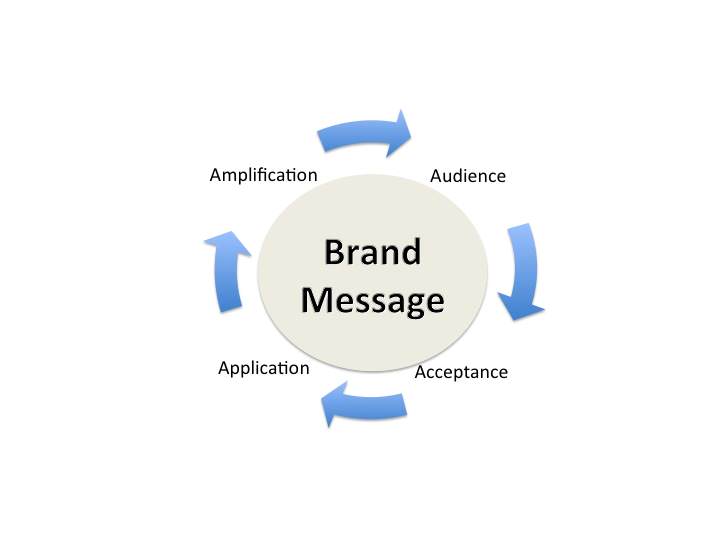
Additionally, whether social scoring helps you identify people or not, to truly get your message out there you still need the Four A’s:

The Four A's

  1. Audience – It used to be the medium was the message, but now the audience is the driver – without knowing them, the message is useless, no matter what medium it’s on.
  2. Acceptance – You can have the greatest product and message ever, but if the audience isn’t ready to accept it, will it even be heard?
  3. Application – How you’re perceived can define your success, and how you approach us defines how you’re perceived.
  4. Amplification – The golden ticket, and not just for brands but for social scoring and influence: how far can you get your message?

These four tenets are core to the marketer’s success – but without knowing how to identify true influencers, how can you get all four aligned and working together?

The conversation is just starting on that one…

The State of Social Media Marketing 2012

Social media measurement

State of Social Media Marketing 2012

Social marketing software company Awareness has just released the second part of its bi-annual State of Social Media Marketing report for 2012, and it makes for some pretty interesting reading.

Surveying 469 marketers from a variety of industries, expertise and verticals, the report looks at how businesses are using social media (or not), the key pain points, and where businesses are heading in 2013.

Some of the key findings include:

  • 44% of companies with social marketing budgets of $100,000 or more are using social CRM software, compared to 16% in general.
  • 68% are interested in expanding their social footprint.
  • 50% see the need to tighten integration between social and more traditional marketing.
  • Social marketing ROI, a larger social presence and reach, and increased content creation and publishing are three areas executives are looking to concentrate on in 2013.

What’s interesting from these points alone is that social is definitely seen as a core strategy for many businesses to take on in the next 12 months and beyond. Yet, clearly, there’s still some ambiguity around social – the ROI question continues, as does building a strong presence where results can be actionable and measured.

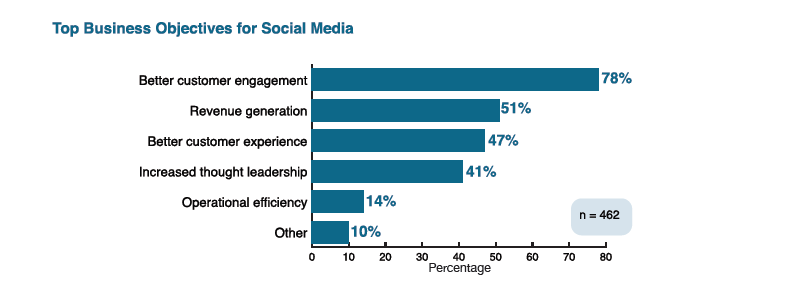
The good news is, despite the ambiguity, when you look at the top business objectives for social media it’s clear that the customer experience is key (click to expand):

Top business objectives in social media

Seeing two of the top three objectives geared towards the customer is encouraging – it would seem that brands are finally realizing the amplification social offers consumers, so they’d better improve and tailor the experience while continuing to foster the initial touch-point.

So what else does the Awareness report tell us?

Social Media is Still a Challenge

It’s sad to say, but social media continues to be a challenge for many businesses in 2012. This, despite many seeing the tipping point of social media as 2010, when the ROI question and the business benefits of social media were really taken into the mainstream.

So what are the challenges that businesses continue to face when it comes to social media?

Top social media marketing challenges

While the lead challenge is still that of ROI, what’s interesting is the percentage that are struggling to integrate with the rest of the marketing vertical.

This accounts for almost a third, and is a clear indication that businesses are finally starting to realize that social isn’t a standalone strategy, but a core part of the bigger marketing picture. While it’s a struggle at the minute, the recognition it needs to be integrated bodes well for the future of these businesses.

Social Media and Measurement

For any business, knowing how successful a campaign is – whether that’s external or internal – is key to understanding where that business needs to grow and improve, and where it’s already doing a good job.

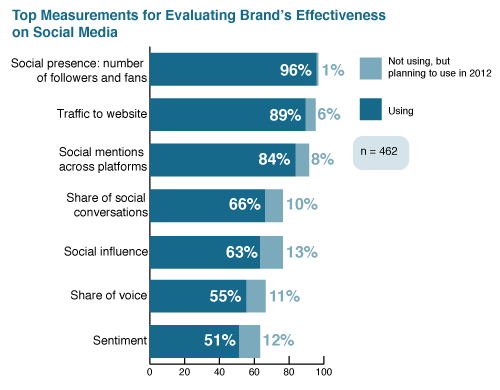
When it comes to social media, measurement is just as key – and brands are definitely keeping score when it comes to how effective their business is on social media:

Top social media measurements for brand effectiveness

What’s interesting about this particular section of the report is that almost every single respondent chose number of fans and followers as the #1 barometer of social media success.

This, despite the fact fans and followers can be bought for as little as $5 for 10,100 Twitter “followers”. While it’s great to have a large following, it’s how engaged and involved with your brand that really matters. Numbers mean squat unless they add to your business overall.

Social influence is truly becoming a mainstay of the business landscape when it comes to social media, with almost 2/3 of businesses looking to increase their influence in the space. As Kred, Klout and others look to grab this slice of the action, expect that number to rise in 2013.

Social Media and Revenue

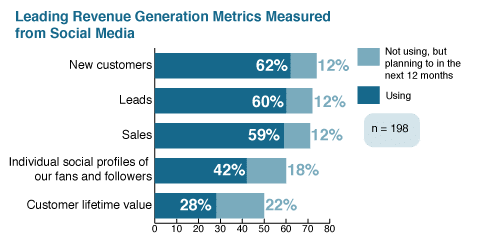
Perhaps one of the biggest questions around social media is that of revenue and lead generation. With ROI still being the leading business question around social media channels and campaigns, it’s no surprise that revenue is a core part of the equation.

What is surprising are two of the answers to the revenue question:

Social media and revenue

While the top three responses make perfect sense, the next two are a little worrying. If, as a marketer, you don’t know where your customers are online, you’re immediately at a disadvantage to your competitors who’re actively profiling their customers.

Even more concerning, perhaps, is the percentage that uses social media when it comes to the lifetime value of a customer. To these businesses, there’s a simple question in return: if you’re not using the simplest way to track a customer’s satisfaction, what exactly are you using?

By knowing your customer’s social footprint and combining that with monitoring and profiling, you can get an untainted and unbiased overview of what they think about you, your brand, your product and/or your service.

Social media continues to be the greatest focus group out there, because it’s tuning in on natural conversations – so why are just over a quarter of marketers understanding this? Scary stuff.

The Future of Social Media

As you can see, there are still some major challenges in the adoption of social media when it comes to business, regardless of size and resources.

As well as the points above, other challenges include tracking multiple channels, choosing the right tools, delegating the right people and tying social media results to actual business results.

The social CRM issue continues to be one that’s lacking in uptake, with only 16% of businesses currently using a social CRM system. While 21% are planning to, 17% don’t know what a social CRM system is and why businesses need it.

It’s perhaps this last stat that’s the most concerning since, without a CRM platform in place, how do you expect to truly measure activity and results, and allocate the right resources and team members, to ensure the customer experience is everything it can be?

The good news is, companies are beginning to notice where they’re lacking and what needs to be done to improve:

  • 53% of businesses are now using more than two Facebook accounts, to offer a more targeted experience (13% have more than five profiles).
  • 45% of businesses have two or more Twitter accounts, with 11% having more than five profiles.
  • 80% of marketers are creating teams of up to three people to manage social media.
  • 65% are using community platforms to engage with their customer base, while collaboration platforms like Basecamp and Huddle are expected to be used more in 2013.

There’s no doubt that social media is here to stay. Consumers continue to be the driving force behind its growth and businesses are clearly realizing they need to catch up.

The State of Social Media Marketing report offers hope that they’re doing just that.

To receive the full State of Social Media Marketing 2012 report, click here.

Related articles
  • Is Social Media a Waste of Time? (dannybrown.me)
  • How Much Listening Does Social Media Listening Really Offer? (dannybrown.me)
  • A Special @JugnooMe Invite to @Seesmic Users #Seesmic (dannybrown.me)
© 2026 Danny Brown - Made with ♥ on Genesis