• Skip to primary navigation
  • Skip to main content
Danny Brown

Danny Brown

podcaster - author - creator

  • About
  • Podcasts
  • Journal

social media applications

Get the Gist About Your Most Important Contacts

For anyone that struggles with managing contacts, new online service?Gist may be just the thing you’ve been looking for.

Working out of Seattle, Gist is a new start-up that takes the hassle out of connecting your online dots. It collates all your contacts – email, Twitter, Facebook, LinkedIn and more – into an easy-to-manage web portal that then gives you a whole ton of features to prioritize which ones you keep track of.

What makes Gist interesting is the pedigree behind the company. Engineers from companies like Microsoft, Amazon, Jobster, Infospace and more are the key minds behind Gist, and this shows with the sheer weight of information available to you once you sign up. It’s also incredibly user-friendly – another sign of the expertise putting the show together.

So what’s Gist all about?

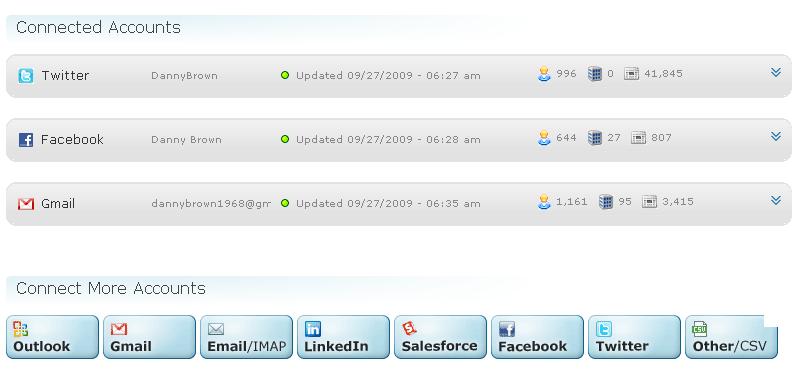
From the company’s own description, Gist works by “connecting your inbox to the web.” So basically, anywhere you have an online contact, Gist transfers them to one point of contact to help you manage them better. Once you set up an account, you can then import your connections from the following services:

  • Email services Outlook and Gmail (with the option of importing others via IMAP)
  • Twitter
  • Facebook
  • LinkedIn
  • Salesforce

You can also upload Excel or csv files as well (so, Yahoo Mail contacts for example). Basically, your most useful social connections and email contacts are covered.

Once uploaded, you’re then offered a dashboard area which is where the real fun begins. Depending on the accounts you’ve linked to Gist, you can then see the latest blog posts, tweets, news and more about and from every contact in your list in the What’s New section. It’s like an RSS feed on steroids, and gives you an incredible amount of information.?There’s also a Google Search box open, so any information you need on a contact or connection is right in front of you.

The admin area is where Gist’s potential shines through. There are three sections – Dashboard, People and Companies. In the Dashboard area, you can tick boxes to check people, companies, blogs, tweets and news from the last 24 hours up to 90 days old. In the People section, you can see when you last contacted someone as well as the date of the most recent article about them. The Companies section offers pretty much the same as the People one, but ties them all under their respective corporate roofs.

The benefit of all this information is clear:

  • Get the most up-to-date information about a sales lead before a meeting or call
  • Send a solution to a problem as it’s mentioned, building your connection to that person or company
  • Expand your connections via shared contacts
  • Jump in to defuse situations and respond to both positive and negative feedback as soon as it happens
  • Keep in contact with your connections, customers and clients on a more regular basis, strengthening the relationship

Gist combines these features with the ability to prioritize which contacts are more important via a slider option where you can increase or decrease relevancy.

It’s clear to see that Gist has come out of the gates flying. The guys behind the company have realized that not everyone is a great project manager and that having an all-in-one solution to some of that is an attractive proposition.

The service isn’t quite perfect yet – it could offer more social networks, for instance, and I noticed some duplication of contacts from the same list when uploading. However, these are minor quibbles in a service that is still in open beta at the minute. As a first run, Gist is already looking like it could be one of my most used tools for connecting people, both personally and to each other.

Check out what founder and CEO T.A. McCann has to say, then have a look at Gist yourself. I’d love to know what you think of it.

How to Take Social Media into the Mainstream

For anyone reading this blog, it’s a pretty good chance that you’re already social media-savvy. Whether you found it through a Twitter link, a blogroll, Technorati or similar means, I’m guessing that you know about the benefits social media can offer.

(For anyone else that arrived here by mistake – well, I thank your error and hope you’ll stick around!)

And therein lies the problem. If you did use one of the methods I mentioned, you’re already a social media user, which is great. But for each one of us that “gets” social media, there’s another 10 that don’t.

(By the way, this figure hasn’t been scientifically proven – I just like round numbers).

This is the problem that social media needs to overcome if it’s ever to be taken seriously. There are some great people out there helping to spread the word about social media, both for personal and professional use. But there needs to be more to help the medium into the kind of acceptance the Internet now has with everyone.

One of the main issues is that there are just too many social media sites, applications, tools and more that it’s all too easy to get lost when you first jump in. No-one likes to be the guy that made the wrong choice – just ask Betamax video or HD-DVD early adopters.

What’s needed is a standard format for the different tools available. Don’t get me wrong – I don’t want to see a monopoly of social media any more than you do – but figures prove that something is much more likely to enjoy success the easier it is to use.

Instead of having multiple microblogging platforms like Twitter, Pownce or Plurk, etc, have one main platform to work from. Differentiate the users by offering categories, if you like, that helps them find like-minded users more easily.

Have three main social networking sites – Facebook for people, MySpace for music, LinkedIn for business. Integrate some of the better features from other sites like Bebo and FastPitch and make these three sites the one-stop shop for whatever field it covers.

Combine the best of Stumbleupon and Delicious to offer a bookmarking site that truly does drive traffic to your website or blog.

These are just some ideas to bring social media to everyone. The biggest stumbling block for people and businesses is simply confusion as to what social media offers. Having so many platforms doesn’t help. Narrowing all the current options down into a more manageable resource would go a long way into negating this confusion.

I’m not saying it’s the ideal solution – but it’s got to be better than the mish-mash that’s currently out there, no? What do you think – are there too many social media platforms or is all this choice a good thing?

If you enjoyed this post, please consider leaving a comment and subscribe to my RSS feed or via email to ensure you can enjoy the latest post(s).

Are We Turning into Social Media Snobs?

From its inception, social media has always been about the romantic notion of connectivity. Full connectivity. Whether it?s being able to interact with the Internet in a more open manner than we?d ever known previously, or connecting with other like-minded people to share, advise and learn, social media and full connectivity have gone hand in hand. Until now.

I read a lot of blogs – some by the biggest names in social media, some by the rising stars, and some that are just entertaining reads by people starting to find their feet in this whole social media world. Then there are the non-niche blogs that are worth anybody?s time.

What I like most about these blogs (and the others that are recommended to me by friends) is the openness and free-to-all approach that they offer the reader. There?s no hidden agenda here – simply the proponents of social media and those interested in it, sharing views along the way.

Recently though, I?ve been leaving many of these blogs with the feeling that the authors are beginning to believe a little bit too much in their own hype. Instead of sharing openly with their readers and asking for opinions on how they view social media, the authors are instead preaching how to approach the medium.

This would be okay if it was merely helpful advice from someone who?s been there and done that. Sadly, it?s becoming less so. Instead, we?re treated to people virtually attacking the medium that gave them such a popular voice to begin with.

Example – there?s a particularly well-known tech blogger that recently chastised other bloggers for not name-checking thousands of blogs a day, or for not using tools like Google Reader in their sidebar to let other bloggers know what they?re currently reading. This irks me.

Not everyone is (or wants to be) a professional blogger. Many simply use the medium for sharing their innermost thoughts with a curious world. So what if someone doesn?t want to link to another blog, or website, just for the sake of linking? Does that make them any less of a person (or blogger)? Does it mean they don?t deserve to be mentioned in the same breath as this tech blogger that raised the point in the first place?

Of course not.

There are many ways that bloggers can show appreciation of the work of others without blatant shout-outs and name checks all the time. Blogrolls, or links, for example. Or using an application like CommentLuv, that shows the last blog post of anyone leaving a comment.

Blogging shouldn’t be a private playground where the ?privileged few? set the rules. Nor should social media. Instead, both should be methods of bringing people together to ultimately make the world a friendlier and better place. Shouldn?t we try keep it that way, before the snobs ruin it for everyone?

The True Meaning of Social Media

So, social media. It can be pretty confusing, right? After all, one person tells you one thing about it while another person tells you the complete opposite not 5 minutes later. And then the day after, you have someone else telling you it’s something in-between the previous two explanations! No wonder social media is so confusing. So what does it mean?

To be honest, social media is exactly what you want it to be. You want it to be a way of finding cool and interesting websites that you would never have found before? Sign up to Stumbleupon. You want to know what blogs are popular? Get yourself a Technorati account. History of all the comments you’ve ever left? Backtype. And the list goes on.

For me, however, the true meaning of social media can be found in the way that people who would normally be business competitors offer support, knowledge and different expertise to those who need it.

I’ll give you an example. On my Twitter account, I’m probably connected to around 40 or so people from the PR and copywriting industry, whether it’s through me following them or them following me (or both, even). Now, in the “normal” business world, they would be competitors so you’d think the last thing we would want to do is help the other out.

Yet instead, Twitter sees any request for help or advice answered almost immediately, and often with information that would offer a distinct advantage if kept private. Now to me, that’s social media at its finest.

Yes, we’re all in business and we all want to succeed, but gone is the “at all costs” attitude of the last decade and beyond. With the Internet opening up a whole new world of commerce and potential customers, there really is enough to go round for everyone. And people are realizing that.

Not only that, but people are also encouraging others to succeed and offering up the tools with which to push for that success. You can’t get much more of a truer meaning of social than that, media or otherwise. Perhaps we should get the leaders of the world into social media? After all, they could use all the help they can get.


© 2026 Danny Brown - Made with ♥ on Genesis