• Skip to primary navigation
  • Skip to main content
Danny Brown

Danny Brown

podcaster - author - creator

  • About
  • Podcasts
  • Journal

influence marketing

State of Play for Influence Marketing in 2013 – Infographic

Influence Marketing the bookBusinesses are now competing with ? and often losing to ? ?the wisdom of crowds? in the branding battle.

Identifying individuals who sway online consumer opinion on specific topics and within specific communities has become critically important to marketers and public relations professionals.

A slew of social scoring platforms have emerged with claims that they can identify who influences who online while providing various tools and scoring systems to rank those who are influential and those who are not on a variety of topics.

However, as with most early adopters, their efforts have been widely criticized. Some say they?re just misunderstood and that the technology is just too new.

Either way, there?s one certainty: Marketers and public relations professionals are taking notice.

We surveyed marketing professionals around the world in our ongoing effort to better understand this growing industry and where businesses stand on the issue.

  • Can social influence truly be measured?
  • Is anyone using them?
  • What?s the future of influence marketing?

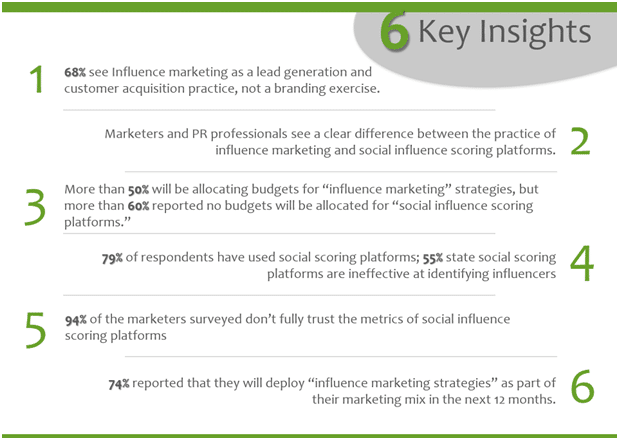
Influence marketing survey key insights

We’ve created the following infographic to highlight some of the key findings:

  • How marketers define Influence Marketing
  • What budgets they?re allocating to Influence Marketing in the next 12 months
  • How do marketers rate various social influence scoring platforms
  • What successes they have had with social influence scoring platforms and if they plan on using them in the future
  • The demographics of audience surveyed
  • And more!
Publish the infographic on your site – use the Embed code at the bottom of this page:

IM infographic

Influence Marketing bookBuy the book that offers the methodologies that answer the needs raised in this report: Influence Marketing: How to Create, Manage, and Measure Brand Influencers in Social Media Marketing

Book Authors: Danny Brown & Sam Fiorella
Copyright: ? 2013 by Que Publishing
ISBN-13: 978-0-7897-5104-1
ISBN-10: 0-7897-5104-6

?Survey Sponsored by:

arc-logo
sensei-logo

The Crossroads of Influence Marketing

Where now for influence marketing

Influence marketing is at a crossroads. As we know it today, influence marketing is primarily defined by social scoring platforms like Klout, Kred and PeerIndex.?However, while these platforms are decent starting points for brands looking to identify influencers, they don’t really go deep enough into contextual and situational human relationships to offer a true metric of influence.

What’s needed is a bigger understanding of how the human psyche works; what makes us tick as people; what impacts our decision process; and where we can predict paths of influence based on transactional relationships, where historic interactions can be merged with current knowledge and the likelihood of a future action based on that knowledge.

To get to that level, though, we need to move to the Third Wave of Influence Marketing.

The First Wave of Influence: Celebrity Endorsements

While Dale Carnegie can arguably be called the Grandfather of Influence as we knew it before social scoring entered the fray, it was the late Dan Edelman and his championing of celebrity endorsements that ushered in the First Wave of Influence.

Edelman saw the value in connecting celebrities with brands to share that brand’s message. The middle of the last century saw Edelman employ people like movie star Vincent Price to be the voice of the California wine industry, and people like baseball legend Nolan Ryan and activist Gloria Steinem.

This type of brand recommendation resulted in several successful campaigns, and turned Edelman’s fledgling self-named company into a global public relations powerhouse.

However, in recent years, the sheen has started to dull with celebrity endorsements. In 2008, Bloomberg BusinessWeek published an excellent article on the dangers of celebrity endorsement, which included (lack of) relevance of the celebrity to the brand.

On her agency blog, Margie Clayman took it one step further and highlighted the worst case scenario for brands when using celebrity endorsements – that of the celebrity “going rogue”.

Tiger Woods and his infidelity; Lance Armstrong and his doping scandal; Oscar Pistorius and the killing of his girlfriend (drawing comparisons to the OJ Simpson murder trial).

The combination of dangers associated to celebrity endorsement, as well as consumers becoming smarter when connecting the dots between endorsement and context, paved the way for the next wave of influence.

The Second Wave of Influence: Social Scoring

The social web has opened up a veritable treasure trove of opportunities for individuals to become the “new celebrity”, or influencer. By having access to social networks, blogging and more, everyday web users can grow a sizable audience and loyal following.

Brands began to take notice of this and naturally wanted to connect. There was just one problem – old school broadcast messaging didn’t quite work on the new web. Instead of connecting with influencers, brands came across as spammy. They needed a conduit.

Enter social scoring.

Early movers in the social influence space like Klout, Kred and PeerIndex saw the opportunity to create a platform that could connect these social influencers to brands looking to use them to promote their goods.

Soon, public scores were attached to individuals, with the higher scoring ones being invited to accept free products from brands, in the hope of exposure to that influencer’s audience.

This was all well and good, until the cracks started to appear.

klout no profile

Questions arose over the validity of the data being used, since it was just based on publicly available information versus more in-depth conversations happening behind closed networks and privacy settings.

People also questioned the right of these platforms to create a public profile and attach a score to you, without your specific content.

Privacy violation was also a hot topic, as well as the creation of profiles of minors – a big no-no for the social networks where the scoring platforms were scraping information from.

Perhaps the biggest crack was the resulting shift in how influence was perceived. Instead of context and micro relationships, influence was now judged by a score and how well a user played into the algorithm of the scoring platforms.

Even today, after improvements to the data, people with social scoring profiles can see their scores drop if they stay away from the likes of Twitter and Facebook for a few days. This “you’re only influential if you’re online” approach has left people questioning the validity of scoring as a method of influence.

Much like celebrity endorsements before them, social scoring platforms are being questioned over the context of how their influence is measured, and where the true transactional influence – that where trust, relationship and more comes into play – sits in their algorithm.

Which leads us to the next wave.

The Third Wave of Influence: The Business of Influence

The biggest problem facing brands today when it comes to influence marketing is the actions and end result that come from their campaigns, and did they result in leads and customers.

While there are various aspects to an influence campaign – short term buzz, new product awareness, donation run for non-profits, etc – the long tail aspect is often forgotten: customer acquisition and loyalty.

The reason for this can be attributed to many things, but the biggest overriding factor is clear – brands are still using influence marketing campaigns as one-offs, and with a campaign mindset.

Influence Marketing survey key insights

This means they find their influencers, agree on the promotion, let the influencer do his or her thing, and then analyze how successful that campaign was.

However, this misses a huge opportunity – to turn influence into true advocacy, and build a loyal and engaged army of fans that are also customers. To do this, brands need to start looking beyond the short-term (potential) viral effect of an influencer, and instead address the needs of the customer via the influencer.

A CRM platform like Nimble can help in this process, and taking influence beyond buzz and into true actionable business return is the natural next step.

Otherwise, the current direction of influence may erode brand trust. The recent indifference to the Kred and LinkedIn Top 1% emails showed early signs that perhaps consumers are getting tired of where we are today.

Instead of generic, we need to address complexity.

  • We need to decipher opinions of those that matter and how they impact us;
  • We need to adapt to fluid influence and how it continuously changes;
  • We need to move beyond public personas and into micro influencers;
  • And we need to stop confusing popularity and amplification for influence.

But most of all, we need to place the customer at the heart of the influence circle, and understand their needs; where they are in the purchase life cycle; and who immediately impacts their decisions based on their current situation (financial, emotional, etc).

The stage is set for The Third Wave of Influence Marketing – all it needs now is you.

[vimeo width=”600″ height=”400″]https://vimeo.com/65202873[/vimeo]

Book Pre-Order Special Offer and Influence Marketing Teaser Video

Danny Brown Sam Fiorella Influence MarketingIn two weeks (or less, depending on shipping), Influence Marketing: How to Create, Manage and Measure Brand Influencers in Social Media Marketing will be released.

The culmination of over three years worth of client research and implementation, discussions with technology vendors, concerns over the impact of scoring on peoples’ livelihoods and more, the fruits of that labour is almost ready to be shared.

I won’t lie – it’s exciting to know that the methodologies Sam Fiorella and myself are presenting in the book will soon be out for all to read and share feedback on.

It’s also a little nervy, since the approach requires a shift in thinking on how we define influence – and, by association, influencers – today.

Thankfully, early feedback so far has been great:

After reading [the free sample Chapter 5], I can tell you it?s a phenomenal chapter that leaves one hungry for the parts on either side of it. Assuming the rest is like Chapter 5, they have certainly written the book that will transform the practice of influence marketing. Evy Wilkins, VP Marketing, Traackr.

Loving the book and its approach – this stuff is incredible. Hessie Jones, CEO, ArCompany.

The sample chapter has certainly made me want to read more; it is thought-provoking. Tema Frank, CEO, Frank Online Marketing.

Brilliant; truly groundbreaking. Tonia Ries, Founder, The Realtime Report.

If we can make people think and reposition how they approach influence marketing today, and see feedback like the early examples above turn itself into business results for readers of the book and the companies they represent, we’ll be happy.

Sales are definitely key (and also help our publisher feel safe that they didn’t sign up a couple of duds when they signed the paperwork with us!) but it’s the transformation in thinking, and shifting influence back to the source – customers – that will really validate the book for Sam and myself.

Which brings me to this special pre-order promotion if you order between now and May 10.

Influence Marketing Book Pre-Order Offers

As part of the launch week, Sam and I have come up with some offers that enable anyone, from solo entrepreneurs and professionals to business owners and executives of organizations, to take advantage of.

Because our goal is to transform the discussion around influence, these offers range from digital to physical and will really complement the book and the methodologies within, and help your business understand and succeed in this important marketing tactic.

So, the offers.

1. Pre-order one copy of the book and, as readers of this blog, you will receive a free copy of the first two videos in the video series we’ve created to partner the book.

2. Pre-order 5 copies, and receive a guest byline for your blog or publication from either myself or Sam, between now and the end of 2013.

3. Pre-order 20 copies, and receive a free, business-specific webinar presentation for your employees and/or clients.

4. Pre-order 50 copies and receive 3 hours of digital or influence marketing consulting. This will include an overview of your business’s target audience, their purchase cycles, and how to filter who influences them directly based on our Customer Centric Influence Model.

5. Pre-order 100 copies, and receive free, on-site presentation to your employees/executives, and/or clients. This also includes identifying your influence marketing goals and providing a framework for your business to follow, based on audience and our Customer Centric Influence Model. You simply cover flights and accommodation for either Sam or myself.

Note: These offers apply to both the digital as well as print versions.

Why You Should Buy Influence Marketing

Prior to the launch of the book, the companies Sam and I work at carried out a survey of over 1,300 professionals, PR consultants, marketers and executives around the topic of influence. The results were clear.

Influence Marketing survey key insights

Influence marketing is becoming an increasingly important part of the marketing landscape, and businesses and organizations are looking to allocate more time and budget to the space in the next 12 months and beyond.

However, they’re looking for true business results and moving beyond social scoring and into a more detailed, targeted and measurable methodology. The Influence Marketing book provides that and more.

We present detailed breakdowns of successful influencer campaigns, both by us and from brands, where identification of true influencers and who impacts their purchase decisions at any given time led to both top line and bottom line results.

We present a blueprint for your business to use – which technologies meet your needs, how to create influence paths (the glue that holds all influence marketing tactics together), and how to not only address the influence question strategically but, more importantly, make it a long-term part of your business’s success and less of a short term hit.

We’re biased, obviously, but we do firmly believe we’ve written a book that will change the influence conversation forever. By writing a business book in the truest sense, we’ve also laid the foundations for your business to be successful and do things the right way in this space for all your influence marketing campaigns.

But we’ll leave it with the words of Evy Wilkins, VP Marketing of Traackr, one of the influence platforms leading the charge in the next wave of influence.

Sometimes a book changes the way we do business.?Influence Marketing: How to Create, Manage and Measure Brand Influencers in Social Media Marketing?will be one of those books.

The first step is almost here – let’s get started. You can pre-order either print or digital versions from your preferred bookstore below.

Influence Marketing book Influence Marketing book Influence Marketing book Influence Marketing book

Note – to take advantage of the various pre-orders here, simply forward a copy of your sales order receipt to info@influencemarketingbook.com with the message header Pre-Order Promo – X Books Ordered, provide your preferred contact details, and we’ll be in touch to arrange.

[vimeo width=”600″ height=”380″]https://vimeo.com/65202873[/vimeo]

Special Pre-Order Promotion for Influence Marketing Book

Influence Marketing survey key insights

Danny Brown Sam Fiorella Influence MarketingIn two weeks (or less, depending on shipping), Influence Marketing: How to Create, Manage and Measure Brand Influencers in Social Media Marketing will be released.

The culmination of over three years worth of client research and implementation, discussions with technology vendors, concerns over the impact of scoring on peoples’ livelihoods and more, the fruits of that labour is almost ready to be shared.

I won’t lie – it’s exciting to know that the methodologies Sam Fiorella and myself are presenting in the book will soon be out for all to read and share feedback on.

It’s also a little nervy, since the approach requires a shift in thinking on how we define influence – and, by association, influencers – today.

Thankfully, early feedback so far has been great:

After reading [the free sample Chapter 5], I can tell you it?s a phenomenal chapter that leaves one hungry for the parts on either side of it.?Assuming the rest is like?Chapter 5, they have certainly written the book that will transform the practice of influence marketing. Evy Wilkins, VP Marketing, Traackr.

Loving the book and its approach – this stuff is incredible. Hessie Jones, CEO, ArCompany.

The sample chapter has certainly made me want to read more; it is thought-provoking. Tema Frank, CEO, Frank Online Marketing.

Brilliant; truly groundbreaking. Tonia Ries, Founder, The Realtime Report.

If we can make people think and reposition how they approach influence marketing today, and see feedback like the early examples above turn itself into business results for readers of the book and the companies they represent, we’ll be happy.

Sales are definitely key (and also help our publisher feel safe that they didn’t sign up a couple of duds when they signed the paperwork with us!) but it’s the transformation in thinking, and shifting influence back to the source – customers – that will really validate the book for Sam and myself.

Which brings me to this special pre-order promotion if you order between now and May 10.

Influence Marketing Book Pre-Order Offers

As part of the launch week, Sam and I have come up with some offers that enable anyone, from solo entrepreneurs and professionals to business owners and executives of organizations, to take advantage of.

Because our goal is to transform the discussion around influence, these offers range from digital to physical and will really complement the book and the methodologies within, and help your business understand and succeed in this important marketing tactic.

So, the offers.

1. Pre-order one copy of the book and, as readers of this blog, I will include a free copy of my Parables of Business ebook, which offers business tips and advice through the art of storytelling.

2. Pre-order 5 copies, and receive a guest byline for your blog or publication from either myself or Sam, between now and the end of 2013.

3. Pre-order 20 copies, and receive a free, business-specific webinar presentation for your employees and/or clients.

4. Pre-order 50 copies and receive 3 hours of digital or influence marketing consulting. This will include an overview of your business’s target audience, their purchase cycles, and how to filter who influences them directly based on our Customer Centric Influence Model.

5. Pre-order 100 copies, and receive free, on-site presentation to your employees/executives, and/or clients. This also includes identifying your influence marketing goals and providing a framework for your business to follow, based on audience and our Customer Centric Influence Model. You simply cover flights and accommodation for either Sam or myself.

Note: These offers apply to both the digital as well as print versions.

Why You Should Buy Influence Marketing

Prior to the launch of the book, the companies Sam and I work at carried out a survey of over 1,300 professionals, PR consultants, marketers and executives around the topic of influence. The results were clear.

Influence Marketing survey key insights

Influence marketing is becoming an increasingly important part of the marketing landscape, and businesses and organizations are looking to allocate more time and budget to the space in the next 12 months and beyond.

However, they’re looking for true business results and moving beyond social scoring and into a more detailed, targeted and measurable methodology. The?Influence Marketing book provides that and more.

We present detailed breakdowns of successful influencer campaigns, both by us and from brands, where identification of true influencers and who impacts their purchase decisions at any given time led to both top line and bottom line results.

We present a blueprint for your business to use – which technologies meet your needs, how to create influence paths (the glue that holds all influence marketing tactics together), and how to not only address the influence question strategically but, more importantly, make it a long-term part of your business’s success and less of a short term hit.

We’re biased, obviously, but we do firmly believe we’ve written a book that will change the influence conversation forever. By writing a business book in the truest sense, we’ve also laid the foundations for your business to be successful and do things the right way in this space for all your influence marketing campaigns.

But I?ll leave it with the words of?Evy Wilkins, VP Marketing of?Traackr, one of the influence platforms leading the charge in the next wave of influence.

Sometimes a book changes the way we do business.?Influence Marketing: How to Create, Manage and Measure Brand Influencers in Social Media Marketing?will be one of those books.

The first step is almost here – let’s get started. You can pre-order either print or digital versions from your preferred bookstore below.

Influence Marketing book Influence Marketing book Influence Marketing book Influence Marketing book

Note – to take advantage of the various pre-orders here, simply forward a copy of your sales order receipt to info@influencemarketingbook.com with the message header Pre-Order Promo – X Books Ordered, provide your preferred contact details, and we’ll be in touch to arrange.?

Does Influence Marketing Have a Future?

The business of influence

Last week, Forbes published an article entitled Who Are the Top 50 Social Media Power Influencers, 2013? by Haydn Shaughnessy. It followed similar posts by Shaughnessy on The Top 20 Women Social Media Influencers, also on Forbes, and a similar Top 50 list 12 months earlier.

The article soon came under fire from certain areas of the web, including Mark Schaefer’s Grow blog and Jure Klepic of the Huffington Post. Additionally, there were numerous conversations across Facebook on the Forbes article, with the majority of people discounting its validation.

So why did a publication like Forbes receive such criticism, and what does the discounting of influencer results like the one on Forbes mean for influence marketing in general?

Popularity is Not Influence

This is beginning to sound like a broken record, but popularity does not equal influence. While having 100,000 followers on Twitter might be a nice statement of your social proof (hint: it’s not really), does that make you influential (another hint: no)?

This is where the majority of the criticism of the Forbes article comes into play.

In his preamble to the list, Shaughnessy shares the “algorithm” behind identifying the influencers, and that he uses Twitter measurement platform Peek Analytics. That should raise the first red flag – Shaughnessy is only defining influence from a single platform.

However, it’s Peek Analytics’ own description that devalues Shaughnessy’s article even more. From the Peek Analytics website:

Social Pull is not a measure of a single individual?s ?influence;? rather, it is an audience-based metric that is a direct reflection of the quality and size of the Twitter audience that has been ?pulled? into following an account or mentioning a keyword @name, hashtag, or URL on Twitter.

So, Peek Analytics doesn’t measure influence; they measure data based on interactions. So why does Shaughnessy use a tracking platform that doesn’t measure influence to create an influencer list?

It’s this flawed approach that the majority of the criticism around the web has picked up on.

…this is a suspicious methodology to define social media influence, and that is about as charitable as I can be. – Mark Schaefer

With their tired standard of measuring Twitter followers, PeekAnalytics adds nothing to the conversation of influence measurement. Similar to every other list that has been made based solely on Twitter followers, there is no attention paid to the metrics of comments on their blogs, content quality and other social networks.?- Jure Klepic

…the thing that bothered me about the Forbes list is they clearly did it based on Twitter followers alone. There are two people on there I know, for a fact, they paid for their followers and don’t interact, engage, or build community. – Gini Dietrich

These criticisms, and others like them, clearly show that the social web has moved way beyond just numbers and a platform where spam bots are plentiful when it comes to defining influence in the truest sense.

Influence is Multi-Layered

The other core issue with the Forbes article is the very fact Shaughnessy limits measurement to a single platform. This is lazy analytics at best, allowing for flawed metrics to be used as a source of influence identification.

It’s also one of the reasons that a recent influence marketing survey of over 1,300 professionals highlighted the need for more accurate and informed data analysis, versus the approach currently taken by social scoring platforms.

Influence marketing survey key insights

For example, Klout’s algorithm only measures your public Twitter data – they need you to connect your other social accounts to offer any true accuracy. From a recent TechCrunch article:

Before we are able to incorporate any data into a person?s score, we need users to connect the network to Klout so we can begin to process the influence data.

So, much like Peek Analytics, they’re using a single platform to measure influence, as opposed to all the other social footprints you may have elsewhere. Klout competitor Kred is in the same boat:

To calculate your Kred, we analyze?billions of tweets?from the last 1,000 days.?We add your Facebook actions when you connect your account.

While there’s no doubt Twitter is an important part of the social media ecosystem, it’s just one piece in a very large puzzle. And it’s this reliance on Twitter data only that dilutes the effectiveness of social scoring when it comes to identifying true influence based on behavioural change, as opposed to reactions to a tweet.

Influence is much more than the sum of Twitter’s parts. If we, as marketers and brands, are looking to truly understand what drives actions in people – the definition of influencing someone – then we need to understand much more than a tweet or social network update.

  • Situational factors – what’s affecting someone’s decision-making at any given time?
  • Peer factors – who offers the most influence based on where you are in that decision-making process?
  • Financial – can you afford to buy, or are you more logical and prudent with your money?
  • Emotional – tied into the financial factor, does emotion for a product override common sense, logic and lack of funds?
  • Familial factors – who’s the decision-maker in the family and how does this impact a brand message being accepted?

These are just a few of the factors involved into identifying where influence may play a part, and who the influencer would be to instill the next part of the equation and, by association, action.

Is Influence Marketing Losing Its Clout?

So what does this mean for influence and influence marketing moving forward? Has the potential of influence already been nixed before it’s even had a chance to reach maturity?

After all, the criticism of a respected media publication like Forbes, as well as questions being raised on current social influence outreach and its effectiveness at ROI, would suggest influence is becoming a tainted topic.

And, to a degree, it is. Lack of results (shared or perceived) harm the medium, as brands (rightly so) look for return on their investments, beyond simple retweets and blog posts that add nothing to the bottom line.

However, as the results of the recent influence marketing survey we shared here show, it’s not influence itself that’s broken, but the definition of how we identify who influencers are today, and what they mean for a brand. Brands are still looking to use influence marketing as a key part of their tactics; but they do expect more.

The problem is we’re still placing “influencers” – whoever they may be – at the heart of the marketing circle, and not always defining what the context is when it comes to filtering them for a brand.

A simple example – Lifestyle Blogger A has a well-read blog, and primarily attracts an audience of women between the age of 25-44. So it makes sense that a brand whose demographics are made up of this audience should work with that blogger.

But the audience has a very different make-up. Blog Reader A is a single mom with two young kids under three; Blog Reader B is a married mom with one kid aged ten and one teenager; and Blog Reader C is a mom who has a child of college age, who’s no longer living at home.

All three of these reader segments fall within the broad category of “women between the age of 25-44” – but that’s where the similarities end.

Disruptive influence

Let’s say the brand sells toddler toys. Using a generic influence outreach campaign, the blogger might be successful at putting the brand in front of the Blog Reader A segment, but the message will be completely off-point for the other two, just-as-important segments.

This is the where the flaws of putting today’s definition of an influencer at the heart of the marketing circle appear; and why we need to move beyond this, and start putting the actual customer at the heart of the circle, and work back from there.

By taking this approach, we understand who the true influencers are – customers – and what they’re looking for, as well as who’s influencing their decisions at a specific point in time.

And if we can redefine influence to the people brands should really be taking notice of, and how to meet their needs and help with their decisions, we can reposition influence back to its true meaning and dispel its lack of effectiveness (perceived or real) currently “enjoyed” today.

In less than three weeks, that repositioning of influence will be ready to take the first steps…

Read Chapter 5 of Influence Marketing, “Situational Influence”, today – click here to download your free copy.
  • « Go to Previous Page
  • Page 1
  • Interim pages omitted …
  • Page 3
  • Page 4
  • Page 5
  • Page 6
  • Page 7
  • Interim pages omitted …
  • Page 10
  • Go to Next Page »
© 2026 Danny Brown - Made with ♥ on Genesis