• Skip to primary navigation
  • Skip to main content
Danny Brown

Danny Brown

podcaster - author - creator

  • About
  • Podcasts
  • Journal

influence marketing

Webfluenz Brings Social Media and Influence Analysis to the Masses

When it comes to social media analysis and influence marketing, and the ability to use software to identify and track potential influencers for your brand, one thing that always comes up as a stumbling block is the cost usually associated with it.

Because of the data required to filter and rationalize the findings of platform-specific algorithms, costs usually range from the $700 per month mark to anywhere between $3,000-$5,000 per month. So far, this has meant the benefits of social analysis, as well as true influence marketing, has been limited to mid-to-Enterprise-level businesses and organizations.

One company aiming to change this is Singapore-based Webfluenz.

Addressing the Cost of Social Data

The pricing model makes Webfluenz an attractive solution for businesses of all sizes, but especially smaller-to-medium ones that don’t have the financial muscle a mid-to-large Enterprise-type business has.

Webfluenz pricing

For a solo entrepreneur or professional, the free account is a great starting place, with a lot of features that you’d expect to find in a premium solution: sentiment tagging, demographic locale and ad-hoc filtering.

However, when you move up a scale, either to the $299 per month option or the $499 one, this is where Webfluenz really starts to show its benefits, not to mention advantages over similarly priced competitive solutions.

Meeting Multi-Level Business Needs

Let’s say you run with the $299 per month option – ?this is much lower than industry leaders like Radian6 or Sysomos. Heck, even the $499 per month option is. So what are you getting for that, and are you losing features because of the lower cost? Short answer to the features question – no.
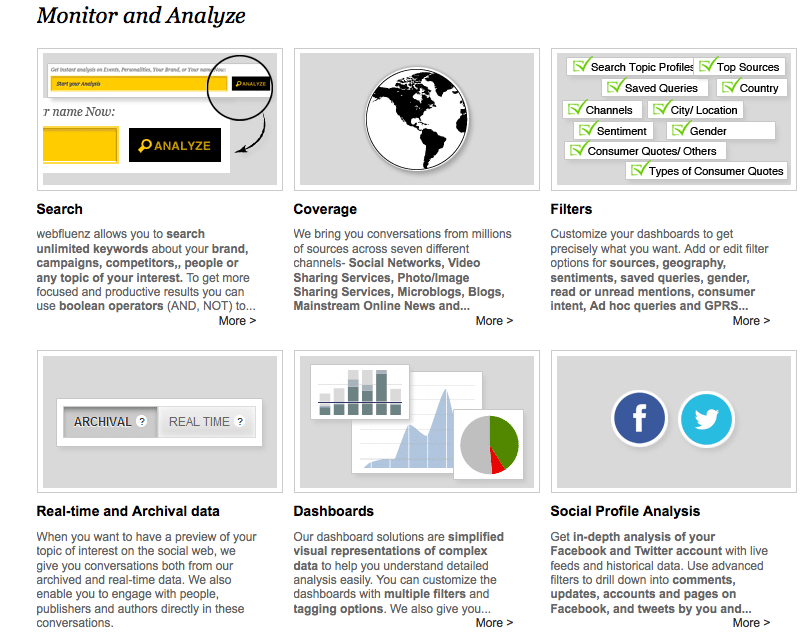
Webfluenz monitor and analyze

Multi-lingual sentiment tagging

Supporting 24 languages of the world’s Internet population, Webfluenz allows you to track around 90% of global languages and allocate sentiment tracking to these conversations. Its proprietary technology breaks common language down into real meaning, as opposed to generic mentions and word definitions.

Qualitative analysis for influencer campaigns

I’m not a fan of judging influence by the amount of amplification an online user can generate. Bots and scripts can inflate numbers. Instead, I’m more impressed by business actions taken based on content shared – sales, leads, downloads, etc. Webfluenz tracks these actions, and the impact on your business, as well as identifies the intent of your target customer (research, compare, buy), enabling a far more effective influencer message can be crafted.

Engagement history

The key to building any kind of business loyalty – online or offline – is the amount you invest in the core relationships that matter. Customer, employee, colleague, stakeholders, etc. Webfluenz tracks all of your enagegements, their levels, frequency, etc., and makes sure you don’t let the most important connections disappear.

Webfluenz Engagement WorkFlow?

Just these three features alone would make an already-attractive price point worthwhile, but the additional features Webfluenz provides takes it up yet another notch.

The Complete Digital Business Suite

One of the biggest complaints around any of the social tools available today is that none of the offer an all-in-one solution.

If you want social monitoring, you need a dedicated monitoring platform. If you want social engagement, you need a good conversation dashboard like a Hootsuite. If you want influence tools, you need ?a Traackr or an InNetwork. If you want a CRM platform, you need a Nimble. And so on.

And this makes sense – it’s rare for any platform to offer an in-depth solution to multiple business needs the way the platforms mentioned above can, in their individual categories.

I’ll give Webfluenz credit here, though – they make a great attempt at answering this criticism.

Competitive analysis

Knowing what works for your competitor, and how they’re driving traffic and sales from their digital efforts, can help you refocus yours and adapt on the fly. Webfluenz shows comparison reports on competitor buzz and growth, while giving you current performance data on your campaigns.

webfluenz - Competitive Benchmarking Analysis? 2013-08-29 15-34-21

Team collaboration and workspaces

Using a simple workflow process, you can assign team roles and duties within the Webfluenz dashboard, as well as follow up on assignments and use this information across internal teams to improve your internal set-ups.

Dashboard reports

If there’s one thing that any business needs, it’s easy-to-understand reports that deliver the kind of data you can act upon. From Deep Dive Reports to Competitive Benchmarking, as well as Comparative Benchmarking and results, Webfluenz has you covered here.

Webfluenz and You

That’s just a sampling of what’s on offer – the full suite of tools, and the ease in which almost any level of user can start diving in, is what helps Webfluenz stand out in an already crowded marketplace.

Add in a detailed user guide, as well as a hands-on support team and account management guide, and you’re going to be pretty hard pushed to find as cohesive a platform at the price Webfluenz is currently being offered for.

If you’re already using a social analysis platform and you’re happy with its performance and features, then you’re probably not going to change anytime soon.?If you’re currently looking for a new suite of tools, though, and you don’t want to break the bank while doing so, I’d definitely recommend checking Webfluenz out.

If they’d create an open API to connect with other tools, it’d be an even better solution that it currently is. The UI could also be a bit slicker when it comes to the engagement dashboard. But?I’ve mostly been impressed so far and, as a demanding grumpy Scotsman, that’s never an easy thing to do.

Nice work, guys.

Edit, August 30: Just heard from Rachana Khanzode, head of social marketing at Webfluenz, and seems the platform does offer an open API, so integration with other platforms should be good to go.

Why We Need More Partnerships Like the @Traackr and @Nimble One

Julia-Hull-on-Nimble-from-Traackr1

The middle of May saw a pretty big announcement in the influence marketing and social business space.

Influence platform Traackr and Social CRM platform Nimble announced a partnership that would see seamless integration of the two solutions, and allow much more effective management of influencer outreach programs.

From Traackr:

As of today, our users can connect their Nimble accounts to their Traackr projects and centrally manage influencer outreach efforts. It?s a huge step forward in closing the loop on influencer marketing.?What makes the Nimble-Traackr duo worth considering is that now you have Traackr?s contextual influencer identification and content tracking coupled with relationship management tools that enable you to create a plan, implement that plan, document the results, and even follow-up periodically with a complete interaction history.

From Nimble:

Up until now, companies that have invested in influencer marketing have faced the challenge of reconciling siloed solutions to manage their marketing programs with discovery, research, engagement and management happening in different places, making it difficult to truly nurture relationships. Using Traackr and Nimble together provide users the ability to perform influencer discovery and tracking, relationship building and nurturing, as well as activating and measuring results.

When I heard about this partnership, I was ecstatic. From a personal point of view, it was validation for the methodologies Sam Fiorella and I talk about in the Influence Marketing book, and what the future of that vertical looks like (integration between complementary platforms).

From a business and marketing point of view, it’s the kind of common sense partnership we see too little off, and yet one that reaps dividends for all involved – the two partners, their clients, and anyone looking to effectively use social media to drive leads, sales, customer service and more.

While this particular partnership is built around influence marketing, it offers a path that other businesses could [should] take when it comes to their own customers and the solutions they offer.

Social Behaviours and Decision Making

For any business, one of the primary goals – if not the main one – is understanding its customers better. These could be existing or potential, as well as stakeholders or employees.

Take it beyond customers, and switch the wording a little, and you get the same thing – donors, political party supporters, activists, etc.

If we, as businesses, can understand what makes our customers tick, and offer them solutions based on their freely submitted data and information, we can identify certain behavioural aspects and provide a message or solution accordingly.

Tie that into their social behaviours online, and then use complementary software that monitors, analyzes, segments and recommends, and we’re moving into an area where we can truly be smarter about how we meet the needs of our customers.

Not only that, but we understand what makes potential clients or strategic partners tick.

Whereas before it could take months or even years to gain enough knowledge to turn a cold call into a warmer introduction, using Traackr’s identifying process along with Nimble’s project management tools gives us data we can really use to break the proverbial ice.

  • New contract details;
  • Personal and professional milestones;
  • RFP timescales;
  • Deciding factors;
  • Competitive influencers;
  • Peer connections.

Information in business is king – analytical information even more so. The Traackr/Nimble partnership brings this information to us in a more cohesive manner than before.

Collaborative Consumption is the Way Forward

Apart from the obvious business solutions the partnership brings, it also enables both companies to fine-tune their own offerings based on how their clients are using the new combination.

For instance, while Traackr has an excellent influence marketing solution, especially when it comes to identifying who influences the influencers, they don’t go quite as deep on the measurement path when keeping track of where someone is in the purchase life cycle.

For a sales team, this information is more key than knowing who the influencers are in a particular vertical – that would fall more to the marketing team to handle.

With Nimble’s integration, a sales VP could allocate team members different leads, at different stages, and base success criteria on how well that sales person moves the potential client into the next stage of the decision-making process.

Each time the lead is moved into a new section – from awareness to research, for example, or research to intent to buy – a new set of influencers could be identified by Traackr. The warmth of that lead would then either increase or decrease based on what needs to happen next.

Alerts are set up to monitor sudden spikes in activity, or mention of certain keywords that would suggest the intention to buy soon.

Now, instead of influence being used for promotion and social share of voice, it’s a true, lead generation tracking tool. All because two companies decided to partner as opposed to leaving clients to figure out how to connect all the dots themselves.

The Possibilities Are Limited Only By You

It’s this kind of forward movement that today’s technologies allow and, for the smarter companies out there, actively encourage.

Developers that build their solutions with Open APIs in mind – the ability for different technologies to connect to each other reasonably easily – are the ones that will be positioned to lead the marketplace.

As the conversation around social media and business matures from “oh, nice to have” into an actual business conversation, partnerships like the Traackr and Nimble one will become ever more prevalent.

It’s about time.

image: Nimble.com

A version of this post originally appeared on DannyBrown.me

Social Media Intelligence, The UK / North America Digital Divide, and Social’s Impact on Influence

Social media measurement

Social media and HR

With a long weekend coming up here in this part of Canada, I’m about to take some downtime with my family and switch off for a few days. So, to end the week, I thought instead of a normal post here, I’d point you in the direction of three recent guest posts / Q&A’s elsewhere around the web.

I was grateful to be asked to contribute to three very different blogs in recent weeks – Canyon Communications, Salesforce and The Social Penguin – and the results can be found below. They cover different yet connected topics, so hopefully you’ll find use in at least one of them!

Cheers, and see you next week!

How Social Media Impacts Influencer Marketing

My guest post for the Salesforce.com blog takes a look at how influence is being skewed by the ever-growing noise and ambiguity of the social web.

By creating systems where noise and amplification is rewarded, and social impressions are currencies versus dollar return, are we creating an ecosystem where brands can no longer pinpoint who can help them reach, and meet the needs of, their target customer base?

Read the full article here.

Social Media Intelligence Isn’t Exclusive to Interaction and Participation

Over at Canyon Communications, the topic of discussion is determining business value and the return on investment for your social media efforts.

Often business are out off from entering the social space because of the “engage or die” mindset that often pervades their participation. This fear of scale, interaction, negative feedback, etc., stops many businesses from enjoying social’s benefits across multiple verticals.

This post shares three ways to overcome that fear and use social media intelligently – Social Research, Social Listening, and Social Influence. But more than just marketing examples, it shares how to optimize data insights, company culture, customer retention, crisis communications and much more.

Read the full article here.

Social Media, Digital, and the UK / North America Digital Divide

The last, but not least, post can be found at UK-based The Social Penguin, and is part one of a two-part Q&A.

While many companies are using social media as an integral part of their bigger business strategy, others are lagging behind or struggling to adapt. This can be for many reasons, all of which may have some validity but more often than not are simply used as a fallback.

In part one of the Q&A, I discuss why conflicting information and the fear of selling is social media’s biggest detractor; an example of a great social media campaign that delivered results; the differences between the UK and North America when it comes to digital and social; and why we need to break the silos of PR, social, SEO and content.

Read the full article here.

And with that, I bid you adios!

Why We Need More Partnerships Like the @Traackr and @Nimble One

The middle of May saw a pretty big announcement in the influence marketing and social business space.

Influence platform Traackr and Social CRM platform Nimble announced a partnership that would see seamless integration of the two solutions, and allow much more effective management of influencer outreach programs.

From Traackr:

As of today, our users can connect their Nimble accounts to their Traackr projects and centrally manage influencer outreach efforts. It?s a huge step forward in closing the loop on influencer marketing.?What makes the Nimble-Traackr duo worth considering is that now you have Traackr?s contextual influencer identification and content tracking coupled with relationship management tools that enable you to create a plan, implement that plan, document the results, and even follow-up periodically with a complete interaction history.

From Nimble:

Up until now, companies that have invested in influencer marketing have faced the challenge of reconciling siloed solutions to manage their marketing programs with discovery, research, engagement and management happening in different places, making it difficult to truly nurture relationships. Using Traackr and Nimble together provide users the ability to perform influencer discovery and tracking, relationship building and nurturing, as well as activating and measuring results.

When I heard about this partnership, I was ecstatic. From a personal point of view, it was validation for the methodologies Sam Fiorella and I talk about in the Influence Marketing book, and what the future of that vertical looks like (integration between complementary platforms).

From a business and marketing point of view, it’s the kind of common sense partnership we see too little off, and yet one that reaps dividends for all involved – the two partners, their clients, and anyone looking to effectively use social media to drive leads, sales, customer service and more.

While this particular partnership is built around influence marketing, it offers a path that other businesses could [should] take when it comes to their own customers and the solutions they offer.

Social Behaviours and Decision Making

For any business, one of the primary goals – if not the main one – is understanding its customers better. These could be existing or potential, as well as stakeholders or employees.

Take it beyond customers, and switch the wording a little, and you get the same thing – donors, political party supporters, activists, etc.

If we, as businesses, can understand what makes our customers tick, and offer them solutions based on their freely submitted data and information, we can identify certain behavioural aspects and provide a message or solution accordingly.

Tie that into their social behaviours online, and then use complementary software that monitors, analyzes, segments and recommends, and we’re moving into an area where we can truly be smarter about how we meet the needs of our customers.

Not only that, but we understand what makes potential clients or strategic partners tick.

Whereas before it could take months or even years to gain enough knowledge to turn a cold call into a warmer introduction, using Traackr’s identifying process along with Nimble’s project management tools gives us data we can really use to break the proverbial ice.

  • New contract details;
  • Personal and professional milestones;
  • RFP timescales;
  • Deciding factors;
  • Competitive influencers;
  • Peer connections.

Information in business is king – analytical information even more so. The Traackr/Nimble partnership brings this information to us in a more cohesive manner than before.

Collaborative Consumption is the Way Forward

Apart from the obvious business solutions the partnership brings, it also enables both companies to fine-tune their own offerings based on how their clients are using the new combination.

For instance, while Traackr has an excellent influence marketing solution, especially when it comes to identifying who influences the influencers, they don’t go quite as deep on the measurement path when keeping track of where someone is in the purchase life cycle.

For a sales team, this information is more key than knowing who the influencers are in a particular vertical – that would fall more to the marketing team to handle.

With Nimble’s integration, a sales VP could allocate team members different leads, at different stages, and base success criteria on how well that sales person moves the potential client into the next stage of the decision-making process.

Each time the lead is moved into a new section – from awareness to research, for example, or research to intent to buy – a new set of influencers could be identified by Traackr. The warmth of that lead would then either increase or decrease based on what needs to happen next.

Alerts are set up to monitor sudden spikes in activity, or mention of certain keywords that would suggest the intention to buy soon.

Now, instead of influence being used for promotion and social share of voice, it’s a true, lead generation tracking tool. All because two companies decided to partner as opposed to leaving clients to figure out how to connect all the dots themselves.

The Possibilities Are Limited Only By You

It’s this kind of forward movement that today’s technologies allow and, for the smarter companies out there, actively encourage.

Developers that build their solutions with Open APIs in mind – the ability for different technologies to connect to each other reasonably easily – are the ones that will be positioned to lead the marketplace.

It’s one of the reasons ArCompany doesn’t tie itself to specific vendors. We may announce strategic partnerships but we’ll still present the most relevant solution(s) based on a client’s specific needs.

At this moment, we’re working with a technology vendor in Toronto to provide the next level of content analysis for both brands and bloggers, and how that solution can tie into other technologies based on verticals and goals.

While we may not be technical engineers, we know what our colleagues in this space are asking for, so it makes sense for us to partner with a vendor that can deliver on these needs, while looking ahead to see how much further we can take the basic premise.

As the conversation around social media and business matures from “oh, nice to have” into an actual business conversation, partnerships like the Traackr and Nimble one will become ever more prevalent.

It’s about time.

image: Nimble.com

Why Influencers Deserve to be Paid

Influencers and paid

Ever since sponsored posts were made popular by the likes of Izea, the question has remained: should influencers be paid for their promotion of your brand?s message, product or service?

On the one hand, you have those that say paying an influencer removes the validity of the review of promotion, since you can?t possibly remain non-biased when there?s been an exchange of money.

On the other hand, you have those that say it?s no different from any other marketing channel, and you pay for that, so why should influencers be any different?

As someone who?s on both sides of the coin ? I?m a marketer who uses influencers for client campaigns, and I?m fortunate enough to work with brands as an influencer for their campaigns ? here?s my take on the topic.

Time is Money

How long do you think the average blog post takes to create? If you, the marketer, don?t blog yourself, how long do you think it takes to put together what you?re reading now?

10 minutes? 30 minutes? An hour? More, less?

The truth is, blog posts take as long as they need to be ready. This might sound clich?d, but it?s true. There?s much more to a blog post than just stringing some words together (or images and sounds, if you?re a video blogger or podcaster).

  • Ideas and research;
  • Content;
  • Format;
  • Links and attribution to relevant topics;
  • Images and media;
  • Proofreading.

That?s just the creation part. Then you have the marketing of a post, along with replying to comments and encouraging further discussion. All told, a blog post can easily take up a few days of your time, if you were to add up all the components.

And that?s just one post, where the blogger knows the topic inside out and can create content on the fly. If there?s a brand message involved, there needs to be further research into the product, testing any giveaways, liaising with the brand, etc.

So that single post has now turned into a mini-campaign. And you want that for free? Um??NO.

Trust Can?t be Bought ? But It Deserves to be Rewarded

When I started my main blog, the one core tenet I made it my mission to adhere to was to never break the trust of whatever community managed to grow around the blog.

That meant all opinions would be treated equally, as long as they were respectful and on topic, and I would never promote or recommend something I hadn?t used myself, or didn?t 100% believe in.

It?s a big reason there have been very few ads on my blog, with the exception of the WordPress theme I use. It?s also why there has been very few sponsored posts on my blog ? perhaps two in five years plus of blogging there.

Simply put, if I?m going to recommend something to my community ? whether as a non-paid fan or a sponsored ?influencer? ? it needs to be right for my audience. There?s no amount of dollar value you can pay to erode the trust that?s built between a blogger and his or her community.

Money comes and goes; trust and a legacy doesn?t.?That can never be bought back.

If you, as a brand manager or agency, want to connect an influencer?s hard-earned community trust to your client, you need to understand what it?s taken to build that trust. It?s the ultimate endorsement, for that influencer to introduce your brand to the community, and not only introduce, but honestly recommend.

You can?t buy that kind of advertising ? but you can reward it.

Relevance Equals More Effective Outreach and ROI

There?s a reason today?s definition of influence ? social scoring platforms like Klout, etc. ? have been very slow at sharing public success stories when it comes to their influencer outreach campaigns.

While generic influence as offered by these platforms can help brands gain share of voice and brand amplification, the fact is the identification process of influencers to use lacks true context and relevance to an audience.

Influence decision process

While a lifestyle blogger with 10,000 subscribers and demographics of 25-44 year old women might be attractive to a brand looking to promote their latest healthcare product, how many of that 10,000 is right for the brand?

Let?s say the product is for women with sensitive skin; that might be one-third of the audience. So what about the other two-thirds? A generic target by score ???this blogger has a score of 72 in women?s products, they?re perfect!??? will immediately reduce your brand?s success rate.

However, get in touch with the blogger that?s 100% right for your brand, and who has a higher engaged audience around that topic, and you?ll immediately see both financial benefits and more positive sentiment around your outreach campaign.

It?s why the InNetwork solution of filtering out the true audience size is so key. Instead of wasting time and resources on partnering with bloggers with 10,000 subscribers but only 1,000 actual interested readers,?you can connect with a blogger with 1,000 subscribers and 900 interested readers.

That?s a big difference in relevance and the ratio for success is much bigger. It?s the smarter way to market, and paying the influencer for connecting you to that more engaged audience means?less risk, more return, and better campaigns.

Influence Marketing is a Key Business Strategy ? Don?t Treat It Like a Cheap Date

At the end of the day, the old adage??you get what you pay for??has never been more true when it comes to influencers and how they can really help turn a promotional campaign into a loyalty-driven customer base.

There?s a reason people are ?influential? in their community: expertise, respect, trust and the ability to make things happen.

You have the choice to pay or not to pay what they?re worth ? in reality, though,?if you?re serious about your campaigns, there?s only one choice to make:?how much is true influence and what it can offer your brand worth to you?

Don?t be cheap with your answer.

This post originally appeared on the InNetwork blog.

image: H.Michael Karshis

  • « Go to Previous Page
  • Page 1
  • Page 2
  • Page 3
  • Page 4
  • Page 5
  • Interim pages omitted …
  • Page 10
  • Go to Next Page »
© 2026 Danny Brown - Made with ♥ on Genesis