• Skip to primary navigation
  • Skip to main content
Danny Brown

Danny Brown

podcaster - author - creator

  • About
  • Podcasts
  • Journal

guest post

7 Ways to Run an Unsuccessful Mobile Email Campaign

Mobile friendly blog

Mobile browsing habits

This is a guest post by Matt Zajechowski.

Mobile gadgets are the preferred media for opening email and responding to mobile marketing. That?s true across demographics, but especially among the youth set known as Millennials and Generation Y.

As revealed in the infographic below from our client?Reachmail, among the general population, 75 percent are using smartphones regularly to manage email. Millennials? use of iPhones, Android phones and iPads to scour daily mail is as high as 80 percent.

Most don?t even re-check mail on desktops and are intolerant of marketers who don?t cater to the small screen revolution.

This means a great deal for businesses who don?t wish to lose the business of new clients or customers.

Specifically it means that advertising will become a game of who can satisfy the most mobile users. The companies with most the mobile-friendly promotions and resources win.

They win not just profit from increased sales and website hits, but they win the trust of the mobile public and perhaps even long-term loyalty from mobile shoppers.

Are You Satisfying Your Mobile Customers?

Basic satisfaction of mobile users involves having email marketing messages that can be scaled down to fit a smartphone screen or a tablet screen without losing its wow factor and effectiveness.

That means the ads are pithy and persuading.

  • They dazzle without relying on too much Flash animation or Javascript that can freeze mobile devices and take an incredibly long time to load.
  • They have images that are optimal for small devices ? between 360 and 480 pixels.
  • They have the good content early in the page or email, along with a call to action that can be read without tedious scrolling.

Often it means having online stores that can be navigated and searched without too much hassle for those using small touchscreens and tiny virtual keyboards.

Satisfying mobile users might mean connecting with mobile shoppers through store apps that take users directly to favorite products or recommendations, and then quickly and efficiently to checkout without wasted clicks.

Closing the Loop Between Mobile and Offline

Increasingly, being mobile-friendly as an email marketer also means merging offline deals with online finesse by using email to preview promotions later reinforced through text messages, geolocation-based shopping deals and scannable QR codes that allow customers to learn about sales, coupons or general brand information without having to type any URLs.

QR codes have been slow to catch on, but nearly 25 percent of people ? mostly in America and Germany — have scanned one while on the go and research from eMarketer suggests the codes will trend upward in the future.

In a survey of 2,000, at least 14 percent of Millennials in the U.S. admitted they scanned a QR code that was included in a marketing email, while 16 percent of those between 25 and 34 said they had done so.

Respondents were most likely to scan codes in magazines or hard copy ads sent by snail mail. However, that was often because those types of media have been more eager to embrace the technology.

In the future, online marketers must be dedicated to using the codes more and ensuring that the codes deliver mobile users to sites that are legible and enjoyable to use on a mobile screen.

Lastly, remember, many mobile users are quick and impatient decision-makers who won?t give an email or website the chance to satisfy them again if they encounter even one instance of a landing page or target page that fails meet mobile standards.

Start now by assessing your company websites, blogs, stores and email campaign designs to make sure they are ready for the continuing expansion of mobile marketing.


ReachMail

Matt ZajechowskiAbout the author: Matt Zajechowski is a marketing specialist at Digital Third Coast Internet Marketing. You can read more from Matt on the Digital Third Coast blog, or connect with him on Twitter @Savard1120.
Turning Fans Into Performers ? Dan Deacon and the Power of Youtility

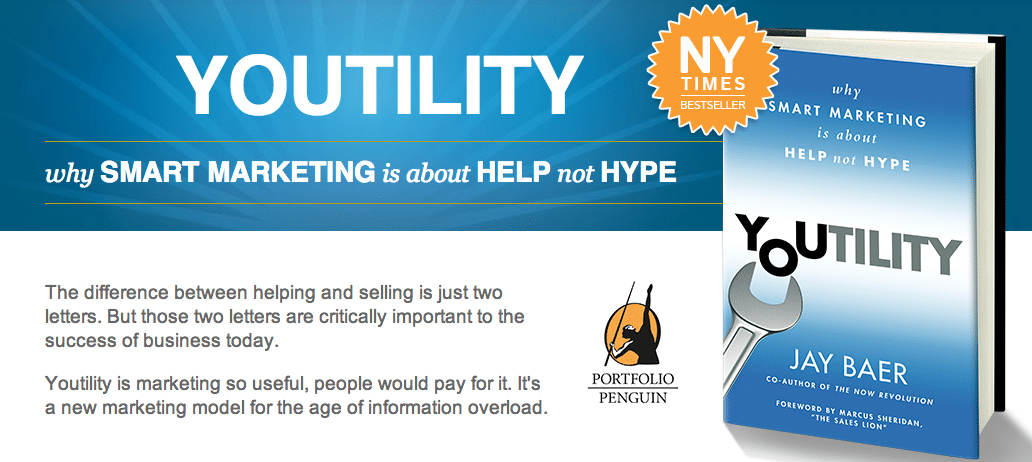
Youtility Why Smart Marketing Is About Help Not Hype

Youtility  Why Smart Marketing Is About Help Not Hype

This is a guest post from Jay Baer.

Today?s consumers are staring at an invitation avalanche, with every company asking for likes, follows, clicks and attention. This is on top of all the legacy advertising that envelops us like a straightjacket.

Lots of books have been written that tell you the way to break through is just to be an ?amazing? company. Pretty much all of them say you can win hearts and minds by doing things differently, providing knock-your-socks-off customer service, or fundamentally changing your corporate culture.

But your company probably isn?t amazing. And becoming amazing is incredibly difficult, and doesn?t produce reliable, linear results. So instead of betting all your money on amazing, what if you just focused on being useful? What if you decided to inform, rather than promote?

If you sell something, you make a customer today; if you help someone, you can create a customer for life.

Marketing Sideways

I call this Youtility. Not utility because a utility is a faceless commodity. Youtility is marketing upside down.

Instead of marketing that?s needed by companies, Youtility is marketing that?s wanted by customers. Youtility is massively useful information, provided for free, that creates long-term trust and kinship between your company and your customers.

Youtility In Your Pocket

But Youtility isn?t all business, and Dan Deacon is proving it every night.

“For the first time, having your phone out at a concert is not a jerk move,” says the description of the official app for Dan Deacon, a Baltimore-based electronic musician known for his engaging live performances. The app turns concert-goers’ phones into a synchronized light show and even an extra instrument that Deacon can “play” from the stage. A short YouTube video demonstrates the app in action.

[youtube]http://youtu.be/R8UlLBuzy6Q[/youtube]

With the app installed and running on a smartphone, Deacon can control the devices en mass by playing audio tones that “instruct” the phones to flash, change color, make sounds and more. It’s quite a spectacle, and a surprise even to fans who have downloaded the app and ostensibly have an idea of what to expect.

“It’s a really cool moment when Dan first plays the tone and then all of the phones change color,” app co-creator Keith Lea says. “Usually people are a little shocked. They’re not really ready for it to work. People are used to their phones being magic, but this registers as a different sort of magic.”

The app has created significant industry chatter for Deacon and Lea, with articles in Rolling Stone, Billboard, SPIN, CMJ and more.

The technology and story behind the genesis of this example of situational Youtility is remarkable.

An Obvious Answer

Says co-creator Lea, “Me and Dan and Alan Reznick, who is also involved with the app, we were all on a bus together. I was running tech and they were both performing on this little tour around the East Coast….I guess Dan had seen the Beijing Olympics Opening Ceremonies and he saw that they handed out LED bracelets and had them sync up. Dan’s idea was why did they bother going through the effort of handing out all of these little LEDs when everybody has, essentially, a little light in their pocket.”

Lea recalls that, as Deacon’s “nerdiest friends,” he and Reznick were asked about the feasibility of using smartphones in this way, which instigated weekly meetings to work on the project, which was more difficult than initially imagined.

“You’d think getting a bunch of pretty sophisticated little mini computers to do something all at once would be easy,? Lea said. ?We first thought the obvious thing was to use WiFi…but we called a couple of networking contractors and just none of them had any ideas because of the need to get 500 to 1,000 people on a wireless network that needs to be torn down and put up every night.”

Simple Solution, Big Outcome

After abandoning WiFi as the syncing technology, the team considered using existing 3G and 4G cellular networks as a connection point but realized that access wasn’t universally strong at all show locations, and music festivals often feature overloaded cellular networks.

Digging deeper, they took an inventory of all the sensor arrays present across all smartphones and realized, “Oh, well every phone obviously has a microphone and a speaker,” remembers Lea, who used the neo-lithic days of dial-up Internet connections as inspiration. “Back in the 90’s we all got on the Internet through a phone connection, and it’s just audio that’s being used to transmit data.”

Deacon and team have no plans to charge for the application, and, while licensing the technology to other artists is certainly a possibility, this is one instance where Youtility isn’t about marketing and brand-building.

“Maybe this is a little trite, but it is pretty cool that a couple artists and a programmer got together, and for a really tiny budget came up with something that is transforming the way people look at their cell phones in this performance context,” Lea says.

Excerpted from the New York Times best sellerYoutility: Why Smart Marketing is About Help not Hype by Jay Baer. See YoutilityBook.com for other resources.

Youtility Excerpt:

Youtility: Why Smart Marketing is About Help not Hype – Exclusive Free Excerpt from Jay Baer

Jay Baer Marketing Keynote SpeakerAbout the author:?Jay Baer is a hype-free social media and content strategist & speaker, and author of the New York Times best selling business book?Youtility: Why Smart Marketing is About Help not Hype. Jay is the founder of http://convinceandconvert.com and host of the Social Pros podcast.

3 Things CEOs Should Never Lose Sight of in Social Media

binocular view

binocular view

This is a guest post from Lisa Petrilli.

I just spent two full days in a phenomenal leadership simulation program entitled, ?Magnetic Leadership? that was conceived, created and offered by Profitability Business Simulations.

I had the privilege of playing the role of the customer throughout the simulation, and then coaching the teams and their leaders after each simulation round was completed.

During each round, one person on each team was appointed ?CEO? and was responsible for determining the overall direction and strategy for their team of eight people.

They had one hour to prepare the team for the 10-minute, high-stress simulation in which they were given a business challenge along with a fickle customer (me) and tasked with meeting the challenge while satisfying the customer.

Three Overarching CEO Success Principles

There were three overarching principles that were critical to the CEOs? success that surfaced during the simulation.

As I was reflecting on how I would talk with my leadership-focused clients about how the experience confirmed the importance of these principles, I realized that it was imperative to talk with my social media clients about the experience as well.

Why?

Because these principles are such that they must be communicated and absorbed throughout the entire organization, so that the company can exude them and live them on a daily basis. As a critical part of marketing, sales, business development and customer relationship building, employees on the front lines of social media must also exude and live these principles through their work.

Vision

As someone committed to ?visionary leadership? I was thrilled to see how the high-ranking leaders I was working with understood the importance of vision to their success, and how they got better over the 2-day experience at clarifying and communicating their vision:

“In an organization, those individuals on the front line of social media must clearly understand the vision for the organization in order to exude that vision when talking, and sharing content with, customers.”

Patagonia

For example, though Patagonia does not have a formal vision statement, it shares its vision when it writes about its ?Reason for Being:?

?Patagonia grew out of a small company that made tools for climbers. Alpinism remains at the heart of a worldwide business that still makes clothes for climbing ? as well as for skiing, snowboarding, surfing, fly fishing, paddling and trail running. These are all silent sports. None requires a motor; none delivers the cheers of a crowd. In each sport, reward comes in the form of hard-won grace and moments of connection between us and nature?

For us at Patagonia, a love of wild and beautiful places demands participation in the fight to save them, and to help reverse the steep decline in the overall environmental health of our planet.?

Patagonia?s vision is to enable its customers to experience that hard-won grace and moments of connection with nature, and to express its love of wild and beautiful places by saving them.

Now see how Patagonia?s social media efforts further their vision to enable customers to experience that hard-won grace and those moments of connection with nature?especially the wild and beautiful places.

From Patagonia’s Facebook Page:

Picture Story: Conditions
Another in our occasional series of posts for the more visually oriented. This one goes out to all those lucky enough to charge off the couch and into the unknown without looking back or thinking twice . . . or doing much thinking at all, for that matter.

And from Twitter:

Twitter Pagatonia

Twitter    Patagonia  Also check out a new video ...It?s clear to me that Patagonia employees immersed in social media understand the company?s vision and how critical it is to share it, and inspire through it, via what they communicate.

Values

It was striking how in such short leadership simulations one?s personal and leadership values became so immediately obvious.

For example, whether or not a leader valued the input of others was demonstrated by how well they listened, because there?s a difference between asking for someone?s opinion ?to appease that person? and asking because you truly want to know. Of course, this is just one of so many ways to demonstrate values.

It?s critical that CEOs not lose sight of the fact that the values that are rewarded in the organization are those that will ultimately be imbued in conversations with, and content shared with, customers socially.

Contrast the fact that I worked with a client who would not allow me to tweet birthday wishes from the organization?s Twitter account to some of our most loyal and active members, with the following, recent tweets from Patagonia:

Twitter    Patagonia  Paul Marsh 1945-2011  Pion ...

Twitter    Patagonia  Bean?s Battle

Which organization would you naturally gravitate toward; the one that allows itself to be human and places value on sharing the human experience or the one that believes doing so just isn?t professional?

Value Proposition

Your company?s value proposition is what sets you apart from your competition; what makes you unique and provides that niche in which you cannot be rivaled.? For Apple and Disney it?s about customer experience while for Walmart it?s low cost and for Nordstrom it?s service.

If Disney social media employees tweeted about low-cost tickets to Disney World or asked Facebook fans to share stories about how to explore the park on a budget, it simply wouldn?t fit with the brand?s value proposition.

Rather, you see tweets about unique customer experiences that cannot be had anywhere but Disney World:

Twitter    Walt Disney World  Party like a princess

Twitter    Walt Disney World  Meet Pirates

And yet, without guidance and clear communication from the CEO, employees immersed in social media might make the mistake of expressing the company in ways that are in direct contrast to its value proposition.

It is the CEO?s responsibility to ensure that all employees understand the vision, values and value proposition (amongst other things!) that the company is committed to, to be their head steward, and to never lose sight of how critical it is to align these principles with their company?s social media efforts.

  • If you?re in the C-suite of your company, ask yourself if you?ve communicated your vision, values and value proposition well enough so that employees in social media roles may do their jobs to the best of their ability and are empowered for success. If not, you run the risk that what they share socially may not be aligned strategically!
  • If you?re in a social media role and you realize you?re not clear on these principles and priorities, make sure you ask and get clear direction!

Your thoughts?

Lisa PetrilliAbout the author:?Lisa Petrilli?is Chief Executive Officer of C-Level Strategies, Inc. and is passionate about visionary leadership. She helps C-suite executives and emerging leaders create strong visions for their companies and for themselves, and then bring these visions to fruition with clear and aligned strategies focused on leadership, marketing, and social media. You can find her on Twitter @LisaPetrilli and running #LeadershipChat every Tuesday night at 8pm ET, and she welcomes your emails at?Lisa@CLevelStrategies.com.

image: Joelk75

Are You Strategic? by Mark W. Schaefer

How are you trying to create competitive advantage for you and your company?

More advertising?

    More time on the social web?

      Work longer hours?

        Cutting costs?

          All of these tactics can provide short-term gains ? but they?re not really strategic. Your competitors are probably trying to do the same thing, aren?t they?? So if they are, how is this going to create ADVANTAGE for YOU?? There is only one way to create competitive advantage in the long-term:

          Listen to your customers more effectively and respond more rapidly than your competitors.

          That?s it.

          I?ve just saved you a ton of money on business books because every successful strategy is based on this idea and every great product innovation has this concept at its foundation. So if times are still tight and you’re looking to make cuts in your business, don?t jeopardize your relationships with your customers.? In fact, this is the time to embrace them more tightly.

          The social web provides a great way to connect more deeply with customers. Mastering that skill really can lead to competitive advantage.? So even when times are tough, keep listening, keep responding, keep innovating!

          About the author: Mark W. Schaefer is the Executive Director of Schaefer Marketing Solutions, and has more than 25 years of global sales and marketing experience as well as advanced degrees in business and applied behavioral sciences. You can follow Mark on Twitter or read his daily blog to learn more.

          Blogger Outreach 2.0

          This is a guest post from Christina Klenotic. Christina is a vice president at Dix & Eaton who specializes in digital communications, media relations and guerrilla marketing. You can visit Christina on Twitter or visit her on her blog, Beyond Social.

          It?s been just over 30 days since Mom Dot launched its PR Blackout Challenge. The controversy was covered by a number of bloggers and mainstream media, including Danny Brown, Dave Fleet, Newsweek and PBS. So what have we learned?

          As a PR professional who routinely works with clients on traditional and blogger relations campaigns, my most important takeaway is that pitching media bloggers and working with indie/mommy bloggers are two very different things. Here are four reasons why:

          Not all bloggers are journalists

          Outreach to indie bloggers who are not tied to a media outlet, like mommy bloggers, should be much different than traditional PR pitching to media bloggers. Think of the word ?pitch? as a swear word. Instead, engage bloggers in conversation to forge a relationship and accept their honest feedback when they give it.

          For moms who write about their experiences as a mom and occasionally pimp out a brand they love, more often than not a giveaway in exchange for an unbiased review is the way to go. The benefit to a company is that an influencer of its target audience will serve as a one-woman focus group about its experience. Blog followers who chime in after a post with their own feedback are a bonus.

          Commercial blogging is here to stay

          The evolving commercial momosphere was a hot topic during July?s BlogHer Business conference. While the controversy over the concept of mommy blogging becoming too commercial is not expected to dissipate anytime soon, there is an audience of bloggers who embrace their mommy blogger label and also welcome working with PR pros.

          Transparency is non-negotiable

          Because mommy blogger endorsements are under the microscope, it?s paramount for both PR professionals and bloggers to disclose expectations and commercial ties up front. Following the FTC?s guidelines for blog product endorsements is the only option that preserves credibility on both sides and is fair to readers.

          Strategic targeting is essential

          More than ever before, PR pros need to be very savvy in helping clients select the right bloggers to approach who can make a positive impact on potential customers. Mommy bloggers are not homogenized. Some write about their experience as a mom related to a niche such as travel, home improvement, work/life balance, etc. It?s a no-brainer that reading and following a blog is the only way to get a sense of whether a blog?s target audience and your client?s are a good fit.

          Thoughts?

          • Page 1
          • Page 2
          • Go to Next Page »
          © 2026 Danny Brown - Made with ♥ on Genesis