• Skip to primary navigation
  • Skip to main content
Danny Brown

Danny Brown

podcaster - author - creator

  • About
  • Podcasts
  • Journal

google

On Loving and Giving Up On Google in Equal Measure

what do you love from Google

what do you love from Google

They say that, to be a great business, you should always leave your customer or user wondering what you’re going to do next.

I’d mostly buy into that, unless what you do next makes you appear to be both a wanky company as well as a cool one. Enter Google and their apparent goal to piss off and enthrall in equal measure.

For a company whose motto is “Don’t be evil”, it makes it doubly frustrating when they go against that and force your hand into doing exactly what they say. Or else.

The frustration is only compounded further, because then they come up with something so cool you love them all over again. Before we look at that, though, let’s start with the bad.

Google+ – You’re Stuck With It, Amigo

Over the weekend, I decided to stop using Google+. I’ve never really been enamoured with the service, truth be told, and I just found it to be another place that sucked my time up.

Not only that, but the amount of fanboy bias on there really got grating?- it became worse than the Sega vs. Nintendo debates back in the 80’s. I almost wanted to ask some users if they wanted tissues and a dark room…

So, having made the decision to not use Google+ anymore, I went to my Android to delete the G+ app, since it’s the second-biggest battery suck on my phone. Except I couldn’t delete it – because Google won’t let you.

Instead, the very best I could do was disable it.

The problem was, it then affected other Google apps on my phone because of Google’s “You WILL be signed up as a G+ user on every Google platform you use, and counted as an active one at that, because we want to pretend we have more numbers than we do.”

The biggest casualty was the Gallery app, which refused to load at all. Enabling the Google+ app allowed Gallery to work again; disabling screwed up Gallery again. Which, considering one of the selling points of Android is easy sharing of your pictures across social networks, seems stupid on so many levels.

Google has already been criticized for its all-or-nothing mindset when it comes to tying you?into their network of apps, with the only way to escape being the deletion of your complete Google account. Easier said than done, which Google knows and is playing to.

So, even though I pay for my phone and pay for its services, I can’t choose which apps I want to run (or not), because some of my other apps will be messed up if I dare turn off those from Google.

Thanks guys, awesome way to treat your customers.

Who Do You Love? Google, Sometimes

The ironic part of the negative experience highlighted above is that, often, Google gets it right in so many ways when it comes to the user experience.

A prime example is the What Do You Love??project.

Conceived by the creative minds over at Big Spaceship, What Do You Love? is a very cool content identification and curation experience, based on topics or keywords chosen by you.

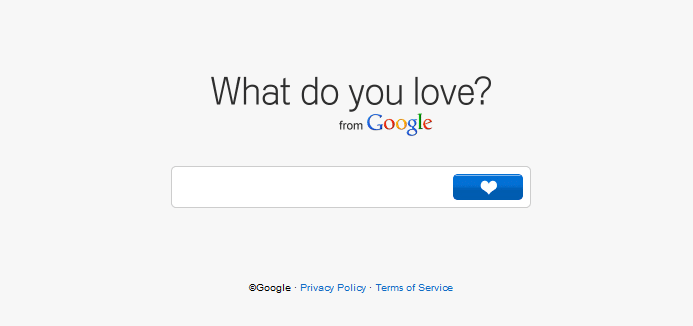
Just like the main search page for Google, What Do You Love? is clean and simple, and looks very similar to the search landing page itself with some text and a big search bar.

The fun happens when you type in the keyword, brand or person you’re looking for.

wdyl baked beans

Instead of the normal search results, you get tabbed results for pretty much everything under the sun on baked beans:

  • Pictures
  • Alerts
  • Patents
  • 3D exploration
  • Popularity of baked beans on the web
  • Videos
  • Books
  • Translations
  • Google Maps of nearby baked beans (seriously!)
  • and much, much more.

It’s quite possibly one of the coolest concepts I’ve seen, and makes search incredibly fun. What it also does, though, is allow you to set up a?research station and immediately get an overview of something you’re interested in.

While the What Do You Love? project is primarily a fun and cool way to bring a bunch of results together under one roof, the potential is much more.

Imagine using?it to monitor trends, see visual representations of your brand or business, or simply?understand how something works by seeing it in 3D. You can then take that information and plan a strategy around the results, or even just create magic of your own based on?the wealth of information available to you.

The story behind What Do You Love? is pretty cool too.

Developed outside Google (though fully endorsed by Larry Page and Eric Schmidt), Big Spaceship was allowed to rip apart the Google Apps API to come up with the WDYL? concept and execution, without any inside interference from the Big G.

The Less You Control, The More We Respond

This is where Google frustrates so much. On the one hand, they’re trying to make you a prisoner of their network by baking their products into each other so much, one won’t work without the other.

On the other hand, you have something so amazingly cool like What Do You Love? that gives you everything you need from Google’s toolset, but doesn’t force you to use them if you don’t?want to. And yet, by allowing this open path, you actually use something like WDYL? more than any other search option.

Notice the irony, Google?

I shouldn’t have to have Google+ active if I want to use my Android phone. I shouldn’t have to be an active user of Google+ if I just want to use Gmail, or share a video on YouTube.

Big Spaceship show you why the less control you place, the more a user will respond. The more response, the more use of a product – seems simple enough.

Would it really hurt to have this approach across your other platforms?

Google+ Is the Social Network That?s All About Search

Google Plus

Google Plus

This is a guest post by Sean McGinnis.

Did you hear that Google launched a social network called Google+? Of course you did!

In the past, Google took a stab at social by purchasing Orkut. Later, they launched both Google Buzz and Google Wave with little success. Now comes Google+.

Kinda seems like Google is the Elizabeth Taylor of the social world, doesn?t it? They?re going to keep trying until they get it right. Given those four trips down the social aisle, and the fact that employee bonuses are tied to getting social right this year, it?s pretty clear Google is borderline obsessed about social.

I wonder why that is?

So have a lot of other people.

In fact, there?s been a lot of handwringing and hypothesizing about why Google launched Google+. Some believe it is designed to kill Facebook; others that it will kill Twitter; still others view it as a play to move everything into the cloud and take on Microsoft and Apple.

I?m not convinced.

I think Google+ is a forward thinking play to keep search market share. Coincidentally, it also opens up billions and billions of new real estate to sell Google ads against, but that?s secondary (believe it or not).

Google Makes Money By Selling Ads

You see, Google has one objective; to sell advertising. Google brought in over 28 billion dollars in ad revenue in 2010 ? 96% of total revenue for the year; and that number is already growing roughly 30% this year.

One of the things we all know is that you make more money when more people see your ads, whether that?s a TV show or a Google paid click within a search result.

Google AdWords

Google?s goal of selling ads is directly served by making services that are as valuable as possible. But, what?s valuable in the context of search?

Think about search for a minute. You ask a question?you expect an answer; a correct answer. That is why you go to a search engine, isn?t it? I know that?s why I go to a search engine. I?m looking for something and I need to find it. So, the more accurate the search results, the more people will want to use a given search engine.

The question is how does one go about creating a better search engine?

One Question. One Answer.

Think about it for a minute. If Google were God (not to stretch credulity too far or anything), you?d ask one question and get one perfect answer. They wouldn?t need to serve you 10 or more possible answers to your question. They would know exactly what you were looking for, even if you were unclear in how you presented your question.

I mean, God would know your intent, right? God would know exactly what you were looking for. I?m really not trying to compare Google to the Omnipotent One, but I am suggesting that in a perfect world they (along with every other search engine) would like to be able to divine what you were looking for and present it to you as fast as possible, maybe even before you asked for it.

(But maybe make you click through an ad in order to get the answer).?

Even more importantly, they would know that what I was looking for may not be what you were looking for.

Enter Personalized Search

The quest for search perfection began long ago. Google made great strides in this direction by including the concept of authority into their algorithm. By indexing the link structure of the web and calculating the value of the structure, Google (unlike many other early search engines) was able to eliminate a lot of spam from their search results.

But it wasn?t enough.

Website owners became wise to the value of links to influence search results and backroom deals, link purchases and other unsavory activities began unduly influencing search results. So, in 2005, Google released a feature called Personalized Search.

Personalized Search

It was a new and shiny object at the time. It represents (to me) the first push down the slide we are accelerating down today. Google started to present back to you (provided you were signed into your Google account when you ran a search) results that were marginally different from other users. They started to personalize those result to you.

Think about that for a minute. What better way to ensure a search engine could answer your question?

In 2009 Google extended Personalized Search to all users, whether logged into their Google account or not.

Over the past 6 years personalized search has improved some of the search experience, but only on the margins. There?s a number of reasons why Google and Bing chose to move slowly in the area of personalization, but that?s fodder for a different post.

A New Dawn for Personalized Search

Here?s the thing about personalized search. The more Google knows about all of us, the more they know about our like, dislikes, profession, connections, friends, enemies, content types, areas of influence, etc? the more they can customize the search experience.

In addition to Google+ giving all that information and more to Google, the introduction and proliferation of the +1 button allows Google to gather signals across the web of what you like and don?t like.

When we use Google+, we are creating data, all of which is within the Google network. No longer is Google relying on facebook or twitter data to learn more about you. That?s why it is so critical that Google get social right. Because social is where the data action is. It?s where we freely give up information about ourselves; where we create the connection nodes that Google can learn from and serve up a better search experience.

So while Google+ may represent a number of things tactically, the business strategy behind it is, in my view, directly correlated to their core business ? search.

More eyeballs means more ad revenue, and the best way to secure eyeballs is to have a near flawless search experience; intuitive, fast and predictive. The only way that happens is when a search engine LEARNS your tendencies ? and social is the best way to glean those tendencies.

That and it creates a few billion extra pages to sell ads against.

What do you think?

Sean McGinnisAbout the Author:?Sean McGinnis consults with businesses on digital customer acquisition and loyalty programs at?312 Digital.?Sean spent much of the last decade leveraging his law degree and 12 years of digital marketing experience by assisting law firms across the country create compelling online marketing programs. He is also co-founder of the group blog?12 Most. Sean currently serves as Managing Director and CMO?of?Multistate Edge, an online bar exam preparation company. You can find Sean on Twitter at @SeanMcGinnis.

Advisory: Google Begins Booting Brands

Google Plus

Google Plus

by Danny Brown and Geoff Livingston

Much has been said about marketing on Google+. Both of us have been intentionally conservative about marketing on the new network due to a statement from Google+ specifically asking business and brands to wait until it formalized its business offering. This offering is rumored to include an open API for applications and data usage. Yesterday, a confirmed report from KCET-TV in LA surfaced that Google+ community managers are enforcing the brand “no fly zone.”

To date, ABC News Radio, LAUNCH and Boing Boing have all been removed, or have voluntarily taken down their Google+ profiles. In the face of complaints about brands being unceremoniously dispatched, community managers have indicated that Google+ will focus on optimizing community interaction between people first.

Google Plus business info

Both Bonsai Interactive and Zoetica represent real brands, corporate and nonprofit. We are posting this advisory to provide clear guidance for our clients and network on how to approach Google+ during this interim phase:

1) Do not invest in formal brand marketing on Google+. As we have seen, Google+ is now policing its network and you risk losing your entire time investment. Further, until the business offering is created by Google, no one really knows how corporations and nonprofits can successfully navigate this new social network. In essence, until Google+ for business is released efforts are likely to be all for naught

2) Do experiment on Google+ and learn how the network works using your personal profile. It’s too soon to formally say that Google+ will be a significant consumer network, but with reports of 18 million followers and growing, momentum indicates the network is succeeding. Further, as demonstrated by its policing of the network, Google is clearly focused on community first. Becoming knowledgable through participation on Google+ is prudent at this point.

3) Be wary of marketing services firms and individuals who are seeking paid fees for Google+ marketing insights. Again, per the first point, no one really knows how to market on Google+. Investing financially in Google+ is not a good use of resources until finite offerings are available. Ethically speaking we would not charge our clients for advice and strategies in the face of such uncertainty.

Google+ is starting field trials with brands in the immediate future. As Google works through the kinks and formalizes its offering, it is a great time to become comfortable with the social network.

Many of our fellow bloggers are openly sharing their insights and learning together in a fashion we have not seen in years. Enjoy this time, friends. This kind of new social network launch is unprecedented.

Update 21 July 2011 11.41am: NBC News is the latest to remove their Google+ profile.

image: Sean MacEntee
image: KCET-TV?

Don’t Do a Google

If actions speak louder than words, and a picture paints a thousand words, take a look at this image and ask yourself what message it portrays.

If you’re a business owner, would you bring out a new product that could change the way your customers use your service (and that of your competitors) forever, yet not allow them to use it via your service?

That’s like? a restaurant that employs the best chef then delivers the food to the restaurant across the street. Or Ford coming up with an amazing safety feature and then making it work in every vehicle except Ford cars and trucks. It’s using your smarts and then opening up the brains to everyone but your team.

You’re not doing a Google, are you?

Would You Trust Google With Twitter?

This Goes Out To. . .From Techcrunch to the Washington Post and beyond, the rumours/semi-rumours of Google buying micro-blogging site Twitter continue.

There’s enough already being written on the subject, so I’ll keep this brief.

Two words – Gmail and Feedburner. One is Google’s email program and the other’s a blog analytical? tool for stats, readers, clickthroughs, etc. But here’s the thing.

According to my Gmail account, it’s still in beta. Despite officially celebrating it’s 5-year anniversary on April 1. Then there’s Feedburner, which was the best friend of bloggers everywhere – until Google took it over. Now it’s the devil in disguise, with constant feed failures and fluctuating statistics.

So, an email system 5 years in beta and the destruction of many bloggers’ favourite tool.

Would you trust Google with Twitter?

Creative Commons License photo credit: Cayusa

  • « Go to Previous Page
  • Page 1
  • Page 2
  • Page 3
  • Go to Next Page »
© 2026 Danny Brown - Made with ♥ on Genesis