• Skip to primary navigation
  • Skip to main content
Danny Brown

Danny Brown

podcaster - author - creator

  • About
  • Podcasts
  • Journal

google

Oh Noes, Google+ is Removing Its Share Counts – Who Cares?

/endsarcasm

I could just leave this post here, and it’d be enough for my take on the news that Google+ (yeah, remember that?) is removing share counts from its sharing button.

Much like Twitter did a couple of years back, Google’s platform will no longer show how many times your post or article has been shared on its network.

And, as expected, content creators are making all sorts of noise about this loss. Which is understandable, given they make money from a social sharing plugin, amongst other things.

But, in the grand scheme of things, does this really matter?

Social Proof, or Social Proof is in the Pudding?

At the start of last year, I removed social sharing buttons from my blog altogether after a couple of experiments around their value, both perceived and real.

My take was (and remains) they’re simply an interruptive part of the content consumption for both reader and post author.

The experiment (for my blog, at least) bore that belief out, with more shares happening as a result of there being no share buttons – go figure!

Now, the argument from many social sharing button fans is that it makes it easier to get shares, thereby increasing your share count, thereby making your posts seem more popular.

This is called “social proof” – by having large numbers of shares, visitors to your site will believe you’re more influential than other bloggers, and will therefore share your content versus similar content elsewhere.

[clickToTweet tweet=”Oh noes, Google+ is removing counts from its sharing button. It’s a disaster! /endsarcasm” quote=”Social proof via social sharing numbers – valid authority metric, or fuzzy fluff?”]

And, to a degree, that can be true. But is that adding to your goals?

  • Does a thousand shares of your latest post mean you have a thousand new subscribers, or a thousand new customers for your online store?
  • Are the shares going out to the right audience when being shared?
  • Are the shares delivering on the message when a visitor comes to your site from it?

These are just three simple examples, but let’s break then down a little further.

Shares versus results

So let’s say your post gets a thousand shares across various networks. How does that impact your content goals? Are you just raising awareness, or is there a strategy behind the shares?

Numbers of shares are all good, but if all that’s happening is your post getting more numbers on your sharing buttons, are these numbers actually providing any value?

Especially when social media users are more likely to share a link than click on it.

Is it the right audience?

So your reader/visitor shared on Twitter, or Facebook, or Google+. Great – more eyeballs for your content, right? Or is it?

Who are the followers of your sharer? Because that’s what really matters – not the amount of shares, but the relevance of that share to new eyeballs.

Although not 100% definitive, this graphic shows how little online content can mean in the grand scheme of things when it comes to what’s shared on social media (using the U.S. as an example).

This ties back to relevance to the visitor – if your sharer is primarily followed by non-buyers of your product, or non-readers of your topics, I don’t care how many times that post is shared, it’s probably not going to mean much in the grand scheme of things.

Does your site deliver?

Most social media sharing is done via mobile now, given the mobile-first nature of the various networks, and their individual apps.

So let’s say a share goes out via a desktop visitor, and is clicked on by a mobile reader – except your site still isn’t set up for mobile visitors (yes, this still happens in 2017!).

Your visitor is going to bounce from the site pretty much immediately, and you’ve lost a potential prospect – but, hey, that sharing count looks great, right?

The Argument Against Share Counts

As I mentioned at the start of this post, there are a lot of people who put social share counts into a bracket of value.

And, for some, maybe that number beside the sharing button validates their content, and they offer examples of why it’s important – and that’s fine.

But, for me at least, the arguments don’t completely hold up.

Social share counts attract advertisers

Maybe they do – initially. But if your analytics don’t back up the numbers, you can bet the advertiser(s) will look elsewhere.

After all, what do you think is more attractive to an advertiser looking for a blog partner – 1,000 shares with 12 visits, or 1,000 visits with no share numbers in site?

Fewer shares can lead to less interaction

Again, maybe, maybe not. As my own experiment showed, having no sharing buttons didn’t negatively impact my blog or the goals I have for it, including interaction.

Besides, what type of interaction are you looking for?

  • Visits?
  • Comments?
  • Subscribers?
  • Downloads?
  • Bookmarking?

There are many forms of interaction, and you don’t need share counts to encourage that.

Share Counts versus Content Goals

Look, I get it – social sharing is a success metric for some, and that’s all good. If that’s part of your content goals, knock yourself out.

But by focusing on the share numbers versus what’s happening behind these numbers (many of which can be inflated any way), you get sucked into creating content to attract shares, as opposed to content to meet goals.

And that type of content will never attract the kind of quality visitors you want, regardless of how many times it’s shared.

So, stop worrying about share counts. Start concentrating on what really matters, then work out how to get there.

Everything else is just a distraction.

Why Google is Missing the Point on Sponsored Content

Over at the InNetwork blog this week, I wrote about why influencers deserve to be paid. It essentially looked at why brands should be treating influencers more professionally, and respecting them as a key partner in any marketing mix.

In the comment section after the post, Kari Rippetoe, Content Marketing Manager at Search Mojo, left an interesting statement:

Interesting post – you pulled me in with that title, because I wasn’t quite sure I agreed. I totally get where you’re coming from regarding the time an influencer not only spends in writing a post, but also in cultivating and managing their influence and community. But, from an SEO standpoint (and I work for a search marketing firm, so we’re very sensitive to this), paid posts (if you’re indeed compensating the influencer with money) can be detrimental to SEO. Google doesn’t like paid links, and while its algorithm can’t necessarily detect all paid links, I’m not sure if it’s worth the risk. That’s why we don’t pursue requests from bloggers to write posts for payment – because that’s a risk we can’t take on behalf of our SEO clients.

Kari’s point about paid links, and Google’s view on them, is a pertinent one, since – while there are other search engines around – Google is the search algorithm that most people take notice of and adhere to, rightly or wrongly.

The thing is, for me, Google’s wrong regarding their stance on sponsored content.

Sponsored Content – The Google Take

To get a better idea of what Google’s take is, here’s what’s being said around the web with regards what Google does and doesn’t “allow” when it comes to sponsored [paid] content:

Google made it clear that they do not want sponsored content indexed in Google News, and sites that mix in promotional articles with their regular news content could be excluded from Google News entirely.

To clarify, the second warning refers to advertorials or articles created entirely by or for a sponsor, along the lines of what?BuzzFeed does… Adam Sherk.

So, essentially, Google is trying to avoid clearly advertorial content that offers nothing but promoting a brand’s message or paid media. Fair enough – there’s enough crap online that’s been paid for and bypasses the good content, which gets lost in amongst the paid stuff.

Where it gets a but muddied, though, is in what Google deems acceptable, as highlighted by the opening sentence in the paragraph that follows Adam’s quote above:

It does not apply to instances in which regular editorial content is given a sponsor treatment.

So, for example, a blogger could write a piece about hair gel and have Garnier Fructus sponsor the post. This means the blogger writes and Garnier might offer free samples. The blogger’s words, the brand’s product.

See a flaw there? Yep, it can still be viewed as paid content by the blogger’s readers. Why would Garnier sponsor without something being in it for them? Did the blogger remain unbiased, or were they tempted by bigger partnerships if they slipped in a couple of favourable mentions of Garnier throughout the post?

While there may not have been physical dollars exchanged, the question is still there – “can this opinion be trusted?”

Once that happens, it counters the very reason Google wants to clamp down on sponsored content: false advertising, inferior products, etc., and how they’re displacing quality-led, honest content.

Sponsored Content – The Irony Factor

Which brings us to the point that Kari made in her comment over at the InNetwork post, about Google not liking paid links and how that can impact a brand that uses this marketing method.

As I mentioned earlier, I can understand why Google wants to keep their results quality-driven. It helps the consumer, who uses Google more, who can charge more for ads, and… oh, right. Ads. Otherwise known as paid content.

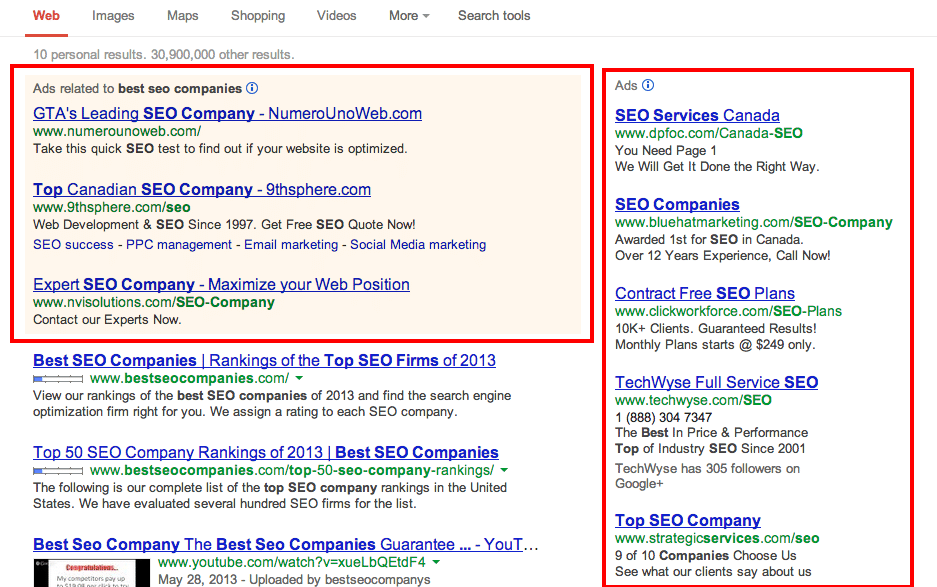
Look at the image below, based around a search for “best SEO companies”.

best seo companies Google Search

There are 11 results visible in the screen shot – essentially, above the fold results (or what people see without needing to scroll down on their screens).

Of these 11 results, only three are organic, and clearly show a solid understanding of SEO by the company involved, which holds the #1 and #2 spot, with #3 being a YouTube video.

Every other result is an ad. Or, for want of a better description, Google accepting paid content to promote a business over another one. Sound familiar?

So it would appear that sponsored/paid content is fine if it’s ads with Google but not if it’s ads appearing within?Google.

This is kind of messed up. Especially since, as I talked about in the post over at InNetwork, trust is the ultimate currency of a blogger, and isn’t something that can be bought at any price.

Sponsored Content – The Trust Factor

Are there bloggers that don’t give a crap and will write any old thing for a brand in exchange for regular sponsored content campaigns? Unfortunately, yes, and these are the ones that Google should quite rightly hammer.

But I’ve tended to find that they’re mostly in the minority.

Instead, what you have are bloggers looking to make a living doing the thing they love – sharing content, making recommendations, helping their community find a solution to help with a certain need.

That love, and that desire to help, allows the blogger to build a loyal and trusted audience – one that they would never deceive or whose trust they’d break, for the sake of a positive review when in fact a product or service was crap.

On the flip side, good brands know that the best way to meet customer needs is to listen to them. Because of the inherent mistrust of brands by consumers, often the only way this listening can happen is by sponsoring a post, allowing a blogger to write about you, offer some trial product, and then monitor the feedback over the coming weeks.

This understanding on both sides sees the blogger write an unbiased view, with the brand allowing that to happen in order to truly understand their target customer’s mindset.

As you can see, it’s a win-win for all involved. Except it’s not – because Google doesn’t really want this type of exchange to happen.

Instead of getting honest and quality content throughout their engine, Google would rather allow other types of paid content – ads – that have no indication of the quality of the company behind them.

At best, this seems a completely flawed approach. At worst, it could ironically enhance the current issue.?After all, if solid content via honest sponsorship and disclosure is being punished and grouped in with the crappy stuff, why even bother…

Thoughts?

Can We Still Trust Google?

what does google want to be

what does google want to be

It’s a question many are asking – can we still trust Google? (In fairness, it’s a question you could ask of any social company).

I’ve written about my falling out of “like” with Google on here a few times recently, and they still continue to piss me off. For example, I completely deleted my Google+ account but folks on there are still allowed to send me updates via email because Google thinks that’s okay.

Or, I tried to access my Google Analytics from my simple Account tab in Gmail, and Google wouldn’t let me progress any further until I “upgraded” to Google+. Yeah, right – piss off, Google, and take your spammy account growth ways with you.

However, I recognize that I’m biased, so I thought this infographic from BackgroundCheck.org was fairly interesting. It gives a nice cross-reference of Google’s history, missteps, and how the general public views online search, privacy and tracking.

For example:

  • I didn’t know that Google had been listed as “Hostile to Privacy” in 2007 by Privacy International, which is the lowest rating you can get.
  • 65% of web users don’t want their search personalized based on prior search history.
  • 73% of web users don’t want their results tracked.

It’s pretty telling stuff, and perhaps another reason why Google is getting so heavy-handed in its Google+ sign-up charge (they’re still quoting incorrect numbers due to the enforced Google+ sign-ups via using new Google products).

I don’t know – I never thought I’d see the day when I preferred Zuckerberg’s machine over anything else when it comes to privacy and operations. But Google’s making that easier every single day.

Ah well… onto the infographic (click to enlarge).

Mother, Can I Trust Google?

Sergey Brin Paints His Kettle Pot Black Over Facebook and Apple

Google versus Facebook versus Apple

Google versus Facebook versus Apple

Over at UK newspaper The Guardian, Google co-founder Sergey Brin shares his views on the future of the Internet, including web freedom and the restrictive practices of Facebook and Apple.

Brin makes some great points, particularly about the ongoing battles certain web users of the world have due to the firewall nature of their governments.

But on other issues, he clearly drank some alternative reality juice, since he conveniently ignores the fact that Google are just as bad (if not more so) than the two companies he’s taking issue with.

Google’s Short-Term Memory

From the Brin interview:

You have to play by their rules, which are really restrictive. The kind of environment that we developed Google in, the reason that we were able to develop a search engine, is the web was so open. Once you get too many rules, that will stifle innovation.

It’s a point that most web users would agree with – yet it’s a point that Google seem to be doing themselves with their new approaches to how Google products interact with each other, and what you can and can’t do within Google.

Look at Google Plus Your World , for example, that gives more credence to search results with your Google Plus account, versus other social networks or websites.

Or the fact that Google had to “punish itself” when it was revealed there were a bunch of sponsored posts written about Google Chrome, violating Google’s own policy of search result bias (at least that’s Google’s story).

Kinda seems like Google themselves are a little guilty of stifling innovation and closing down the web, when their own platforms are given such prominence by Google.

Adding to that is something Brin says further in the interview, when criticizing Facebook for making it difficult to switch data to other platforms:

Facebook has been sucking down Gmail contacts for many years.

Perhaps – although Facebook (currently) is a private company and, as such, doesn’t need to share squat.

Then again, maybe the real reason Brin is upset is because every new Gmail user is automatically logged as a new active Google Plus user whether they use the platform or not. Google is still seeing their social network struggling to find ground, so any extra numbers (real or otherwise) would ease investor burdens.

Pick The Right Fights

Brin also complains about the garden wall approach of Facebook and Apple and how this inhibits search pulling details about iTunes apps and Facebook statuses, etc.

This in turn leaves less information for Google to share with advertisers.

But is this really surprising, when Google themselves have been found to give preference to their own results and networks? Why should anyone else – especially a competitor – give over information that helps line the pockets of a competing company that gives bias to their own ads and services?

There’s no doubt Google is smarting, especially given the fact that Facebook continues to beat them hands down in pretty much every department, and Apple still has the upper hand in the smartphone and tablet market?when it comes to hard profits.

But I can’t help but feel Brin is picking the wrong battle here.

Instead, why not counter with the consumer victories the Google brand has? Or how YouTube aims to be the go-to network for rich multi-social media and ad revenue for channel partners?

There are many ways to counter your competition – unfortunately, examples of where you’re just as bad isn’t a great strategy…

Jack of All Trades, Master of… The Problem with Google

what does google want to be

what does google want to be

So, it looks like Google is entering the comment system fray.

Never mind that it smacks of yet another “let’s copy Facebook” move. Nor that there are already excellent comment systems out there at the minute – the awesome Livefyre (used on this very blog), Disqus and IntenseDebate to name just some of the third-party options.

Google’s clearly taken a look at how Facebook Comments tie the user into Zuckerberg’s network, and wants a piece of that pie to go along with their recent abandonment of their “don’t be evil” mantra.

While it’ll no doubt attract its fans and users – especially the Google+ aficionados – I can’t help but feel the announcement is just another indication of why Google is struggling when it comes to social.

We Think We Want To Be…

One of the problems Google faces is it doesn’t seem to know what it wants to be. It was a lot easier in its early days, when search was the be all and end all of the Google equation.

But search only gets you so far (in Google’s case, being #1 means you kind of have nowhere else to go). Cue growth time.

Google Ads; PageRank; Google Earth; Blogger; YouTube; Feedburner; Google Voice; Gmail; Google Labs and more. From the small beginning of a search idea between two friends, Google became a fully-fledged multimedia company.

And it seems to be confusing them.

While Google was busy adding cool stuff to its repertoire, it wasn’t really making that cool stuff particularly sticky with the general public. Yes, they own the search space – but think of their real success stories, and they’re mostly external projects.

YouTube, they bought. Android, they bought. Google Earth, they bought. Google Voice, they bought. In fact, when you really think about it, the biggest success story for Google internally is its very first product.

And maybe that grinds them, when they see what Facebook has achieved since its inception back in the middle of the last decade.

  • It got the everyday user buy-in that most Google products haven’t (yet).
  • It made the web fun.
  • It appealed to all ages.
  • It attracted brands as well as consumers.
  • It’s continued to innovate internally.

Yet, perhaps more importantly, Facebook has managed to do all this without really needing the search strength of Google to achieve its popularity and success (just ask yourself how many other businesses don’t care about where they rank on Google’s algorithm).

Google PlusTo combat this, Google launched Google+, their own social network and the one that Google is pinning a lot of its hopes on in its battle with Facebook, especially after the abysmal failures of Buzz and Wave.

Early indications are good – 100 million users and reports of the network’s importance to search.

Although numbers aren’t everything – Google forces you to create a Google+ profile?whenever you open a new Google product account, so that immediately adds to installed user base.

And when questioned recently at South by Southwest, the Google representative admitted that they class “active use” of Google+ something as miniscule as clicking the little alert button in your Gmail account, without even going through to the main Google+ site.

So take the numbers with a huge pinch of salt.

And now there’s the news of the Google comments system. Talk about throwing everything but the kitchen sink at the wall…

Too Many Google Pies

As I mentioned earlier, it’s easy to see why Google is going this route. With their recent “One Privacy” announcement, Google are looking to bake all their products into a more cohesive offering.

By doing this, they’ll (hopefully) make it such an integrated experience that you won’t need – or want – to use any other provider. From email to videos, business applications to smartphones, search, social networking and e-commerce, Google wants to be be the kingpin.

The problem is, they’re not doing a very good job of it so far.

If they really wanted to integrate, they’d already be making Google+ the centrepiece for their users, and a simple one at that. Unfortunately, that’s not coming across (currently) in the user experience.

Let’s say I wanted to create a promo video with customer testimonials, for example.

I should be able to grab images from my storefront on Google+ (the one they don’t really provide), collate them into a slideshow, add a voiceover, create a Hangout with some of my best customers, get testimonials, edit into the video, polish and then publish direct to YouTube.

Then I should be able to work in Google Docs to create a promo kit, call up my Circles of journalist friends, and send an invitation to the media kit as well as embedded video for them to watch. Voila, an instant interactive release.

Could this be on the way? Maybe – but if Google really wants Google+ to be truly adopted, they need to be doing this now. Instead, they’re just adding more things and, by doing so, adding to the problem.

Take the Google comments system. Let’s say that’s adopted as Google’s standard system – what happens to all the comments left on a Blogger blog post? Or a YouTube video? How do these get integrated – do they, or are they just cast aside, which seems to be Google’s usual way (just look at Picnik).

And the problem when you can’t merge old platforms or designs with new ones doesn’t always go over well (just ask YouTue users who got pissed at that channel’s makeover, and how it messed up their feeds).

One World or One Success at a Time?

There’s no doubt Google has the resources to take on Facebook and other platforms and businesses they want to compete with. Their Android platform is going head-to-head with the Apple machine and doing very well for itself.

But social seems to escape them, for some reason. Do we really need another comments system, even one that’s baked into Google’s core products? Will that be enough to see Facebook users – or at least the ones used to using their comments system – add Google+ to their repertoire?

Despite their early success, the jury’s still out on Google+ in general, and what Google actually wants to be as a company.

The latest comment news doesn’t really answer any questions; instead, it just poses more. And no matter what company you are, get too many users asking too many questions about who you really are, and that’s never a good thing…

Your thoughts? Is Google over-extending itself, or simply laying the bricks for an unassailable foundation?

  • Page 1
  • Page 2
  • Page 3
  • Go to Next Page »
© 2026 Danny Brown - Made with ♥ on Genesis