• Skip to primary navigation
  • Skip to main content
Danny Brown

Danny Brown

podcaster - author - creator

  • About
  • Podcasts
  • Journal

future of content

The Future of Content Part 4: The Return to Pure Blogging

Blogging success

As content continues to become an ever-important staple for businesses of all shapes and sizes, I thought it?d be interesting to share some thoughts on what the future of content might look like.

However, instead of sharing just my own thoughts, I wanted to bring you what the future of content looks like for some of the folks I look up to and respect in this space.

This mini-series will bring you some of the web?s most critical thinkers when it comes to content ? hopefully you?ll enjoy reading as much as I did, and these thoughts will spark ideas of your own on what the future of this thing we call content looks like.

Today?s topic is the question of “Pure Blogging”.

I’m seeing more and more content creators push back on the Buzzfeed Economy and actually want to create, and partake in, meaningful content and discussions. Focusing on content, not shares; interactions, not reactions; making people think, not thinking for them.

In essence, returning to pure blogging when it comes to their content.

[clickToTweet tweet=”Pure blogging is the focus on content, not shares; interactions, not reactions. #blogging” quote=”Pure blogging is the focus on content, not shares; interactions, not reactions. “]

Sharing their thoughts on this topic are Amy Vernon, David Kutcher, and Tonia Ries, and our round table is powered by social conversation platform ReplyAll.

If you have a question you’d like to ask the panel, drop it in the comments below and I’ll share with the guests. And if you want to be sent the transcript of?the full conversation, you can click the subscription option at the bottom of the ReplyAll conversation box.

Enjoy!

Other posts in this series:

  • The Future of Content Part 1: with Clay Morgan
  • The Future of Content Part 2: with Lisa Gerber
  • The Future of Content Part 3: with Richard Becker

The Future of Content Part 3: with Richard Becker

The future of content

As content continues to become an ever-important staple for businesses of all shapes and sizes, I thought it?d be interesting to share some thoughts on what the future of content might look like.

However, instead of?sharing just my own thoughts, I wanted to bring you what the future of content looks like for some of the folks I look up to and respect in this space.

This mini-series will bring you some of the web?s most critical thinkers when it comes to content ? hopefully you?ll enjoy reading as much as I did, and these thoughts will spark ideas of your own on what the future of this thing we call content looks like.

Today?s thoughts come from Richard Becker, president of Copywrite, Ink.

The Future of Content Marketing Isn’t in Marketing Content

When most marketing professionals think about content, they think in terms that have grown all too familiar. They want to produce consumable content that is considered valuable, shareable, and drives measurable action.

It doesn?t matter what form the content takes as long as it meets those three criteria. Social media, articles, electronic newsletters, case studies, white papers, videos, webcasts, photos, and other content are all part of the marketing mix.

Sure, most marketers prefer some tactics over others, which is largely based upon budgets, production capabilities, content trends, and self-actualized outcomes.

When you boil it all down, however, content marketing is largely the same with an emphasis on brand attention over substance ??short, punchy bits of data that marketers hope (emphasis on hope) will propel the public to do something, anything.

Richard Becker on the Future of Content

Like it or not, that is the model. It isn?t a very attractive model, but that is the model that has grown out of what some people branded a social media revolution.

They were partly right too. It changed marketing, just not necessarily for the better.

As the social media revolution continued, marketers created new barriers in that the only way most organizations think they can be heard is to increase production budgets and increase the volume of content as if spray and pray is a real strategy.

It all coincides with how marketing is perceived right now. But not for long.

Marketing is Ripe for Another Technological Shakeup

We are currently standing at the edge of the next technological leap forward and most marketers are largely unaware and unprepared for it. But once the right piece of hardware is introduced, the term ?medium? will be given up for multimedia with an increasingly immersive participant experience.

What is the right piece of hardware? The writing is on the wall, but not everyone sees it.

The next generation device will be whatever technology provides a portable processor strong enough to allow a participant access to all of their applications and data (desktop or mobile) and then project any number of them onto relevant screens or display panels with the wave of a hand or voice command.

We?re this close to it.

The next generation smart watch will likely provide enough processing power to enable access to desktop-tablet-mobile applications and content and then direct this data to the most appropriate interactive display device ? whether it is function-specific tech like a motorcycle helmet, handheld like a tablet, desktop screen and keyboard, table- or wall-mounted flat screen, or full room virtual reality display.

So whatever desktop you sit down in front of will become your desktop. Whatever presentation is in the room will become your presentation screen.

Whatever table- or wall-mounted flat screen is within proximity can become your gaming access pass or set up a tabletop game with a touch screen interface. No wires needed.

The functionality will be dynamic enough that people will be able to simultaneously interact with content in different ways on more than one screen, enable shared interactive features on demand, and enjoy an increasing array of creatively interactive touch displays. Interactive paper and notebooks are not too far off in the future.

A portable processor would likely bring them to market sooner.

What Will Content Marketing Look Like in Such a World?

While some of the specifics are only as limited as your imagination, there are some core concepts that have some universal benefits in such a world. As an introduction to an exploratory of what is possible, here are four key components to the future of content and content marketing.

Multimedia

While some people bank on content marketing becoming more visual, they are neglecting that not all people consume information the same way. As educators know, people can be visual (see), auditory (told), kinesthetic (touch), or language (read/write) learners.

This suggests that the content of the future needs to be more malleable, catering to each learning style, or more multimodal, catering to all styles at once.

To accommodate, marketers may have to be more effective in creating multimedia presentations that reach people in whatever way they are most comfortable, including content that might augment big screen presentations with small screen definitions, graphics, or exercises.

Richard Becker on the Future of Content

Nonlinear

As a natural extension to multimodal content, information will become increasing nonlinear. Linear communication can be effective in many instances, but? isn?t always the most efficient means of communication as it relies on sequential data.

Nonlinear data opens up a scalable communication experience whereby every piece of data can be attached to additional bits of increasingly in-depth data.

For example, a reference to a battle during World War II might lead to a non-sequential array of data about that battle or about the politics of the war or about the individual combatants. In short, the participant drives the direction of the data, helping fill in details they might not have.

Personal

A nonlinear communication array doesn?t necessarily have to be tied to pre-existing data. It can just as easily provide participants with a seamless choice of communication options, thereby allowing them to move from data sources to messaging platforms to one-on-one calls to town hall video conferences.

Imagine, for example, the effectiveness of Twitter if participants could move from typing to talking to video chat or from one-on-one to one-to-some or one-to-all communication simply by directing the application to a suitable display.

In short, people can pick what style of communication makes the most sense without changing applications or devices much like social media managers do today but without the need for a middle man application.

Interactive

By giving people the power to choose what they learn, how they learn, and by what degree of intimacy they communicate, technology really could change everything about content.

It would provide people with the ability to learn about a product or service, focus on details that are important to them, provide outside opinions, and contact live customer service representatives on demand.

https://www.youtube.com/watch?v=b7AYfq9uIY8

When all of these factors are brought together with varying degrees of interactivity among people as well as people and their proximity within an environment, anything is possible. ?This can be?via visors or glasses or googles (without the added bulk of technology on your face) to activating full-room virtual reality simulations.

Technology is Still the Best Bet for Form to Fit Function

In biology, it is commonly accepted that form fits function. This means that things take on designs and shapes based upon their function. It?s why nature works.

The Internet is designed in reverse. Sites are given a form and participants are required to adapt to it. In essence, form dictates function.

The next technological leap, with a nonlinear, multimodal, interactive form that accommodates personal choice is the first step in realigning the space as it was meant to be experienced, with form fitting function on the screen and in our day-to-day environments.

But you don?t have to wait. Function-first content can be now.

Richard BeckerAbout Richard Becker: Richard R. Becker (Rich) is an American writer, journalist, communication strategist, educator, and entrepreneur.?He is best known as an accredited business communicator and president of Copywrite, Ink., a strategic communication and writing services firm with experience on more than 1,000 accounts, including BlogCatalog, City of Henderson, Fidelity Investments, McDonald?s, National Emergency Number Association (NENA), U.S. Air Force, and Volkswagen.?

In addition to this position, he currently serves as a city council-appointed commissioner on the Las Vegas Parks And Recreation Advisory Commission, social media director for AIGA Las Vegas and the Vegas Valley Book Festival, and is a co-founder of BloggersUnite.org. He has also assisted more than 60 nonprofit and professional organizations as a consultant and/or board member. This includes nine years of service as a governor-appointed state commissioner for Nevada Volunteers (AmeriCorps) and a decade as an examiner for the IABC International Accreditation Board.?

Read more from Richard on his blog, or connect with him on Twitter, Google+ or LinkedIn.

image: Emerson

Other posts in this series:

  • The Future of Content Part 1: with Clay Morgan
  • The Future of Content Part 2: with Lisa Gerber
  • The Future of Content Part 4: The Return to Pure Blogging

The Future of Content Part 2: with Lisa Gerber

The future of content

As content continues to become an ever-important staple for businesses of all shapes and sizes, I thought it?d be interesting to share some thoughts on what the future of content might look like.

However, instead of?sharing just my own thoughts, I wanted to bring you what the future of content looks like for some of the folks I look up to and respect in this space.

This mini-series will bring you some of the web?s most critical thinkers when it comes to content ? hopefully you?ll enjoy reading as much as I did, and these thoughts will spark ideas of your own on what the future of this thing we call content looks like.

Today?s thoughts come from?Lisa Gerber, founder of Big Leap Creative Integrated Communications.

Content and the Lack of Originality

I don’t know I can predict what will happen in the future when it comes to content but I’d love to share my hopes. I can share what will differentiate those who succeed from those who fail.

There will always be brands who are late to the game, and try to take the shortcut to get to the finish line by copying and/or stealing ideas.

This will never change.

Lisa Gerber on the Future of Content

Matt Cutts, head of Google’s web spam team, said,

Ultimately… we can’t have nice things in the SEO space: a trend starts out as authentic, then more and more people pile on until only the barest trace of legitimate behaviour remains.

He was referencing SEO tactics but it applies to anything that happens in marketing. Look at what happened after Oreo made the famous tweet in the dark. The following year, every brand was poised at the Superbowl waiting for their big moment in the Twitter spotlight.

We are out of original ideas.

Content and?Creating from the Heart

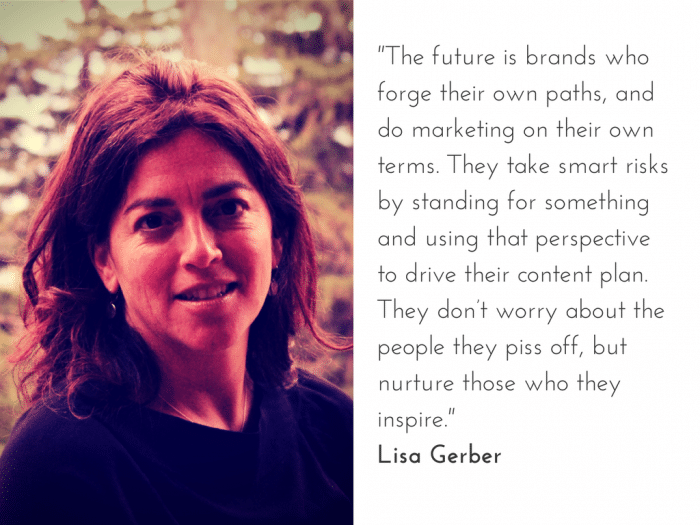
What I hope for the future is brands who forge their own paths, and do marketing on their own terms.

They take smart risks by standing for something and using that perspective to drive their content plan. They don’t worry about the people they piss off, but nurture those who they inspire.

Because when they take take that stance, they come from a place where they are creating from the heart; and it shows. In quality and substance.

Lisa Gerber on the Future of Content

As technology improves, our consumers expect a more personalized experience. Search engines are lagging when it comes to this because we’re still getting results based on who is best at SEO, not what is best for me, as a searcher.

So we’ll start to see better curated content sites – much like public radio programs that work hard to bring out indie musicians; we’ll see curators cherry picking better, deeper, content that doesn’t have the following and backlinks that allow them to compete with those early adopters who have too much track record to be able to compete with.

Content and the Fundamentals

The bottom line is, as always, the fundamentals remain the same. We need to continue to create helpful and relevant content.

Lisa Gerber on the Future of Content (1)

The difference is we’ll have to rely on other channels outside of search engines to get in front of audiences by building relationships with influencers and networks.

Which isn’t much different from present day.

Lisa GerberAbout Lisa Gerber: Lisa Gerber is the founder of Big Leap Creative Inc., an integrated marketing and communications company in Sandpoint, Idaho. Lisa is on the perpetual search to balance happiness with ambition. Read more from Lisa on the Big Leap Creative blog, or connect with her on Twitter @LisaGerber.
image: Emerson

Other posts in this series:

  • The Future of Content Part 1: with Clay Morgan
  • The Future of Content Part 3: with Richard Becker
  • The Future of Content Part 4: The Return to Pure Blogging

The Future of Content Part 1: with Clay Morgan

Content

As content continues to become an ever-important staple for businesses of all shapes and sizes, I thought it’d be interesting to share some thoughts on what the future of content might look like.

However, instead of?sharing just my own thoughts, I wanted to bring you what the future of content looks like for some of the folks I look up to and respect in this space.

Starting today, this series will bring you some of the web’s most critical thinkers when it comes to content – hopefully you’ll enjoy reading as much as I did, and these thoughts will spark ideas of your own on what the future of this thing we call content looks like.

Today’s thoughts come from Clay Morgan, Vice President of Operations at Arment Dietrich.

Content and Standing Out from the Crowd

In one of her recent speeches, Gini Dietrich said there are about 152 million blogs.

That?s just blogs.

It doesn?t include news sites that are generating tons of content or the millions (billions?) of websites that have some type of content on them. That means standing out from the crowd is going to be more and more difficult.

Clay Morgan on the Future of Content

I think there will be increased focus on how the content is presented, and I?m talking beyond design.

  • Is it written, and if so, long form or short form?
  • Is it video or audio?
  • A slideshow?
  • Infographics?

Something I think about is songs. I can?t sing, but children?s television has successfully delivered good content via songs for decades.

Should people look at packaging their content as other forms of art? Photography? Illustration? What about fiction writing? After all, children?s authors have used fiction to teach children for decades.

The point is, whether we see it or not, I think we should really get creative in our approaches when it comes to presenting our content.

Content and Distribution Channels

Right now as I write this, the girls are in Vacation Bible School.

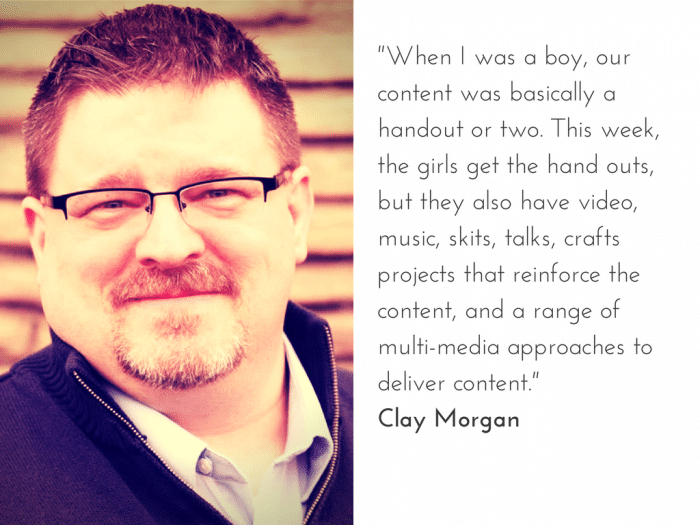
When I was a boy, our content was basically a handout or two. This week, the girls get the hand outs, but they also have video, music, skits, talks, crafts projects that reinforce the content, and a range of multi-media approaches to deliver content.

The content is being delivered in many different ways, and they are ways to which the children respond. Just something to think about.

Clay Morgan on the Future of Content Approach

The second thing I think (or hope) we?ll see is an increased focus and an increased sophistication in terms of distribution. There are large companies telling people that if they create a landing page or a blog, and post x amount of content each week, they will organically gain more sales leads than they know what to deal with.

Funny how ?organically? and ?magically? sound very much alike.

Organic growth is the result of strategy, planning, implementation – in other words hard work. There are no magic bullets and if you want your content to get to the right people, you have to hand it to those people.

I think we will see more people realize they need more sophistication and more strategy when it comes to distribution, if for no other reason there is so much content being developed.

Content and the “Smaller” Blogger

It is going to be critical for small bloggers to think about distribution.

Clay Morgan on the Future of Content Distribution

They will need to be very strategic in the use of SEO, email marketing, RSS feeds, social media, and other tactics in order to break through the domination of content offered by major bloggers and companies with deep resources.

The idea of organic growth through this type of strategic approach always reminds me of my aunt.

She?s quite a successful romance novelist. She works with a major publisher and has a real following. She?s one of the ?hot new stars? in romance fiction and an ?overnight success.? What she tells people is it took her 10 years of hard work before she became an ?overnight success.?

Organic growth always has hard work behind it. Always.

Clay MorganAbout Clay Morgan:?Clay Morgan is the vice president of operations for Arment Dietrich and is based in Nashville.

He believes if you can?t deliver content to the right people, and if you can?t make money off it, content will never be king…or queen.

He?s a husband, foster father, and has two cats and an unexpected fish. You can read more from Clay on Spin Sucks, or connect with him on Twitter and/or Google+.

image: Emerson

Other posts in this series:

  • The Future of Content Part 2: with Lisa Gerber
  • The Future of Content Part 3: with Richard Becker
  • The Future of Content Part 4: The Return to Pure Blogging
© 2026 Danny Brown - Made with ♥ on Genesis