• Skip to primary navigation
  • Skip to main content
Danny Brown

Danny Brown

podcaster - author - creator

  • About
  • Podcasts
  • Journal

facebook

Draw a Tree, Get Cool Stuff

Over at Bonsai Interactive, we made an art video on how to draw a bonsai tree, but we’re not sure of the results. So… we want you to show us the way.

Draw your interpretation of a bonsai tree (either yourself or with friends) and then upload to the Bonsai Interactive Facebook page wall (and hey, feel free to give us a quick Like while you’re over there if you haven’t already).

The best will get a cool little bonsai package sent to them. We’ll also upload to our Bonsai album so you can tag you and your friends if it’s a joint collaboration! We’ll choose our favourite next Friday at noon eastern. So, watch our video then get drawing.

Bonsai!!!
Facebook Pisses Off Users. Again.

Bonsai Interactive Facebook Page

For all its cool connectivity features and business tools, Facebook can still manage to piss users off even when it’s trying to be helpful.

Whether it’s new privacy features gone mad, or redesigns to the site itself, Facebook always seems to divide its userbase between happy, non-chalant and hate. Now a new feature for Facebook Page admins – Getting Started – seems to be getting more criticism than praise.

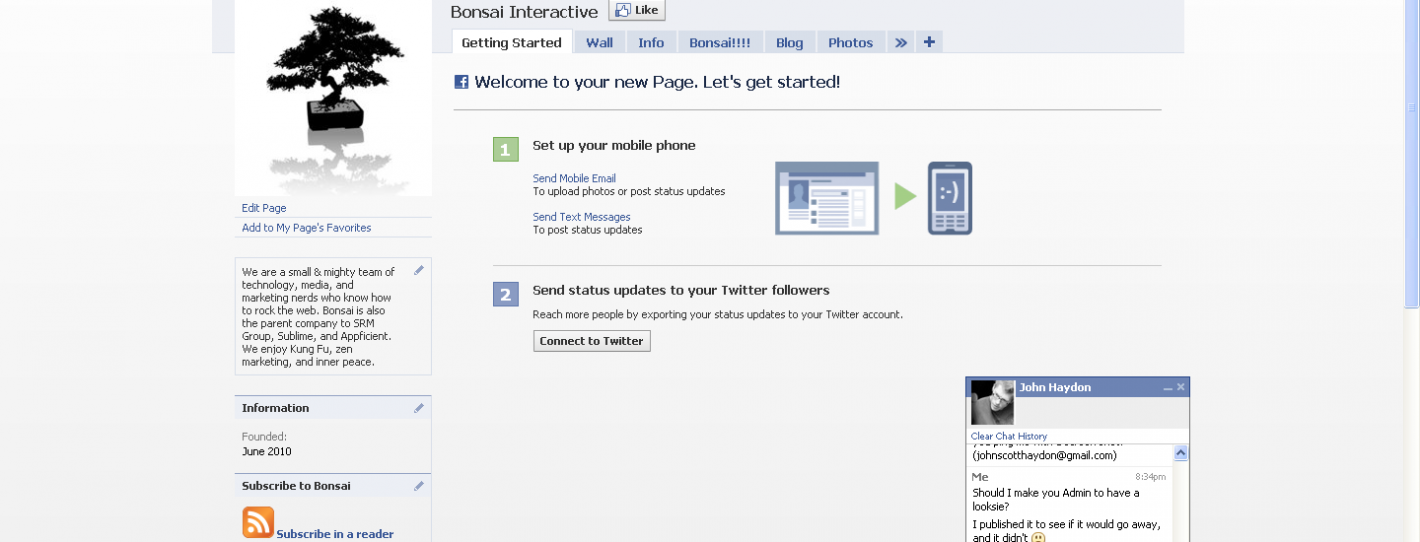
I only noticed it when I jumped on to design the new Bonsai Interactive Facebook Page. Instead of the normal tabs along the menu like Wall, Info and Photos, there was also a new tab called Getting Started.

Bonsai Interactive Facebook Page

As it suggests, it offered some tips on how to set your Facebook Page up. Great – anything that helps new Page users get the best from their Page has to be great, right?

Hey, it’s Facebook – so, no, is the short answer.

Since I already know how to set a Page up, I went to hide the tab. And found that I couldn’t. There was no way for me to drag it into non-displayed tabs, nor was there an option for me to delete the tab either.

In fact, the only way I could get rid of the damn thing was to link my Twitter account to the Page, as well as my mobile phone.

Riiiiiight…

The social side of me wants to think that this is just a way to connect your accounts together and make it easy to populate your Facebook Page from either Twitter or your mobile phone.

The cynical side of me sees it as another way for Facebook to have more information about you, and then possibly open up that information (purposely or not) to mobile ad companies and Twitter spammers.

I opened up a Help Ticket on Facebook last Thursday, asking how to remove. As of writing this post, no-one from Facebook has actually answered.

But there are plenty of other frustrated users complaining about this “helpful” addition.

Facebook upsets Page Admins

Like I say, I can see the benefit of having a Getting Started tab, especially for new Page users. But not having a way to delete or remove it manually, while it takes up a tab that could be used for something more beneficial to the Page, seems kinda lame to me (I had to link my Twitter and mobile accounts and then remove access to get rid of the tab).

What’s your take on it? Have you seen this new feature yet, and is it useful or just another Facebook faux pas?

Facebook Fan Page Evaluation Fun with Vitrue

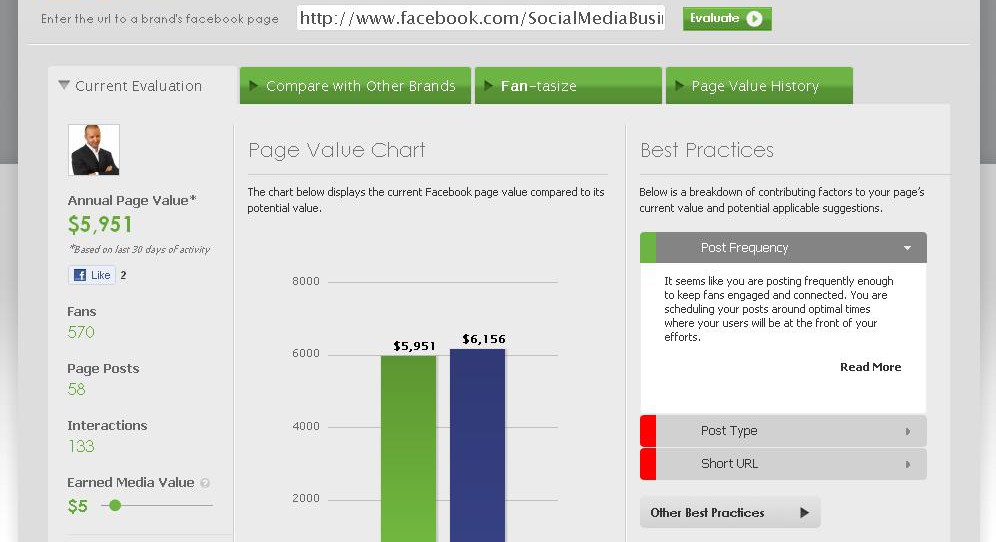
Danny Brown Facebook page evaluator

One of the reasons I set up a Facebook page was to offer an outlet where folks that were more comfortable on Facebook could connect and interact.

Yes, my blog is my home space, and then there’s also Twitter, LinkedIn, YouTube and other social profiles where we can connect. But not everyone likes reading blogs; not everyone’s on Twitter; some folks don’t like to get too involved with LinkedIn, and so on. So, making an outpost available where you’re most comfortable was a no-brainer.

So far, it seems to have worked pretty well. There’s a good mix of extended blog posts, shared resources, exclusives and connections, as well as folks that add comments or make suggestions of their own about resources that may be interesting to those that like my page. And I can’t ask for much more than that.

However, it’s always cool to see how anything we do online is perceived. After all, if we’re not measuring (or at least evaluating) our progress, how can we see where we’re going wrong and correct, or what we’re doing right and build upon?

That’s why something like Vitrue’s Social Brand Evaluator is so interesting.

At its heart, the evaluator is a simple method to see how your Facebook page rates for interaction, social value, and the potential for future marketing or monetary worth.

It also highlights some of the best practices for growing your page, as well as give you a breakdown of page value history (so if you’ve had your page a while, you can see if you’re going in the right direction or not).

While it’s not a direct replacement for proper metrics and measurement, it is a solid enough little app that can show you how you compare to others in your niche or industry. So if there’s someone you really admire, then Vitrue’s evaluator will let you see where you need to be headed to get closer to that page’s social value.

The main problem with it as it currently stands is that it doesn’t really tell you what these figures mean. For example, what does the Annual Page Value indicate – what the page is worth to advertisers, or how much you have the potential to make with offers to those that like your page?

The same goes with the Earned Media Value slider – again, is this for advertisers, page owners, a mix of both or none of the above? A little more clarification on the evaluator would be really useful (though maybe Vitrue is saving that for paid client work instead).

Either way, it’s a decent look at how your Facebook page is being used and viewed, and that’s always useful.

Here’s my social value. If you have a Facebook page, check out the evaluator for yourself and see where you currently sit and where you could either change or improve interactions. And I’d love to hear what you think of the tool and its use.

Danny Brown Facebook page evaluator

Twitter Advertising on Facebook? No Thanks

Have you signed up for Sponsored Tweets on Twitter? Or Magpie? Or TweetROI? Do you offer sponsored posts and paid reviews on your blog? If so, you might have to re-think how you share this information, thanks to a Terms of Service update from Facebook.

Why does a Facebook update affect you if you’re on Twitter, or writing on your blog? Think of your Status Update box. Many users of both Facebook and Twitter have their accounts synced, so when you post on Twitter it goes to your status box (or main feed). The same for blog posts – a lot of bloggers auto-update their Facebook status with their latest post.

Now, however, if that tweet or post includes an advertisement from the likes of Sponsored Tweets, or a paid review from a company like?IZEA and other paid blogging services, Facebook would be in their rights to see that as part of their “unauthorized commercial communications”. This could, in return, see your Facebook account closed or deleted.

Of course, the easy thing to do would be for IZEA and other companies to talk to Facebook. Or, for people to stop syncing accounts and blogs (Twitter updates is something a lot of “just Facebook users” have already complained about). The question is, will people want to change their current set-up?

What’s your take? Do you sync accounts? Will this make you change or will you keep posting regardless? Or should advertising companies be the ones taking the proactive approach to work to a solution?

When Social Network Security Can’t Protect You

Justin Michael is like many online users. He has a Twitter account and a Facebook account, as well as his own website.

He’s passionate about new technology and social media/networking and what it can do for you, personally and professionally.

Justin is also running for Mayor of Santa Barbara in the upcoming November 3 election. He’s using these social tools – Facebook especially – to help spread his political message, as well as his philanthropical one (Justin’s campaign message is “Humanitarian first, politician second”).

It seems a natural thing to do, when you see how much social media and online networks helped the Obama presidential campaign.

And it would be – if Justin wasn’t the victim of a cyber criminal who has stolen his identity on Facebook. Not just the fake account “fun” that Twitter suffers from – Justin’s legitimate Facebook account has been closed due to the actions of the cyber criminal.

Here are just some of the events so far:

  • Justin’s original Facebook profile cloned.
  • Account starts sending weird spam to friends and supporters.
  • Account starts to get flagged by cyber criminal so people believe real Justin is impostor.
  • Legitimate Facebook account deleted.
  • Spam attacks start on Justin’s Facebook political page.
  • Calls Facebook Palo Alto office and is advised to speak to cyber crimes division.
  • Files police report.

Justin’s tried talking to the person behind these attacks. The responses from the fake Justin Michael account show that the hacker isn’t too bothered about the legal ramifications. He’ll simply keep changing IP addresses each time the one he’s using is tracked.

The reasons behind the attacks aren’t clear. Justin suspects who the cyber criminal is. Maybe it’s politically charged? In one of the message exchanges on Facebook, Justin is advised that if he removes his Internet presence (MySpace, Twitter, Facebook) and reverts to traditional campaigning, his harasser will remove the fake accounts.

Whatever the reasoning, it’s another sad example of how vulnerable our identities are on social networks. It’s too easy to set up an account and impersonate a person or business. All that’s needed is a basic email account and some knowledge of the person or brand involved.

Sure, there are ways that you can protect yourself – brand monitoring, alerts and observant friends and colleagues being just some of the methods. But these will only alert you after the event. By then, the damage can be irreparable.

What about the social networks in question? Can they be more stringent in their account activation process? Possibly. But how do you know the initial account isn’t fake to begin with? And that you’re subsequently blocking the real person or brand from coming on to your network to try and limit damage control?

Sadly, there doesn’t seem to be any immediate and easy answers. For social networks. For cyber crime. For people like Justin Michael. For you, for me.

Social networking is the ultimate connection platform. The question is, are people connecting with you or someone else?

  • Note: With the political background and November dateline in mind, I asked Justin if this was simply a clever PR stunt to raise awareness for his campaign. He swears it is not.
  • Update July 18 – Following Katie’s comment below, this blog piece may offer some insight into reasons behind the Facebook fake account(s).
  • « Go to Previous Page
  • Page 1
  • Page 2
  • Page 3
  • Page 4
  • Page 5
  • Go to Next Page »
© 2026 Danny Brown - Made with ♥ on Genesis