• Skip to primary navigation
  • Skip to main content
Danny Brown

Danny Brown

podcaster - author - creator

  • About
  • Podcasts
  • Journal

facebook

The Mysterious Case of Oracle Social and Facebook Likes

Oracle Social

Oracle is a well-respected brand when it comes to solutions for I.T as well as social media and business intelligence for enterprise users. They have a collection of toolsets that cover everything from loyalty programs to service management and analytics.

So you’d expect them to have a fairly robust social media strategy for themselves, right? Except when it comes to Facebook, it would seem.

[Read more…] about The Mysterious Case of Oracle Social and Facebook Likes
Sunday Shorts – Facebook Edition

Facebook

Facebook

It’s been quite the couple of weeks for Facebook – from the long-awaited launch of its IPO offering, to chief egg Mark Zuckerberg getting hitched, and the announcement of its own photo app just weeks after buying Instagram.

Here’s a short recap of what’s going on in Facebook’s world.

Was the IPO Really All That Bad?

By now, everyone and their mother will know that Facebook launched itself onto the publicly traded stage with a lot of fanfare and then promptly fizzled out. Shares in the social giant topped at around $42 (after coming out at $38) and are currently sitting around the $28 mark – losing a third of its value since the launch.

So a complete disaster, right? Maybe not a complete one. The IPO market when Facebook launched was a shaky one – Dealogic said six IPO’s were stopped before going public around the time of Facebook’s offering because of market conditions.

Additionally, last year there were only 80 IPO’s in the U.S.,which is a third of the number between 2004-2006.

Given that one in 10 IPO’s normally trade at least 20% below their offering price, and there’s still probably life left to reinvigorate Facebook yet before we call it a complete failure.

Counters and the Truth About The GM Pull Out

Part of Facebook’s shaky entrance into the public stock exchange was believed to have been the after-effect of the announcement that General Motors had pulled their Facebook ad campaigns to the tune of $10 million.

GM’s official take was that “the ads on Facebook have little impact on consumers’ car purchases.” The reactions were quick, with many pointing out the flaws in the ad model at Facebook for brands.

But how much of GM’s statement was a bigger issue for brands, and how much of it was down to GM’s failings themselves?

For example, while $10 million isn’t chump change by any standards, it pales in comparison to GM’s overall ad budget globally, which stands at $1.8 billion.

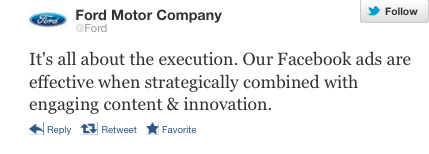
Then take a look at their big rival Ford, who wasted no time in piling on the agony for GM by saying their ads work just fine – because they have a strategy. Ouch.

Ford and Facebook

The most interesting part, though, is Facebook’s take on the matter. They claim that GM wanted full page advertising, as opposed to the more subtle Sponsored Stories approach that brands and advertisers currently use. Facebook said no, citing user experience as more important than GM’s budget.

If this turns out to be true, it’s a major win for Facebook in the eyes of their users, and a warning to brands that old school advertising isn’t welcome on their platform. Works for me.

Money Well Spent?

Short recap. Facebook buys photo app Instagram for $1 billion. Cue gnashing of teeth from Instagram users about the platform being ruined, and assurances from Facebook the app will be left alone. Looks like Facebook was right.

Shortly after the purchase of Instagram, Facebook announces its very own photo app, called Facebook Camera, whose features make it sound an awful lot like Instagram. So why bother purchasing them in the first place?

Simple – kill the competition and buy your way into the mobile market fast. Facebook’s mobile experience so far has been crap, to say the least, on all platforms. Their official Facebook app sucks, and many of the core features aren’t usable on third-party apps.

By buying Instagram, they take over one of the best way to share photographs on Facebook and combat Google’s easy upload feature to Google+ via that platform’s superior app.

Then, by announcing Facebook Camera, they now have a bona-fide app that will make the mobile experience on Facebook (and not just image sharing) a lot smoother than it currently is. Everybody wins – Instagram users keep their beloved app and Facebook users who don’t have Instagram get their own version.

So, quite the few weeks for Facebook, and this is bound to be just the start. Who says all the interesting stuff is happening over at Google+?

Game on.

Related articles
  • Facebook Might Make 2 More Acquisitions (newser.com)
  • Facebook launches ‘Instagram rival’ camera app (telegraph.co.uk)
  • FACEBOOK FALLOUT: These Companies Just Got Downgraded (FBZNGA) (businessinsider.com)

Sergey Brin Paints His Kettle Pot Black Over Facebook and Apple

Google versus Facebook versus Apple

Google versus Facebook versus Apple

Over at UK newspaper The Guardian, Google co-founder Sergey Brin shares his views on the future of the Internet, including web freedom and the restrictive practices of Facebook and Apple.

Brin makes some great points, particularly about the ongoing battles certain web users of the world have due to the firewall nature of their governments.

But on other issues, he clearly drank some alternative reality juice, since he conveniently ignores the fact that Google are just as bad (if not more so) than the two companies he’s taking issue with.

Google’s Short-Term Memory

From the Brin interview:

You have to play by their rules, which are really restrictive. The kind of environment that we developed Google in, the reason that we were able to develop a search engine, is the web was so open. Once you get too many rules, that will stifle innovation.

It’s a point that most web users would agree with – yet it’s a point that Google seem to be doing themselves with their new approaches to how Google products interact with each other, and what you can and can’t do within Google.

Look at Google Plus Your World , for example, that gives more credence to search results with your Google Plus account, versus other social networks or websites.

Or the fact that Google had to “punish itself” when it was revealed there were a bunch of sponsored posts written about Google Chrome, violating Google’s own policy of search result bias (at least that’s Google’s story).

Kinda seems like Google themselves are a little guilty of stifling innovation and closing down the web, when their own platforms are given such prominence by Google.

Adding to that is something Brin says further in the interview, when criticizing Facebook for making it difficult to switch data to other platforms:

Facebook has been sucking down Gmail contacts for many years.

Perhaps – although Facebook (currently) is a private company and, as such, doesn’t need to share squat.

Then again, maybe the real reason Brin is upset is because every new Gmail user is automatically logged as a new active Google Plus user whether they use the platform or not. Google is still seeing their social network struggling to find ground, so any extra numbers (real or otherwise) would ease investor burdens.

Pick The Right Fights

Brin also complains about the garden wall approach of Facebook and Apple and how this inhibits search pulling details about iTunes apps and Facebook statuses, etc.

This in turn leaves less information for Google to share with advertisers.

But is this really surprising, when Google themselves have been found to give preference to their own results and networks? Why should anyone else – especially a competitor – give over information that helps line the pockets of a competing company that gives bias to their own ads and services?

There’s no doubt Google is smarting, especially given the fact that Facebook continues to beat them hands down in pretty much every department, and Apple still has the upper hand in the smartphone and tablet market?when it comes to hard profits.

But I can’t help but feel Brin is picking the wrong battle here.

Instead, why not counter with the consumer victories the Google brand has? Or how YouTube aims to be the go-to network for rich multi-social media and ad revenue for channel partners?

There are many ways to counter your competition – unfortunately, examples of where you’re just as bad isn’t a great strategy…

The $1 Billion Instagram Success Story, Instagram Style

Instagram Facebook sale

Okay, so by now everyone and their mother has more than likely heard about the sale of photo app Instagram to Facebook for $1 billion in shares and cash.

There are already a phalanx (awesome word, if maybe misplaced here) of posts from bloggers and analysts talking about the reasons for the sale, and what it means for Facebook and, more importantly perhaps, Instagram. So, I won’t bore you with more here.

Instead, here’s the perfect overview of what turns a cool idea between friends into a billion dollar business in less than two years – the Instagram story, Instagram infographic style, from the creative guys over at Visual.ly (click image to enlarge).

Enjoy.

by visually. Browse more Social Media infographics.

Should Facebook Remove Holocaust Denial Groups?

Against Holocaust Denial Laws

Against Holocaust Denial Laws

When the Allied forces began to turn the tide of their conflict against Hitler’s Germany in 1944, one of history’s most disturbing events was about to be discovered.

Named the Final Solution by the Nazis, and subsequently known as the Holocaust around the world, concentration camps were found by Allied forces advancing toward Germany. The first major camp was Majdanek, which was found by the Russians in July 1944. This was followed by other camps in 1945.

The concentration camps were built for one reason – the extermination of the Jewish race by Hitler, in an attempt to breed the perfect Aryan race of blond hair and blue eyes.

While the exact number isn’t known, over six million Jews died in these camps – two thirds of the Jewish residents of Europe at that time. Of this number, one million children perished, along with two million women and three million men.

However, the numbers could be far more – many scholars feel the genocide of other ethnic groups by the Nazis, such as homosexuals, disabled people, Romani and other cultures, should be included. This would mean around 11 million people were murdered in the Holocaust, all because of one man’s twisted vision.

Over the years, there have been many claims by groups and individuals that the Holocaust never happened and that it was a myth created by Israel. Despite the public video footage; the images taken by Allied troops; the admittance of guilt by past Nazi generals – many still believe the Holocaust never happened.

It’s a viewpoint that’s raised questions on free speech and opinions and if, by denying the right to deny the Holocaust, people are having their own right to speak abused.

Now that debate and fight is involving Facebook.

Facebook and Free Speech

A caveat. I’m a huge believer in free speech and differing opinions, and often get shit on because of it – c’est la vie. I will admit I don’t agree on all speech being free – clear hate and sex crime/hate, for example, are some areas I feel opinions step over the line. But then does that make me against true free speech? Possibly.

That’s a personal opinion, though, and would affect very few people in the grand scheme of things (and only if I spoke out). A social network like Facebook, with over 700 million users, is a different kettle of fish. It’s a public platform that allows anyone and everyone to post (and access) status updates, thoughts, views and more.

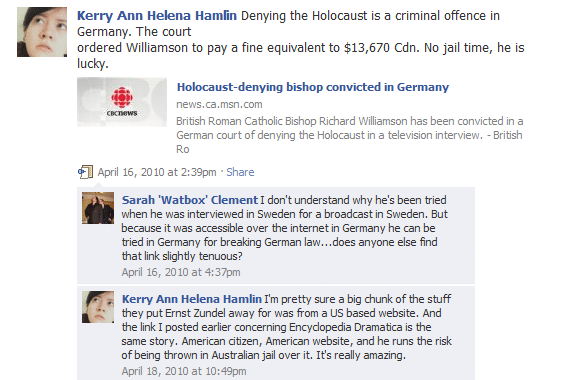
Holocaust denial

Facebook’s policies look to encourage free speech and opinion, and rightly so. But is there a limit to which this should stop, and a different policy invoked?

That’s one of the questions currently being asked of Facebook by survivors of the Holocaust, in a plea to Facebook to remove groups that have been set up to deny the Holocaust ever happened.

In an open letter posted on the Simon Wiesenthal Center website, the survivors ask Facebook to re-evaluate their approach to what’s classed as free speech versus hate speech so that the atrocities of the past aren’t repeated.

In dialogue so far between the survivors group and Facebook, a Senior VP at Facebook has advised of the importance to “…maintain consistency in our policies, which don’t generally prohibit people from making statements about historical events, no matter how ignorant the statement or how awful the event.”

I’m not sure I can buy that.

Free Speech or Road to Conflict?

As I mentioned earlier, I’m a huge believer in free speech and opinion – yet should all speech be free? Opinion is different – you can keep that to yourself. But, by definition, speech is public and has the ability to change mindsets and start movements.

A speech by Hitler in 1938 led to a movement. It resulted in the deaths of at least six million people.

I’m not naive enough to believe that had the speech never happened, the Holocaust wouldn’t have. Hitler was determined in his path to the Final Solution, and if that speech hadn’t happened, others would have (some did). Nazism was much more than words from a balcony.

But if there’s one thing that history can teach us, it’s that words can be dangerous. When hate is powerful enough, it can see words become a powerful weapon. The world saw its results from Nazi Germany. It sees its results in countries where dictators rule by force, and people live in fear of their gender, sexuality, beliefs and religion being used against them.

Free speech is important – it differentiates true freedom from state-defined freedom. The question is, if free speech is silencing voices and historical fact – and has the potential to incite violence – should it still be free?

I don’t have the answers, just my opinion. You?

  • « Go to Previous Page
  • Page 1
  • Page 2
  • Page 3
  • Page 4
  • Page 5
  • Go to Next Page »
© 2026 Danny Brown - Made with ♥ on Genesis