• Skip to primary navigation
  • Skip to main content
Danny Brown

Danny Brown

podcaster - author - creator

  • About
  • Podcasts
  • Journal

email

Making the Full Switch to Postmatic ? What You Need to Know

Alarm

Regular readers and subscribers to this blog will know of the praise I’ve been putting the way of email commenting solution Postmatic in recent months.

Not only does the solution work seamlessly, it does exactly what it says on the tin – encourage blog commenting, comment interaction, and increased engagement. And it does it all in a snazzy email template that looks great on both desktop and mobile.

So enamoured have I been with the difference Postmatic has made not just to this blog, but to my overall blogging enjoyment too, I’ve decided to make the full switch over to a Postmatic-powered blog (at least as far as email and commenting is concerned).

Given I currently run a weekly newsletter with MailPoet, this is going to mean some changes. Here’s what they are, and what they mean for you.

If You’re a Current Newsletter Subscriber

If you’re an active subscriber to my weekly newsletter, you don’t need to do anything – you’ve already been moved over. However, this is only if you’re an active subscriber – so, you opened or clicked one of my newsletter emails.

If you didn’t do any of that, an email invite went out yesterday to advise of the change, and how to subscribe to the new format.

* Note – due to a glitch between MailPoet and Postmatic, several of you may have received multiple invites. My sincere apologies, and the Postmatic team is looking into what happened.

If you wish to continue receiving my posts, but now as soon as they’re published as opposed to a weekly digest, you’ll just need to reply with “agree” in your email and Postmatic will do the rest. If you don’t wish to change over, simply ignore the email and job done, subscription over. 🙂

The last newsletter will go out this coming Sunday, June 21, with an update on the new set-up.

If You’re a Current RSS Subscriber

Lucky you – you don’t have to do squat! 😉

Because Postmatic is an email-based delivery and commenting solution, my move won’t affect your RSS subscription. You can continue to get the posts you like via your chosen feed reader, or Feedly, since these are handled by my RSS provider, Feedio.

Of course, if you did want to get email delivery instead of RSS curation, then the next section is for you.

If You’re Not Yet Subscribed via Email

Because I’m moving from MailPoet to Postmatic, this means my email list details need to change. So, from this post on, anyone that uses the email subscription box at the end of each post will be added to my Postmatic email service.

This means any new posts I publish will be emailed straight to your Inbox, and then that’s when the fun really begins.

Because Postmatic not only delivers my posts to you by email, but also allows commenting by email, you never need to leave your Inbox again (at least for this blog).

Here’s what’ll happen:

  • I create a post and hit Publish
  • Postmatic delivers to your email
  • You read the post, and if you want to comment, you hit Reply
  • You write a comment as you would an email, and hit Send
  • The comment appears on my post in the comments section
  • Any replies to your comment, or new comments by others, will come back to your Inbox
  • You choose whether to reply (by repeating the third and fourth bullet points)
  • You continue to take part in the comments as long as you want.

The real beauty of Postmatic is that you, the reader/subscriber/commenter, are fully in control of what comes into your Inbox.

  • If you simply want to read a post, you get that post by email, read it, then delete it. You won’t see any comment emails unless you leave a comment yourself.
  • If the comments are getting too busy, Postmatic will pause notifications (when there are more than 6 comments on a single post within an hour). You choose if you wish to continue receiving notifications.
  • If you simply want to stop comment notifications, you just send an email with the word “Unsubscribe”, and you drop out of that conversation.

Don’t worry, Postmatic reiterates these points with an introduction email when you sign up to my blog via email.?It’s a very elegant way of ensuring your Inbox doesn’t get clogged with multiple emails from the same blog post.

So there you have it. As of this post, all future posts will be delivered by Postmatic. There are also some cool features coming down the line to make your experience an even better one, so stay tuned.

Thank you for being with me this far, and I look forward to seeing you in the comments in posts to come!

Does Your Blog Really Need to Provide an RSS Feed Anymore?

Back in 2010, I published a blog post about the choices bloggers gave?when it came to how readers consumed their content.

The gist of the post was simple: should it be via RSS, or email?

My own take was bloggers should offer both (remember, this was at a time when RSS was still the #1 choice for bloggers to distribute their content). In the comments section after the post, the majority of commenters thought email was the better option too.

– I?m with you 100%! The blogs I never, ever want to miss (including yours) are ones I subscribe to via email. In addition to making sure I don?t miss anything this also allows me to read at my leisure and if I get swamped for a week or so I know which posts I still have to read. Michelle Mangen.

– Maybe it?s the Boomer in me, but I only read?on a daily basis?the blogs of those to whom I can subscribe via email, or perhaps on a blog roll. I realize, of course, that I may be missing out on some good reads; but the blogger is missing me as a subscriber. Ken Jacobs.

Even back then, both bloggers and readers were seeing the value of email, and (perhaps) the diminishing return of RSS. The thing is, though, it didn’t seem to matter – Google Reader was king and RSS feeds were the currency of any blog worth its salt.

Man, how times do change.

Alas, Google Reader, I Knew Thee Well

In March 2013, Google announced it was closing down its Reader service. For most content creators who had built a healthy subscriber base via RSS, this came as a bit of a shock.

In Google’s own words, however, perhaps it shouldn’t have been as big a shock.

We know Reader has a devoted following who will be very sad to see it go. We?re sad too.?There are two simple reasons for this: usage of Google Reader has declined, and as a company we?re pouring all of our energy into fewer products. We think that kind of focus will make for a better user experience.

When the company behind the leading RSS solution says use of its product has declined, you know it marks a change in how we, as readers, consume content. Perhaps it’s the other part of the statement that says more, though: “We think that kind of focus will make for a better user experience.”

As a long-time user of Google Reader, both as a provider of content and a consumer of one, the user experience was a major pain in the ass. Yes, you could create folders based on topics and categories, but if you subscribed to a lot of blogs, even that minimal filtering option soon became overrun and clunky.

As content moved into a cleaner, richer experience – both on the web and (increasingly) on mobile – RSS feeds and the way they’re curated became less attractive.

For me, I’d even say RSS feeds are pretty much redundant, and not worth the effort of trying to grow.

Email = Investment, Trust and Loyalty

Think about the one area you spend most of your day, personally and professionally. It doesn’t matter what job you’re in, or what social media channel you prefer over the other, or what smartphone you use – the one thing we all have in common is email.

Our inboxes rule us. Whether it’s getting notifications about a friend’s update on Facebook, or confirming tickets, or replying to a question that can’t wait until you get to the office, our email inbox is still the most-used direct communication tool we use.

It’s one of the reasons I switched my commenting solution (and soon-to-be subscription solution) to Postmatic. If it doesn’t matter where and when people are accessing email, because it’s second nature and easy to do, doesn’t it make sense to use that as your primary content distributor, conversation starter and loyalty builder?

Why would you want to continue using a clunky, increasingly-irrelevant piece of technology like RSS feeds that offer less value and less return for your content investment?

Looking at my own analytics for the last 30 days, I had just under 16,500 sessions (Google’s new name for visitors). Of that, guess how many came via RSS? 10,000? 5,000? 1,000?

Chance would be a fine thing. What I actually got, you can see below.

Danny Brown RSS

A whopping 335 sessions, or just over 2% of all traffic for the 30 day period. Worse still, the bounce rate is atrocious – RSS readers are simply reading the article and leaving my site (when/if they actually visit).

While I’ve never really used my blog as a lead generator (so I’m not particularly bothered about bounce), for any content creator looking to use their blog as a business creator, that bounce rate would be a major stumbling block.

What makes this lack of traction stand out more is when you look at some of the other traffic drivers – in particular, Twitter (which is ironic, given a recent article about Twitter’s own lack of value for traffic).

Even in the image above, you can see automated Twitter feeds (where blog posts are aggregated by RSS-to-Twitter) accounts for almost the same amount of traffic as a dedicated RSS solution like Feedly.

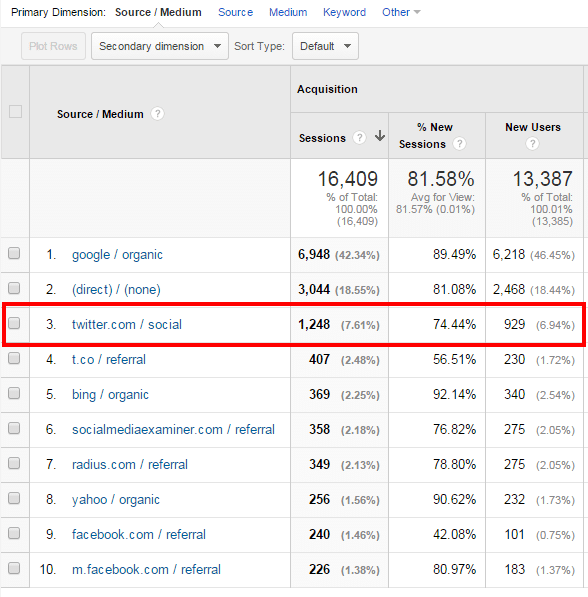
When you dig a little more into the analytics, you can see Twitter actually blitzes RSS out of the water.

Danny Brown Twitter

Direct traffic from Twitter accounted for almost 1,250 visits – almost 10x the amount from my RSS subscribers. Add in the indirect traffic using Twitter’s link-shortener, and you can see why Twitter is a better RSS solution than actual RSS feeds themselves.

In the direct stats, almost 2,500 of the 3,044 total is from my email subscribers – beginning to see a pattern? If you want quality traffic and trust in your content, RSS is not going to get you it.

RSS = Really So-over-it Syndication

Okay, it’s a play on words for what RSS actually stands for (Really Simple Syndication), but for me personally so-over-it would be a better choice of words.

Anyone can subscribe to an RSS feed. One click of the mouse, done. And (more usually than not) forgotten. When I stopped using my reader account a few years back, I kid you not – I must have had about 500+ blog feeds in there. Do you think I regularly visited them all?

Hell no – as Michelle Mangen mentions in her quote at the beginning of this post, the blogs I wanted to really subscribe to were done by email – and that’s been the way I’ve subscribed for the last 4-5 years.

There are multiple benefits to this:

  • Like I mention, anyone can subscribe by RSS. Doesn’t mean squat. Giving someone your email address, though, and trusting them not to take advantage of that? That’s the kind of investment you want in your content.
  • Email subscribers are more adaptive to change. When I recently changed my email and RSS subscription methods, I shared an update post via both email and RSS. 81% of my email subscribers updated their subscription – 81%. Guess how many RSS subscribers updated their feed? 9% – quite the difference.
  • The best relationships are those one-to-one interactions you get when someone replies to your blog post with an email about how it made them feel. I’ve had some of the most personal and powerful conversations via email after a post has gone live – RSS could never hope to achieve that.
  • When Google Reader closed its doors, I lost 6,500 subscribers overnight. 6,500! Now, given, many of them may not have visited anyway, but you take away 60% of a blog readership overnight and see what happens. Another reason I refocused my energy into email.

Content is changing. How we consume content is also changing. We don’t need “traditional” RSS anymore. We have social channels, as well as sites like This. and Flipboard, to aggregate and syndicate.

But they’re all external, and you’re competing for space with thousands of other like-minded souls. Email, on the other hand – you have these eyeballs, and they’ve chosen you over the competition already.

Now might just be the time you consider dumping that good old blog RSS feed for good or, at the very least, stop promoting it as an option to subscribe (you’ll see that I only offer email subscriptions in the box below this post).

After all, is it really doing you any good?

A version of this post originally appeared on the Wood Street Inc. blog.

© 2026 Danny Brown - Made with ♥ on Genesis