If you take a look at the sidebar to the right of this post, you’ll see the Lijit logo next to the search box. Lijit is a third-party search platform for bloggers – and a heck of a lot more on top.
While it’s perfectly fine to use whatever standard search box comes with your blogging platform (or add something like Google Custom Search), using Lijit takes all the goodness of your search box options and then amplifies it to the power of, oh, eleventy billion or so.
Here’s why.
Snapshot Audience Intelligence
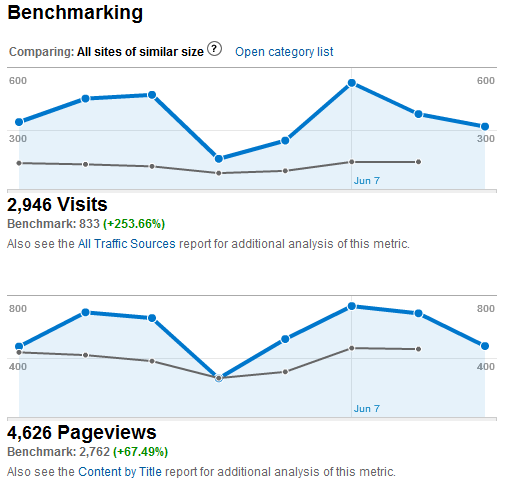
While you can’t beat something like Google Analytics or Woopra for a full-on overview of your site traffic, Lijit gives you a great and user-friendly checklist for you to see how your blog is performing and help you target areas to work on.

By looking at these stats for the last 30 days on here, I can see that I had just under 20,000 unique readers, but just over 48,500 page views. So this tells me that the average reader is spending time checking out at least one more page or post while they’re here – great for keeping your bounce rate down.
Additionally, I can also see that almost a quarter of these page views came from search engines, which is great news since it means I’m not relying solely on social networks for my audience. So, if Twitter or Facebook died overnight, I’d still have a nice amount of blog traffic. It also means my SEO (search engine optimization) is working too, for the topics I want to be found for.
I can also see what the most popular search is – both on-site and off-site – and I can use that to tailor future blog posts and topics.
Blog Content Guidance By Your Audience
While I always say that you need to be writing for you first and that everything else is a bonus, it also makes perfect sense to ensure you’re at least aware of what your audience wants to read about. After all, they’re the ones that make blogging so enjoyable, by sharing their thoughts in the comments and making you look at topics in a new light.
So why wouldn’t you want to write on something that clearly interests them (and bring new readers to your blog into the bargain)?
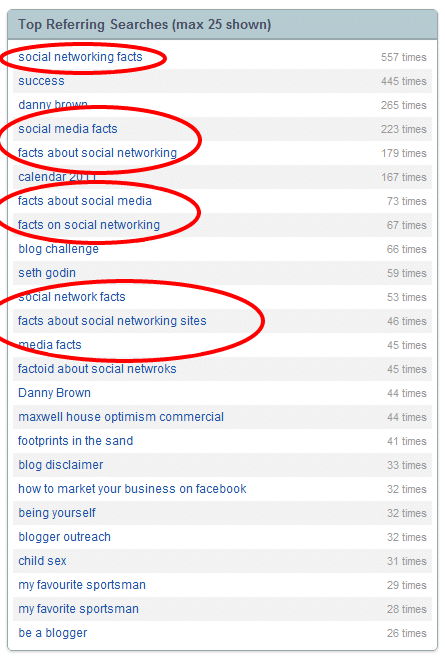 Look at the figure to the right, for instance, and you can see that one of the most popular search terms in the last 30 days has been for “social media facts”, or other keyword terms based around that.
That search is pretty understandable, since I wrote a post last year on 52 cool social media facts that turned out to be pretty popular and resulted in a lot of social shares and syndication.
However, because Lijit shows me within my dashboard that this is still a pretty popular term – and the original post was written last summer, so the stats are already out of date – then perhaps I should be thinking of updating the post, and include newer networks.
Additionally, I can ask myself whether it might be an option for me to compile an ebook, which looks at the stats and collates them into a more flowing form.
And, say I was to offer some strategies based around the social media facts, could that ebook be premium, or would I want to offer it as a free ebook, which could then lead to premium offerings down the line?
So as you can see, already I’m starting to get a feel for my audience and understand both the current readers, and those coming in from search engines and what they’re looking for while they’re here.
Location Based Marketing – Not Just for Mobile
By using Lijit so far, I’m seeing where my audience is coming from, and what searches are happening not only off-site, but on-site too. This is allowing me to build up my audience’s profile which in turn is helping me write content that they’re going to read.
This is key for both personal and business blogs, and everything in between.
But then we can start taking that one step further, and really start writing content for a specific target audience. Not only that, but then we can start using our other social profiles in a far more strategic way.
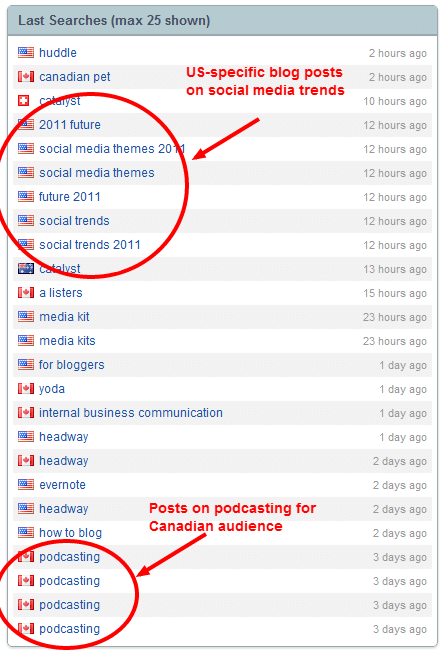 For example, you can see by looking at the image on the right that there are two key pieces of information that stand out, that I could tailor into future posts:
- A lot of U.S. visitors are looking for information about social media trends for 2011.
- A lot of Canadian visitors are looking for information on podcasting.
This means I can now tailor some posts around social media trends and how they affect U.S. social media users for the next six months or so.
These can be for personal social media use in the U.S.; mobile browsing; social media and business use in the U.S.; is the U.S. falling behind in social media use compared to the rest of the world or leading the way; and more.
Switching to Canada, I could then tailor posts based around podcasting and its position within the Canadian space. Is it more popular in Canada than elsewhere; are there opportunities for guest posts from Canadian podcasters; can businesses use podcasting more in Canada, as opposed to text or video blogging?
These are just some of the approaches I could take. As you look more into the Lijit dashboard and the intelligence it builds around your readers – especially internal searches from the Lijit search box – you can really begin to blog strategically. Which is perfect for growing your existing blog audience.
The Added Bonus of Community Content
While Lijit is great for intelligence based around your readers and audience, one of the things I really like about the platform is how it lets you promote other parts of your own network, and that of your community.
When you set up your Lijit account, you can add all your other profiles from around the web (as seen by the Content Tab on the search result in the image below). This then lets you pull search results from other blogs you might have, or your company website, or video channels, etc.
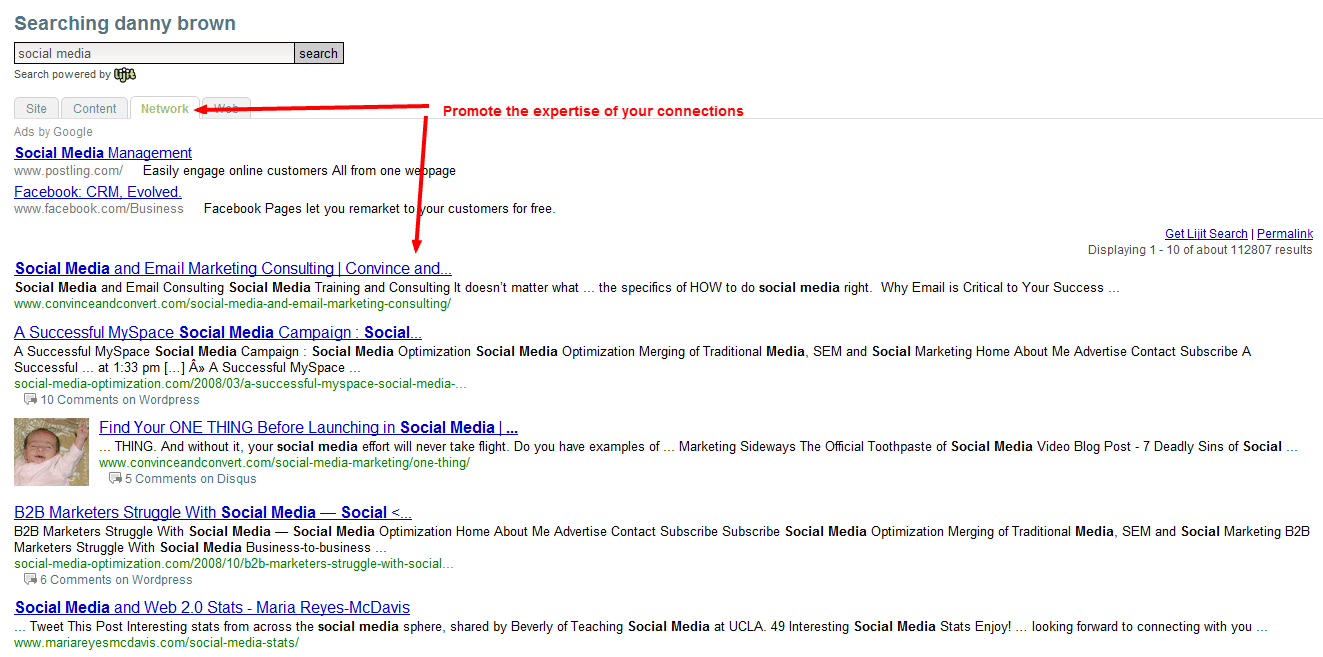
Next to the Content Tab is your Network Tab. This looks to your social profiles, along with any blogs you may link out to via your blogroll, and shares similar posts based around the search term on your blog.
The nice thing about this is that you’re not only allowing your reader to get the most comprehensive results for their query, you’re also sharing the cool folks you’re connected with and (potentially) driving traffic to their site too. Which is nice.
These are just some of the ways you can use Lijit to build a content marketing strategy for your blog. There are more, and this recent case study by Marketing Sherpa expands on some of these (disclosure – it features a certain Scotsman…).
Any blogger will tell you that knowing your audience is key – Lijit makes this just that little bit more effective. Which is never a bad thing, right?

 Last week, I released a