• Skip to primary navigation
  • Skip to main content
Danny Brown

Danny Brown

podcaster - author - creator

  • About
  • Podcasts
  • Journal

Business

Mining for Gold in Blog Comments

Two blog posts caught my eye today. The first was The Art of Blog Commenting by Arik Hanson, and the other was The Time for Location-Based Marketing is Now by Gini Dietrich.

Two different blog posts – Arik’s (as the title suggests) is about blog comments, while Gini’s is about platforms like Foursquare and Gowalla and acts as a rebuttal to a recent Forrester report.

Yet despite being different, they’re both very much tied together by one defining factor – blog comments.

You see, what both blog posts confirmed is something I believe in wholeheartedly – it’s not the blog that offers the most bang for your buck, but the comments that follow once published.

Digital Gold

While a blog starts any conversation, that’s all a good blog should be – a conversation starter.

Think about it – why do you blog (either personally or as a business)? To extend your brand? To promote products and news? To increase your search rankings? All of the above? None? Some? Others?

It doesn’t really matter, since all you’re doing is opening up a conversation.

  • Customer to sales.
  • Potential client to marketing.
  • Job-seeker to new employer.
  • Website to Google’s algorithms.

All these and more are simply conversations between two entities – the blog and whatever shape the audience takes.

So if you’re opening up a conversation to connect to your audience, then there’s only one place that happens – the comments section. And that part of your blog is where the digital gold is melted into shape.

Look Beyond the Blogger

One of the things I hear a lot when speaking to new clients about their existing social strategies is the advice to “read bloggers X, Y and Z to learn about your business.”

Good points. Bloggers X, Y and Z are writing some great stuff and there’s no doubt there are useful nuggets to take away.

But the real juice? That’s not necessarily from the bloggers, who often stop at the crucial point of ideas without offering real-world ideas or examples to let you take away and put into action. Maybe that’s just for paying clients…

Which is why I always advise to go beyond the blogger and read more into the comments if you want to find the real gold.

Cash

Take Gini’s post about geo-location marketing, for example. She makes some excellent points on why Forrester are off the mark with their report, and uses figures and ideas to show why. But Gini is a marketer – that’s her job (and one that she’s damn good at).

But in the comments, there are even more ideas that show businesses what their customers want. If I’m a marketing or promotions manager at Starbucks, for example, I’d be looking at Rob Reed’s comment and putting that on the agenda at my next brainstorming meeting.

Who knows, I might just find that Rob’s suggestion saves me thousands in focus groups but makes me millions in sales.

That’s just one example – considering there are at least 133 million blogs in the world, think how many other examples there could be.

Content is the Apperitif

What both Arik and Gini’s posts show – and many others like them – is that content (while still great) is no longer the king.

Yes, it’s hugely important, and not only shows your thoughts on a topic, but your expertise to a potential client, employer or customer. And as a marketing platform for your business, a blog is hard to beat.

But the real meat is in the comments. That’s where the creativity can really be let loose, and ideas bounced off others and taken to new heights. There’s no limit to a comments section, but there is a finite amount to what makes a readable blog post.

So think of the blog as the apperitif. A great cocktail to ease you into the main course ahead – the comments.

If you’re a business, think of who you want to have a drink with (your customers), and then get out to the restaurant (blog) they frequent the most. And then listen to what they’re ordering.

Because order filling is what you’re good at, right?

Creative Commons License photo credit: damo1977
Creative Commons License photo credit: lusobrandane

Picking Your Fights

In business (and life) we have to fight.

Fight for our clients. Fight for our beliefs. Fight for our ideas to be heard and understood why we’re presenting them.

Fight for our value and worth.

Choosing when to fight, though, isn’t easy. Even though there are times when we know we are so right, no matter what we say it’s going to be viewed as wrong.

It takes a lot to walk away at times like these.

You put in a lot of work. Man hours, development hours, project hours. But that’s the work stuff – you expect that. There’s also the personal hours away from those you love.

But you do it, because you’re doing it to make a better life for those you love. That’s why you fight.

Pride comes into it too. You can see why those that are fighting with you are having qualms, but you also have the solutions to those qualms. Or at least you would, if they would let you.

But they don’t.

So now you have to decide, do you fight or do you surrender?

Surrender isn’t necessarily a bad thing. It smooths the water and allows you and your combatant’s ships to sail more easily in the same waters again. And everyone loves plain sailing.

But every sailor knows the next big storm is only one grey cloud away.

So now you’re back to fighting. But how long do you allow a fight to go on before realizing it’s only creating lasting damage? How long before you’re punch-drunk and unable to fight any more? And not just with this opponent, but every single one from now on?

Anyone can fight. Some can fight better than others, and for longer.

The question is, are the victories sweet or bittersweet? Are they even victories at all?

Creative Commons License photo credit: Profound Whatever

Ambassadors of Quan

FriendsMarketers are savvy.

Marketers make you want what you don?t need. Marketers embed a desire whether you?re hot to trot or not.

Marketers are the Ambassadors of Quan for sales targets and brand focus.

Or are they?

Does your decision rest on your head or your heart? Is there an emotional reason for buying something or a logical one?

Does it matter??As long as you buy, the marketer?s job is done, right?

Maybe, maybe not.

Take a look at some of the key tools in marketing?s make-up:

  • Target markets
  • Products
  • Promotion
  • Distribution
  • Pricing
  • Support services

These aren?t all that marketing does, but they?re the ones that need to be done well to succeed and measure the success. Savvy marketers would use a combination of these and instill a want for a product or service, collect the check and move on. Game over, new challengers please.

That was then; this is now

Today, marketing is different. Today,?consumer marketing is the new tool-set. Communication channels have changed and the message distribution model has changed with it.

Today, it’s not word of mouth but world of mouth that’s leading the charge of marketing. Services like Twitter, blogs, Youtube, citizen journalism and more mean a single marketing message isn?t enough anymore.

Consumers no longer like to be told what they want; they like to be asked what they?need. Want is the old; need is the present?and the future.

But not everyone?s on board with this idea.

Companies are still spending thousands, and often millions, on a message that isn?t being heard. Or if it?s being heard, it isn?t being listened to. Marketing agencies are just as at fault ? many still cling to the power base they used to have and feel they can ride out the storm that is social media.

After all, what do us consumers know, right? Wrong.

Today, we?re connected in ways that marketers can only dream off. We have instant access to the best information on anything we need. We?re now the tool-set that used to be the sole domain of the marketer.

And still many don?t get this. And they wonder why results are crap.

To paraphrase?The Cluetrain Manifesto:

?When we?re not busy being your ?target market?, many of us are your people. We?d rather be talking to friends online than watching the clock. That would get your name around better than your entire million dollar website. But you tell us speaking to the market is Marketing?s job.?

It is marketing?s job; but today the target audience is the marketer.

We?re your people too, marketers ? isn?t it about time you opened up to?our tool-set?

Creative Commons License photo credit:?Kippras

Why Arkayne is Good for Your Blog and Business

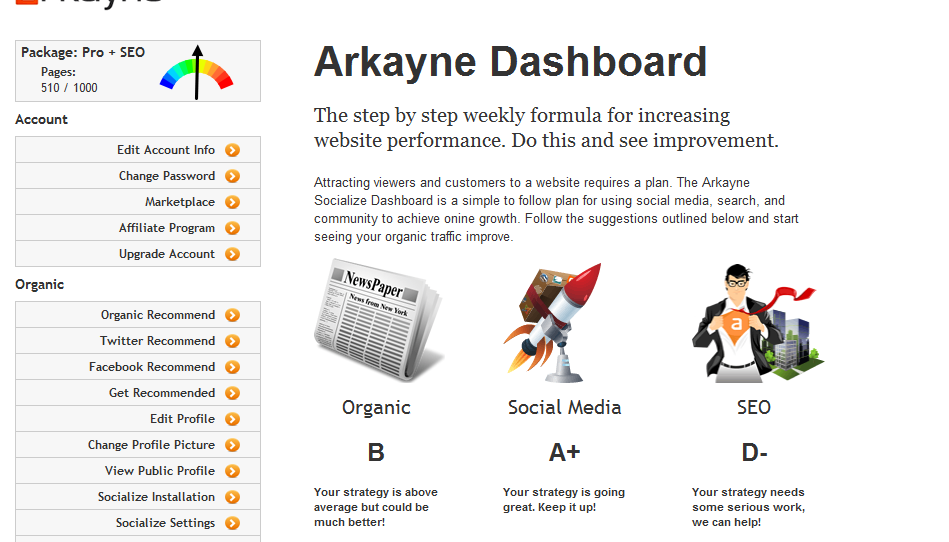
For any blogger (especially if you’re using your blog for your business), Arkayne is a pretty solid platform that you might want to check out.

I’ve been using Arkayne on my blog for the last month or so, and I gotta say, I’m enjoying the experience so far. I’ve not used all the features to their full advantage yet, but that’s more to do with me than the tool itself.

So what is Arkayne and why should you be bothered?

Simple. Two of the most asked questions by bloggers is how to get more traffic and how to monetize it. To grow and monetize your blog you need readers but, as any blogger will tell you, finding those readers initially can be tough.

It takes a combination of content worth reading, strong search engine visibility and social network sharing and relevance. Arkayne can help with all three.

Search Engine Optimization

Arkayne’s built-in SEO Analyzer helps you increase the visibility of a page or post to the various search engines. Once your post is written and saved to draft mode, you can use the analyzer to test how well it’s optimized.

Danny Brown 52 cool facts about social media SEO

The Arkayne SEO analyzer scores the post according to title, meta description and content. It then tells you where you’re going wrong and how to improve. You can make the changes and then re-analyze until you get that magic 100% (or A rating).

It’s similar to the Scribe SEO system with one main difference. With Scribe, you’re allocated credits depending on which package you buy. Each analysis uses a credit, as does each re-analysis when fixing your content, which means your credits can soon be eaten up and you have to buy more.

Arkayne’s SEO analyzer allows as many analysis checks and corrections as you need without charging extra – a nice touch.

  • Update – Arkayne has just published a comparison chart between Arkayne SEO Analyzer and Scribe SEO, which shows Arkayne’s offering ahead in most comparisons.

Network Sharing

Another nice feature from Arkayne is the social sharing and network syndication options it offers. There are a few ways it does this and each one offers a great way to increase your traffic by building relevance into each post and share.

For example, if you link your Twitter and/or Facebook account to Arkayne, you can post an update from within your dashboard to your profile. Arkayne then posts this link as a status update on Facebook, or a tweet on Twitter. So what – just like any other content sharing platform, right?

Not quite. Where Arkayne differs is that the link goes back to your publisher page on Arkayne, and offers your profile along with related links to more content you’ve written on a similar topic. But that’s not all.

By searching your content and providing even more relevant links, Arkayne is constantly figuring out how to connect to your site from the link you provided, and increase its traffic and relevance every time.

Arkayne also offers the option to show related posts at the end of your own blog post (both from your blog and content across the web), which again helps decrease bounce rate on your blog while sharing content with and from others.

What I like about Arkayne’s approach is they take the time to find the most relevant links and then add to your post, so it’s not just a bunch of links grabbed by keywords only. It does mean that related posts don’t appear immediately, but when they do you know they will be relevant.

Another way Arkayne helps your blog grow is by its own social network of bloggers and publishers. You can use Arkayne’s recommendation engine to either recommend blogs or publications you read, or help find ones that would be useful to you. And of course this works in reverse.

Each recommendation or connection you make appears on your publisher profile, offering more visibility to that blog. So if you connect to other publishers and they find you relevant, your blog will then appear in their feed, increasing your visibility again.

Using Arkayne for Business

So far, I’ve looked at some of the features that make Arkayne a very cool platform for bloggers, but it doesn’t stop there. It can also help you with your business goals, regardless the size of you and/or your campaign(s).

For example, you can use Arkayne to examine your existing content (web, publisher strategies and relationships) and the social relevance options of Arkayne, and make sure you’re using the right approach (and amend if you’re not).

Additionally, you can also use Arkayne’s engine to find those that can help you spread your message more, as well as manage any syndicated news and content and adapt if any updates about your business are made.

Then there’s the analytics integration with Google Analytics, Omniture and Core Metrics to manage your campaign and click-throughs or tracking codes; traffic metrics to see who’s the best partner for your campaign; and white label branding to make Arkayne part of your client offering.

And that’s just brushing the surface – depending on your needs, you can really get deep into how you manage Arkayne for your business or enterprise goals.

Is Arkayne Worth It?

From my own (still limited) use so far, hell yes. As a blogger, the SEO Analyzer, as well as the RSS syndication and social integration options, makes it worthwhile to me.

And as a business owner, I can see where the various publisher and campaign solutions would be useful as well.

From a price standpoint, Arkayne also makes a lot of sense. As well as a free account, you can also purchase plans for Pro, Pro + SEO (the one I have), Business and Enterprise.

I’m still playing with all the features that Arkayne has, but I can already see the benefits. My bounce rates have dropped since I activated a related posts option, and my SEO visibility has improved too.

Would I recommend Arkayne? Yes – especially since you can test a lot of the features with a free account. Though to really benefit, I’d recommend the Pro + SEO package.

What about you – is Arkayne something you can see benefit from? Or if you’ve checked it out already, I’d love to hear your thoughts – as always, the comments are yours.

Virally Fungal

A virus is something that comes along, knocks you for six for a while, then usually leaves your system once your immune system kicks in.

A fungus, on the other hand, usually gets its teeth into you then never lets go. It’s there in the background, and just when you think you’ve seen the last of it, there it is again. Ever-present, ever-ready to keep its grip on you.

So many businesses try to go viral with their promotions. Great. Get the extra eyeballs while you can and ride the wave.

But wouldn’t it be better to be fungal instead?

  • « Go to Previous Page
  • Page 1
  • Interim pages omitted …
  • Page 5
  • Page 6
  • Page 7
  • Page 8
  • Page 9
  • Interim pages omitted …
  • Page 25
  • Go to Next Page »
© 2026 Danny Brown - Made with ♥ on Genesis